
Introduction
Per- and polyfluoroalkyl substances, commonly called PFAS, have become one of the most important drinking water concerns in recent years. These synthetic chemicals were widely used for decades in industrial processes and consumer products because they resist heat, water, grease, and stains. That same chemical stability, however, is what makes them so difficult to manage once they enter rivers, groundwater, reservoirs, and public water supplies. As a result, many households, businesses, and municipalities are now looking for reliable approaches to pfas in drinking water removal.
PFAS are often referred to as “forever chemicals” because many of them do not break down easily in the environment. They can persist in soil, migrate into groundwater, move through watersheds, and accumulate in living organisms over time. Public attention has grown as scientists have improved detection methods and regulators have begun setting stricter standards for several PFAS compounds in drinking water.
Understanding PFAS requires more than knowing that they are present. It also involves learning where they come from, how they affect human health, how they are measured, and which technologies are most useful for reducing exposure. Consumers frequently ask about pfas in drinking water filtration methods, how different pfas in drinking water treatment systems compare, and which options are considered the pfas in drinking water best filters for homes or larger facilities. They also need realistic information about pfas in drinking water maintenance and long-term pfas in drinking water effectiveness.
This article provides a practical, science-based overview of PFAS in drinking water. It explains the nature of these contaminants, outlines major contamination pathways, discusses health and safety implications, reviews testing strategies, and examines prevention and treatment options from household filtration to municipal-scale systems. For readers looking for broader background, additional resources on water contamination and a more comprehensive overview in the complete guide to PFAS in drinking water can provide helpful context.
What It Is
PFAS are a large class of man-made fluorinated chemicals. The group includes thousands of individual compounds, though only some have been widely studied. Two of the best known are PFOA and PFOS, which were heavily used historically and are still frequently discussed in environmental investigations. Newer PFAS compounds have been introduced as replacements in some applications, but many of them also raise concerns because they can persist and may pose health risks.
What makes PFAS unique is the strong carbon-fluorine bond. This bond is one of the strongest in organic chemistry, which gives PFAS exceptional stability. In practical terms, this means PFAS can resist degradation from sunlight, biological activity, and normal environmental processes. While those properties were attractive in manufacturing, they create a serious challenge for water quality management.
PFAS have been used in:
- Nonstick cookware coatings
- Water-resistant and stain-resistant textiles
- Food packaging
- Industrial plating and manufacturing processes
- Firefighting foams, especially aqueous film-forming foam (AFFF)
- Certain cleaning products, cosmetics, and specialty applications
In drinking water discussions, PFAS are important because they can dissolve or disperse into water and travel significant distances. Some PFAS are highly mobile in the environment, especially in groundwater. Others may adsorb to soils or organic matter but can still eventually reach drinking water sources under the right conditions.
The phrase pfas in drinking water removal usually refers to technologies that reduce PFAS concentrations after they are already present in source water or tap water. It is important to understand that most treatment methods do not destroy PFAS completely at the point of use. Instead, many systems separate or capture the chemicals, leaving spent media or concentrated waste streams that must then be managed responsibly.
Because PFAS chemistry is complex, no single treatment approach is ideal for every situation. Performance depends on the specific compounds present, concentration levels, water chemistry, flow rate, and how the treatment system is designed and maintained. This is why selecting among pfas in drinking water treatment systems requires a careful review of testing data, performance claims, certifications, and maintenance requirements.
Main Causes or Sources
PFAS can enter drinking water from many pathways, and contamination often results from a combination of historical and current sources. In many affected communities, the contamination may have begun years or even decades before it was discovered. Identifying the source is an important step in deciding how to respond.
Major sources of PFAS in water include:
- Industrial facilities that manufacture or use PFAS
- Airports, military bases, and firefighter training sites where AFFF was used
- Landfills that receive PFAS-containing waste
- Wastewater treatment plants and biosolids land application
- Leaching from contaminated soils and sediments into groundwater
- Stormwater runoff from urban and industrial areas
One of the most common high-profile contamination scenarios involves firefighting foam. AFFF has been used extensively to suppress fuel fires, especially at military installations and airports. Repeated use can leave PFAS in soils, where rain and infiltration gradually move them downward into groundwater or into nearby surface waters. Wells located downgradient from these areas may eventually become contaminated.
Industrial discharge is another major contributor. Facilities involved in metal plating, textiles, paper coatings, electronics, and chemical manufacturing may have released PFAS in wastewater, air emissions, or waste disposal streams. Even when direct releases have stopped, legacy contamination may remain in groundwater plumes for a long time.
Landfills and waste disposal sites can also be significant PFAS sources. Consumer products containing PFAS may release them as they break down, and landfill leachate can carry these compounds into wastewater systems or nearby water resources if not fully contained and treated.
Some communities face contamination from wastewater residuals. PFAS can pass through conventional wastewater treatment because standard treatment plants are not specifically designed to remove them. When biosolids or treated wastewater are reused, PFAS may be reintroduced into soils, streams, or groundwater.
For homeowners, private wells are a special concern. Public water systems may eventually implement testing and treatment programs, but private well owners are often responsible for monitoring and remediation themselves. A well near an industrial site, landfill, or firefighting training area may be vulnerable even if the water looks, smells, and tastes normal.
Readers wanting a deeper explanation of contamination pathways can explore PFAS in drinking water causes and sources, which provides source-specific context and examples.
Health and Safety Implications
The health significance of PFAS depends on many factors, including which PFAS are present, the concentration in the water, how long exposure has occurred, and individual susceptibility. Scientists have studied some PFAS much more extensively than others, so there is stronger evidence for certain compounds such as PFOA and PFOS than for many newer replacements.
Research has linked exposure to certain PFAS with a range of potential health effects. While the exact risk level for any person depends on exposure details, the health concerns have been serious enough to prompt increasingly strict regulatory action and public health advisories.
Potential health concerns associated with some PFAS include:
- Increased cholesterol levels
- Liver and metabolic effects
- Immune system impacts, including reduced vaccine response
- Developmental effects in infants and children
- Pregnancy-related concerns, such as elevated blood pressure
- Kidney and testicular cancer associations for certain compounds
- Thyroid disruption and other endocrine-related effects
PFAS are concerning not only because they may be harmful, but also because they can accumulate in the human body over time. Repeated low-level exposure through drinking water may contribute to a rising body burden, especially when combined with food, dust, and product-related exposure.
Children, pregnant individuals, and people with certain health vulnerabilities are often considered priority populations when assessing PFAS exposure. Infants can be particularly sensitive because of their body size and developmental stage. Communities with long-standing contamination may have had years of unrecognized exposure before PFAS testing became common.
From a safety perspective, one of the most challenging aspects of PFAS contamination is that consumers usually cannot detect it without laboratory testing. PFAS generally do not create an obvious taste, color, or odor in water. Water that appears clean may still contain concentrations of concern.
This is one reason why pfas in drinking water effectiveness should not be judged by sensory changes alone. A filter may improve taste by reducing chlorine or organic compounds, but that does not automatically mean it is effective against PFAS. Verified performance data are far more important than subjective impressions.
For a more focused overview of medical and public health concerns, see PFAS in drinking water health effects and risks.
Testing and Detection
Testing is the foundation of any PFAS response strategy. Before selecting a treatment option, it is important to know whether PFAS are present, which compounds have been detected, and at what concentrations. Good testing helps determine whether treatment is necessary, which technology is likely to work best, and how often systems should be monitored.
PFAS testing is typically conducted by certified laboratories using advanced analytical methods such as liquid chromatography with tandem mass spectrometry. These methods can detect extremely low concentrations, often measured in parts per trillion. Because PFAS standards are becoming stricter, highly sensitive analysis is essential.
Testing may be performed for:
- Public water system compliance monitoring
- Private well investigations
- Real estate due diligence
- Environmental site assessments
- Treatment system design and post-installation verification
For homeowners with private wells, the first step is often contacting a state-certified lab or local environmental agency to ask about PFAS sampling procedures. Sampling must be done carefully to avoid contamination from common items that may contain fluorinated materials, such as certain waterproof clothing, food wrappers, or even field equipment.
Important considerations in PFAS testing include:
- The list of PFAS compounds being analyzed
- Detection limits and reporting limits
- Whether results are compared with current state or federal standards
- The difference between raw source water and treated water sampling
- Repeat testing to confirm trends or treatment performance
Testing is also central to evaluating pfas in drinking water filtration methods. A filter or treatment device should ideally be assessed with laboratory results before and after treatment, not just manufacturer claims. For example, if activated carbon or reverse osmosis is installed, follow-up sampling can show whether concentrations are consistently reduced to acceptable levels and whether performance is changing over time.
Municipal systems often use pilot studies before full-scale treatment installation. In a pilot, engineers test several media types or process combinations under actual water conditions. This is important because PFAS treatment performance can vary depending on competing organic matter, hardness, pH, and flow conditions.
Even after treatment is in place, continued monitoring is necessary. PFAS treatment media eventually become exhausted, membranes can foul, and source water conditions may change. Ongoing verification is therefore a major part of pfas in drinking water maintenance and responsible long-term system management.
Prevention and Treatment
Prevention is always preferable to remediation. The best way to reduce PFAS risk is to limit releases into the environment in the first place. This includes changing industrial practices, restricting high-risk chemical uses, improving waste management, controlling contaminated runoff, and replacing PFAS-containing firefighting foams where safer alternatives exist. However, because existing contamination is already widespread, treatment remains essential in many locations.
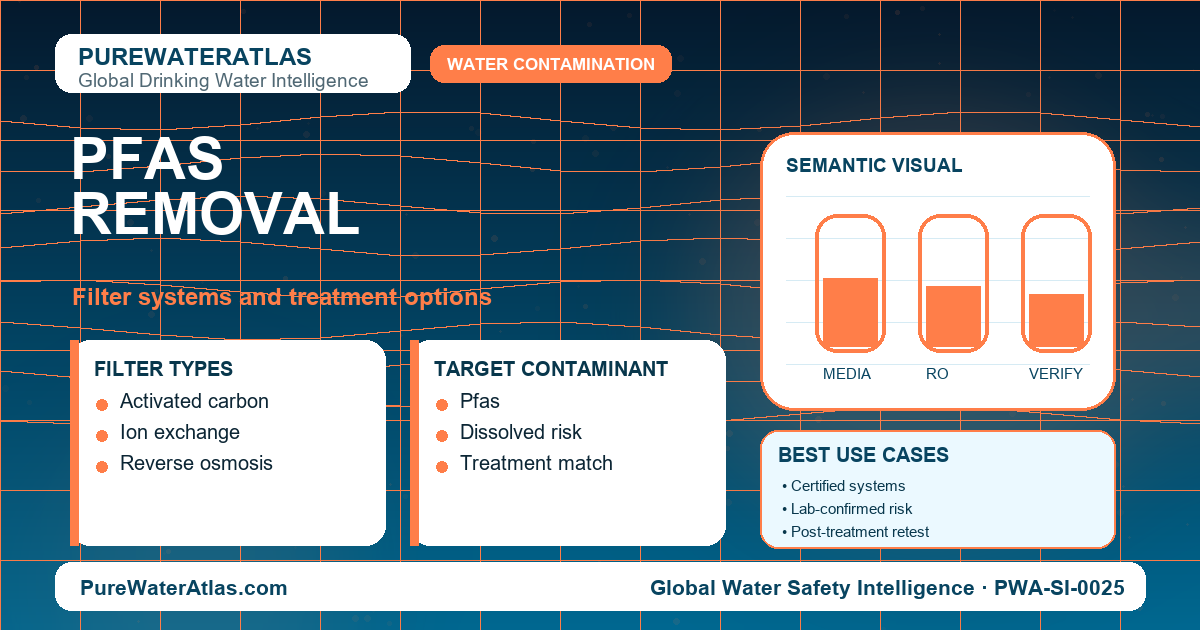
When discussing pfas in drinking water treatment systems, it helps to separate approaches into point-of-use, point-of-entry, and municipal-scale technologies.
Point-of-Use Systems
Point-of-use systems treat water at a specific faucet, usually for drinking and cooking. These systems are often more affordable than whole-house installations and can be very effective when properly selected and maintained.
Common point-of-use options include:
- Under-sink reverse osmosis systems
- Specialized activated carbon units
- Certain certified countertop filtration devices
Reverse osmosis is often considered one of the strongest household options for PFAS reduction. It uses a semipermeable membrane to separate many contaminants from water. In practice, under-sink RO systems are often among the pfas in drinking water best filters for consumers who want high removal performance at the tap. However, they produce a reject stream, may reduce water flow, and require regular replacement of prefilters, postfilters, and membranes.
Activated carbon can also reduce many PFAS, especially some longer-chain compounds, when designed appropriately. Not all carbon filters perform equally. A small pitcher filter may not provide the same contact time or media volume as a dedicated cartridge or large block carbon unit. Product certification and test data matter greatly.
Point-of-Entry Systems
Point-of-entry systems treat water as it enters the building, supplying filtered water to multiple fixtures. These systems are useful when PFAS contamination is significant and the goal is whole-home protection. They are larger, more expensive, and more maintenance-intensive than point-of-use options.
Point-of-entry treatment may use:
- Granular activated carbon (GAC)
- Ion exchange resin
- In some specialized applications, multiple-stage treatment combinations
GAC is one of the most established pfas in drinking water filtration methods. Water passes through a bed of carbon media, and PFAS adsorb to the surface. GAC can work well, particularly for certain PFAS compounds, but breakthrough eventually occurs as adsorption sites become saturated. The replacement schedule depends on PFAS concentration, water chemistry, bed size, and flow rate.
Ion exchange resin is another strong option. These synthetic resins can be highly effective for many PFAS and may outperform carbon in some conditions, especially for shorter-chain compounds. However, they are often more costly and still require periodic replacement or regeneration strategies that must be managed carefully.
Municipal and Utility-Scale Treatment
Public water suppliers face a different challenge because they must treat large volumes of water reliably and consistently. Utility-scale PFAS treatment often uses:
- Large GAC vessels
- Ion exchange systems
- High-pressure membrane systems such as nanofiltration or reverse osmosis
- Blending, source substitution, or well shutdown in some cases
Blending and source substitution are management strategies rather than true removal technologies. A utility may switch to cleaner wells, mix contaminated water with lower-PFAS sources to meet standards, or temporarily take impacted wells offline. These approaches may help in the short term, but they do not eliminate contamination at its source.
Destruction vs. Separation
Most commonly deployed PFAS treatment technologies separate PFAS from water rather than destroy them. This creates a secondary waste issue. Spent carbon, exhausted resin, and concentrated membrane reject water must be handled so that PFAS do not simply re-enter the environment elsewhere.
Emerging destruction technologies include advanced oxidation, plasma treatment, electrochemical methods, supercritical water oxidation, and high-temperature thermal approaches. Some are promising, but many are still being optimized for cost, energy use, and full-scale reliability.
Choosing the Right System
Consumers and facility managers should consider several factors when comparing pfas in drinking water best filters and larger treatment systems:
- Whether the product is certified for PFAS reduction
- Which PFAS compounds were tested
- The influent concentration and treated water target
- Flow rate and daily water demand
- Installation location and plumbing compatibility
- Replacement cost and service schedule
- Independent performance data, not just marketing claims
No treatment system should be selected based only on general water filtration reputation. Some devices are excellent for sediment, chlorine, taste, or hardness but are not suitable for PFAS. Looking at independent certification and site-specific water test results is essential.
Maintenance and Long-Term Performance
Pfas in drinking water maintenance is one of the most overlooked aspects of treatment. A good system can fail to protect users if cartridges are not changed, media are not replaced, membranes are not serviced, or post-installation testing is never performed.
Key maintenance practices include:
- Following manufacturer replacement intervals
- Adjusting service frequency if source concentrations are high
- Keeping records of filter changes and service dates
- Testing treated water periodically
- Watching for pressure drop, flow changes, or signs of fouling
- Properly disposing of or managing spent treatment media
Pfas in drinking water effectiveness depends not just on the technology itself but on proper sizing, installation, and upkeep. A certified reverse osmosis system that is overdue for membrane replacement may not perform as intended. Likewise, a carbon unit installed on water with much higher PFAS levels than it was designed for may saturate quickly.
For broader information on technologies used to improve water quality, readers may find useful resources in water purification and water treatment systems.
Common Misconceptions
Because PFAS contamination has received intense media attention, misinformation and oversimplification are common. Clearing up these misunderstandings helps consumers make better decisions.
“Boiling water removes PFAS.”
Boiling is not a reliable method for pfas in drinking water removal. In fact, boiling may slightly concentrate PFAS if water evaporates while the contaminants remain behind. Boiling can help with microbiological issues, but it is not an appropriate PFAS treatment strategy.
“Any water filter will remove PFAS.”
This is false. Many standard filters are designed mainly for sediment, chlorine taste, or common organic compounds. PFAS reduction requires a technology that has been shown to address these chemicals specifically, such as certain activated carbon, ion exchange, or reverse osmosis systems.
“If the water looks clear, it is safe.”
PFAS usually cannot be seen, smelled, or tasted. Clear water may still contain concentrations that exceed health-based guidelines or regulatory limits.
“Reverse osmosis destroys PFAS.”
Reverse osmosis is highly effective at reducing many PFAS in treated water, but it generally separates them into a reject stream rather than chemically destroying them. Waste handling remains important.
“Once a filter is installed, the problem is solved permanently.”
No filter works forever. Every treatment approach requires maintenance, periodic verification, and eventually replacement of media or components. Ignoring pfas in drinking water maintenance can lead to breakthrough and reduced protection.
“Only industrial towns need to worry about PFAS.”
Industrial areas may face elevated risk, but PFAS contamination can also appear near military bases, airports, landfills, wastewater-impacted areas, and even in communities far from obvious major sources.
Regulations and Standards
PFAS regulation is evolving rapidly. For many years, PFAS oversight relied mainly on health advisories and state-level guidance. More recently, governments have moved toward enforceable drinking water standards for certain compounds. Because scientific understanding and analytical capability continue to advance, these regulations may change over time.
In the United States, the Environmental Protection Agency has established regulatory frameworks and drinking water limits for several PFAS compounds. States may also adopt their own standards, and some have acted earlier or set limits that differ from federal levels. Public water systems are typically required to monitor, report, and respond to exceedances based on applicable regulations.
Key regulatory themes include:
- Maximum contaminant levels or similar enforceable limits for specific PFAS
- Required monitoring by public water systems
- Public notification and consumer confidence reporting
- Treatment requirements when levels exceed legal standards
- Site cleanup obligations under environmental laws
Private wells are an important regulatory gap in many places. Owners of private wells often do not benefit from the same routine monitoring and compliance oversight that public systems must follow. As a result, well owners may need to take independent action to test and treat their water.
Standards also affect the market for pfas in drinking water treatment systems. As permissible levels decline, treatment technology must achieve lower and lower residual concentrations. This increases the importance of proper design, certification, and monitoring. A system that once seemed adequate may no longer satisfy newer regulatory or health-based expectations.
Certification bodies and product testing organizations play a role as well. For consumer products, independent certification can help identify the pfas in drinking water best filters for specific applications. Certifications should be reviewed carefully to understand which compounds were included, under what testing conditions the product was evaluated, and whether the certification aligns with current water quality concerns.
Because regulations continue to develop, staying informed through health departments, environmental agencies, and water utilities is essential. Communities affected by PFAS often see changes in standards, funding programs, and treatment guidance as new evidence emerges.
Conclusion
PFAS contamination in drinking water is a complex issue that combines chemistry, public health, environmental persistence, and infrastructure challenges. These chemicals are difficult to remove because they are exceptionally stable and often present at very low concentrations that still matter from a health perspective. Yet effective responses are available when contamination is properly identified and treatment is selected based on sound evidence.
The most important first step is testing. Without laboratory data, there is no reliable way to know whether PFAS are present or which pfas in drinking water filtration methods are most appropriate. Once contamination is confirmed, households and utilities can compare treatment options such as activated carbon, ion exchange, and reverse osmosis. Each has strengths and limitations, and long-term success depends heavily on system design, monitoring, and pfas in drinking water maintenance.
Consumers should be cautious about broad claims and focus instead on independent certifications, post-treatment sampling, and realistic expectations for pfas in drinking water effectiveness. The goal is not simply to buy a filter, but to implement a treatment strategy that consistently reduces exposure over time.
As regulations continue to evolve and more communities address legacy contamination, public understanding will remain critical. With good testing, informed source control, and properly managed treatment systems, meaningful progress in pfas in drinking water removal is possible.
Read the full guide: Water Contamination Guide
Explore more in this category: Water Contamination Articles