
Choosing the best water test kit is harder than it looks. The market is crowded with strips, drops, handheld meters, mail-in laboratory panels, and multi-parameter “all-in-one” products that promise quick answers about drinking water safety. Yet not all contaminants can be detected with the same level of confidence, and not every kit is suited to every water source. A family using chlorinated city water has different testing priorities than a household on a private well, a renter worried about lead from old plumbing, or a homeowner troubleshooting taste, odor, or scale. This guide compares the major categories of home water testing kits, explains how they work, where they perform well, where they fail, and how to choose a kit that gives results you can actually use.
Water testing matters because drinking water can contain contaminants that are invisible, odorless, and tasteless. Some affect aesthetics more than health, such as hardness or iron staining. Others can have real public health implications, including nitrate, lead, arsenic, microbial contamination, and disinfection byproducts. According to the U.S. Environmental Protection Agency, public water systems are regulated under federal standards, but water quality can still change between the treatment plant and the tap due to plumbing materials, distribution system issues, or building-specific conditions. Private wells face a different reality: the homeowner is usually responsible for testing and treatment. The CDC’s drinking water guidance and the World Health Organization’s drinking water fact sheet both emphasize that safe drinking water depends on source protection, appropriate monitoring, and effective treatment where needed.
This article provides a practical water testing comparison grounded in chemistry, microbiology, and real-world use. We will look at the main types of kits, compare their strengths and weaknesses, review common analytes, discuss water test accuracy, and outline when a diy water testing kit is enough and when you should move to certified laboratory testing. If you want broader background on sampling strategy and contaminant categories, PureWaterAtlas also has a more general resource on how to test drinking water.
What counts as a water testing kit?
A water testing kit is any consumer-facing product designed to measure one or more characteristics of water. In practice, kits fall into five broad groups:
- Test strip kits
- Liquid reagent drop kits
- Color-disk or comparator kits
- Digital meters and probe-based devices
- Mail-in laboratory kits
These products differ in analytical principle, detection limit, susceptibility to user error, and intended use. Some estimate broad ranges. Others can produce relatively precise numerical values. Importantly, “best” does not mean “most parameters on the box.” The best kit is the one that measures the contaminants relevant to your water source, at concentrations that matter for health or treatment decisions, with enough reliability for the purpose at hand.
Why comparing water test kits scientifically matters
Many buyers focus on convenience and price alone. But a scientifically meaningful comparison should evaluate at least six factors:
- Target analytes: What substances or properties the kit actually measures
- Detection range and resolution: Whether the kit can distinguish low, moderate, and high levels near important thresholds
- Analytical specificity: Whether the method measures the intended compound or can be confused by similar substances
- Precision and repeatability: Whether repeat tests give similar results
- Sample handling sensitivity: Whether timing, lighting, temperature, or contamination affects the reading
- Decision value: Whether the result helps you make a safe and practical choice
For example, a hardness strip may be entirely adequate for deciding whether to install a softener. A strip-based lead test, by contrast, may not provide the confidence needed when children or pregnant women could be exposed. Similarly, a TDS meter is useful for tracking reverse osmosis performance, but it does not tell you whether harmful bacteria or lead are present.
The main contaminants and parameters people test for
Before comparing top water kits, it helps to separate water concerns into categories. Different methods are appropriate for different targets.
General chemistry and water condition parameters
- pH
- Total dissolved solids (TDS)
- Electrical conductivity
- Hardness
- Alkalinity
- Chlorine or chloramine
- Iron, manganese, copper
- Sulfate
These are often the easiest to test at home. They influence corrosion, scaling, taste, odor, and treatment system design.
Health-relevant inorganic contaminants
- Lead
- Nitrate/nitrite
- Arsenic
- Fluoride
- Mercury and other heavy metals
These require more caution because concentrations of concern can be low, and some consumer tests are only semi-quantitative.
Microbiological contaminants
- Total coliform bacteria
- E. coli
- Heterotrophic bacteria in some specialty kits
Microbial testing is especially relevant for private wells, post-flood situations, intermittent water supply problems, and suspected contamination events.
Organic contaminants and specialty analytes
- Pesticides
- Volatile organic compounds (VOCs)
- PFAS
- Radionuclides
These are generally not well covered by simple consumer kits. Mail-in lab analysis is usually the better route.
How home water testing kits work
Most home water testing kits rely on one of a few basic scientific principles.
Colorimetric reactions
A chemical reagent reacts with the target analyte and produces a color change. The user matches the color to a printed scale or reads it with an app or comparator. This is common for chlorine, nitrate, hardness, iron, and pH.
Titration
A reagent is added dropwise until a color endpoint is reached. The number of drops corresponds to concentration. Hardness and alkalinity kits often use this method. Titrations can be surprisingly useful because they offer better resolution than broad-range strips when performed carefully.
Electrochemical sensing
Digital probes can estimate pH, conductivity, ORP, or dissolved oxygen using electrodes. These require calibration and proper maintenance but can offer rapid and repeatable readings for selected parameters.
Presence-absence microbial culture
Some microbial kits use nutrient media that change color or fluoresce when coliforms or E. coli grow after incubation. These can be useful screening tools, but they must be handled carefully to avoid contamination and false interpretation.
Laboratory instrumental analysis
Mail-in kits typically involve collection bottles and professional analysis using methods such as ICP-MS for metals, ion chromatography for anions, GC-MS for volatile organics, or membrane filtration and culture for bacteria. These methods generally offer the highest confidence when performed by a qualified lab.
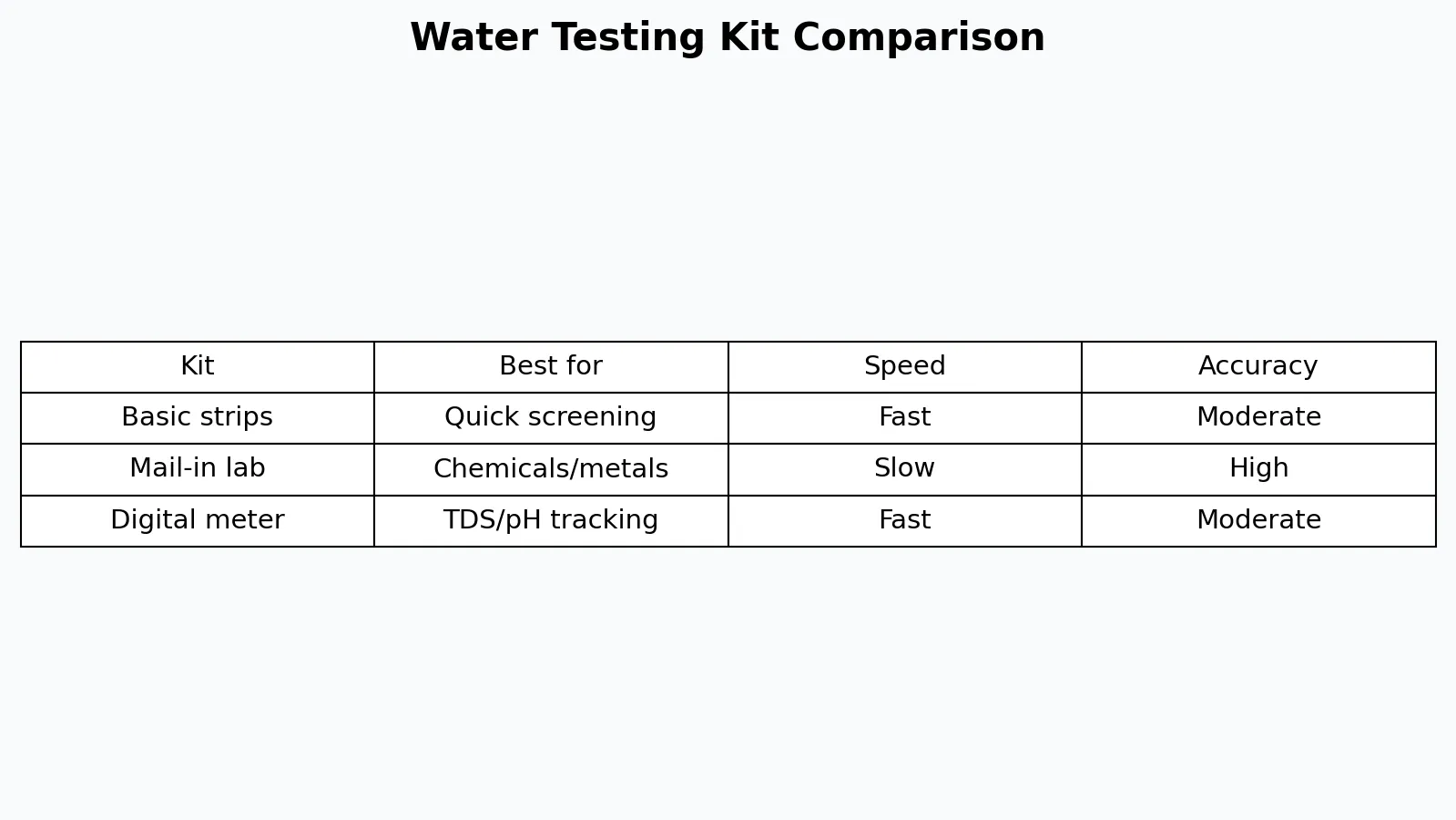
Best water test kit categories compared
Below is the core water testing comparison. Rather than ranking brands, which change constantly, this comparison focuses on kit categories and where each fits best.
| Kit Type | Best For | Advantages | Limitations | Typical Accuracy |
|---|---|---|---|---|
| Test strips | Quick screening of multiple basic parameters | Fast, inexpensive, easy to use | Broad ranges, lighting-sensitive, user interpretation issues | Low to moderate, depending on analyte |
| Liquid reagent kits | Hardness, alkalinity, chlorine, nitrate, iron | Better resolution than strips, often affordable | More steps, timing matters, reagents expire | Moderate |
| Comparator/color-disk kits | Users wanting more consistent color reading | Improved visual matching, often clearer scales | Still color-based and semi-quantitative | Moderate |
| Digital meters | pH, TDS, conductivity, some specialized analytes | Instant numerical output, repeatable if calibrated | Limited contaminant scope, calibration required | Moderate to high for suitable parameters |
| Mail-in lab kits | Health-relevant contaminants and confirmation testing | Highest confidence, low detection limits, broad analyte options | Slower, more expensive, shipping and chain-of-custody considerations | Generally highest |
1. Test strip kits
Test strips are the most common entry point for consumers looking for a diy water testing kit. A strip contains dried reagents that react when dipped into water. After a specified wait time, the user compares each pad to a color chart.
Best use cases:
- Basic screening of pH, hardness, alkalinity, chlorine, nitrite, nitrate, and sometimes iron or copper
- Routine monitoring where exact precision is not critical
- Quick checks before and after treatment changes
Strengths: They are cheap, fast, and convenient. They are especially useful for trend detection. If hardness changes from low to high, or if chlorine suddenly disappears, strips can alert you that something has shifted.
Weaknesses: The broad color bands can hide meaningful differences near regulatory or treatment thresholds. Human color perception varies. Room lighting changes the reading. Timing errors matter: reading too early or too late can distort results. Humidity can degrade the strips if the container is left open.
Bottom line: Good for screening, poor for high-stakes decisions unless followed by a better method.
2. Liquid reagent and titration kits
These kits use bottles of reagent added to a water sample in a test tube or vial. Some rely on a final color intensity; others use titration endpoints. They are common for aquarium and pool testing but can also be effective for drinking water parameters such as hardness, alkalinity, chlorine, and nitrate.
Best use cases:
- Households managing hard water, corrosivity, or treatment systems
- Users who need narrower measurement increments than strips provide
- Repeat testing over time
Strengths: Often more precise than strips, especially for hardness and alkalinity. Endpoints can be easier to judge than comparing multiple strip colors. Cost per test can be low.
Weaknesses: More steps means more potential for handling errors. Reagent age matters. Droplet size, vial cleanliness, and endpoint interpretation can affect the result.
Bottom line: Among the best options for practical, affordable household chemistry testing.
3. Digital meters
Digital devices are excellent for some measurements and nearly useless for others, so buyers need to be selective. A conductivity or TDS meter measures the water’s ability to conduct electricity, which correlates with dissolved ionic content. A pH meter uses an electrode to estimate hydrogen ion activity. Some devices combine multiple functions. For readers considering instrument-based tools, this overview of digital water testing devices explains calibration and use in more depth.
Best use cases:
- Monitoring reverse osmosis performance
- Checking pH for corrosion control or treatment adjustment
- Tracking consistency in treated water
Strengths: Immediate readings, no color matching, high repeatability when calibrated. Especially useful for process monitoring rather than one-time screening.
Weaknesses: They do not identify specific contaminants unless the sensor is designed for that purpose. TDS is often misunderstood: a “low TDS” reading does not prove water is microbiologically safe or free of lead, VOCs, or PFAS.
Bottom line: Excellent for targeted parameters, but not a substitute for comprehensive contaminant testing.
4. Mail-in laboratory test kits
Mail-in kits bridge the convenience of home sampling with the analytical power of laboratory methods. They often target metals, well water chemistry, bacteria, or broad drinking water panels.
Best use cases:
- Private well annual checks
- Lead, arsenic, and nitrate concerns
- Home purchase due diligence
- Confirming suspicious results from strips or meters
Strengths: Better sensitivity, lower detection limits, broader analyte lists, and stronger decision value. For contaminants with significant health relevance, mail-in kits are often the practical minimum standard.
Weaknesses: They take longer and cost more. Some analytes require preservation, cold shipping, or rapid transit. A poorly collected sample can still invalidate a good laboratory method.
Bottom line: Usually the best overall choice when the result may affect health decisions, treatment purchases, or property-level risk assessment.
Which kit type is best for which water source?
Municipal tap water
If you are on a regulated public supply, start with your annual consumer confidence report, then test for issues specific to your home: lead from plumbing, copper from corrosion, chlorine residual, hardness, and possibly disinfection byproducts or PFAS if locally relevant. For many households, a combination of strips or titration for routine chemistry plus a lab kit for lead is sensible.
Private well water
Well owners should take a more comprehensive approach. Basic home water testing kits can screen pH, hardness, iron, manganese, nitrate, and bacteria presence-absence, but laboratory confirmation is strongly advisable. Annual testing commonly includes total coliform, E. coli, nitrate, and locally relevant contaminants; some wells need arsenic, fluoride, or radionuclide testing depending on geology. The USGS water resources information is helpful for understanding how geology and land use influence groundwater quality.
Homes with old plumbing
Lead and copper become higher priorities. First-draw and flushed samples can tell different stories because stagnation in pipes changes concentrations. Cheap strips are not the ideal tool here. Use a lab-based lead kit or certified local testing service.
Homes with a treatment system
If you already have reverse osmosis, softening, activated carbon, UV, or iron filtration, testing should verify performance. A TDS meter can help monitor RO membrane decline, but system-specific checks matter: hardness before and after a softener, chlorine before and after carbon, microbial safety for untreated well sources, and pH where corrosion control is a concern. If you are deciding what equipment to install after testing, this guide to choosing the right water treatment system can help connect results to treatment options.
Understanding water test accuracy
Water test accuracy is one of the most misunderstood topics in consumer water testing. Accuracy is not a single yes-or-no property. It includes bias, precision, detection capability, interferences, and user technique.
Accuracy vs precision
A kit can be precise without being accurate if it consistently gives the same wrong answer. It can also be accurate on average but imprecise if repeated tests vary widely. For home use, both matter.
Detection limit matters
If a lead test cannot reliably distinguish between 2, 5, 10, and 15 parts per billion, it may not be suitable for risk-sensitive decision-making. The ability to detect meaningful concentrations near health or action thresholds is critical.
Matrix effects and interferences
Water is chemically complex. Iron can interfere with color interpretation in some tests. High chlorine can distort certain microbial assays if neutralizers are not included. Turbidity can affect visual readings. Extreme pH can alter reagent performance.
Sampling error may exceed kit error
The sample itself can be the largest source of uncertainty. Stagnant vs flushed water, morning vs afternoon collection, first-draw kitchen tap vs bathroom tap, and seasonal variability in wells can all change the result. This is one reason why a single test should not always be treated as the final truth.
User technique strongly affects results
Common mistakes include:
- Using expired strips or reagents
- Reading colors under warm indoor lighting instead of neutral light
- Ignoring the exact reaction time
- Touching test pads with wet fingers
- Using dirty sample containers
- Failing to calibrate meters
For many household decisions, reasonable screening accuracy is enough. But for contaminants with health significance, you should lean toward methods with stronger validation. PureWaterAtlas discusses the tradeoffs in more detail in its article on DIY vs professional water testing.
Important regulatory and health context
Water test results only become meaningful when interpreted against standards or goals. In the United States, public drinking water standards are generally framed as Maximum Contaminant Levels (MCLs), action levels, treatment techniques, or secondary standards for aesthetic issues.
Examples of commonly referenced thresholds
- Lead: often discussed relative to the EPA action level in public systems, though many health experts emphasize that no lead exposure is ideal
- Nitrate: commonly compared to the federal MCL as nitrogen because of infant methemoglobinemia risk
- Total coliform/E. coli: any confirmed E. coli in drinking water is a serious concern
- pH: usually considered for corrosion and treatment performance rather than direct toxicity in typical drinking water ranges
- Hardness: not usually a primary health hazard, but important for scaling, soap performance, and equipment lifespan
Secondary standards matter too. Iron, manganese, and sulfate may drive taste, odor, staining, or laxative effects at high concentrations even when they are not regulated in the same way as acute toxic contaminants. A good best water test kit decision therefore depends on whether your concern is health protection, treatment selection, or both.
How to choose the best water test kit for your specific goal
Start with the question you actually need answered.
If your goal is “Is my water generally okay?”
Use a broad screening kit covering pH, hardness, alkalinity, chlorine, nitrate/nitrite, and perhaps iron or copper. For many city-water households, this is a useful first pass.
If your goal is “Should I worry about lead?”
Choose a laboratory-based lead analysis or a high-quality mail-in metals panel. This is especially important in older homes, after plumbing work, or if a child lives in the home.
If your goal is “Why does my water taste strange or stain fixtures?”
Focus on hardness, iron, manganese, pH, alkalinity, sulfate, and chlorine. A reagent kit or mail-in panel is often better than a simple strip-only product.
If your goal is “Is my well microbiologically safe?”
Use a bacteria test designed for total coliform and E. coli, ideally with laboratory confirmation or local public health support if positive.
If your goal is “Is my filter system working?”
Use parameter-specific checks: TDS for RO trend monitoring, hardness for softeners, chlorine for activated carbon, and periodic lab confirmation for contaminants the system is supposed to remove.
What a strong water testing kit should include
When comparing products, look past the marketing claims and check for these practical features:
- Clearly listed analytes with measurement ranges
- Instructions with exact timing and sample volume
- Expiration date or lot date
- Color chart that is readable and not overly compressed
- Separate guidance for well water vs city water if relevant
- Contamination-prevention instructions for microbial kits
- Interpretation guidance tied to recognized drinking water standards
- Customer support or confirmatory testing options
Be skeptical of kits that promise to test “everything” cheaply. Truly broad contaminant coverage at meaningful detection limits is analytically difficult.
Common mistakes people make when comparing top water kits
- Confusing TDS with safety: low TDS does not equal contaminant-free water
- Overvaluing parameter count: 20 mediocre strip readings are not always better than 5 strong tests
- Ignoring local risk factors: nitrate risk in agricultural areas, arsenic in certain geologies, lead in old housing stock
- Relying on one test only: contamination can vary over time
- Skipping interpretation: numbers mean little without standards, units, and context
If you already have results and are unsure what they imply, PureWaterAtlas provides a detailed primer on understanding water test results.
Recommended testing strategies by household type
Apartment or rental on city water
- Basic strip or reagent screening for chlorine, pH, hardness
- Lab lead test if building age or plumbing is a concern
- Repeat after long vacancies or plumbing changes
Suburban homeowner on municipal supply
- Annual chemistry screening
- Lead/copper testing if home has older plumbing materials
- Filter-performance checks if using under-sink systems
Private well household
- Annual lab testing for bacteria and nitrate at minimum
- Additional testing for pH, hardness, iron, manganese, arsenic, fluoride, or local concerns
- More frequent testing after flooding, repairs, or changes in taste, odor, or clarity
Home with infants, immunocompromised residents, or pregnancy concerns
- Prioritize nitrate, lead, and microbial safety
- Use higher-confidence lab-based testing where risk is plausible
- Do not rely solely on broad strip kits for high-stakes questions
How often should you test?
Testing frequency depends on water source and risk profile.
- Municipal water: typically when moving in, after plumbing changes, when taste/odor changes occur, or periodically for lead and treatment verification
- Private wells: at least annually for core parameters, and after floods, maintenance, or contamination events
- Treatment systems: according to manufacturer guidance plus periodic independent verification
For more routine resources and topic-specific articles, readers can browse the broader water testing category on PureWaterAtlas.
Practical tips to improve the quality of any home test
- Wash and rinse sample containers with the sample water unless the kit instructs otherwise
- Follow the exact sample volume and reaction time
- Use neutral, bright lighting for color comparisons
- Run duplicate tests if the result is near an important threshold
- Record the date, location, and whether the sample was first-draw or flushed
- Store strips and reagents tightly sealed and away from humidity and heat
- Calibrate digital meters with fresh standards
These simple steps often improve reliability more than switching between similar consumer kits.
When a DIY water testing kit is not enough
A diy water testing kit is not the final answer when:
- You suspect lead, arsenic, PFAS, VOCs, or other toxic contaminants
- A baby or vulnerable person may be exposed to nitrate-contaminated water
- Your microbial test is positive or ambiguous
- You are making a major treatment-system purchase
- You need results for a property transaction, regulatory issue, or documented remediation decision
In those situations, laboratory analysis offers more defensible information. Home kits remain valuable for screening and ongoing monitoring, but they should not be asked to do more than they are capable of doing.
So what is the best water test kit in 2026?
The scientifically honest answer is that there is no universal single winner. The best water test kit depends on the question:
- Best for quick household screening: a reputable multi-parameter strip or reagent kit
- Best for treatment-system monitoring: a calibrated digital meter plus parameter-specific chemistry tests
- Best for well owners: a combination of at-home screening and annual mail-in lab analysis
- Best for lead or health-critical contaminants: a mail-in laboratory kit
- Best overall for decision quality: a hybrid approach that uses simple home testing for routine checks and lab testing for confirmation
If forced to choose one category for the broadest real-world usefulness, mail-in laboratory kits usually provide the best balance of relevance and confidence for health-related decisions. If forced to choose one category for affordability and day-to-day practicality, reagent-based kits often outperform strips for common chemistry testing. For households serious about water quality, the strongest strategy is not one kit but a small toolkit matched to the water source and the risks.
FAQ
Are home water testing kits accurate enough?
They can be accurate enough for screening and routine monitoring, especially for hardness, pH, chlorine, and similar parameters. They are less reliable for some low-level toxic contaminants where laboratory methods provide stronger confidence.
What is the best water test kit for well water?
For wells, the best approach is usually a mail-in lab kit for bacteria, nitrate, and local contaminants, supplemented by home tests for hardness, pH, iron, and other routine chemistry indicators.
Can a TDS meter tell if water is safe to drink?
No. A TDS meter measures dissolved ionic content indirectly. It does not detect bacteria, lead specifically, PFAS, or many organic chemicals.
How often should I test my tap water?
City water users often test when moving, after plumbing changes, or when water quality changes are noticed. Well owners should typically test at least annually and after flooding, repairs, or unusual changes.
Should I trust a positive bacteria result from a home kit?
Treat it seriously, but confirm it promptly with a certified laboratory or local health authority guidance. Sampling contamination can occur, but true positives require follow-up.
Conclusion
The best choice is not the kit with the most aggressive marketing or the longest parameter list. The best water test kit is the one that matches your water source, your suspected risks, and the level of certainty you need. For everyday chemistry, a well-designed reagent or strip kit may be entirely sufficient. For lead, nitrate, bacteria, and other health-relevant contaminants, laboratory analysis is often the smarter and safer option. Use home testing to screen, track changes, and verify treatment performance, but use higher-confidence methods when the stakes are higher. A good testing plan is not just about getting numbers; it is about getting the right numbers, from the right sample, by the right method, and knowing what to do next.
Featured image: Photo by adrian vieriu on Pexels.
Read the full guide: Water Testing Guide
Explore more in this category: Water Testing Articles