Digital water testing has moved water analysis far beyond color strips, single-use vials, and laboratory-only measurement. Today, compact meters, connected probes, and cloud-enabled platforms can measure key parameters in seconds, log changes over time, and alert users when conditions shift outside expected ranges. For households, utilities, building managers, laboratories, and field professionals, these tools promise faster insight into water quality and a more continuous view of what is happening between occasional manual tests. Yet the technology is often misunderstood. A digital display can make testing feel definitive, even when every reading still depends on calibration, sensor limitations, sampling conditions, and the difference between what a device can measure directly and what still requires certified laboratory analysis. This article explains digital water testing devices in scientific but practical terms: how they work, what they can and cannot tell you, why they matter for drinking water safety, and how to use results responsibly.
What digital water testing means
At its core, digital water testing refers to the use of electronic instruments to detect, quantify, log, or transmit measurements related to water quality. These devices range from simple handheld meters that report a single value such as pH or total dissolved solids, to multi-parameter sondes that continuously monitor several indicators at once, to networked smart water sensors integrated into larger water monitoring systems. Some are designed for home use, some for industrial process control, and some for environmental or municipal applications.
Unlike basic analog or visual tests, digital instruments convert a physical, chemical, or optical signal into numerical data. A pH electrode measures voltage differences related to hydrogen ion activity. A conductivity probe measures how well water carries electrical current. A turbidity sensor detects how suspended particles scatter light. A dissolved oxygen probe may use electrochemical or optical principles to estimate oxygen concentration. Chlorine analyzers can use amperometric or colorimetric methods paired with electronics that quantify the response.
These devices do not all do the same job. In public conversation, people sometimes assume a single digital meter can determine whether water is “safe” overall. In reality, drinking water quality is multidimensional. Safety depends on microbiological, chemical, and physical characteristics. A meter may measure one or several useful indicators, but no single handheld device can comprehensively assess every contaminant of concern. To understand the broader context, it helps to review the foundations of water science, contaminants, treatment, and water quality.
Why digital water testing matters for drinking water safety
Water quality can change due to source variability, distribution system conditions, plumbing materials, treatment performance, seasonal runoff, stagnant storage, and accidental contamination. Traditional testing remains essential, especially laboratory analysis for regulated contaminants, but it is often periodic rather than continuous. Digital tools fill an important gap by providing speed, trend visibility, and in some settings, real time water monitoring.
For drinking water safety, that matters in several ways:
- Early detection of change: A sudden rise in turbidity, drop in disinfectant residual, or unusual conductivity shift can signal treatment failure, intrusion, source change, or plumbing-related issues.
- Operational control: Utilities and facilities use digital devices to optimize treatment steps, verify process stability, and maintain distribution system conditions.
- Targeted follow-up testing: Digital screening can indicate when a sample should be sent for certified laboratory analysis.
- Trend tracking: Repeated measurements over time can reveal whether a one-time result is normal variation or part of a sustained pattern.
- Rapid field assessment: Portable meters help inspectors, environmental professionals, and homeowners assess immediate conditions before deciding on next steps.
Organizations such as the U.S. Environmental Protection Agency, the World Health Organization, and the Centers for Disease Control and Prevention emphasize that safe drinking water depends on control of microbial hazards, chemical contaminants, and system integrity. Digital devices can support that goal, but they are usually one part of a broader testing and treatment strategy.
The scientific basis of digital water measurement
To use digital water testing intelligently, it helps to understand what a sensor actually measures. A digital device does not “see contamination” in a general sense. It detects a specific property and translates it into a number. That distinction is central to interpreting results correctly.
Electrochemical measurement
Many common water quality parameters are measured electrochemically.
- pH: A glass electrode develops a voltage related to hydrogen ion activity. The meter compares this with a reference electrode and converts the signal to pH units.
- Oxidation-reduction potential (ORP): Measures the tendency of water to gain or lose electrons. ORP can be used as an operational indicator in disinfection and process control, though it is not a direct measure of pathogen safety.
- Conductivity: Reflects ionic content and is often used to estimate salinity or total dissolved solids. Higher conductivity means more dissolved charged species are present, but not necessarily harmful ones.
- Dissolved oxygen: Electrochemical sensors consume oxygen at a membrane or electrode interface, whereas optical sensors infer concentration from fluorescence quenching.
Optical measurement
Optical instruments use light absorption, transmission, fluorescence, or scattering.
- Turbidity: A light source shines through water, and detectors measure scattered light. More suspended particles usually produce higher turbidity values, commonly reported in NTU.
- Colorimetric analyzers: A reagent reacts with a target substance, producing a color whose intensity is measured digitally. This is common for chlorine, nitrate, iron, manganese, and phosphate in some devices.
- UV absorbance: Some advanced systems use ultraviolet absorption patterns to estimate dissolved organic matter or detect changes suggestive of contamination events.
Selective membranes and ion-sensitive technologies
Some sensors use membranes or ion-selective electrodes that respond preferentially to a target ion such as fluoride, nitrate, ammonium, or chloride. These can be useful but are sensitive to interferences, matrix effects, and maintenance quality.
Biosensing and emerging platforms
More advanced water tech devices now include biosensors, microfluidic cartridges, and lab-on-a-chip systems that can detect biological markers, toxins, or specific chemicals with increasing speed. These technologies are promising, especially for distributed monitoring and rapid screening, but many are still complementary rather than replacements for accredited lab methods.
What digital water testing devices commonly measure
Not every parameter has equal relevance for every user. The value of a device depends on whether the measured parameter is meaningful for the water source, treatment process, and risk profile in question.
pH
pH indicates how acidic or basic water is. It affects corrosion, disinfection chemistry, metal solubility, and taste. In drinking water practice, pH is often managed not because pH itself is usually a direct health hazard at normal levels, but because it influences system performance and contaminant behavior. Water that is too acidic may increase corrosion of plumbing and release metals such as lead or copper under certain conditions. A digital pH meter is one of the most common and useful tools, provided it is regularly calibrated.
Conductivity and TDS
Conductivity measures the ability of water to carry an electric current and is related to the concentration of dissolved ions. Many handheld devices convert conductivity into an estimated total dissolved solids value, but this is an approximation based on a conversion factor. TDS readings are frequently overinterpreted. A low TDS reading does not prove water is safe, and a high TDS reading does not necessarily mean it is dangerous. Sodium, calcium, magnesium, bicarbonate, sulfate, and chloride can all contribute to conductivity, and the health implications depend on composition, not just total amount.
Turbidity
Turbidity is a key operational parameter in treatment and distribution because cloudy water can indicate suspended solids, source disturbance, filtration problems, or microbial shielding. High turbidity does not identify a specific contaminant, but it can correlate with reduced treatment effectiveness or increased likelihood of contamination events. In treated drinking water, persistently elevated turbidity deserves attention.
Free chlorine and total chlorine
Disinfectant residual is especially important in systems that use chlorination. Digital analyzers and photometers can help verify that some disinfectant remains available in distribution or storage. Too little residual may reduce microbial protection; too much may affect taste, odor, and byproduct formation concerns. Measuring chlorine digitally can be useful in homes with storage tanks, private systems, or point-of-entry treatment using chlorination, but interpretation should reflect local system design.
Dissolved oxygen
Dissolved oxygen is more commonly used in environmental and process monitoring than direct drinking water safety assessment, but it can still provide useful information in source water, storage, and treatment settings. Low oxygen can indicate stagnation or biologically active conditions in some contexts.
Temperature
Temperature influences many other parameters, including conductivity, dissolved oxygen, reaction rates, and microbial growth dynamics. Most quality digital devices either compensate for temperature or report it alongside other readings.
ORP
Oxidation-reduction potential can help operators understand oxidative conditions and disinfection environment, but ORP should not be treated as a stand-alone proof of microbial safety. It is best used as one operational metric among several.
Specific ions and chemicals
More advanced devices may test nitrate, fluoride, ammonia, iron, manganese, or other targets. These instruments can be valuable screening tools, but performance varies with sample composition and maintenance. For contaminants with major health implications, laboratory confirmation is often warranted.
What digital devices usually cannot tell you on their own
This is where many misconceptions arise. A numerical reading can create false confidence if users assume it covers hazards the instrument never measured.
Most standard consumer digital meters do not directly identify:
- Pathogenic bacteria, viruses, or protozoa
- Lead at regulatory precision
- PFAS as a class of contaminants
- Pesticides and many industrial chemicals
- Arsenic without a dedicated test method
- Radionuclides
- Complex disinfection byproducts comprehensively
For example, a low TDS meter reading does not rule out lead, arsenic, nitrate at low-conductivity levels, or microbial contamination. A normal pH does not rule out bacteria. Clear-looking water with low turbidity can still carry dangerous microorganisms. This is why digital water testing should be understood as targeted measurement, not universal diagnosis.
If you want a broader overview of available analytical approaches, including when strips, meters, and laboratory methods each make sense, see water testing methods explained.
Types of digital water testing devices
The market includes a wide spectrum of tools. The right choice depends on whether you need occasional spot checks, routine household screening, process control, or continuous data streams.
Handheld single-parameter meters
These devices measure one main parameter, such as pH, conductivity, TDS, ORP, or dissolved oxygen. They are portable, relatively affordable, and useful for quick checks. However, quality varies significantly. Cheap devices may drift quickly, lack reliable calibration support, or provide poor temperature compensation.
Portable photometers and colorimeters
These devices typically use reagents to generate a color response, then digitally measure intensity. They are common for chlorine, nitrate, iron, and other chemical parameters. They can be more specific than generic conductivity or TDS meters, but proper technique matters, including sample handling, reagent freshness, and timing.
Multi-parameter probes and sondes
These instruments combine multiple sensors in one unit, often including pH, conductivity, temperature, dissolved oxygen, turbidity, and depth or pressure. They are widely used in field science, utilities, and environmental monitoring. Their strength is the ability to characterize water conditions more holistically and over time.
Inline analyzers
Installed within treatment systems or water lines, inline analyzers support continuous process control. Utilities use them to watch disinfectant residual, pH, turbidity, conductivity, and other parameters in near real time. Buildings and industrial facilities also use them to monitor water entering or leaving specific treatment stages.
Connected home monitors
Some newer devices are marketed directly to homeowners. They may attach under a sink, integrate with filtration systems, or connect to smartphone apps. These can be useful for operational awareness, but consumers should be cautious about marketing claims. If a device says it “monitors water quality” without clearly specifying which parameters it measures and its detection limits, the claim may be broader than the actual function.
Networked smart sensors
At the more advanced end are distributed smart water sensors that transmit data to dashboards, cloud platforms, or supervisory control systems. These support real time water monitoring, anomaly detection, and long-term analytics. Utilities and large facilities increasingly rely on such water monitoring systems to track trends, automate alerts, and improve resilience.
For a focused look at continuous and connected approaches, PureWaterAtlas also covers real-time water monitoring.
How digital water testing supports drinking water decisions
The practical value of digital instruments depends on using them for appropriate decisions. In household and professional settings, they often support four broad functions.
Screening
A digital device can quickly indicate whether water appears broadly consistent with expectations. For example, if a household well usually shows a conductivity of 450 µS/cm and it suddenly reads 900 µS/cm after heavy rain, that change may justify further investigation. Screening does not confirm root cause, but it highlights abnormal conditions.
Routine surveillance
Repeated measurements can reveal trends that one-time testing misses. A home with corrosion concerns may monitor pH over weeks. A building manager may log incoming water temperature, disinfectant residual, and conductivity to identify unusual patterns. A utility can continuously watch treatment performance and distribution stability.
Treatment optimization
Digital instruments are especially valuable when paired with treatment systems. Reverse osmosis users often compare feed and product water conductivity. Chlorination systems require residual checks. UV systems may integrate sensors related to intensity or transmittance. Filtration systems can be evaluated using differential indicators relevant to the process.
Readers comparing equipment options may also find it useful to review water treatment systems and how to choose the right solution for safe drinking water.
Event response
After flooding, plumbing repairs, well disturbances, wildfire runoff impacts, or sudden taste and odor changes, digital tests can provide immediate operational information. However, these situations often warrant microbial testing and laboratory analysis as well, especially if drinking water exposure is possible.
Calibration, maintenance, and quality assurance
One of the biggest differences between responsible and misleading use of digital water testing is attention to quality control. A sensor is only as trustworthy as its calibration status, cleanliness, storage, and operating conditions.
Calibration
Many electrochemical sensors require routine calibration against standards. pH electrodes commonly need two-point or three-point calibration using buffer solutions. Conductivity meters are checked with known conductivity standards. Dissolved oxygen sensors may require air calibration or zero-point verification depending on type. Skipping calibration can create errors large enough to make the reading misleading.
Sensor drift
Sensors age. Membranes foul, electrodes degrade, optics accumulate deposits, and reference solutions change over time. Drift can be gradual and hard to notice unless the instrument is checked against standards on a regular schedule.
Temperature compensation
Many water quality measurements vary with temperature. Good instruments either automatically compensate or clearly report measurement conditions. Comparing data from devices with different compensation settings can create confusion.
Cleaning and storage
pH probes should usually be stored in a proper storage solution rather than dry or in pure water for long periods. Optical surfaces need careful cleaning to avoid signal distortion. Conductivity cells can accumulate scale or biofilm. Maintenance instructions are not optional; they are part of the measurement method.
Quality control checks
Professional users often run blanks, standards, duplicates, or known control samples to verify performance. Even homeowners can adopt simple quality assurance habits: note calibration dates, test with a standard periodically, compare unusual results with a second method, and document sample location and time.
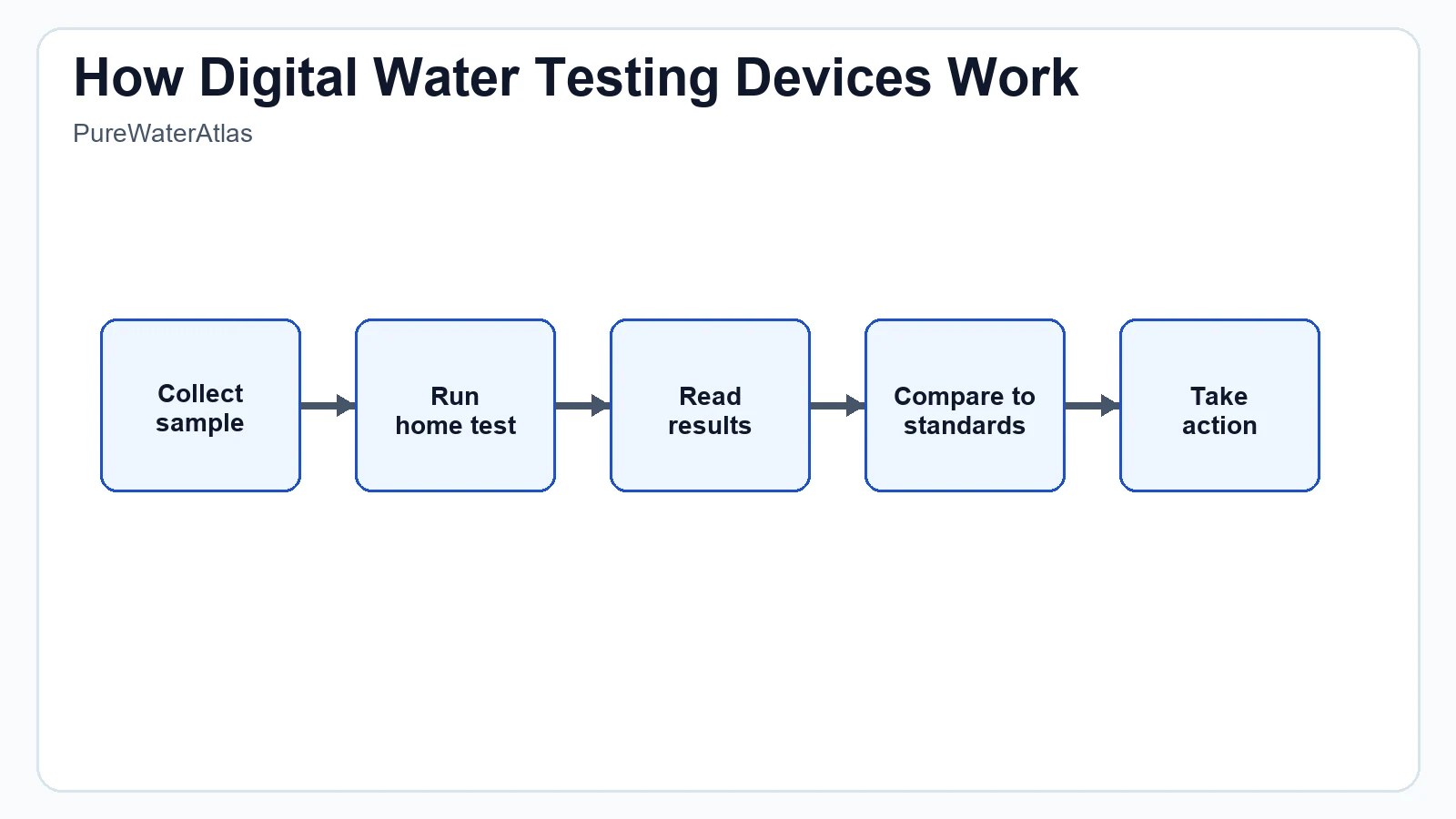
How to interpret digital water testing results responsibly
Interpretation is where science meets judgment. A reading only becomes useful when placed in context.
Know the parameter’s meaning
A TDS value is not a toxicity score. pH is not a microbial safety indicator. Turbidity is not a direct measure of contamination type. Free chlorine is not the same as total chlorine. Users should understand what each parameter indicates and what it does not.
Compare against relevant standards or goals
For some parameters, health-based or operational benchmarks exist. For others, measurements are mainly comparative and process-oriented. Regulatory context varies by country and water system type. In the United States, the EPA regulates public drinking water systems under national standards, while private well owners are generally responsible for their own testing and treatment decisions. The EPA and CDC provide practical public guidance on drinking water quality and health considerations. USGS resources can also help users understand source water variability and hydrologic context through the U.S. Geological Survey water resources program.
Look for trends, not isolated numbers
A single unexpected reading may result from sampling error, incomplete stabilization, dirty sensors, or temporary fluctuation. Repeated measurements under similar conditions are often more informative than one number. A stable trend outside expected range is generally more meaningful than one anomalous result.
Understand action thresholds
Some practical examples:
- pH: Water well below neutral may increase corrosion risk in plumbing systems, though the significance depends on alkalinity, dissolved inorganic carbon, and pipe materials.
- Turbidity: Noticeable increases in treated water should prompt attention, especially if paired with color, odor, or supply disruptions.
- Disinfectant residual: Very low or absent residual in a system expected to maintain chlorine may warrant follow-up according to local design and operator guidance.
- Conductivity: Sudden shifts can indicate source or treatment changes even when absolute values are not themselves alarming.
When health-significant contaminants are possible, action should not depend on broad indicator meters alone. Lead, arsenic, nitrate, PFAS, and microbial contamination often require dedicated testing methods.
Digital devices and microbiological safety
Microbiology is one of the most important and commonly misunderstood aspects of drinking water safety. Most routine consumer digital devices do not directly detect pathogens. That matters because microbial hazards can cause acute illness even when water looks clear and tastes normal.
Indicators such as turbidity, temperature, ORP, and chlorine residual can provide indirect information about conditions associated with microbial control, but they do not replace microbiological testing. For example:
- A chlorine reading may suggest whether disinfectant is present, but it does not confirm complete inactivation of all pathogens at every point.
- Low turbidity can support confidence in filtration performance, but clear water is not automatically pathogen-free.
- ORP can reflect oxidative conditions, but interpretation depends on pH, chemistry, and system design.
When contamination is suspected after flooding, sewage intrusion, well damage, pressure loss, or boil-water advisories, microbiological testing and public health guidance should take priority over generalized digital screening.
Consumer use cases: when digital water testing is genuinely helpful at home
Homeowners often ask whether buying a digital meter is worth it. In many cases, yes, but only if expectations are realistic.
Useful household scenarios
- Checking pH and conductivity before and after a treatment device
- Monitoring reverse osmosis performance over time
- Verifying basic chlorine residual in stored or disinfected water
- Tracking well water changes seasonally or after storms
- Identifying unusual trends that justify laboratory testing
Less useful expectations
- Assuming a TDS meter can certify that tap water is safe
- Using one meter to rule out lead, bacteria, or PFAS
- Relying on an app-connected device without understanding measured parameters
- Ignoring calibration and then treating numbers as definitive
Consumers who are building a practical home testing plan often benefit from combining digital tools with certified lab tests and occasional manual methods. PureWaterAtlas also maintains a broader water testing category covering these complementary approaches.
Digital water testing in utilities and professional settings
In municipal systems, hospitals, laboratories, food facilities, schools, and industrial plants, digital water testing is not just convenient; it is often central to risk management and operations. Continuous sensors can watch for rapid process changes faster than batch sampling alone. Data historians and alert systems help operators identify treatment instability, distribution anomalies, and equipment failure earlier.
Common professional applications include:
- Monitoring raw water quality changes before treatment
- Watching filter performance through turbidity trends
- Controlling pH adjustment and corrosion management processes
- Maintaining disinfectant residual through storage and distribution
- Supervising deionized or purified water loops in technical settings
- Tracking building water systems for stagnation and operational changes
However, professional use also reinforces a key lesson: digital data are most powerful when integrated with standard operating procedures, laboratory confirmation, maintenance logs, and trained interpretation.
Limitations, interferences, and common mistakes
No article on digital water testing is complete without discussing limitations. Good water analysis depends as much on recognizing uncertainty as on generating numbers.
Matrix effects
Water chemistry is complex. High ionic strength, colored water, suspended particles, dissolved organics, or interfering ions can distort sensor response. A device validated in relatively clean water may perform differently in groundwater, surface water, or heavily treated process water.
False precision
Many screens display readings to several decimal places. This can imply accuracy that the device does not actually have. If a low-cost meter reads 7.03 pH, the real uncertainty may still be much larger than 0.01 units under field conditions.
Improper sampling
Stagnant tap water, inadequate flushing, dirty containers, air bubbles, poor mixing, and delayed analysis can all affect results. Sampling protocol matters.
Overreliance on one parameter
The classic example is TDS. It is useful, but not comprehensive. Another is ORP, which can be informative in treatment but is often oversold in consumer products.
Ignoring detection limits
A device may not be sensitive enough for health-relevant thresholds. This is especially important for regulated contaminants that matter at very low concentrations.
How to choose a digital water testing device
Selecting the right instrument starts with the question, “What decision am I trying to make?” The answer should guide the parameter, accuracy level, and form factor you need.
Key buying criteria
- Target parameter: Choose a device that measures what actually matters for your concern.
- Accuracy and range: Make sure the measurement range and uncertainty fit the use case.
- Calibration support: Reliable standards, replacement parts, and instructions are essential.
- Temperature compensation: Important for many field measurements.
- Data logging: Useful if trend analysis matters.
- Probe durability: Especially relevant for field and continuous use.
- Maintenance burden: Some sensors require frequent care or consumables.
- Transparency: Avoid vague marketing language that promises broad “purity” or “safety” results without specifying measured analytes.
If you are comparing household options, a helpful companion resource is PureWaterAtlas’s guide to best water testing kits, which can complement digital meters with broader contaminant screening.
The future of digital water testing
The next generation of water tech devices is moving toward smaller sensors, lower power use, better networking, more automation, and smarter analytics. Emerging systems aim to reduce calibration burden, improve selectivity, and combine multiple sensing modalities in a single platform. Artificial intelligence and anomaly detection are increasingly being layered onto water monitoring systems to help identify abnormal patterns faster, though those systems still depend on sound instrumentation and validation.
Likely areas of progress include:
- Improved biosensors for pathogen indicators and toxin screening
- Microfluidic cartridges for rapid multi-analyte analysis
- Lower-cost distributed sensors for decentralized systems and buildings
- Better cloud integration for asset management and alerts
- More robust fouling resistance and self-cleaning mechanisms
- Enhanced data interpretation tools that combine hydraulic, chemical, and environmental information
For readers interested in where the field is heading, PureWaterAtlas has also explored future water testing technologies.
FAQ
Are digital water testing devices accurate?
They can be accurate for the parameters they are designed to measure, but only when used correctly. Accuracy depends on device quality, calibration, maintenance, sample conditions, and operator technique. Even good devices have limits and do not measure every possible contaminant.
Can a digital meter tell if my drinking water is safe?
Not by itself in a comprehensive sense. A meter may provide useful information on pH, conductivity, chlorine, or turbidity, but drinking water safety also depends on contaminants many digital consumer devices do not directly detect, such as pathogens, lead, PFAS, and some toxic chemicals.
Is a TDS meter enough for home water testing?
No. A TDS meter is useful for tracking dissolved ionic content and treatment performance, especially with reverse osmosis, but it is not a complete safety test. It should be considered one tool among several.
What is the difference between a water quality sensor and a lab test?
A water quality sensor usually provides rapid measurement of a specific parameter, sometimes continuously. A laboratory test can use more sensitive, selective, and standardized methods to identify contaminants at lower concentrations and with stronger quality assurance.
When should I follow digital results with laboratory testing?
Follow up with lab testing when a digital reading is abnormal, when a health-relevant contaminant is suspected, after environmental events such as flooding or well damage, when required by regulation, or when you need defensible results for contaminants that digital field devices do not reliably measure.
Conclusion
Digital water testing is a powerful advance in how we measure, understand, and manage drinking water quality. It offers speed, convenience, trend visibility, and in many settings the benefits of real time water monitoring. Used well, digital devices can help homeowners track treatment performance, help facilities maintain control, and help professionals detect changes before they become larger problems. But the science matters. Each device measures specific parameters, not overall safety in a universal sense. The best results come from matching the instrument to the question, maintaining it properly, interpreting data in context, and recognizing when certified laboratory analysis is still necessary. In that balanced role, digital water testing is not just a gadget category; it is an important part of modern water quality protection.
Featured image: Photo by ThisIsEngineering on Pexels.



Read the full guide: Water Testing Guide
Explore more in this category: Water Testing Articles