
Heavy metals in drinking water are a serious public health concern because they can be tasteless, odorless, and invisible even when present at levels that matter. A proper heavy metals water test helps identify whether a water source contains metals such as lead, arsenic, mercury, cadmium, chromium, copper, nickel, or manganese at concentrations that may affect safety, plumbing, treatment choices, and long-term health risk. For homeowners, facility managers, and anyone responsible for drinking water quality, testing is the first step toward moving from uncertainty to evidence. This guide explains how heavy metals enter water, which contaminants are most important, how laboratory and field testing work, how to interpret results, and what to do next if a report shows elevated concentrations.
To understand why metals testing is so important, it helps to remember a basic fact of water chemistry: “heavy metals” is not a strict regulatory category, but rather a practical term used to describe metallic elements that can pose toxicological or operational concerns in water. Some, like copper, iron, zinc, and manganese, may be essential or commonly encountered in trace amounts yet become problematic at higher levels. Others, such as lead, arsenic, cadmium, and mercury, are considered high-priority contaminants because even low exposure over time can be harmful. In drinking water, risk depends on the specific metal, its chemical form, the concentration, the duration of exposure, and the age and health status of the person drinking it.
For a broader foundation in contaminants and treatment processes, PureWaterAtlas readers may also benefit from understanding contaminants, treatment, and water quality science. Heavy metals are one part of a larger water quality picture, but they deserve focused attention because they behave differently from microbes, pesticides, or disinfection byproducts and often require specialized sampling and analysis.
What Is a Heavy Metals Water Test?
A heavy metals water test is an analytical assessment designed to measure the concentration of one or more metallic contaminants in a water sample. Depending on the test panel, it may include:
- Lead
- Arsenic
- Mercury
- Cadmium
- Chromium
- Copper
- Nickel
- Manganese
- Iron
- Selenium
- Uranium and other trace elements in some expanded panels
Testing can be performed for different purposes. A homeowner may want to know whether private well water is safe. A building manager may need to investigate corrosion in plumbing. A family living near mining, industrial, agricultural, or legacy contamination zones may want a screening for water contamination metals associated with local geology or land use. In municipal systems, utilities may conduct metals monitoring to comply with drinking water regulations and corrosion control requirements.
The most reliable testing is usually performed by a certified laboratory using validated methods such as inductively coupled plasma mass spectrometry (ICP-MS), inductively coupled plasma optical emission spectrometry (ICP-OES), atomic absorption spectroscopy (AAS), or specialized methods for low-level mercury and arsenic detection. Simple at-home strips or color kits may be useful as rough screening tools for a few metals, but they should not be treated as equivalent to accredited laboratory data when a health-based decision is at stake.
Why Heavy Metals Matter in Drinking Water Safety
Heavy metals matter because water can act as a long-term exposure pathway. Unlike a short-lived contamination event that causes immediate odor or taste changes, metals may remain unnoticed for months or years. Their effects can also be cumulative. A person may not feel any immediate symptoms, yet chronic exposure at elevated concentrations can increase risk over time.
From a public health perspective, some groups are more vulnerable than others. Infants, young children, pregnant people, older adults, and individuals with kidney disease or nutritional deficiencies may face greater risk from certain metals. Lead is a well-known example because no beneficial biological role exists for lead in the human body, and children are especially sensitive to its neurodevelopmental effects. Arsenic is another high-concern contaminant because long-term ingestion has been associated with increased risk of several adverse health outcomes, including skin changes and certain cancers. Mercury, depending on its form, can affect the nervous system and kidneys.
Authoritative public health agencies emphasize the importance of safe drinking water and contaminant control. The U.S. Environmental Protection Agency drinking water program, the World Health Organization drinking water fact sheet, and the CDC healthy drinking water resources all stress that chemical contaminants require monitoring, source protection, treatment, and informed interpretation. In the United States, private well owners are generally responsible for testing their own water because private wells are not regulated in the same way as public water systems.
Where Heavy Metals in Water Come From
Metals can enter drinking water from natural geology, industrial emissions, agricultural practices, mining, waste disposal, stormwater runoff, or the water distribution system itself. The source matters because it helps determine which metals to test for and what kind of solution is likely to work.
Natural Geologic Sources
Some aquifers naturally contain minerals that release trace metals into groundwater over time. Arsenic is a classic example. In some regions, arsenic dissolves from rocks and sediments under certain geochemical conditions, especially where groundwater chemistry favors mobilization. Manganese, iron, uranium, and selenium may also occur naturally depending on local geology. The U.S. Geological Survey water resources program provides valuable regional context on groundwater quality, aquifers, and contaminant occurrence.
Corrosion of Plumbing Materials
Not all metal contamination starts at the well or source water. Sometimes the water enters a building with acceptable quality and picks up metals from plumbing materials on the way to the tap. Lead can leach from old lead service lines, lead solder, brass fixtures, and certain valves. Copper can leach from copper plumbing under corrosive conditions. Corrosion is influenced by pH, alkalinity, chloride, sulfate, dissolved oxygen, temperature, and water stagnation time.
This distinction is crucial because a sample taken after water has sat overnight in household pipes may show higher lead or copper than a sample taken directly from the well pressure tank or from a flushed tap. That is why sampling instructions matter so much in metals testing.
Industrial, Mining, and Waste Sources
Mining and metal processing can release arsenic, cadmium, lead, mercury, and other contaminants into soil and water. Historic smelting sites, battery recycling operations, metal finishing plants, and hazardous waste sites may all contribute to localized contamination. Even if a facility is long closed, metals can persist in the environment for decades because they do not biodegrade like many organic pollutants.
Agricultural and Land Use Contributions
Some metal contamination can be associated with agricultural chemicals, treated wood, ash, or land disturbance that changes runoff and sediment transport. While nitrate and pesticides usually receive more attention in agricultural areas, water safety metals should not be overlooked, especially where shallow wells, legacy chemical use, or mixed industrial-agricultural land history exists.
Which Metals Are Most Commonly Tested?
The best heavy metals panel depends on location, water source, plumbing age, and local risk factors. Still, a core group of metals appears in many drinking water investigations.
Lead
Lead is among the most important contaminants to test because even low concentrations can be significant. In drinking water, lead usually comes from plumbing rather than the source aquifer. Homes built before lead plumbing restrictions are of special concern, but “newer” plumbing does not automatically eliminate risk because brass components can also contribute lead. If lead is your main concern, PureWaterAtlas has a dedicated guide to testing lead in water.
Arsenic
Arsenic water testing is especially important for private wells because arsenic often occurs naturally in groundwater and cannot be seen, smelled, or tasted. Arsenic is typically tested as total arsenic, but in some situations speciation may be useful because arsenite and arsenate behave differently in treatment systems. If a test shows elevated arsenic, treatment selection depends heavily on oxidation state and water chemistry.
Mercury
A mercury water test is often requested less frequently than lead or arsenic testing, but it may be relevant near industrial sites, mining regions, or locations with known contamination history. Mercury can be challenging to analyze accurately at very low levels, so proper preservation, sample handling, and laboratory capability are essential.
Cadmium
Cadmium may be associated with industrial contamination, corrosion of galvanized materials, batteries, pigments, and some mining-related sources. It is typically included in broad metals panels because of its toxicological significance.
Chromium
Chromium occurs in different forms, and its toxicology depends strongly on speciation. Total chromium testing is common, but in certain investigations chromium-6 may be of special interest. Industrial sources and natural geology can both contribute.
Copper
Copper is often discussed alongside lead because both can be released by corrosive plumbing. Elevated copper can cause blue-green staining and metallic taste, and acute gastrointestinal symptoms may occur at high levels. Copper testing is especially important in homes with new copper plumbing, acidic water, or signs of corrosion.
Manganese and Iron
Manganese and iron are often more associated with aesthetic and operational problems than classic toxicity concerns at low concentrations, but that does not mean they should be ignored. Manganese has received increasing attention because higher levels may be undesirable from both health and water quality perspectives. Iron can cause staining, unpleasant taste, and filter fouling.
Regulatory Context and Health-Based Thresholds
Interpreting a heavy metals water test requires understanding what benchmark is being used. Different agencies may publish Maximum Contaminant Levels (MCLs), health advisories, action levels, aesthetic guidelines, or risk-based screening values. These are not all the same thing.
In the United States, public drinking water systems are regulated under the Safe Drinking Water Act. The EPA sets MCLs for many contaminants and an Action Level for lead and copper under the Lead and Copper Rule framework. Private wells are not directly regulated under those rules, but the same benchmarks are often used as reference points when evaluating private well test reports.
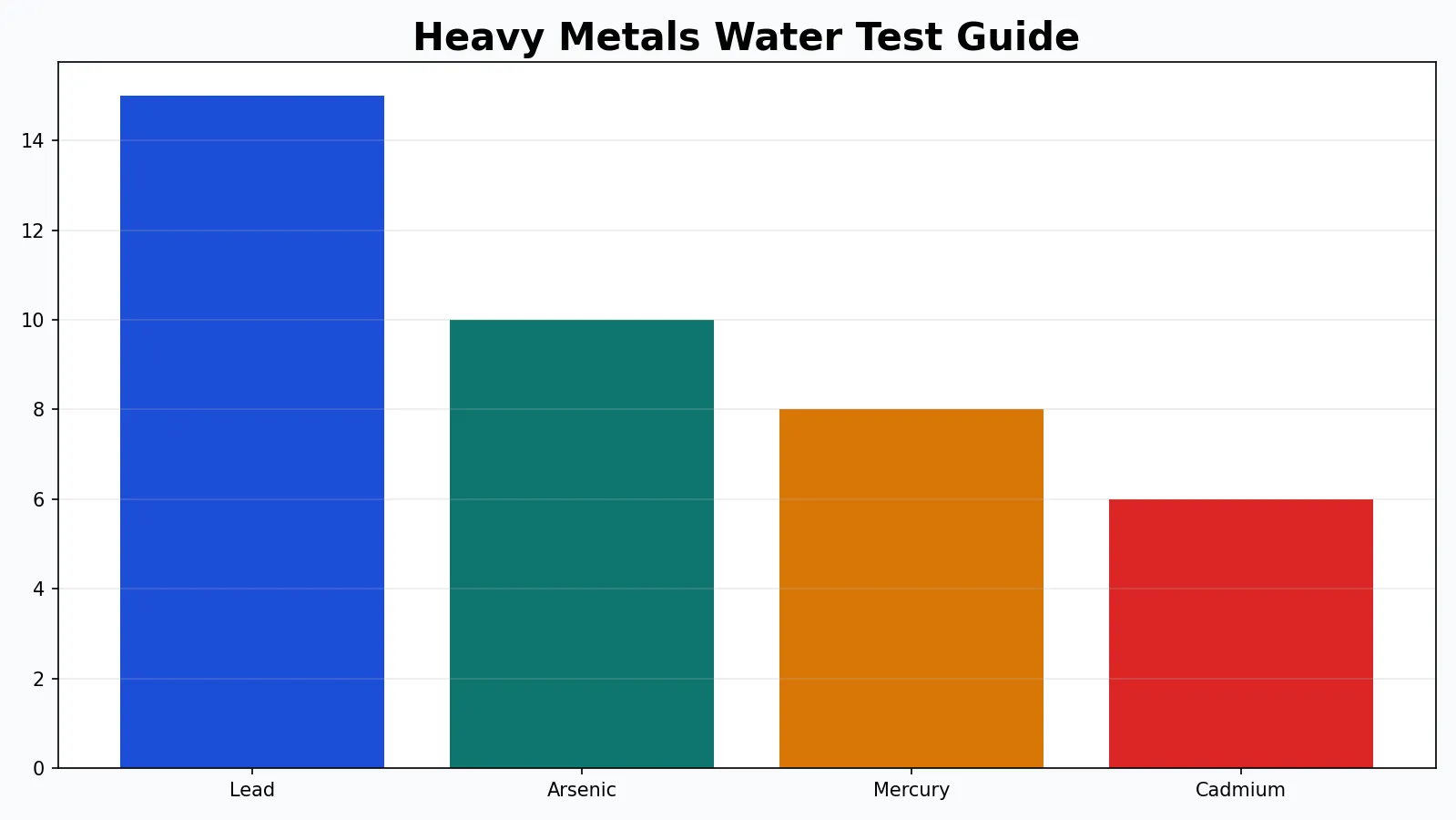
| Contaminant | Common U.S. Reference Benchmark | Notes |
|---|---|---|
| Arsenic | 10 µg/L (MCL) | Important for private wells; often naturally occurring |
| Lead | 15 µg/L (Action Level for public systems) | Not a health-based “safe level”; lower exposure is better |
| Mercury | 2 µg/L (MCL) | Requires reliable low-level analytical methods |
| Cadmium | 5 µg/L (MCL) | Toxic metal often included in broad panels |
| Chromium | 100 µg/L (MCL for total chromium) | Speciation may matter in some cases |
| Copper | 1.3 mg/L (Action Level) | Often related to corrosion of plumbing |
These values can change as regulations evolve, and interpretation should always consider the current regulatory framework and the laboratory reporting units. A result reported in mg/L is different from µg/L, and confusion between those units can lead to serious misunderstanding. One mg/L equals 1,000 µg/L.
For readers comparing reports, PureWaterAtlas also offers help with understanding water test results. That is especially useful when a report includes detection limits, reporting limits, qualifiers, and unit conversions that are unfamiliar.
The Science Behind Metal Behavior in Water
Metals do not all behave the same way in water. Their mobility, toxicity, and treatability depend on chemistry. A scientific understanding of that chemistry helps explain why one household sees high lead after overnight stagnation while another sees elevated arsenic in every sample from the well.
Dissolved vs Particulate Metals
A metal may be present in dissolved ionic form or attached to particles. This affects both testing and treatment. If a sample is acid-preserved and analyzed as “total recoverable” metals, the reported result may include material dissolved from particles during preparation. If filtered analysis is performed, the result reflects a dissolved fraction. In practical terms, particulate lead from disturbed plumbing scale may appear intermittently, while dissolved arsenic in groundwater may be more stable over time.
Oxidation State and Speciation
Arsenic can occur mainly as arsenite (As III) or arsenate (As V). Chromium may occur as chromium-3 or chromium-6. Mercury can exist in elemental, inorganic, or organic forms. These forms differ in toxicity, transport behavior, and removal efficiency. For example, arsenite is typically harder to remove by some adsorptive media than arsenate unless pre-oxidation is used.
pH, Alkalinity, and Corrosivity
Water that is acidic or otherwise corrosive may dissolve metals from plumbing materials more readily. Low pH, low alkalinity, high chloride, elevated sulfate, and long stagnation times can all contribute. Corrosion control is not simply a matter of replacing pipes; it may also involve adjusting water chemistry so that metals are less likely to leach into drinking water.
Redox Conditions in Groundwater
In groundwater systems, the amount of oxygen and the overall redox environment influence whether metals stay bound in sediments or dissolve into water. Reducing conditions can mobilize arsenic, iron, and manganese in some aquifers. That is one reason why neighboring wells can have very different test results even when they draw from similar geologic settings.
When Should You Get a Heavy Metals Water Test?
Testing is appropriate in many common situations, including:
- When using a private well for drinking water
- When moving into a new home with unknown water history
- When a home has old plumbing, lead service lines, or brass fixtures
- When local geology is associated with arsenic or other trace metals
- When there is nearby mining, industrial activity, landfill history, or hazardous waste concern
- When water shows staining, metallic taste, discoloration, or sediment
- When a child, pregnant person, or vulnerable adult lives in the home
- After plumbing repairs, well work, or treatment system changes
If you are deciding where to start, this broader resource on how to test drinking water provides a practical overview of sampling strategy, choosing a lab, and selecting test panels. For ongoing monitoring options, the water testing category can help you compare related testing topics.
How Heavy Metals Testing Is Performed
Testing quality depends on the full chain of events: planning, sampling, preservation, transport, laboratory analysis, and interpretation. A technically strong lab result can still be misleading if the sample was collected incorrectly.
Step 1: Define the Question
Before collecting a sample, decide what you are trying to learn. Are you testing the source water from a private well? Investigating lead release from household plumbing? Screening for a broad range of water contamination metals after nearby industrial activity? The answer determines which sample points and sample conditions are appropriate.
Step 2: Choose the Right Sample Location
Sample location strongly affects metal results. Examples include:
- Raw well water sample: Helps evaluate the groundwater source itself
- First-draw kitchen tap sample: Useful for lead and copper exposure at the tap after stagnation
- Flushed tap sample: Helps distinguish plumbing contribution from source water
- Post-treatment sample: Evaluates treatment system performance
In a lead arsenic water investigation, for example, you may need both a raw water sample and a first-draw tap sample because arsenic may come from the aquifer while lead may come from household plumbing.
Step 3: Use Proper Containers and Preservation
Metals samples are typically collected in laboratory-provided bottles and preserved with acid, often nitric acid, to stabilize dissolved metals and minimize losses to container walls. Never rinse out a preserved sample bottle unless the lab explicitly instructs you to do so. Always follow the lab’s chain-of-custody and sampling instructions exactly.
Step 4: Laboratory Analysis
Certified laboratories commonly use the following techniques:
- ICP-MS: Highly sensitive multi-element analysis, often preferred for low-level trace metals
- ICP-OES: Effective for many metals, especially at moderate concentrations
- Graphite furnace atomic absorption: Sensitive method for certain individual metals
- Cold vapor techniques: Often used for mercury
Laboratories report results with associated units, method detection limits, reporting limits, and occasionally data qualifiers if a result is estimated, below quantitation range, or affected by matrix interference.
Step 5: Quality Assurance and Quality Control
Reliable metals testing depends on blanks, calibration, duplicates, spikes, and control standards. While a homeowner may not see all QC data in a basic lab report, choosing an accredited lab increases confidence that accepted analytical procedures were followed.
At-Home Kits vs Certified Laboratory Testing
At-home testing products are popular because they are convenient, but they vary widely in quality and usefulness. For heavy metals, there are three broad categories:
- Color strips or rapid kits: Fast and inexpensive, but usually limited in sensitivity and scope
- Mail-in consumer kits: Sampling done at home, analysis performed by a lab
- Direct certified lab sampling: Highest control over procedure and often best for confirmation
For major decisions about health, treatment purchases, or regulatory compliance, laboratory analysis is usually the better choice. Rapid kits may miss low-level contamination or provide only rough categories. That matters because some metals are concerning even at concentrations too low for simple field kits to measure accurately.
How to Interpret a Heavy Metals Water Test Report
A lab report can seem intimidating, but interpretation becomes easier if you focus on a few key questions.
1. What Metals Were Tested?
A “metals panel” is not standardized. One panel may include arsenic, lead, copper, iron, and manganese, while another includes a much broader suite. Make sure the contaminants relevant to your local risks were actually analyzed.
2. What Are the Units?
Most trace metals in drinking water are reported in micrograms per liter (µg/L), equivalent to parts per billion in dilute water. Some are reported in milligrams per liter (mg/L). Unit mistakes are common and can completely change interpretation.
3. Is the Result Above a Benchmark?
Compare each result with the appropriate regulatory or health-based value. Be careful with lead: the public system action level is not the same as a guarantee of safety for an individual household, and many health professionals advise minimizing lead exposure as much as reasonably possible.
4. What Was the Sampling Condition?
A first-draw sample may show higher lead or copper because of overnight contact with plumbing. A flushed sample may be lower. A raw well sample may better represent the groundwater source. Without this context, a number alone can be misleading.
5. Were There Any Qualifiers?
Some reports mark values as “ND” for not detected, or use symbols indicating estimated results. “Not detected” does not necessarily mean zero; it means the concentration was below the reporting threshold of the method.
Common Heavy Metals Scenarios in Real Homes
Scenario 1: High Arsenic in a Private Well
A family tests untreated well water and finds arsenic at 18 µg/L. The kitchen tap sample after treatment is 4 µg/L. This suggests the groundwater source contains arsenic and the treatment system is reducing, but not completely removing, it. The homeowner should verify treatment performance, maintenance schedule, and whether the system is appropriate for the arsenic species present.
Scenario 2: Elevated First-Draw Lead, Low Flushed Lead
A first-draw kitchen sample after overnight stagnation shows 12 µg/L lead, while a flushed sample after several minutes shows less than 1 µg/L. This pattern suggests plumbing-related contamination rather than source-water contamination. Risk reduction may involve fixture replacement, flushing practices, certified point-of-use filtration, and investigation of lead-bearing plumbing components.
Scenario 3: Manganese and Iron Causing Staining
A well owner notices black and reddish-brown staining. Testing shows elevated manganese and iron but low arsenic, lead, and mercury. In this case, the issue may be primarily aesthetic and operational, though manganese should still be reviewed against health-based guidance where applicable. Oxidation and filtration may be more relevant than adsorptive media designed for arsenic.
Treatment Options When Metals Are Found
There is no universal filter that optimally removes every metal under every condition. Effective treatment depends on the specific contaminant, concentration, oxidation state, pH, competing ions, flow rate, and maintenance practices.
Reverse Osmosis
Reverse osmosis systems can reduce many dissolved metals, including arsenic, lead, cadmium, chromium, and copper, when properly selected and maintained. Performance varies, especially for different arsenic species, so system certification and water chemistry review matter.
Adsorptive Media
Activated alumina, iron-based media, and other specialty adsorbents are commonly used for arsenic and some other metals. Media selection must match the contaminant form and the overall water chemistry.
Ion Exchange
Some ion exchange systems can remove certain metal ions, but they are not always the best choice and may be sensitive to competing ions in the water.
Oxidation and Filtration
For iron and manganese, oxidation followed by filtration is often effective. In some arsenic applications, pre-oxidation improves removal by converting arsenite to arsenate.
Corrosion Control and Plumbing Replacement
When metals come from household plumbing, source treatment alone may not solve the problem. Adjusting water chemistry, replacing lead-bearing fixtures or service lines, and using point-of-use certified filters may be necessary.
If results exceed acceptable levels, the next steps should be systematic rather than improvised. PureWaterAtlas provides a practical action framework in what to do if your water test fails.
How Often Should Heavy Metals Be Tested?
Testing frequency depends on water source and prior results.
- Private well owners: Consider periodic metals testing, especially for arsenic, lead, copper, manganese, and region-specific contaminants
- After installing treatment: Test to confirm performance, then retest at intervals recommended by the manufacturer or a water professional
- After plumbing changes: Retest if fixtures, pipes, or service lines are replaced
- After changes in taste, color, or local land use: Additional testing may be justified
There is no one-size-fits-all schedule, but routine monitoring is generally wiser than assuming an old safe result still reflects current conditions.
Special Considerations for Private Wells
Private well users carry a unique responsibility because there is no utility performing routine compliance testing for them. A private well may be microbiologically safe yet chemically unsafe, or vice versa. Heavy metals are particularly important in well testing because groundwater chemistry can vary with depth, season, redox conditions, pumping patterns, and nearby land disturbance.
If your area is known for arsenic, uranium, manganese, or mining-related contamination, a standard bacteria test alone is not enough. Comprehensive testing should include relevant inorganic contaminants and be repeated over time, especially if a new well is drilled or if the existing well is modified.
Preventing Exposure While Awaiting Results
If you suspect metal contamination and are waiting for lab results, practical exposure reduction may include:
- Using cold water for drinking and cooking, since hot water can increase metal leaching from plumbing
- Flushing taps after prolonged stagnation when plumbing-related lead or copper is a concern
- Using a properly certified point-of-use filter matched to the contaminant of concern
- Using an alternative safe water source if contamination is strongly suspected or previously confirmed
These are interim measures, not substitutes for testing and corrective action.
Frequently Asked Questions
Can you taste heavy metals in water?
Sometimes, but often not. Iron, copper, and manganese may affect taste or cause staining, while arsenic, lead, and mercury can be present without obvious sensory warning signs. A heavy metals water test is the only reliable way to know.
What is the most important metal to test for?
There is no single answer. Lead is critical in older plumbing systems, while arsenic water testing is especially important for private wells in affected geologic regions. The right panel depends on the source water, plumbing, and local contamination history.
Are home test kits accurate enough?
For screening, some may be useful. For decisions about health protection, treatment selection, or confirmation of contamination, certified laboratory testing is generally more reliable, especially for low-level lead, arsenic, and mercury.
What if my water has both lead and arsenic?
A combined lead arsenic water problem is possible because lead often comes from plumbing while arsenic may come from the groundwater source. In that case, both the source and the household plumbing need evaluation, and treatment may need to address more than one pathway.
Does boiling remove heavy metals?
No. Boiling does not remove heavy metals and can even increase concentration slightly as water evaporates. Metals require appropriate filtration, adsorption, membrane treatment, corrosion control, or source correction depending on the contaminant.
Conclusion
Heavy metals testing is one of the most important parts of drinking water assessment because metal contamination is often invisible, persistent, and highly dependent on both source water and plumbing conditions. A well-planned heavy metals water test can reveal whether contaminants such as lead, arsenic, mercury, cadmium, chromium, copper, or manganese are present at levels that require attention. The most useful approach is targeted, scientific, and practical: choose the right sample locations, use a qualified laboratory, compare results to current benchmarks, and match any treatment or corrective action to the specific metal and its source. Whether you are investigating water safety metals in a private well or evaluating plumbing-related exposure in a home, accurate testing is the foundation of safe decision-making.



Read the full guide: Water Testing Guide
Explore more in this category: Water Testing Articles