Real-time water monitoring is changing how utilities, facility managers, researchers, and even some homeowners understand drinking water quality. Instead of relying only on occasional grab samples sent to a laboratory, modern systems can watch key water quality indicators continuously and alert operators when conditions begin to drift. That shift matters because water quality is dynamic. It changes with source water conditions, rainfall, pipe corrosion, treatment performance, temperature, microbial activity, and distribution system disturbances. A continuous stream of measurements can reveal patterns that periodic sampling may miss, helping decision-makers respond faster and manage risk more effectively.
For drinking water, speed matters. A delayed result can mean that a treatment upset, disinfectant loss, or contamination event is not recognized until hours or days later. Real time water monitoring does not replace all laboratory testing, and it does not directly measure every possible contaminant. However, it provides an essential layer of surveillance. By tracking indicators such as pH, turbidity, conductivity, free chlorine, oxidation-reduction potential, temperature, total organic carbon, pressure, and flow, operators can detect abnormal conditions earlier and investigate before they escalate into a public health concern.
This article explains how real time water monitoring systems work, what they measure, why they matter for drinking water safety, and how to interpret their outputs responsibly. It also covers the scientific principles behind common sensors, the role of IoT connectivity, regulatory context, practical deployment considerations, data quality challenges, and the limits of current technology. For readers building a broader foundation in contamination and treatment, PureWaterAtlas also offers a useful overview of water science, contaminants, treatment, and water quality.
What Is Real Time Water Monitoring?
Real time water monitoring is the continuous or near-continuous measurement of water quality and system performance using installed instruments, sensors, communications hardware, and software analytics. The phrase usually refers to a setup in which data are collected automatically at frequent intervals, transmitted to a dashboard or control platform, and reviewed either by people or by automated alarm logic.
In practice, a real time system often includes:
- One or more in-line or submerged sensors
- A controller or data logger that stores and processes raw readings
- Communications hardware such as cellular, radio, ethernet, or low-power wide-area networking
- Software for visualization, trending, alerts, and historical analysis
- Quality assurance routines such as calibration checks and maintenance records
The “real time” part does not always mean every second. Depending on the application, measurements may update every few seconds, every minute, every 15 minutes, or at another interval. What matters is that the data stream is frequent enough to support timely detection of changes.
This approach sits within a broader family of water testing resources and monitoring practices, but it is distinct from traditional periodic sampling because the system is persistent. It is always watching, rather than checking only at preselected moments.
Why Real Time Water Monitoring Matters for Drinking Water Safety
Drinking water safety depends on more than a single test result. It depends on consistency. A treatment plant may produce excellent water most of the time, yet still face brief but important deviations during storm events, equipment failures, chemical feed interruptions, or abrupt shifts in source water quality. In a distribution network, water quality can change after treatment because of pipe age, stagnation, biofilm activity, cross-connections, pressure fluctuations, or disinfectant decay.
Real time water monitoring helps address these realities in several ways.
Early warning of treatment problems
If turbidity begins rising after filtration, or if disinfectant residual suddenly drops, operators can investigate immediately. That can reduce the duration and geographic spread of a problem.
Improved control of treatment processes
Continuous measurements allow staff to optimize coagulant dose, filtration run times, pH adjustment, oxidation, and disinfection. Better control can improve both safety and efficiency.
Protection in the distribution system
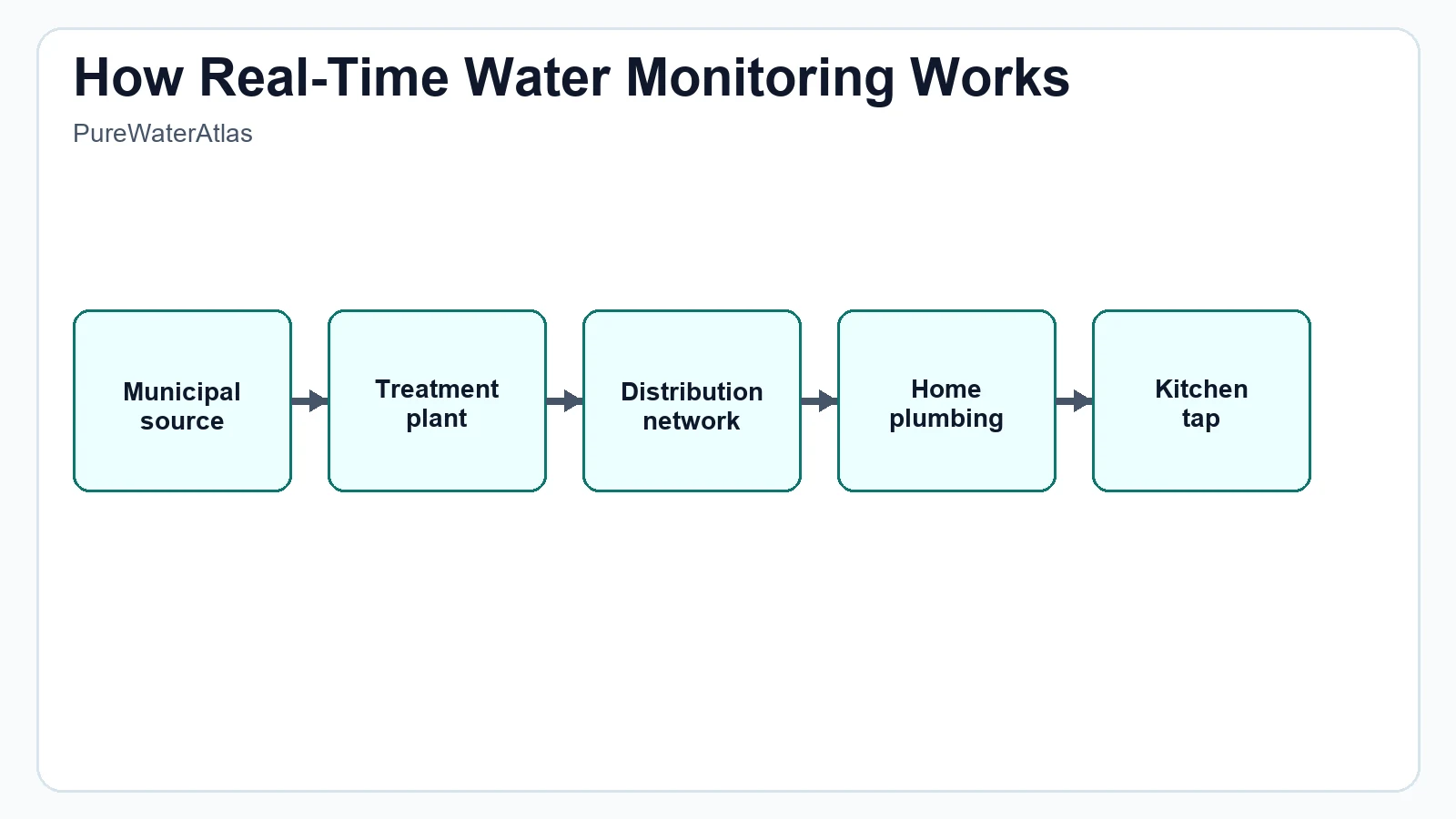
Water that leaves the plant in compliance must remain safe all the way to the tap. Monitoring pressure, chlorine residual, conductivity, and other indicators at remote points can help utilities identify loss of disinfectant, intrusion risks, or unusual hydraulic conditions.
Trend recognition
Some issues are not obvious in single data points. Slow seasonal changes, recurring nighttime anomalies, or correlations with rainfall become much easier to see in continuous data.
Better incident response
When alarms are linked to operational protocols, staff can respond faster. That may include resampling, isolating a zone, adjusting treatment, checking pump status, or issuing public communications if warranted.
Public health agencies emphasize the importance of safe drinking water management from source to tap. Readers seeking foundational health guidance can review the World Health Organization’s drinking water fact sheet, which explains major risks and preventive approaches, and the CDC drinking water resources for practical public health context.
The Scientific Background: Water Quality Is Dynamic
To understand the value of continuous water testing, it helps to understand why water quality changes over time.
Source water variability
Rivers, lakes, reservoirs, and groundwater each have distinct chemistries and vulnerabilities. Surface water can change rapidly after rain, snowmelt, algal blooms, wildfire runoff, or upstream discharges. Groundwater is often more stable, but it can still shift due to aquifer mixing, pumping changes, seasonal recharge, geochemistry, and land use impacts. The U.S. Geological Survey water resources program provides extensive scientific information on hydrology, water quality, and watershed processes that shape these changes.
Treatment process interactions
Drinking water treatment is a sequence of physical and chemical operations. Coagulation and flocculation depend on pH, alkalinity, temperature, and raw water organic content. Filters perform differently depending on loading and particle characteristics. Disinfection effectiveness depends on disinfectant concentration, contact time, pH, temperature, and demand from organic and inorganic substances. Small shifts in one variable can affect several others.
Distribution system chemistry
Once water enters pipes, additional factors matter: residence time, pipe material, corrosion scale, nitrification risk in chloraminated systems, mixing behavior in storage tanks, and local stagnation. A stable chlorine residual at the treatment plant does not guarantee stability at the farthest point in the network.
Microbial ecology
Water systems are not sterile environments. Biofilms can develop on pipe surfaces and respond to nutrient availability, disinfectant levels, and flow conditions. Real time monitoring cannot directly identify all microbes, but it can track environmental conditions associated with microbial control or risk.
This is why water monitoring tech is best viewed as a systems tool. It does not merely measure isolated numbers. It helps operators understand the movement and behavior of water across time and infrastructure.
Core Parameters in Real Time Water Monitoring
No single sensor can tell the whole story. Effective systems monitor a set of parameters chosen for the water source, treatment process, distribution system, and risk profile. Below are the most common measurements used in real time water monitoring for drinking water.
Temperature
Temperature influences chemical reaction rates, disinfectant stability, solubility, sensor performance, microbial growth potential, and taste perception. It is simple to measure and often valuable as a contextual parameter.
pH
pH indicates how acidic or basic water is. It affects coagulation efficiency, corrosion control, disinfectant effectiveness, and metal solubility. Sudden pH changes can signal treatment upset, chemical feed issues, or source water changes.
Conductivity
Conductivity reflects the ability of water to carry electrical current, which relates to the concentration of dissolved ions. It is not a direct measure of contamination, but abrupt changes can indicate blending changes, intrusion, salinity shifts, or other alterations in water chemistry.
Turbidity
Turbidity measures the scattering of light by suspended particles. In treated drinking water, elevated turbidity may indicate poor clarification, filter breakthrough, or particulate intrusion. Because particles can shield microbes from disinfectants, turbidity is an important operational and regulatory parameter in many systems.
Free chlorine or total chlorine
Disinfectant residual monitoring is central to distribution system safety. A declining residual can suggest increased demand, long water age, nitrification, contamination, or inadequate dosing. Too much chlorine may create taste and odor complaints and increase concerns about disinfection byproduct formation, depending on conditions.
Oxidation-reduction potential (ORP)
ORP is a measure of the water’s tendency to gain or lose electrons. It is often used as an indirect indicator of oxidation and disinfection conditions. ORP can be informative, but interpretation requires context because it reflects multiple chemical influences, not just disinfectant concentration.
Dissolved oxygen
Dissolved oxygen is more common in source water and wastewater monitoring, but it can also be relevant in some drinking water applications, especially where source water quality, biological activity, or corrosion conditions are under study.
Total organic carbon (TOC) or dissolved organic carbon (DOC)
Organic carbon affects coagulant demand, disinfectant demand, biological stability, and disinfection byproduct precursors. Online TOC analyzers are more complex and expensive than basic probes, but they can be highly valuable in treatment optimization.
Pressure and flow
These are hydraulic rather than chemical indicators, but they are critical. Low or negative pressure increases the risk of intrusion in compromised systems. Abnormal flow patterns may indicate leaks, line breaks, unauthorized use, or operational disturbances.
Specific analytes
Some advanced systems can monitor nitrate, ammonia, phosphate, fluoride, or selected metals. These measurements often require more specialized analyzers, greater maintenance, and stronger quality control than simpler field sensors.
How Water Quality Sensors IoT Systems Work
The phrase water quality sensors IoT refers to instrument networks in which sensors are connected through digital communications and cloud or edge computing tools. While the concept can sound futuristic, the basic logic is straightforward: sense, transmit, analyze, alert.
1. Sensing
A sensor or analyzer converts a physical or chemical property into a measurable signal. For example:
- A pH electrode generates a voltage related to hydrogen ion activity
- A conductivity probe measures electrical conductance between electrodes
- A turbidity sensor measures the intensity of scattered light
- A chlorine analyzer may use amperometric, colorimetric, or membrane-based methods
2. Signal processing
The instrument electronics convert the raw signal into a reported measurement. Compensation may be applied for temperature or other known influences. Some devices also perform onboard diagnostics to detect sensor drift or fouling.
3. Data logging
A controller stores readings with time stamps, location identifiers, and metadata such as calibration status or alarm conditions. Logging frequency depends on the monitoring objective.
4. Transmission
Data are transmitted using wired or wireless networks. Common options include cellular modems, LoRaWAN, radio telemetry, SCADA integration, Wi-Fi, or ethernet.
5. Analytics and visualization
Software dashboards display current status, trends, alarm histories, and sometimes predictive insights. More sophisticated smart water systems can compare sites, identify anomalies, and trigger escalating notifications.
6. Response
The final step is operational. Someone must interpret the alert and decide what to do. In mature systems, alarm thresholds are tied to standard operating procedures.
Readers interested in adjacent instrumentation can explore PureWaterAtlas guidance on digital water testing devices, which helps explain how modern electronic measurements compare with traditional methods.
Common Sensor Technologies and Their Scientific Principles
Continuous water testing depends on sensor science. Understanding the strengths and limits of each technology is essential for interpreting results correctly.
Electrochemical sensors
These include pH, ORP, conductivity, and some chlorine analyzers. They respond to ionic activity or redox conditions. Electrochemical sensors are widely used because they provide fast readings and can be integrated in-line. However, they may drift over time, require regular calibration, and be affected by fouling or interfering substances.
Optical sensors
Optical methods use absorption, fluorescence, or light scattering. Turbidity probes and many dissolved oxygen sensors are optical. UV absorbance methods can estimate organic matter or nitrate under some conditions. Optical systems often have good stability but can be affected by dirty windows, bubbles, or color interferences.
Colorimetric analyzers
These systems add reagents to water and measure color development to estimate analyte concentration. Online chlorine, ammonia, phosphate, and some metal analyzers may use this principle. They can be quite specific, but they require reagent supply, plumbing, waste handling, and maintenance.
Ion-selective electrodes
These are designed to respond preferentially to a specific ion, such as fluoride or nitrate. Performance depends on matrix chemistry, temperature, and the presence of interfering ions.
Biosensors and emerging methods
Research is expanding into biosensors, microfluidics, and spectroscopic systems for faster and more selective contaminant detection. These technologies may eventually broaden what can be monitored continuously, including microbial markers and trace contaminants that are currently difficult to measure online.
For a look ahead at where the field is going, see PureWaterAtlas on future water testing technologies.
What Real Time Systems Can Detect Well, and What They Cannot
One of the most important educational points is that real time water monitoring is powerful but not all-seeing.
Strong use cases
- Tracking disinfectant residual changes
- Identifying turbidity spikes or filter breakthrough
- Watching pH stability and conductivity trends
- Monitoring pressure and flow disturbances
- Detecting source water changes that affect treatment
- Providing early warning of abnormal operational conditions
More difficult or limited use cases
- Direct detection of many pathogens in real time
- Trace-level PFAS or many organic micropollutants online
- Legally defensible confirmation for every contaminant type
- Distinguishing all causes of a signal change without follow-up testing
For example, a chlorine residual drop may indicate increased demand from natural organic matter, nitrification, contamination, a sensor problem, or a dosing interruption. The signal is useful, but it is not a diagnosis by itself.
That is why continuous monitoring should be paired with confirmatory sampling and a sound understanding of water testing methods. Real time systems are surveillance tools, operational tools, and risk management tools. They are not a complete substitute for laboratory analysis.
Regulatory and Standards Context
Drinking water regulation varies by country and jurisdiction, but most frameworks combine treatment requirements, distribution system oversight, periodic compliance sampling, and operator responsibilities. In the United States, the EPA oversees national drinking water regulations and guidance under the Safe Drinking Water Act. A practical starting point is the EPA drinking water program, which covers standards, contaminants, and system responsibilities.
Real time water monitoring often supports compliance, but it is not identical to compliance. Many regulations still specify approved analytical methods, sample handling rules, and certified laboratory procedures for formal reporting. Online instruments can support operational decision-making, provide evidence of control, and trigger required follow-up actions, yet some parameters still require laboratory confirmation.
Examples of regulatory or guideline relevance include:
- Turbidity limits and treatment technique requirements for filtered systems
- Maintenance of disinfectant residual in distribution systems where applicable
- pH and corrosion control targets used to limit lead and copper release
- Monitoring of source water and treatment performance to reduce microbial risk
Operators should always align alarm thresholds and decision rules with the regulations, permits, and operating plans that apply in their jurisdiction.
Continuous Water Testing in Different Settings
Real time monitoring is not used in only one kind of environment. The design and value of the system depend heavily on where it is deployed.
Municipal treatment plants
Plants often monitor raw water, treatment basins, filter effluent, clearwells, and plant discharge. These systems help optimize treatment and identify process upsets quickly.
Distribution networks
Remote monitoring stations can track chlorine residual, pressure, conductivity, and temperature across neighborhoods or pressure zones. This supports faster detection of dead zones, abnormal demand, low-pressure events, or declining disinfectant.
Hospitals, schools, and large buildings
Premise plumbing can have stagnation, temperature management, and local water quality issues not visible at the utility level. Continuous monitoring may help manage building water safety plans, especially in complex facilities.
Industrial and commercial facilities
Many facilities monitor incoming water to protect products, equipment, and on-site users. Food and beverage operations, laboratories, semiconductor plants, and pharmaceutical facilities may require tighter process control than ordinary distribution systems provide.
Private wells and residential use
Home-scale smart water systems usually focus on leak detection, pressure, conductivity, pH, or basic filtration performance rather than comprehensive contaminant surveillance. Homeowners should be cautious about overinterpreting consumer sensor data. Periodic certified testing remains important, especially for wells.
How to Interpret Real Time Water Monitoring Data Correctly
Water data monitoring only improves safety if the data are interpreted in context. This is where many users make mistakes. A dashboard can create false confidence if people assume every number is equally reliable or equally meaningful.
Look for trends, not just single points
One unusual data point may be noise, a bubble, a calibration issue, or a transient disturbance. Sustained deviation or repeated patterns are usually more informative than isolated spikes.
Use baseline behavior
Every system has a normal range that reflects its source water, treatment, and infrastructure. A conductivity value that is normal in one area may be unusual in another. Good interpretation starts with historical baselines.
Correlate multiple parameters
A turbidity increase alongside a pressure drop and chlorine decline suggests a different situation than a turbidity increase alone. Multi-parameter interpretation is generally more robust.
Consider maintenance status
If a sensor is overdue for calibration or known to foul easily, abnormal readings deserve verification before major decisions are made.
Set meaningful alarm thresholds
Thresholds should reflect risk and operational relevance. If set too tightly, alarms become constant and are ignored. If too loose, important problems may be missed.
Confirm when stakes are high
When readings suggest a possible safety issue, follow-up testing using approved methods is essential. Real time systems support rapid response, but confirmation protects against both missed events and false alarms.
Practical Design Considerations for Smart Water Systems
Deploying real time water monitoring successfully requires more than buying sensors. The system must be matched to the monitoring objective.
Define the question first
Are you trying to detect filter breakthrough, optimize chlorine dose, identify low-pressure events, or watch for source water changes? The answer determines sensor choice, location, and data frequency.
Choose representative monitoring points
Placement matters. A sensor installed where water is well mixed and hydraulically representative will provide more useful information than one placed in a stagnant bypass or poorly flushed side line.
Account for matrix effects
High iron, manganese, hardness, organics, or suspended solids may interfere with some sensors. Always verify that the selected technology is suitable for the water chemistry.
Plan for maintenance
Fouling, scaling, membrane wear, reagent depletion, and drift are normal realities. Systems fail when maintenance is treated as optional.
Protect data integrity
Communications outages, power disruptions, and software errors can create data gaps or false confidence. Redundancy and auditability are important, especially for critical operations.
Integrate with operations
Alarms must reach the right people, and staff must know what actions to take. Monitoring without response planning does not deliver full value.
Maintenance, Calibration, and Quality Assurance
No discussion of water monitoring tech is complete without emphasizing quality assurance. Online sensors are only as trustworthy as their calibration and upkeep.
Typical quality practices include:
- Routine cleaning to remove biofilm, sediment, and mineral deposits
- Scheduled calibration against traceable standards
- Verification checks with grab samples and laboratory or benchtop methods
- Documentation of maintenance events and sensor replacements
- Review of drift, downtime, and alarm performance metrics
Some parameters are relatively stable and easy to maintain. Others demand close attention. Free chlorine analyzers, for example, can be highly valuable, but they may require careful flow control, membrane maintenance, reagent management, or verification against manual methods depending on design.
Users who need a practical comparison of more traditional approaches may also benefit from reviewing PureWaterAtlas guidance on the best water testing kits, especially for situations where laboratory or field confirmation is still necessary.
Benefits of Real Time Water Monitoring
When implemented well, real time systems provide substantial benefits for drinking water management.
- Faster recognition of abnormal conditions
- Better treatment control and operational efficiency
- Improved visibility across large or complex distribution systems
- Reduced reliance on sparse snapshots alone
- Enhanced ability to investigate complaints or incidents
- More complete historical records for troubleshooting and planning
- Support for risk-based water safety management
These gains are especially strong when data are integrated into smart water systems that combine quality monitoring with hydraulic and asset data.
Limitations and Common Misunderstandings
Real time water monitoring is useful, but overclaiming its capabilities can create risk.
It does not measure everything
Many regulated and emerging contaminants still require laboratory methods for reliable detection and quantification.
Continuous does not mean infallible
Sensor drift, fouling, communication failures, and algorithm errors all occur in real systems.
Proxy indicators are not direct proof
A stable pH and chlorine residual do not guarantee absence of all hazards. Conversely, one unusual reading does not prove contamination.
Data overload is real
Without prioritization, dashboards can overwhelm staff. Good systems simplify action instead of multiplying noise.
Consumer marketing can be misleading
Some residential devices imply broad contaminant detection when they only measure a few general indicators. Consumers should understand exactly what parameter a device is measuring and what it cannot infer.
The Future of Water Data Monitoring
The field is advancing quickly. Several trends are likely to shape the next generation of real time water monitoring.
- Lower-power distributed sensor networks for wider geographic coverage
- Improved anti-fouling materials and self-cleaning designs
- Machine learning for anomaly detection and predictive maintenance
- Better integration of water quality, hydraulics, weather, and asset data
- Expansion of online analyzers for nutrients, metals, and organic matter
- Progress in rapid microbial detection and biosensing
Even as the technology becomes more sophisticated, the core principle will remain the same: better decisions come from timely, trustworthy, context-rich information.
FAQ
Is real time water monitoring the same as laboratory water testing?
No. Real time systems provide continuous or frequent measurements of selected parameters, while laboratory testing provides confirmatory analysis for many contaminants that cannot yet be measured reliably online in routine practice.
Can real time water monitoring detect bacteria or viruses instantly?
Usually not in a direct and comprehensive way. Most current drinking water systems rely on indirect indicators such as turbidity, disinfectant residual, and operational conditions, then use microbiological testing and investigation when needed.
What is the most important parameter to monitor continuously?
There is no single answer. For treated drinking water, common priorities include turbidity, disinfectant residual, pH, pressure, and conductivity, but the best selection depends on the system’s source, treatment process, and risk profile.
Are smart water systems useful for homes?
They can be helpful for leak detection, pressure monitoring, and some basic water quality indicators. However, homeowners should not assume that a consumer sensor can replace certified testing for contaminants such as lead, nitrate, arsenic, or coliform bacteria.
How often do online water sensors need maintenance?
It varies by sensor type, water conditions, and installation environment. Some need frequent cleaning or calibration, while others are more stable. A written maintenance schedule and periodic verification are essential.
Conclusion
Real time water monitoring offers a major advantage in drinking water protection because it turns water quality from an occasional snapshot into an ongoing stream of evidence. By combining sensors, communications, analytics, and operational response, these systems can reveal treatment changes, disinfectant loss, hydraulic problems, and distribution system anomalies much faster than traditional sampling alone. Their value is greatest when they are designed around clear objectives, maintained carefully, interpreted scientifically, and paired with confirmatory testing where needed. In that role, real time water monitoring is not a replacement for all other testing. It is a critical layer of modern water safety management.
Featured image: Photo by Fernando Narvaez on Pexels.



Read the full guide: Water Testing Guide
Explore more in this category: Water Testing Articles