
Tap water testing is one of the most practical ways urban households can verify what is actually coming out of the faucet rather than relying only on assumptions about municipal treatment. City systems are often highly regulated and professionally managed, yet urban water quality can still vary from neighborhood to neighborhood, building to building, and even tap to tap within the same apartment or house. Pipes age, plumbing materials differ, distribution systems experience pressure changes, and local contamination events can occur. For homeowners, renters, landlords, and families in dense metropolitan areas, understanding how to test tap water is a critical part of protecting drinking water safety, reducing uncertainty, and making evidence-based decisions about filtration, maintenance, and everyday use.
What tap water testing means in an urban home
At its core, tap water testing is the measurement of physical, chemical, and microbiological characteristics of water at the point where people actually use it. In an urban setting, that usually means testing water from kitchen taps, bathroom sinks, refrigerators with water dispensers, and sometimes building entry points. The purpose is not only to ask whether the city meets treatment requirements, but whether the water arriving inside a specific home is safe, pleasant, and consistent.
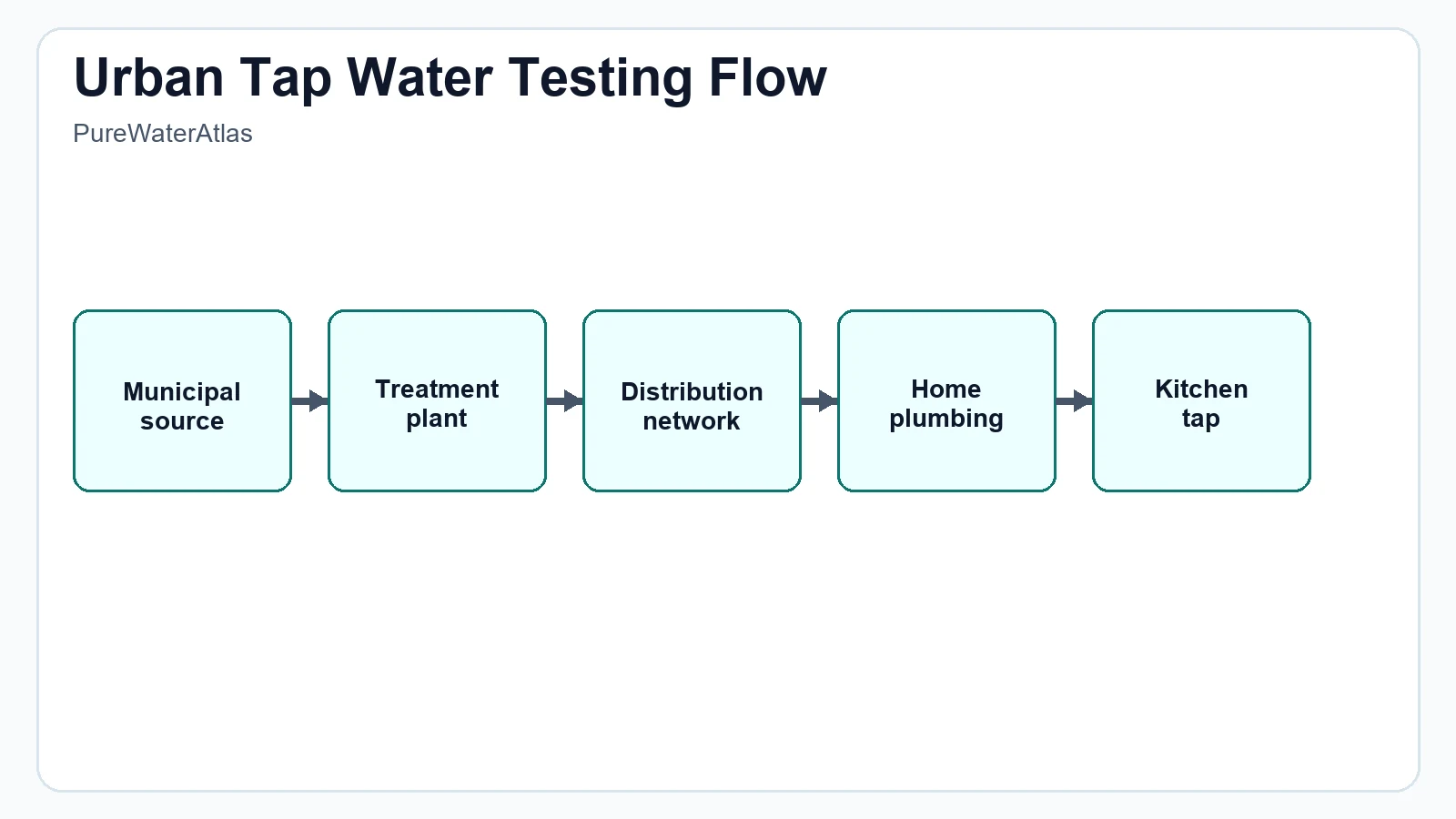
Municipal utilities generally treat source water and monitor compliance with drinking water regulations. However, city water quality at the utility level is not exactly the same as point-of-use water quality inside a residence. Water can change after it leaves the treatment plant. It moves through miles of pipes, storage tanks, service lines, and internal plumbing before it reaches a kitchen glass. In older urban buildings, that last segment of the journey can be especially important.
Urban homes present a unique testing context because they are affected by multiple layers of infrastructure:
- The source water itself, such as rivers, reservoirs, aquifers, or mixed supplies
- The municipal treatment process
- The city distribution network
- The neighborhood service line
- The building plumbing system
- Fixtures, aerators, storage tanks, and in-home treatment devices
This layered pathway is why drinking water urban households use may differ in taste, odor, corrosivity, disinfectant residual, and contaminant profile. A city may deliver compliant water to the service connection, while a building with aging brass fittings, lead-bearing components, corroded galvanized pipes, or poorly maintained storage systems introduces new risks downstream.
If you want a broader overview of household water analysis methods before focusing on city systems, this complete guide to water testing and analysis provides useful background.
Why tap water testing matters in cities
Many urban residents assume that municipal water testing alone makes household testing unnecessary. That assumption is understandable, but incomplete. Public water systems perform essential compliance monitoring, yet they do not test every faucet in every dwelling. Regulatory monitoring is based on a defined sampling framework, not universal point-of-use verification.
Testing matters because several important water quality questions are local:
- Does the water contain lead from the building plumbing or service line?
- Has disinfectant residual dropped enough to allow microbial regrowth in a large building?
- Are copper levels elevated due to corrosive water and pipe deterioration?
- Is water stagnant in infrequently used apartments, offices, or secondary bathrooms?
- Do taste and odor complaints reflect chlorine, chloramine, sulfur compounds, metals, or organic contamination?
- Is an in-home filter actually improving quality or creating maintenance problems?
In urban settings, water safety city concerns often arise from infrastructure complexity. Multi-unit buildings may have pressure zones, rooftop storage, booster pumps, recirculating systems, and sections of plumbing with variable water age. Construction nearby can disturb sediments. Main breaks can alter pressure and turbidity. Seasonal source blending can shift mineral content. Even where contamination is not acute, testing can reveal water characteristics that affect corrosion, filtration needs, and confidence in drinking water.
For a broader public health perspective on safe drinking water, the CDC drinking water resources are a strong reference point.
How city water quality is regulated and why household results can still differ
In the United States, public drinking water systems are regulated primarily under the Safe Drinking Water Act. The U.S. Environmental Protection Agency establishes standards for many contaminants, treatment techniques, and monitoring requirements. Utilities are typically required to issue annual consumer confidence reports, identify source water, report detected contaminants, and maintain treatment performance. The EPA’s overview of ground water and drinking water regulation explains this framework clearly.
Regulation, however, does not eliminate the need for household-specific evaluation. There are several scientific reasons why municipal water testing data may not fully predict what happens inside an urban home:
Distribution system variability
Water chemistry changes as it travels. Chlorine residual can decay, temperature can vary seasonally, and interactions with pipe scales can affect metal release. Long residence time in low-flow zones may alter microbial ecology and disinfectant concentrations.
Premise plumbing effects
Premise plumbing refers to the pipes, fixtures, valves, fittings, and devices inside the property boundary. Corrosion, scale buildup, and incompatible materials can all influence contamination levels. Lead and copper are the best-known examples, but iron, zinc, nickel, and other metals may also be relevant.
Stagnation
Water that sits in pipes for several hours can accumulate dissolved metals and lose disinfectant residual. This is particularly relevant overnight, during vacations, in guest bathrooms, and in partially occupied apartment buildings.
Building-specific storage and treatment
Urban high-rises may use tanks, pressure vessels, or booster systems. Poorly maintained equipment can affect microbiological quality, sediment accumulation, and taste. Point-of-use filters that are not replaced on time can also degrade performance or harbor microbial growth.
Local contamination events
Main breaks, construction, cross-connections, and backflow incidents can create temporary changes that are not reflected in a utility’s routine monitoring data.
If you want to understand how public standards relate to household measurements, this resource on water quality standards explained helps connect regulation with real-world testing.
Key contaminants and indicators in urban water contamination
Not every city has the same risks, and not every test is relevant for every household. Good tap water testing starts with target selection: choosing parameters based on plumbing age, local utility data, building type, health concerns, and observed water issues.
Lead
Lead remains one of the most important reasons to test urban tap water, especially in older neighborhoods and buildings. Lead can enter drinking water from lead service lines, lead solder in older plumbing, brass fixtures, and some faucets. Water that is corrosive or has poor corrosion control may dissolve lead more readily. Lead is particularly concerning because exposure can be harmful even at low levels, especially for infants and children. In the United States, the action level used in utility compliance for lead is 15 parts per billion at the 90th percentile, but household interpretation requires care because a single tap result is not the same as system-wide compliance data.
Copper
Copper commonly enters water from household plumbing. Elevated copper may produce metallic taste, blue-green staining, or fixture discoloration. It can increase when water is acidic or corrosive. First-draw and flushed samples may differ substantially.
Chlorine and chloramine
Disinfectants are added to suppress microbial growth. Their presence often indicates that treated water retains protective residual through the distribution system. Too little residual can permit regrowth; too much may affect taste and odor. Chlorine dissipates relatively quickly, while chloramine tends to be more stable. Some households with kidney dialysis equipment, aquariums, or certain treatment systems need to know which disinfectant the utility uses.
Total coliform and E. coli
Microbiological testing is used to screen for potential contamination pathways. Total coliform bacteria are indicator organisms rather than always direct pathogens. Their presence may suggest intrusion, regrowth, or sanitation problems. E. coli is more specifically associated with fecal contamination and requires prompt attention. In city systems, microbial contamination in household taps is less common than chemical issues, but risks can increase in buildings with storage tanks, plumbing dead legs, chronic stagnation, or pressure disruptions.
Nitrate and nitrite
These are more often associated with agricultural contamination, but testing can still be relevant where source water conditions, blending, or local issues warrant it. Infants are particularly sensitive to high nitrate exposure.
PFAS and other emerging contaminants
Per- and polyfluoroalkyl substances are a growing concern in many public water systems. They generally require laboratory analysis rather than simple home strips. Not every urban household needs routine PFAS testing, but concern may be justified if local utilities report detections or if industrial contamination has affected regional supplies.
Arsenic, chromium, and other trace metals
These depend heavily on local source water geology, industrial history, and treatment efficacy. For most city residents, they are not the first tests to order unless local reports, health department alerts, or known contamination history suggest relevance.
Turbidity, sediment, and particles
Cloudiness, visible particles, or brown water often reflect sediment disturbance, pipe corrosion products, manganese, or iron. While not always a direct toxic hazard, they can indicate infrastructure issues and can interfere with disinfection and fixture performance.
pH, alkalinity, hardness, and conductivity
These are not usually contaminants in the health-risk sense, but they are scientifically important because they shape corrosion, scaling, taste, soap performance, and the behavior of dissolved metals. Hardness can cause mineral deposits. Low alkalinity or low pH may increase corrosivity. Conductivity gives a rough indication of dissolved ionic content.
Volatile organic compounds
Some urban areas with industrial legacies or solvent contamination issues may need testing for volatile organic compounds. These typically require laboratory methods and proper sample handling.
The science behind how contamination reaches urban taps
Understanding contamination pathways helps make testing smarter and more efficient. Urban water contamination rarely comes from a single universal source. Instead, it emerges through interactions among source water, treatment, infrastructure, chemistry, and water use patterns.
Corrosion chemistry
Corrosion is one of the most consequential processes in urban drinking water. It occurs when water chemistry promotes the dissolution of pipe materials or destabilizes protective mineral scales. Factors that influence corrosion include pH, alkalinity, chloride, sulfate, dissolved oxygen, disinfectant type, and temperature. Utilities often use corrosion control measures, but effectiveness can vary across buildings and plumbing configurations.
Lead release is not simply a matter of whether lead-containing materials exist. It also depends on whether scales lining the pipe remain stable. Changes in source water, treatment chemistry, or stagnation conditions can disturb that equilibrium.
Water age and disinfectant decay
Water age refers to how long water remains in the distribution system and building plumbing before use. As water age increases, disinfectant residual tends to decline. Biofilms can develop on pipe surfaces, especially in low-flow areas. In large apartment complexes or office-to-residential conversions, certain branches may experience prolonged stagnation, changing microbial conditions and taste.
Pressure loss and intrusion
Under normal conditions, positive pressure in water mains helps prevent contaminants from entering. If pressure drops significantly during main breaks or repair events, intrusion risk can increase where the system is compromised. Utilities address such incidents with flushing, disinfection, and boil water advisories when necessary, but residents may still choose to test afterward for reassurance.
Pipe scale disturbance
Construction, hydrant use, valve operations, and abrupt flow changes can dislodge accumulated deposits from pipes. These deposits may contain iron, manganese, or adsorbed lead particles. Short-term discoloration events after nearby infrastructure work are common reasons residents seek municipal water testing or independent verification.
When urban households should consider tap water testing
Routine testing is useful, but some situations make it especially important. You should strongly consider testing if any of the following apply:
- Your building was constructed before modern lead restrictions and plumbing upgrades
- You notice metallic, bitter, earthy, musty, or chemical tastes and odors
- The water appears brown, yellow, cloudy, or leaves unusual stains
- Your neighborhood has old service lines or recent water main work
- You live in a multi-unit building with rooftop tanks or internal storage
- Your home has been vacant or lightly used for extended periods
- There has been a boil water advisory or pressure-loss event
- You are pregnant, preparing infant formula, or have children in the home
- You are installing, replacing, or troubleshooting a filter system
- You want to verify whether annual utility reports reflect actual tap conditions
For people just getting started, this guide on how to test drinking water at home is a useful entry point before ordering more advanced analysis.
Tap water testing methods for urban homes
There is no single best testing method for every situation. The right approach depends on the contaminant of concern, required accuracy, budget, and the decisions you need to make from the results.
Home test strips
Test strips are inexpensive and fast. They are useful for screening parameters such as hardness, pH, chlorine, nitrite, nitrate, iron, and sometimes copper. They can be valuable for initial checks, but they generally offer lower precision than laboratory methods. They are not ideal for high-stakes decisions involving lead, PFAS, or microbiological contamination.
Colorimetric reagent kits
These kits use liquids, powders, or tablets that react with specific constituents to produce a color change. They can be more specific than broad strip tests and are widely used for chlorine, alkalinity, and some metals. Quality varies among products, so choosing reputable kits matters.
Digital meters and sensors
Portable devices can measure pH, conductivity, total dissolved solids, and sometimes dissolved oxygen. These are useful for tracking trends and understanding general water chemistry, but they are not substitutes for contaminant-specific testing. A TDS meter, for example, cannot tell you whether lead or bacteria are present.
Certified laboratory analysis
Lab testing is the most reliable option for contaminants of major health concern. Laboratories can analyze metals, bacteria, VOCs, PFAS, and more using validated methods. This is usually the best path for confirming lead, copper, coliform bacteria, or regulated contaminants where precise results matter.
Utility-provided testing programs
Some cities or water utilities offer free or subsidized testing for lead or other concerns. These programs can be useful, although the scope may be limited and turnaround times may vary.
Professional sampling and inspection
In complex buildings, especially where contamination may be intermittent or plumbing-related, a professional water consultant or environmental health specialist may be warranted. This can help with sampling design, chain of custody, and interpretation across multiple fixtures.
If you are comparing products for preliminary screening, the roundup of best water testing kits can help narrow the options.
How to collect a representative water sample
Sampling technique strongly affects tap water testing results. A poorly collected sample may misrepresent true exposure or obscure the source of contamination. Urban households should think about the question they are trying to answer before collecting water.
First-draw samples
A first-draw sample is taken from water that has remained stagnant in plumbing for a defined period, often at least 6 hours. This type of sample is useful for detecting metals such as lead and copper that accumulate during stagnation. It reflects potential exposure from the water people often drink first thing in the morning.
Flushed samples
A flushed sample is taken after letting water run for a specified time. This can help distinguish contamination from nearby plumbing versus upstream service lines or distribution water. If lead is high in first-draw water but much lower after flushing, premise plumbing is strongly implicated.
Sequential sampling
Sequential sampling involves collecting several consecutive samples after stagnation. This method can help identify whether contamination is likely coming from the faucet, indoor plumbing, or service line. It is especially helpful in older urban buildings with uncertain pipe materials.
Microbiological sample collection
Bacteria sampling requires strict technique. Use sterile bottles, avoid touching bottle rims or caps, and follow lab instructions exactly. Aerators may need to be removed, and taps may be disinfected depending on the protocol. Timing and temperature control are important because bacteria results can change if samples sit too long before analysis.
General best practices
- Read all instructions before sampling
- Use only the provided containers for laboratory tests
- Label samples immediately
- Record the date, time, location, and whether the sample was first-draw or flushed
- Do not sample after unusual recent plumbing disturbances unless that is specifically what you want to assess
- Ship or deliver time-sensitive samples promptly
What a practical urban testing plan looks like
Many households benefit from a tiered approach rather than testing everything at once. A scientifically reasonable urban plan often includes the following steps.
Step 1: Review your utility’s water quality report
Start with the consumer confidence report or local utility dashboard. Identify disinfectant type, source water, any detected contaminants, treatment notes, and lead service line information if available.
Step 2: Consider your building age and plumbing materials
Older buildings raise concern for lead, copper, and iron issues. Recent renovations do not always eliminate service line risks, so internal upgrades should not be assumed to solve every problem.
Step 3: Screen basic parameters
Home tests for pH, hardness, chlorine residual, and general observations of color, taste, and odor can help frame next steps.
Step 4: Prioritize health-relevant contaminants
For many urban homes, lead is the top priority, followed by copper and bacteria if there are plumbing, storage, or pressure concerns.
Step 5: Confirm with a laboratory if needed
Any concerning screening result, or any high-stakes question involving child exposure, should be followed with a certified laboratory test.
Step 6: Retest after interventions
If you flush lines, replace fixtures, install filters, or complete plumbing work, test again to verify improvement.
Households wanting broader educational resources can also browse the water testing category for related guidance.
How to interpret results without overreacting or dismissing them
Interpretation is where many people get stuck. A result is only meaningful when considered in context: the contaminant, the sampling method, the units, the laboratory method, and the intended use of the water.
Know the units
Water results may be reported in mg/L, µg/L, ppm, or ppb. For dilute aqueous solutions, 1 mg/L is roughly equivalent to 1 ppm, and 1 µg/L is roughly equivalent to 1 ppb. Confusing these units can lead to serious misunderstanding.
Compare to the right benchmark
Not all benchmarks have the same meaning. Some are enforceable maximum contaminant levels for utilities. Others are action levels, treatment technique triggers, health advisories, or aesthetic guidelines related to taste and staining rather than direct health risk.
Remember that a single sample is a snapshot
Tap water can vary by time of day, stagnation duration, season, and use pattern. If a result is borderline or surprising, repeat sampling may be useful.
Separate aesthetic concerns from health concerns
Hardness, chlorine taste, and iron staining matter to consumers, but they do not carry the same risk profile as lead, E. coli, or high nitrate. Both categories matter, but they should be interpreted differently.
Use building context
If the utility reports good compliance and your flushed water is acceptable but first-draw lead is elevated, the problem likely lies in local plumbing. If multiple units in a building show similar patterns, a shared infrastructure issue becomes more likely.
For a deeper walk-through of lab reports and common units, this article on understanding water test results is especially helpful.
Health and safety implications of common findings
Tap water testing has practical value because different findings suggest different response priorities.
Lead detection
If lead is detected at elevated levels, especially in water used for drinking or infant formula, exposure reduction should be prioritized promptly. Short-term risk management may include using an appropriate certified filter, consuming alternative water for drinking and cooking, and flushing strategies where recommended. Long-term control often requires plumbing or service line replacement. Because lead exposure risk depends on concentration and frequency, consult relevant public health guidance and your utility for next steps.
Bacterial contamination
If E. coli is detected, immediate action is warranted. This may include avoiding consumption until the issue is clarified and seeking guidance from the utility, health department, or laboratory. Total coliform positives without E. coli still deserve investigation, especially in buildings with storage tanks or plumbing maintenance issues.
Excess copper
Copper above guidance values may indicate corrosive conditions or plumbing contribution. It can also signal the need to adjust fixture use patterns, flushing, or treatment approaches.
Low disinfectant residual
Low or absent residual in a building with long water age can suggest vulnerability to microbial regrowth, though residual alone is not a direct measure of contamination. It is an operational clue rather than a diagnosis.
Aesthetic issues
Even when health risk is low, taste, odor, and discoloration affect trust and water consumption behavior. If unpleasant water leads residents to avoid tap water entirely, they may rely on more expensive or less regulated alternatives. So-called minor water quality issues are not trivial from a public health communication perspective.
The World Health Organization’s drinking water fact sheet gives a concise global summary of health relevance and safe water principles.
What to do if your urban tap water test shows a problem
The right response depends on what was found, how high it was, and whether the issue appears to originate in the utility system or the building.
Contact the right party
If results suggest system-wide issues, contact the water utility. If the pattern points to building plumbing, contact the landlord, building management, or a licensed plumber familiar with potable water systems.
Reduce exposure while investigating
Use cold water for drinking and cooking, since hot water can dissolve metals more readily from plumbing. Flush stagnant lines where appropriate. If needed, use bottled water temporarily or a filter certified for the target contaminant.
Confirm and localize
Repeat testing using first-draw, flushed, and possibly sequential samples to identify where the contamination is entering. This is particularly important for lead and copper.
Inspect fixtures and plumbing
Faucets, aerators, flexible connectors, old valves, and sections of galvanized pipe can all contribute to water quality problems. Visual plumbing assessment may reveal likely sources.
Maintain treatment devices correctly
If you use activated carbon filters, reverse osmosis systems, or specialty lead-removal devices, follow replacement intervals strictly. Poorly maintained filters can underperform or create microbial concerns.
Special considerations for apartments, condos, and older city buildings
Urban residents often do not control the full plumbing system, which makes household water testing both more important and more complicated.
Apartment renters
Renters may only be able to test at the faucet, not the service line or building entry point. Even so, point-of-use results still matter because they reflect actual exposure. Keep records of all test results and communications with property management.
Condominium buildings
Shared plumbing infrastructure means a problem in one unit may reflect a broader building issue. Coordinated testing across several units can reveal whether contamination is isolated or systemic.
Older buildings
Historic buildings may contain mixed plumbing materials installed over decades. Renovations often occur in stages, creating unpredictable water quality patterns. Lead solder, galvanized pipe with accumulated lead deposits, and outdated fittings deserve attention.
Large buildings with storage tanks
Where water is stored before distribution within the building, maintenance quality is crucial. Sediment, temperature conditions, and insufficient turnover can all influence water quality.
How often should urban homes test tap water?
There is no universal schedule, but several practical intervals are reasonable.
- Annually for households with known plumbing risk factors or prior issues
- After plumbing repairs, renovations, or fixture replacement
- After long vacancies or low-occupancy periods
- After local water main breaks, boil advisories, or unusual discoloration events
- Any time taste, odor, or appearance changes suddenly
- Before and after installing a new water treatment device
For most urban homes, annual or risk-triggered testing is more practical than frequent random testing. The goal is not to test constantly, but to test strategically and interpret the data correctly.
FAQ
Is city tap water automatically safe because it is treated by the municipality?
Not automatically at every faucet. Municipal treatment and compliance monitoring are essential, but water can change in distribution systems, service lines, and building plumbing. Household tap water testing helps verify point-of-use quality.
What is the most important contaminant for urban homes to test first?
In many older cities and buildings, lead is the first priority, especially where children or infants are present. Copper and bacteria may also be important depending on plumbing and storage conditions.
Are home water testing kits accurate enough?
They are useful for screening some parameters, but they are not equally reliable for all contaminants. For lead, bacteria, PFAS, or any issue with significant health implications, laboratory testing is the better choice.
Should I test hot water too?
Usually, drinking water assessments focus on cold water because that is what should be used for drinking and cooking. Hot water can pick up more metals from plumbing, but it is generally not the primary sampling target for potability decisions.
How can I tell whether contamination comes from my building or the city?
Comparing first-draw and flushed samples, checking multiple fixtures, and reviewing neighborhood or utility information can help identify the source. Sequential sampling is especially useful for metals such as lead.
Conclusion
Tap water testing gives urban households something more valuable than speculation: direct evidence about the water they actually drink. Even in well-regulated municipal systems, city water quality at the treatment plant is not always identical to water safety at the kitchen tap. Plumbing materials, stagnation, storage, corrosion, and local infrastructure events can all shape urban water contamination in ways that matter for health, confidence, and daily use. A smart testing strategy begins with local context, targets the most relevant contaminants, uses proper sampling methods, and interprets results against the right standards. For homeowners and renters alike, that approach turns municipal water testing data into practical household protection and better-informed decisions about drinking water urban life depends on.
Featured image: Photo by Sudarson Alwin on Pexels.



Read the full guide: Water Testing Guide
Explore more in this category: Water Testing Articles