
Introduction
Concerns about pfas in drinking water causes and sources have grown rapidly as researchers, regulators, and communities learn more about these highly persistent chemicals. PFAS, short for per- and polyfluoroalkyl substances, are a large group of synthetic compounds used for decades in manufacturing, industrial processes, and consumer products. Their strong carbon-fluorine bonds make them resistant to heat, oil, grease, and water, which is why they became so widely used. That same durability, however, also means they can persist in the environment for years and move through soil, surface water, groundwater, and eventually drinking water supplies.
Understanding where PFAS come from and how they enter water systems is essential for homeowners, public health professionals, water utilities, and policymakers. Unlike some contaminants that appear only in certain industrial areas, PFAS contamination can affect rural communities, suburbs, and major cities alike. It may be linked to firefighting foam use, manufacturing discharge, landfill leachate, wastewater treatment residuals, or even long-term accumulation from multiple smaller sources. In many cases, contamination is not obvious until targeted testing reveals it.
This article explains the science behind PFAS, the most important pfas in drinking water common sources, the main pfas in drinking water risk factors, and the practical steps involved in pfas in drinking water detection and pfas in drinking water prevention. It also explores how contamination can contribute to pfas in drinking water household exposure and why regulations continue to evolve. For broader context on pollution pathways and related contaminants, readers may also find useful background in water contamination resources and wider discussions in water science.
What It Is
PFAS refers not to a single chemical but to a broad family of thousands of man-made substances. Some of the best-known PFAS include PFOA, PFOS, PFHxS, PFNA, and GenX chemicals. These compounds were developed because they perform extremely well in harsh conditions. They can resist moisture, withstand high temperatures, and repel oils and stains. As a result, they have been used in products such as nonstick cookware, stain-resistant fabrics, food packaging, metal plating materials, cleaning agents, and firefighting foams.
The reason PFAS are so important in drinking water discussions is their persistence. They are often called “forever chemicals” because they do not break down easily in the environment. Once released, many PFAS can travel long distances. Rainfall can move them through soil. Surface runoff can carry them to streams and lakes. Infiltration can bring them into aquifers. Wastewater systems can redistribute them rather than fully destroy them. Over time, these pathways can lead to contamination of private wells and municipal water supplies.
Another challenge is that different PFAS behave differently. Some are more mobile in water, some bind more strongly to soils or sediments, and some are more likely to accumulate in living organisms. Short-chain PFAS may move more readily through groundwater, while some long-chain PFAS may accumulate more in the body. This variation makes risk assessment and treatment more complex than dealing with a single pollutant.
Exposure can occur through more than one route. Drinking water is one of the most significant pathways in contaminated areas, but it is not the only one. People may also encounter PFAS in food, household dust, consumer products, or occupational settings. Even so, drinking water remains a major concern because it can lead to repeated daily exposure over long periods. A more comprehensive overview is available in this complete guide to PFAS in drinking water.
Main Causes or Sources
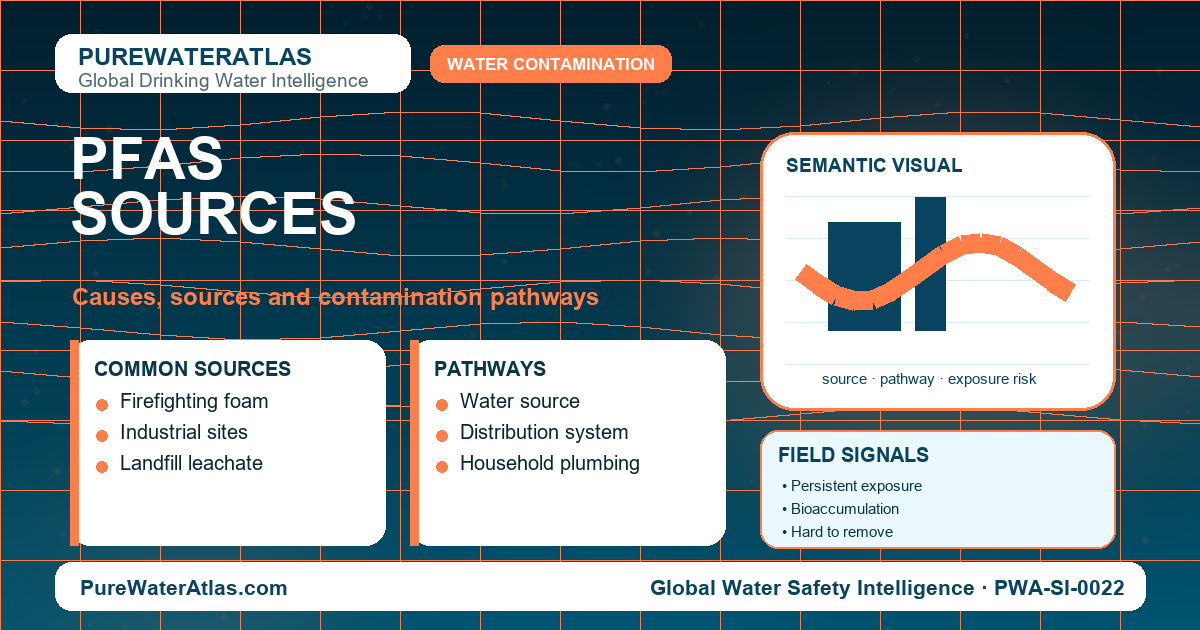
When examining pfas in drinking water causes and sources, it is helpful to think in terms of both direct releases and indirect environmental pathways. PFAS rarely appear in water by accident alone. In most cases, they enter the environment through specific human activities and then migrate into water systems.
Industrial Manufacturing and Processing
Manufacturing facilities are among the most significant pfas in drinking water common sources. PFAS have been used in chemical production, metal finishing, semiconductor fabrication, textile treatment, paper coating, and plastics manufacturing. Facilities may discharge PFAS into air, wastewater, or land disposal systems. Even when direct discharge is controlled, historical contamination can remain in soil and groundwater for years.
Industrial sites can affect nearby rivers, lakes, and aquifers in several ways:
- Direct discharge of industrial wastewater containing PFAS
- Leaks or spills from storage tanks, pipelines, or process equipment
- Air emissions that later deposit onto soil and water surfaces
- Improper disposal of PFAS-containing waste materials
In some communities, contamination originates from factories that no longer operate, which makes historical site investigation especially important.
Firefighting Foam Use
Aqueous film-forming foam, commonly known as AFFF, has been one of the most widely recognized sources of PFAS contamination. This foam has been used extensively at military bases, airports, firefighting training centers, and industrial facilities where flammable liquid fires are a concern. Many legacy foams contained high concentrations of PFAS because these chemicals helped smother fuel fires quickly.
Repeated training exercises or emergency foam releases can contaminate surrounding land. Once foam reaches the ground, PFAS can seep into soil and migrate to groundwater. This is one reason communities near airports and defense facilities are often considered high-priority areas for investigation.
Landfills and Waste Disposal Sites
Landfills are another important source. Many PFAS-containing consumer products eventually enter municipal solid waste streams. Over time, rainwater percolating through waste can create leachate, a liquid that may contain PFAS. If leachate is not fully contained or treated effectively, contamination can reach surrounding water bodies or wastewater treatment plants.
This source is often overlooked because the contamination does not come from a single industrial discharge point. Instead, it results from the gradual accumulation of many discarded materials, including treated textiles, food packaging, carpets, upholstery, and industrial waste.
Wastewater Treatment Plants and Biosolids
Conventional wastewater treatment plants are generally not designed to destroy PFAS. Instead, they may transfer PFAS between water and solid residuals. Effluent discharged into rivers can carry PFAS downstream, while sewage sludge or biosolids applied to land can introduce PFAS into soils. From there, the chemicals may migrate into groundwater or be carried by runoff into surface water supplies.
This creates a cycle in which PFAS from households, commerce, and industry enter sewer systems, pass through treatment processes, and are redistributed into the environment rather than eliminated.
Agricultural Pathways
Agricultural contamination may occur when biosolids, compost, irrigation water, or soil amendments contain PFAS. Farms can be affected if contaminated wastewater residuals are applied to fields over time. In such cases, PFAS may move into groundwater, nearby streams, and in some circumstances food-producing systems. Private wells in agricultural areas may be vulnerable when these practices occur near shallow aquifers.
Consumer Product and Household Contributions
Although industrial and institutional releases are often the largest drivers, smaller diffuse sources also matter. PFAS have been present in stain-resistant carpets, water-repellent clothing, food wrappers, some cosmetics, cleaning products, and other household items. These uses may contribute to indoor dust and wastewater contamination. While a single home is unlikely to create major water pollution alone, the combined contribution from millions of households can add to the environmental burden.
Contaminated Soil and Groundwater from Historical Use
Many PFAS problems are linked to legacy contamination. Because these substances persist for so long, a release from years or even decades ago may still be affecting groundwater today. Soil can act as a long-term reservoir. As water moves through the subsurface, PFAS can slowly leach into aquifers and continue contaminating wells long after the original source has stopped operating.
Surface Water to Drinking Water Transfer
Communities that draw drinking water from rivers and reservoirs may be vulnerable if PFAS are present upstream. Industrial discharge, landfill leachate, airport runoff, and wastewater effluent can all contribute to surface water contamination. If treatment systems are not designed specifically for PFAS removal, these compounds may pass into finished drinking water.
These pathways show why identifying pfas in drinking water common sources requires a watershed-scale perspective. The issue is often not one isolated event but a network of inputs across the landscape.
Health and Safety Implications
The reason PFAS contamination receives so much attention is not simply that these chemicals are widespread, but that prolonged exposure may be associated with meaningful health concerns. Research on all PFAS is still developing, and individual chemicals can differ in toxicity, persistence, and bioaccumulation. However, studies of several well-known PFAS have linked exposure to a range of health effects.
Potential concerns discussed in public health literature include:
- Changes in cholesterol levels
- Liver function effects
- Immune system impacts, including reduced vaccine response in some studies
- Developmental and reproductive effects
- Increased risk of certain cancers for some PFAS under certain exposure conditions
- Thyroid and hormonal disruption concerns
Much depends on the amount, duration, and timing of exposure. Drinking contaminated water over many years is especially important because it can lead to cumulative intake. PFAS can remain in the human body for varying lengths of time, and some are eliminated slowly. This makes chronic low-level exposure a central issue in risk evaluation.
Certain populations may face higher concern. Infants fed formula mixed with contaminated water, pregnant individuals, people with preexisting health conditions, and communities with long-term exposure histories may need especially careful assessment. That does not mean every exposure leads to illness, but it does explain why even low concentrations in drinking water are treated seriously by health agencies.
From a safety standpoint, one challenge is that PFAS contamination usually has no obvious taste, color, or odor. Water may appear completely normal while still containing measurable concentrations. This is why public awareness and systematic monitoring are so important. Readers interested in the medical and toxicological side can explore more detail in PFAS in drinking water health effects and risks.
Key Risk Factors for Exposure
Several pfas in drinking water risk factors increase the likelihood that a household or community may be affected:
- Living near an airport, military installation, firefighting training area, or industrial facility
- Using a private well in an area with limited water quality oversight
- Residing near landfills, wastewater discharge points, or biosolids application sites
- Relying on groundwater in regions with known historical PFAS use
- Receiving water from surface sources downstream of industrial or municipal discharges
Households may also have additional vulnerability if they use untreated well water for drinking, cooking, infant formula preparation, or garden irrigation. This is where pfas in drinking water household exposure becomes especially relevant, since repeated daily uses can increase cumulative intake.
Testing and Detection
PFAS in drinking water detection is more complicated than routine testing for contaminants such as hardness, nitrate, or bacteria. Specialized laboratory methods are required because PFAS are measured at very low concentrations, often in parts per trillion. Accurate sampling also matters because PFAS can be unintentionally introduced during collection if inappropriate materials or field practices are used.
How Water Is Tested
Testing generally involves collecting samples in PFAS-free containers and analyzing them using advanced methods such as liquid chromatography paired with mass spectrometry. Laboratories look for a panel of targeted PFAS compounds. The exact number of analytes varies by method, regulatory program, and laboratory capability.
Key considerations in testing include:
- Whether the water source is a private well, municipal supply, or treated tap water
- The specific PFAS compounds included in the test panel
- The laboratory’s reporting limits and accreditation status
- Whether the sample represents raw source water or finished drinking water
Why Detection Can Be Difficult
PFAS contamination is not always evenly distributed. Concentrations can vary by season, pumping conditions, rainfall, water source blending, and treatment performance. One sample may not tell the full story. In addition, some newer or less commonly studied PFAS may not be included in standard analytical panels, which means contamination can sometimes be undercharacterized if testing is too narrow.
Another challenge is interpretation. A lab report may contain several PFAS names, detection limits, and concentration values that are not easy for the average person to understand. Comparing results with current health advisories or legal standards is essential, and because regulations change, old interpretations may no longer be current.
Municipal Monitoring vs. Private Well Testing
Public water systems are increasingly required in many jurisdictions to monitor PFAS and report findings. Private well owners, however, often bear the responsibility for arranging their own testing. This creates a gap in protection, especially in rural areas. If a home is near a known source, private well sampling should be considered even if the water looks and tastes normal.
Homeowners often ask whether at-home test strips are enough. In most cases, they are not a substitute for certified laboratory analysis. Because PFAS are present at extremely low concentrations and involve multiple chemicals, reliable results usually require professional methods. More on this topic can be found in PFAS in drinking water testing and detection methods.
What to Do If PFAS Is Detected
If testing shows PFAS in water, the next steps depend on the concentration levels, the chemicals involved, and the water source. For municipal systems, utilities may increase monitoring, notify customers, install treatment, or change source water operations. For private wells, owners may need confirmatory testing, temporary alternative water, point-of-use treatment, or long-term source replacement.
It is also important to investigate whether contamination is isolated to one well or part of a broader area-wide problem. Mapping nearby industrial sites, fire-training locations, landfill operations, and historical waste handling practices can help clarify the likely source.
Prevention and Treatment
Pfas in drinking water prevention requires a combination of source control, monitoring, infrastructure investment, and household action. Because PFAS are difficult to destroy once widespread contamination occurs, preventing releases is generally more effective and less costly than cleaning them up later.
Source Prevention Strategies
The most effective long-term approach is reducing or eliminating avoidable PFAS releases into the environment. This can include:
- Restricting nonessential PFAS uses in products and industrial processes
- Replacing legacy firefighting foams with safer alternatives where possible
- Improving industrial waste management and spill prevention
- Strengthening landfill leachate control and treatment
- Monitoring biosolids and wastewater residuals before land application
These measures help stop new contamination from entering the water cycle. Prevention is especially important because once PFAS reaches deep groundwater or large watersheds, remediation can be technically difficult and expensive.
Municipal Water Treatment Options
Water utilities may use several treatment technologies to reduce PFAS concentrations. Common approaches include granular activated carbon, ion exchange resins, and high-pressure membrane systems such as reverse osmosis. Each has strengths and limitations depending on the PFAS profile, water chemistry, operating costs, and waste disposal requirements.
- Granular activated carbon: Often effective for certain long-chain PFAS, though performance varies and media must be replaced or regenerated.
- Ion exchange: Can be highly effective across a range of PFAS, but costs and residual handling are considerations.
- Reverse osmosis: Very effective at removing many PFAS, though energy use, concentrate disposal, and system complexity can be significant.
No treatment system is maintenance-free. Long-term effectiveness depends on proper design, monitoring, and timely replacement of treatment media or membranes.
Household Protection Measures
For individual homes, especially those using private wells, reducing pfas in drinking water household exposure may involve point-of-use or point-of-entry treatment. Reverse osmosis units and certain activated carbon filters are among the most commonly recommended options, but consumers should verify that a product is certified or specifically tested for PFAS reduction.
Useful household steps may include:
- Testing water through a certified laboratory if contamination is suspected
- Using a properly selected and maintained treatment system
- Following manufacturer schedules for cartridge or membrane replacement
- Using treated or alternative water for drinking, cooking, and infant formula if needed
- Reviewing local advisories and utility reports regularly
It is important to note that boiling water does not remove PFAS. In fact, evaporation can potentially concentrate contaminants if water volume decreases. This is a common point of confusion.
Community-Level Prevention
Communities can reduce risk by identifying vulnerable areas before contamination becomes severe. This includes monitoring near known sources, protecting recharge zones, updating emergency response practices involving firefighting foam, and ensuring transparency in public reporting. Regional planning matters because contamination can travel across municipal boundaries and affect downstream users.
Broader international and regional perspectives on water quality trends can also be explored through global water quality discussions.
Common Misconceptions
Misinformation can make PFAS issues harder to understand and manage. Several misconceptions appear frequently in public discussions.
“If the water looks clean, it is safe.”
This is false. PFAS usually cannot be seen, smelled, or tasted at levels of concern. Clear water can still contain measurable contamination.
“Only communities near factories have PFAS problems.”
Industrial facilities are important sources, but they are not the only ones. Airports, military bases, landfills, wastewater discharges, and contaminated biosolids can all contribute.
“All filters remove PFAS.”
Not all household filters are effective. Basic sediment filters and many standard pitcher filters may not remove PFAS sufficiently. Treatment should be selected based on verified performance data.
“Boiling water solves the problem.”
Boiling does not destroy most PFAS and is not a reliable treatment method.
“PFAS is one chemical, so one rule covers everything.”
PFAS is a large class of chemicals. Different compounds can have different properties, toxicity profiles, and treatment behavior. Regulations and testing programs may cover only a subset.
“If contamination came from years ago, the danger is over.”
Because PFAS are persistent, old releases can continue affecting groundwater and drinking water long after the original source has stopped.
Regulations and Standards
Regulation of PFAS is evolving quickly. Historically, many countries had limited enforceable standards, relying instead on health advisories or guidance values. As evidence grew and detection improved, governments began setting more formal limits for specific PFAS in drinking water.
Regulatory frameworks vary widely by jurisdiction. Some focus on a few well-studied compounds such as PFOA and PFOS, while others regulate a broader group. Standards may apply to public water systems, industrial discharge, site cleanup, product content, or waste management. This means a community may be affected by multiple overlapping rules from environmental, public health, and consumer protection agencies.
Important themes in modern PFAS regulation include:
- Lower allowable concentrations in drinking water based on updated toxicology
- Expanded monitoring requirements for public water systems
- Site investigation and remediation obligations for contaminated properties
- Restrictions on PFAS use in firefighting foam and consumer products
- Improved reporting and public notification requirements
One challenge is that science and regulation do not move at the same speed. Health research may suggest concern before enforceable rules are fully adopted. As a result, some communities act based on precautionary guidance even when legal standards are still developing.
For households and local officials, the practical lesson is simple: always check the most current state, national, or regional guidance rather than relying on outdated thresholds. Regulatory change is likely to continue as more data becomes available and more PFAS compounds are studied.
Conclusion
Understanding pfas in drinking water causes and sources is the foundation for effective action. These chemicals enter water through a range of pathways, including industrial activity, firefighting foam use, landfill leachate, wastewater discharges, biosolids application, and long-term legacy contamination. Because PFAS are persistent and often invisible in water, contamination can remain undetected for years unless targeted testing is performed.
The issue is not only environmental but also public health related. Ongoing exposure through contaminated drinking water can contribute to long-term health concerns, which is why pfas in drinking water detection, monitoring, and clear communication are so important. Identifying pfas in drinking water common sources and evaluating local pfas in drinking water risk factors can help utilities, regulators, and households make informed decisions.
At the same time, progress is possible. Improved testing methods, stronger standards, source control measures, and better treatment technologies are helping communities reduce contamination and limit pfas in drinking water household exposure. The most effective strategy combines prevention with ongoing vigilance: stop new releases where possible, test where risk exists, and apply appropriate treatment when contamination is found.
For readers continuing their research, additional background is available in the complete guide to PFAS in drinking water, along with related information on water contamination and water science. As regulations and scientific understanding continue to evolve, staying informed will remain one of the best tools for protecting drinking water quality.
Read the full guide: Water Contamination Guide
Explore more in this category: Water Contamination Articles