
Introduction
Concerns about PFAS in public water systems and private wells have grown rapidly in recent years, and for good reason. Per- and polyfluoroalkyl substances, commonly called PFAS, are a large group of synthetic chemicals valued for their resistance to heat, water, grease, and stains. That same chemical stability, however, is what makes them so persistent in the environment and difficult to remove from water supplies. As more communities test for these compounds, many households are now searching for practical answers about pfas in drinking water best filters, treatment performance, and long-term maintenance.
This article explains what PFAS are, where they come from, why they matter, and how different treatment options compare. It also looks closely at pfas in drinking water reverse osmosis systems, pfas in drinking water carbon filters, and the key factors involved in a useful pfas in drinking water treatment comparison. Whether you are evaluating a whole-house system, a point-of-use unit at the kitchen sink, or a pitcher-style filter, the goal is the same: reduce exposure with a solution that matches your water quality, budget, and maintenance capacity.
PFAS treatment should never be approached as a one-size-fits-all issue. Water chemistry varies, contamination levels differ, and not all filters are designed or certified for the same compounds. Consumers often benefit from understanding broader water quality topics as well, including other sources of contamination and how treatment technologies work together. For related reading, see water contamination, the complete guide to PFAS in drinking water, and background resources in water science.
What It Is
PFAS refers to a broad family of human-made fluorinated chemicals. They have been used for decades in industrial processes and consumer products such as nonstick cookware, stain-resistant fabrics, food packaging, fire-fighting foams, metal plating operations, and certain manufacturing applications. Their carbon-fluorine bonds are among the strongest in chemistry, which means they do not easily break down in the environment.
Because they persist for so long, PFAS are often called “forever chemicals.” This term is not a formal scientific classification, but it accurately reflects the challenge they present in water treatment and environmental cleanup. Once released into soil, groundwater, surface water, or wastewater systems, PFAS can travel and remain detectable for years. Some compounds in this group are more mobile than others, and some are harder to remove than others.
Not all PFAS are identical. Historically, some of the most studied compounds have included PFOA and PFOS, but many other PFAS now draw concern, including short-chain alternatives introduced to replace older formulations. As regulations and testing methods improve, water providers and homeowners are learning that PFAS contamination may involve a mixture of compounds rather than a single chemical. This is important because treatment performance can depend on chain length, molecular structure, contact time, and competing contaminants in the water.
From a household perspective, PFAS become a drinking water issue when they enter the source water used by a public utility or private well. Water may look, taste, and smell normal even when PFAS are present. Unlike sediment or chlorine odor, PFAS contamination is generally invisible without lab testing. That is why education, proper testing, and technology selection are so important.
Main Causes or Sources
PFAS contamination in drinking water usually begins with releases into the environment. These chemicals can reach groundwater, rivers, reservoirs, and wells through several pathways. Understanding those sources helps households, communities, and regulators identify risk and prioritize treatment.
Industrial and manufacturing releases
Facilities that make or use PFAS-containing materials may discharge waste streams or emit pollutants that later settle onto land and water. Historical manufacturing activities have been linked to some of the most significant PFAS contamination sites. Even when operations have changed, legacy contamination can remain in soils and aquifers for many years.
Fire-fighting foam use
Aqueous film-forming foam, often called AFFF, has been widely used at military installations, airports, training centers, and industrial fire response sites. Certain foam formulations have been major sources of PFAS contamination because repeated use during training and emergency response can allow chemicals to infiltrate the ground and migrate into groundwater.
Landfills and waste disposal
Consumer products containing PFAS often end up in landfills. Over time, landfill leachate can carry PFAS into surrounding water systems if not effectively managed. Wastewater treatment plants can also receive PFAS from industrial discharges and household waste streams, and conventional treatment does not reliably destroy or remove all PFAS compounds.
Biosolids and land application
Some wastewater byproducts used as fertilizers or soil amendments may contain PFAS. If these materials are applied to agricultural land, the chemicals can potentially move into soil, crops, or groundwater depending on conditions.
Household products and diffuse contamination
Although major contamination events are often associated with industrial or military sites, diffuse sources also matter. PFAS have been used in textiles, carpets, cosmetics, food wrappers, and cleaning products. Individually, these may seem minor, but collectively they contribute to environmental loading over time.
For a deeper look at pathways and contamination origins, readers can explore PFAS causes and sources. Broader contamination patterns across drinking water systems are also discussed in water contamination.
Health and Safety Implications
PFAS have become a major public health concern because some compounds are associated with adverse effects in people and animals. Research is ongoing, and not every PFAS has been studied equally, but the evidence for concern is strong enough that many public health agencies recommend minimizing exposure where possible.
Potential health concerns associated with PFAS exposure may include effects on cholesterol levels, liver function, immune response, thyroid function, reproductive health, and developmental outcomes. Some studies have also examined associations with certain cancers. Importantly, health risk depends on multiple factors, including the specific PFAS involved, the level in water, duration of exposure, age, and individual health status.
One reason PFAS raise concern is bioaccumulation. Some compounds can remain in the human body for long periods, meaning repeated low-level exposure may contribute to an increasing body burden over time. This is especially relevant for communities exposed through drinking water over months or years.
Infants, young children, pregnant individuals, and people with existing health vulnerabilities are often considered priority populations when evaluating drinking water risk. Formula prepared with contaminated water, for example, can increase exposure in infants. In these cases, selecting the pfas in drinking water best filters is not only a matter of convenience but a meaningful risk-reduction decision.
Although drinking water is only one exposure route, it is often one of the most controllable. When PFAS are identified in a supply, a properly selected and maintained filtration system can significantly reduce exposure. However, the key phrase is “properly selected and maintained.” A low-cost filter without certification or adequate replacement schedules may provide a false sense of security.
For additional discussion of research findings and risk context, see PFAS health effects and risks. Readers interested in water-related biological and environmental interactions may also find water microbiology useful for broader context, even though PFAS themselves are chemical rather than microbial contaminants.
Testing and Detection
Testing is the foundation of any PFAS treatment plan. Because PFAS cannot be detected by taste, smell, or appearance, laboratory analysis is necessary to confirm whether they are present and at what levels. Homeowners should avoid guessing based on rumor alone, but they should also take concerns seriously if they live near known sources such as airports, military bases, industrial facilities, or landfills.
Public water systems
If you are served by a municipal utility, start by reviewing the utility’s water quality reports and any PFAS-specific notices. Some systems now publish PFAS data separately from standard annual reports. Utilities may test for a list of regulated or advisory compounds and report concentrations in parts per trillion.
Private wells
Private well owners typically bear responsibility for testing their own water. If your property is in a potentially affected area, contact your state environmental or health agency for recommendations on PFAS sampling. Use a laboratory experienced in PFAS analysis because sample collection, handling, and interpretation require special care to avoid contamination and ensure reliable results.
Interpreting test results
PFAS results may list individual compounds or combined values depending on the reporting framework. Interpretation depends on current federal and state standards, which continue to evolve. A result that appears numerically small may still be important because PFAS are regulated or advised at very low concentrations.
Why test before buying a system
A test result helps you decide whether you need treatment at all, where to install it, and which technology is most appropriate. This is a crucial part of any pfas in drinking water buying guide. For example:
- If PFAS are present only at the tap used for drinking and cooking, a point-of-use system may be sufficient.
- If contamination affects the entire household supply and there are concerns beyond ingestion, a whole-house approach may be considered, though it is often more expensive and complex.
- If other contaminants are present, such as nitrate, arsenic, hardness, or high organic matter, these may affect treatment design and maintenance needs.
Post-installation verification
Testing should not stop once a filter is installed. Follow-up sampling confirms that the system is performing as expected. Because filter media eventually becomes exhausted, periodic retesting is an important part of pfas in drinking water filter maintenance. Without verification, homeowners may not know when removal efficiency has declined.
Prevention and Treatment
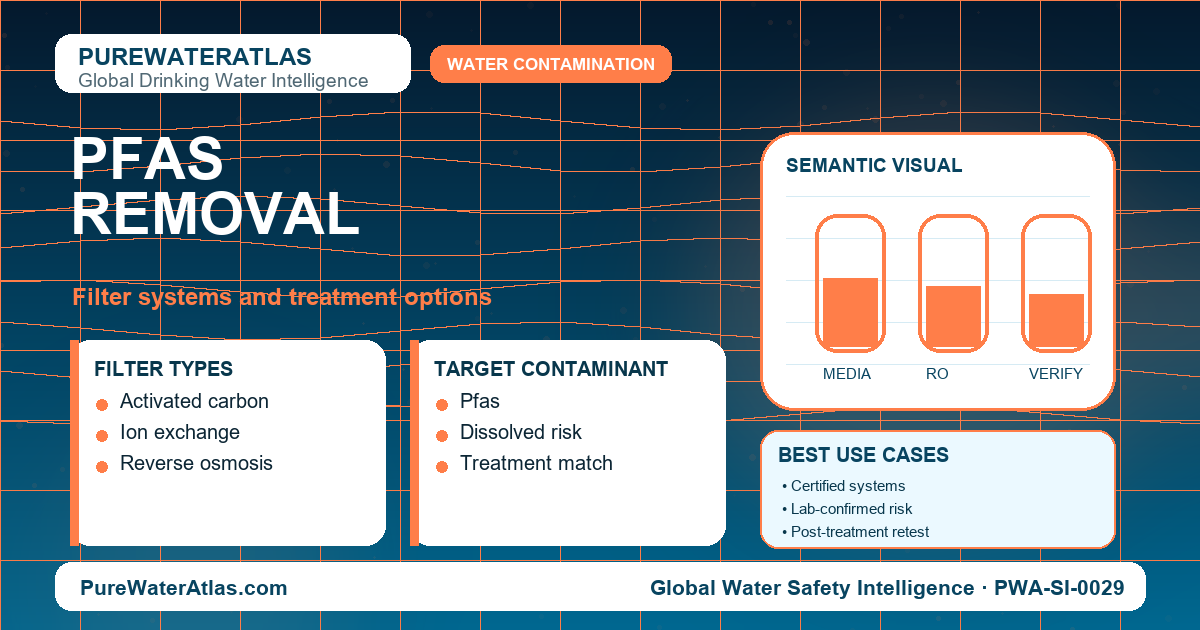
Prevention begins at the source: reducing industrial releases, improving waste controls, substituting safer chemicals where possible, and cleaning up contaminated sites. For households, however, the immediate question is usually how to treat water already entering the home. The most commonly discussed options for PFAS reduction are activated carbon, reverse osmosis, and ion exchange. Distillation may also reduce some PFAS, but it is less commonly used as a primary residential solution.
Choosing point-of-use versus whole-house treatment
Because the main exposure concern is ingestion, many experts recommend treating the water used for drinking, cooking, and beverage preparation first. This often makes a point-of-use system installed at the kitchen sink the most practical and cost-effective choice. Whole-house systems can treat all incoming water, but they require more media, more maintenance, and higher upfront costs.
Activated carbon filters
PFAS in drinking water carbon filters are among the most accessible treatment options. Activated carbon works by adsorbing contaminants onto the surface of porous carbon media. Granular activated carbon and carbon block filters are commonly used in under-sink units, countertop systems, and some whole-house setups.
Carbon can be effective for certain PFAS, especially longer-chain compounds such as PFOA and PFOS, when the system is properly designed and the contact time is adequate. However, performance can vary widely. Small or low-quality filters may have limited capacity, and shorter-chain PFAS can be more difficult to remove. Water chemistry also matters: high levels of natural organic matter, sediment, or other contaminants may compete for adsorption sites and shorten filter life.
When evaluating carbon systems, look for third-party certification or performance data specific to PFAS. Avoid assuming that any carbon filter marketed for taste and odor is suitable for PFAS reduction. In many cases, carbon is a strong choice for moderate contamination or as part of a staged treatment approach.
Reverse osmosis systems
PFAS in drinking water reverse osmosis treatment is widely regarded as one of the most effective residential options for reducing a broad range of PFAS compounds. Reverse osmosis, or RO, forces water through a semipermeable membrane that rejects many dissolved contaminants. Under-sink RO systems often include prefilters and postfilters as well, creating a multi-barrier treatment process.
RO systems can achieve high reduction rates for many PFAS, particularly when properly maintained. They are often a strong option when homeowners want broad protection against multiple contaminants in addition to PFAS. However, there are trade-offs:
- RO systems are usually more expensive than basic carbon filters.
- They produce reject water, which can matter in areas where water conservation is important.
- Membranes and prefilters require regular replacement.
- Flow rate is slower than a standard faucet unless a storage tank is included.
For many households comparing technologies, RO stands out in a pfas in drinking water treatment comparison because it combines strong PFAS reduction with broad contaminant removal. Still, the best solution depends on actual water conditions and user priorities.
Ion exchange and specialty media
Ion exchange resins and specialty adsorptive media are used in some residential and commercial PFAS systems. These media can be highly effective, particularly for certain PFAS profiles, but performance depends on system design, competing ions, and water chemistry. Some specialized systems are intended for larger-scale treatment and may be less common in standard residential retail channels.
Treatment comparison: strengths and limitations
A practical pfas in drinking water treatment comparison should consider not only removal efficiency but also cost, maintenance, certification, and ease of use.
- Activated carbon: widely available, often lower cost, useful for many longer-chain PFAS, but performance varies and capacity can be limited.
- Reverse osmosis: generally very effective across many PFAS, also reduces other dissolved contaminants, but costs more and requires membrane maintenance.
- Ion exchange: can be highly effective in the right applications, but may be less familiar to consumers and more dependent on technical design.
- Pitcher and faucet filters: may offer convenience, but only some are tested or certified for PFAS; many are too limited for reliable high-level treatment.
- Whole-house systems: useful when broad treatment is desired, but much more expensive and maintenance-intensive than point-of-use systems.
Buying guide: how to choose the right system
A practical pfas in drinking water buying guide starts with matching the product to the contamination problem. Consider the following factors:
- Verified performance: prioritize systems with third-party certification or clearly documented PFAS test results.
- Contaminant profile: review your water test to see whether PFAS are the only concern or part of a broader water quality issue.
- Installation location: choose point-of-use for drinking and cooking, or whole-house only if the added cost and maintenance are justified.
- Capacity: check the rated gallon capacity and replacement interval under realistic household use.
- Maintenance requirements: understand the schedule and cost of cartridges, membranes, media replacement, sanitization, and follow-up testing.
- Water pressure and space: RO systems in particular require adequate pressure and room for filters and storage components.
- Manufacturer support: reputable companies provide clear instructions, replacement parts, and technical data.
Filter maintenance and long-term performance
PFAS in drinking water filter maintenance is often overlooked, but it is critical. Every treatment system has a service life. Once carbon media is saturated or an RO membrane is fouled or degraded, performance can decline. In some cases, breakthrough can occur without obvious warning.
Good maintenance practices include:
- Following the manufacturer’s replacement schedule for filters and membranes.
- Adjusting replacement frequency based on actual water use and contamination level.
- Replacing prefilters on time to protect carbon beds or RO membranes.
- Sanitizing systems when required.
- Retesting treated water periodically to confirm continued PFAS reduction.
- Keeping records of installation dates, cartridge changes, and lab results.
Consumers should remember that a neglected high-end system can perform worse than a well-maintained simpler system. Reliability depends not only on technology choice but on consistent upkeep.
Common Misconceptions
“If water tastes fine, it must be safe.”
This is false for PFAS. These chemicals are typically undetectable by taste, smell, or appearance. Laboratory testing is necessary.
“Any carbon filter removes PFAS.”
Not all carbon filters are designed for PFAS reduction. Product quality, media volume, contact time, and certification all matter. A generic taste-and-odor filter is not automatically an effective PFAS solution.
“Boiling water removes PFAS.”
Boiling does not reliably remove PFAS. In fact, boiling can concentrate some dissolved contaminants as water evaporates. Households should use appropriate filtration rather than heat as a treatment strategy.
“Reverse osmosis solves everything with no downsides.”
RO is highly effective for many PFAS, but it has trade-offs, including wastewater generation, slower production rate, and maintenance needs. It is excellent in many settings, but not universally ideal.
“Filter replacement dates are just marketing.”
Replacement intervals are based on capacity and performance limits. Ignoring them can reduce effectiveness and increase the risk of contaminant breakthrough. For PFAS in particular, maintenance discipline is essential.
“Whole-house systems are always better than under-sink systems.”
Not necessarily. Since ingestion is the primary concern, treating only drinking and cooking water is often more economical and easier to maintain. Whole-house treatment may be useful in some cases, but it is not automatically superior.
Regulations and Standards
PFAS regulation is evolving quickly. Different countries, states, and agencies may set different limits, guidance values, or monitoring requirements. In the United States, federal action has increased in recent years, with growing attention to enforceable standards for certain PFAS and expanded monitoring of public water systems.
Consumers should understand that regulatory thresholds are often very low, reflecting concern about long-term exposure even at trace concentrations. A result measured in parts per trillion can still be significant. State-level standards may be stricter or broader than federal rules, and utilities may be required to notify the public if levels exceed applicable limits.
Private wells often fall outside direct utility regulation, which means well owners must stay informed and proactive. Checking state environmental agency resources, local health departments, and utility updates is an important part of ongoing PFAS risk management.
Standards also matter when evaluating filters. Product claims should ideally be supported by third-party testing against recognized protocols. Independent certification helps consumers compare systems more confidently and reduces reliance on vague marketing language.
Because this area continues to change, households should treat regulations as a baseline rather than a complete personal risk assessment. A family may choose to install treatment even below a legal threshold if PFAS are detected and a practical reduction option is available.
Conclusion
PFAS contamination presents a difficult but manageable drinking water challenge. These persistent chemicals can enter water supplies through industrial activity, fire-fighting foam use, waste disposal, and other environmental pathways, yet they are often impossible to detect without testing. That is why an informed, evidence-based approach matters so much.
For most households researching pfas in drinking water best filters, the strongest options typically include well-designed activated carbon systems and reverse osmosis units. PFAS in drinking water carbon filters can be effective, especially for certain compounds and properly sized systems, while pfas in drinking water reverse osmosis treatment often offers broader and stronger reduction across many PFAS. The best choice depends on your test results, budget, water use patterns, and ability to keep up with maintenance.
A good pfas in drinking water treatment comparison should never focus on purchase price alone. It should also weigh certified performance, contaminant profile, installation type, media capacity, and the real demands of pfas in drinking water filter maintenance. If you approach the decision through a careful pfas in drinking water buying guide mindset, you are far more likely to choose a system that delivers meaningful long-term protection.
Above all, test first, verify performance, and maintain the system you install. Those three steps do more to reduce risk than any marketing claim ever could. For more educational resources, visit the complete PFAS guide, explore water science, and browse related topics in water contamination.
Read the full guide: Water Contamination Guide
Explore more in this category: Water Contamination Articles