
Introduction
Concerns about metals in tap water have grown as more households learn that contamination can come from both natural geology and aging plumbing. Heavy metals in drinking water testing is an important part of understanding whether a water supply is safe, whether contamination is occasional or ongoing, and what kind of corrective action is appropriate. While many people associate poor water quality with taste, odor, or cloudiness, metal contamination often has no obvious warning signs. Water may look perfectly clear and still contain lead, arsenic, cadmium, chromium, mercury, copper, or other metals at levels that matter for health.
Testing is not only about identifying a problem. It is also about making informed decisions. Accurate results can help a homeowner decide whether to flush pipes, install a filter, replace plumbing components, use an alternative source, or seek professional remediation. For public water systems, testing supports compliance, treatment design, and community notification. For private well owners, it may be the only reliable way to detect a hidden hazard.
This article explains what heavy metals in drinking water are, where they come from, why they matter, and how testing works in real-world settings. It covers both heavy metals in drinking water home testing options and heavy metals in drinking water lab analysis, along with the strengths and limitations of each approach. It also reviews heavy metals in drinking water sampling methods, discusses heavy metals in drinking water accuracy, and explains how to interpret heavy metals in drinking water test results responsibly. For broader background, readers may also find useful resources in water contamination and the overview at this complete guide.
What It Is
In water quality discussions, the term “heavy metals” usually refers to metallic elements that can be toxic at relatively low concentrations or become harmful when exposure accumulates over time. Not every metal in water is equally dangerous, and not every metal classified as “heavy” behaves the same way chemically. Some are primarily toxic even at trace levels, while others are essential nutrients in small amounts but harmful when concentrations rise above safe limits.
Common metals of concern in drinking water include:
- Lead: Often associated with old service lines, solder, brass fixtures, and plumbing components.
- Arsenic: Frequently linked to natural geologic deposits, though it can also result from industrial and agricultural activities.
- Cadmium: May enter water through industrial waste, corrosion, or contaminated soil.
- Chromium: Can occur naturally, but industrial sources are also important; chromium exists in different chemical forms with different toxicities.
- Mercury: Less common in typical tap water than in some other exposure routes, but still relevant near certain pollution sources.
- Copper: An essential nutrient, but elevated levels may result from pipe corrosion and can cause health and aesthetic issues.
- Nickel, manganese, iron, and zinc: These may also appear in water supplies, with varying implications for health, appearance, and infrastructure.
One important point is that metals may be present as dissolved ions, attached to particles, or bound in chemical complexes. This affects how they move through the water system, how samples should be collected, and how treatment technologies remove them. For example, a dissolved metal may require different treatment than a particulate form that can be filtered more easily.
Another important distinction is between source water contamination and plumbing-related contamination. Source water contamination originates in groundwater, surface water, or the distribution system before water reaches the building. Plumbing-related contamination occurs after water enters the building and interacts with pipes, fittings, water heaters, valves, or household fixtures. Testing must account for this difference, because the timing and location of sampling can strongly influence the result.
Main Causes or Sources
Heavy metals can enter drinking water through several pathways, and identifying the likely source is critical for choosing the right testing strategy and corrective action. In many cases, contamination is not caused by a single factor but by a combination of environmental conditions, infrastructure age, and water chemistry.
Natural geologic sources
Many metals occur naturally in rocks, soils, and mineral deposits. As groundwater moves through geologic formations, it can dissolve small amounts of these elements. Arsenic is one of the most important examples, especially in some aquifers where natural concentrations may exceed recommended or regulated levels. Manganese and iron are also common in certain groundwater sources. Natural occurrence does not mean harmlessness; it simply means the contamination is not necessarily caused by recent industrial activity.
Corrosion of household plumbing
In homes and buildings, metal contamination often comes from corrosion. Water that is acidic, low in mineral buffering capacity, or otherwise chemically aggressive can dissolve metals from service lines, solder, and fixtures. Lead can leach from older plumbing materials, while copper commonly comes from copper pipes and fittings. Brass fixtures may contribute lead and other metals depending on composition and age. In these cases, water that has been sitting in pipes for several hours often shows higher concentrations than water sampled after flushing.
To learn more about where contaminants come from, readers can explore causes and sources of heavy metals in drinking water.
Industrial and mining activities
Industrial facilities may release metals through wastewater discharges, waste disposal practices, accidental spills, or atmospheric deposition that later reaches water sources. Mining and ore processing can mobilize arsenic, cadmium, lead, mercury, and other metals into nearby groundwater or streams. Even old industrial sites can remain sources of contamination long after active operations end, especially if waste materials were poorly contained.
Agricultural influences
Agriculture is more commonly linked with nutrients and pesticides, but certain fertilizers, soil amendments, and historical pesticide applications can contribute metals to the environment. Over time, these can accumulate in soils and potentially move into water under the right conditions. The extent of impact depends on local practices, drainage, soil chemistry, and hydrology.
Distribution system materials and changes in water chemistry
Municipal systems may have source water that leaves the treatment plant in compliance but still develop metal problems within the distribution network or at the tap. This can happen when corrosion control is inadequate or when changes in disinfectants, pH, alkalinity, or treatment practices alter the stability of protective pipe scales. Well-known contamination events have shown that even treated water can become unsafe if water chemistry changes cause metals to leach from pipes.
Point-of-use devices and local plumbing components
Sometimes the issue is not the main water line or municipal system but a single fixture, filter housing, water heater, or faucet component. New plumbing products can leach metals temporarily, and older components may corrode over time. This is why collecting samples from more than one location can be useful when trying to trace the source.
Health and Safety Implications
The health significance of heavy metals in drinking water depends on the specific metal, its concentration, the duration of exposure, the age and health of the person exposed, and other factors such as nutrition or exposure from food and air. In general, chronic exposure is a major concern because many metals can accumulate in the body or produce subtle long-term effects that are not immediately obvious.
Lead
Lead is especially concerning because there is broad scientific consensus that even low exposure can be harmful, particularly for infants and children. It can affect brain development, learning, behavior, and growth. In adults, lead exposure has been associated with cardiovascular, kidney, and reproductive effects. Pregnant women and developing fetuses are also high-risk groups.
Arsenic
Long-term arsenic exposure has been associated with increased risks of skin changes, cardiovascular effects, diabetes, and several cancers. Because arsenic often has no taste or smell in water, testing is essential in areas where natural occurrence is known or suspected.
Cadmium, chromium, and mercury
Cadmium may affect the kidneys and bones over time. Chromium raises concern because toxicity depends on its chemical form, with hexavalent chromium generally considered more hazardous than trivalent chromium. Mercury can affect the nervous system and kidneys, though drinking water is not always the main route of exposure in most households.
Copper and other metals
Copper can cause gastrointestinal irritation at elevated levels and may create metallic taste or blue-green staining. Manganese, iron, and zinc often cause aesthetic or operational issues before severe health concerns arise, but high levels can still be important, especially for vulnerable populations or long-term exposure scenarios.
Health risk should never be judged from symptoms alone. Many effects are nonspecific or develop gradually. That is why water testing should be paired with proper interpretation and, when warranted, consultation with a healthcare professional or local public health authority. For a broader discussion of exposure concerns, see health effects and risks of heavy metals in drinking water. Readers interested in overlapping water quality issues may also benefit from materials on water microbiology, since chemical and microbial safety are both important but require different testing approaches.
Testing and Detection
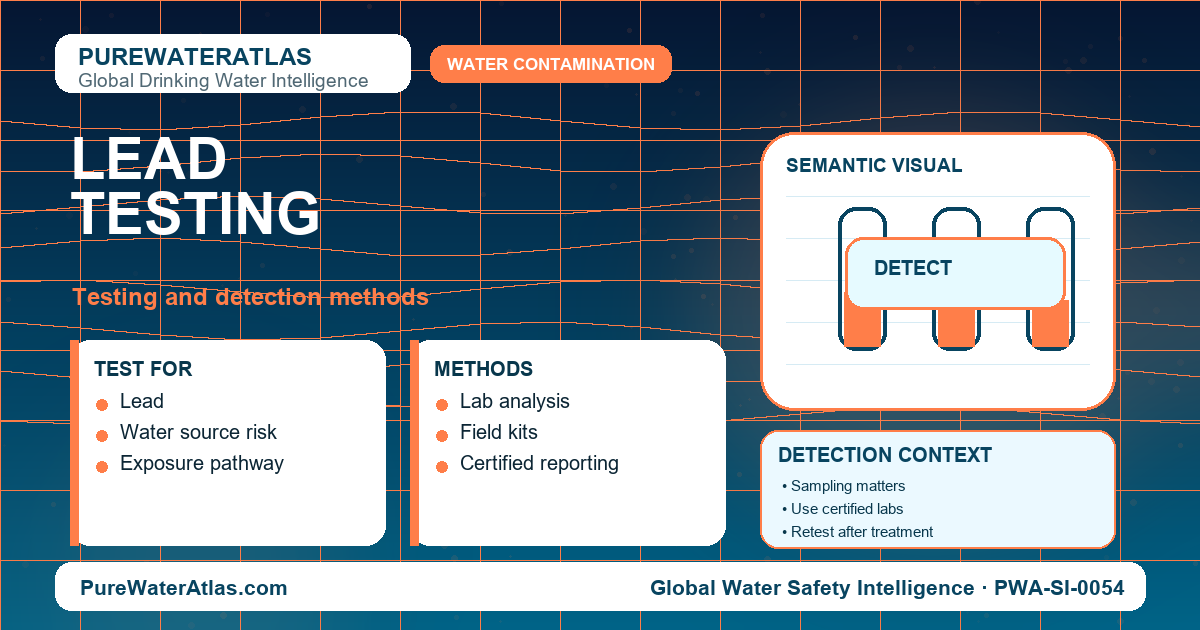
Heavy metals in drinking water testing can range from simple screening kits to highly sensitive laboratory methods. Choosing the right approach depends on the purpose of the test, the metal of concern, the needed detection limit, and the decisions that will be based on the result. Screening is useful for initial awareness, but confirmatory laboratory testing is generally preferred when health decisions or regulatory questions are involved.
When testing is recommended
Testing is especially important under the following conditions:
- You use a private well and have not tested recently.
- Your home was built with older plumbing or may contain lead-bearing materials.
- Water has a metallic taste, staining, discoloration, or unexplained corrosion problems.
- There is nearby mining, industrial activity, or known contamination history.
- You are pregnant, have young children, or live with someone especially vulnerable.
- You have changed plumbing materials, treatment equipment, or water source.
- Neighbors or local authorities have reported elevated metal levels.
Home testing kits
Heavy metals in drinking water home testing usually involves test strips, reagent-based color changes, or simple mail-in kits that include instructions and sample containers. These tools can be helpful for preliminary screening, especially when they are easy to use and affordable enough to encourage testing. Some home kits focus on a single metal such as lead, while others provide broad screening panels.
However, home tests have limitations. Their detection thresholds may be too high for certain health-based concerns. Color interpretation can be subjective. Interference from other dissolved substances may affect the result. Some tests indicate a range rather than an exact concentration, which is less useful when results are close to a regulatory limit. For these reasons, a positive home result should usually be confirmed by a certified laboratory, and a negative result does not always rule out contamination if the method lacks sensitivity.
Laboratory analysis
Heavy metals in drinking water lab analysis is the most reliable option when accuracy matters. Laboratories use validated methods and calibrated instruments designed to detect metals at low concentrations. Common techniques include:
- ICP-MS (Inductively Coupled Plasma Mass Spectrometry): Highly sensitive and capable of detecting many metals simultaneously at very low levels.
- ICP-OES or ICP-AES (Inductively Coupled Plasma Optical/Atomic Emission Spectrometry): Useful for multi-element analysis with good accuracy for many routine applications.
- Atomic Absorption Spectroscopy: Often used for individual metals or smaller analytical panels.
- Cold vapor techniques for mercury: Specialized methods that improve sensitivity for mercury analysis.
Laboratories also follow quality assurance procedures such as blanks, spikes, duplicates, calibration verification, and method controls. These practices increase confidence that the reported number reflects the actual sample rather than contamination, instrument drift, or handling error.
Sampling methods
Heavy metals in drinking water sampling methods are critical because poor sampling can produce misleading results. The question being asked should guide the sampling plan. For example, if the goal is to assess exposure from household plumbing, a first-draw sample after water has sat in the pipes for several hours may be appropriate. If the goal is to assess the water source itself, a flushed sample or a sample collected before contact with interior plumbing may be more informative.
Common sample types
- First-draw sample: Collected after water has remained unused in the plumbing for a set period, often 6 to 12 hours. Useful for evaluating metals released from plumbing materials.
- Flushed sample: Collected after running the water for a specified time. Helps assess the quality of water coming from the main line or well source rather than stagnant household plumbing.
- Sequential samples: Multiple samples collected in order to identify where contamination is entering, such as faucet, interior pipes, or service line.
- Raw water sample: Collected before treatment systems to evaluate source contamination.
- Treated water sample: Collected after filters or treatment units to assess performance.
Best practices for collecting samples
- Use the container provided by the lab or specified by the method.
- Do not rinse sample bottles unless instructed.
- Avoid contaminating the bottle cap or inside surfaces.
- Follow holding time and preservation instructions carefully.
- Record where, when, and how the sample was taken.
- If comparing results, keep sampling conditions consistent.
Many metal samples require acid-preserved bottles or prompt laboratory preservation, because metals can adsorb to container walls or particles if samples are mishandled. If total metals versus dissolved metals are being assessed, filtration procedures must also be defined properly.
Accuracy and limitations
Heavy metals in drinking water accuracy depends on the entire chain of testing, not just the instrument. Sampling error, bottle contamination, shipping delays, and poor interpretation can all reduce confidence in the result. Accuracy can also be affected by whether the sample was representative of normal exposure. A perfectly analyzed sample is still of limited value if it was taken at the wrong location or under unusual conditions.
Important factors influencing accuracy include:
- The detection limit of the method
- The quality and certification status of the laboratory
- Proper sample preservation and transport
- Potential contamination during collection
- Whether the result reflects dissolved, particulate, or total metals
- Temporal variability in water use patterns and source conditions
If results are close to a health benchmark or seem inconsistent, repeat sampling is often justified. In some situations, testing more than one tap and more than one sample type gives a clearer picture than relying on a single number.
Understanding test results
Heavy metals in drinking water test results are usually reported in milligrams per liter (mg/L) or micrograms per liter (µg/L), with 1 mg/L equal to 1,000 µg/L. Results should be compared against the appropriate benchmark, such as a maximum contaminant level, action level, health advisory, or local health recommendation. It is important to know that not all benchmarks represent the same type of risk threshold. Some are enforceable regulatory limits, while others are guidance values.
When reviewing results, ask the following questions:
- Which metal was detected, and at what concentration?
- Was the sample first-draw, flushed, or raw source water?
- Was the analysis for total metals or dissolved metals?
- What benchmark applies to that specific metal and sample type?
- Does the result suggest a source issue, a plumbing issue, or both?
- Should confirmatory testing or additional sampling be done?
If a lab report includes “ND” or “non-detect,” that means the concentration was below the method detection limit, not necessarily zero. The detection limit matters. A non-detect from a method with a relatively high reporting threshold may provide less reassurance than a non-detect from a more sensitive method.
Prevention and Treatment
Once testing identifies a metal problem, the next step is reducing exposure and correcting the source where possible. The right solution depends on whether contamination originates from the source water, the distribution system, or the plumbing inside the building.
Short-term exposure reduction
- Use bottled water or an alternative safe source for drinking and cooking if levels are significantly elevated.
- Flush stagnant water before use when plumbing corrosion is suspected.
- Use only cold water for drinking, cooking, and preparing infant formula, since hot water may contain higher metal levels from plumbing contact.
- Clean faucet aerators regularly to remove trapped particles.
Point-of-use and point-of-entry treatment
Treatment options vary by metal and concentration. Common technologies include:
- Reverse osmosis: Effective for many dissolved metals when properly maintained.
- Distillation: Can remove many contaminants, though practicality and energy use may limit application.
- Ion exchange: Useful for certain metals under appropriate conditions.
- Adsorptive media: Specialized cartridges may target lead, arsenic, or other metals.
- Oxidation and filtration: Often used for iron and manganese and some particulate metal forms.
Any treatment device should be certified for the specific contaminant of concern and tested after installation to confirm performance. A filter that improves taste is not automatically effective for toxic metals. More information on treatment approaches can be found in water purification.
Source correction and plumbing replacement
If contamination is linked to plumbing, replacing lead service lines, lead-bearing fixtures, old solder, or corroded pipes may offer the most durable solution. If contamination comes from the well or aquifer, treatment may be required at the entry point to the home, or a new well location may be considered in severe cases. For municipal systems, corrosion control adjustments and infrastructure replacement are often central responses.
Ongoing monitoring
Testing should not always end once a treatment system is installed. Follow-up sampling confirms whether the intervention is working and whether maintenance schedules are being followed. Filters can become exhausted, membrane systems can decline in performance, and seasonal water chemistry changes can affect corrosion and metal release.
Common Misconceptions
Misunderstandings about water testing can lead to false reassurance or unnecessary alarm. Several misconceptions appear frequently in public discussions.
“If the water looks clear, it is safe.”
Many metals are invisible in water at concentrations relevant to health. Clear water can still contain lead or arsenic above recommended levels.
“A home test kit is always enough.”
Home tests can be useful screening tools, but they are not always sufficiently sensitive or specific for decision-making. Laboratory confirmation is often needed.
“Only old wells have metal problems.”
New wells can also be affected if local geology contains metals. The age of the well does not guarantee safety.
“Boiling water removes heavy metals.”
Boiling does not remove metals. In fact, evaporation can slightly increase concentration if water volume decreases.
“A single negative result means there is no problem.”
Metal concentrations can vary by location, water use pattern, and time. One sample may not represent every exposure condition.
“Municipal water is always free from heavy metals.”
Even when utility source water meets standards, contamination can still occur through corrosion in service lines or household plumbing.
Regulations and Standards
Drinking water standards differ by country and region, but most regulatory systems establish maximum allowable concentrations or action levels for certain metals. In the United States, the Environmental Protection Agency sets standards for public water systems under the Safe Drinking Water Act. Some values are enforceable maximum contaminant levels, while others involve treatment techniques or action levels, as in the case of lead and copper.
Private wells are often not subject to the same routine compliance monitoring as public systems, which means the well owner is generally responsible for testing and maintenance. Local or state agencies may publish recommended testing intervals and target analytes based on regional geology or known contamination issues.
When interpreting standards, several points matter:
- A regulatory limit is not always the same as a no-risk threshold.
- Some standards are designed around treatment feasibility as well as health protection.
- Action levels may trigger corrective steps rather than function as direct toxicity boundaries.
- Local health departments may recommend additional testing beyond minimum legal requirements.
It is also important to recognize that standards evolve as scientific understanding improves. Laboratories and water professionals should rely on current guidance documents and approved analytical methods when evaluating samples.
Conclusion
Testing for metals in drinking water is one of the most practical steps a household, facility manager, or water provider can take to protect health. Because contamination may come from geology, industrial impacts, or corrosion inside plumbing, there is no single test strategy that fits every situation. The most effective approach begins with a clear question: are you evaluating source water, tap water exposure, plumbing corrosion, or treatment performance?
Heavy metals in drinking water testing works best when good sampling practices are paired with reliable analytical methods and careful interpretation. Heavy metals in drinking water home testing can provide a useful first screen, but heavy metals in drinking water lab analysis generally offers the confidence needed for important decisions. Paying attention to heavy metals in drinking water sampling methods and heavy metals in drinking water accuracy helps ensure that heavy metals in drinking water test results truly reflect the risk you need to manage.
For anyone concerned about potential contamination, the key message is simple: do not rely on appearance, taste, or assumptions. Test strategically, confirm results when needed, and choose treatment or corrective action based on the actual source of the problem. With informed monitoring and appropriate intervention, metal-related drinking water risks can often be identified early and reduced effectively.
Read the full guide: Water Contamination Guide
Explore more in this category: Water Contamination Articles