
Introduction
Understanding water quality by country testing is essential for anyone concerned with public health, environmental safety, and reliable access to clean drinking water. Water quality varies widely across the world because natural geology, industrial activity, agricultural practices, infrastructure quality, regulation, and climate all influence what ends up in rivers, lakes, groundwater, and municipal supplies. A country with advanced treatment systems may still face localized contamination, while a country with abundant freshwater may struggle with distribution, sanitation, or monitoring gaps.
Testing is the foundation of water safety. Without proper analysis, it is impossible to know whether water contains harmful microbes, excessive minerals, toxic metals, chemical pollutants, or emerging contaminants. This is why comparing water quality across countries requires more than observing water clarity or taste. It depends on standardized sampling, laboratory methods, field screening, reporting practices, and the ability to interpret results in a meaningful way.
In practice, evaluating water quality across nations involves both broad monitoring systems and site-specific investigation. Governments test public supplies, researchers assess regional patterns, industries monitor process water, and households increasingly use point-of-use kits for screening. These layers of monitoring help reveal where water is safe, where it is at risk, and what interventions are necessary.
This article explains how water quality is defined, what causes contamination, what the health consequences can be, and how modern testing methods work in domestic, field, and laboratory settings. It also explores water quality by country home testing, water quality by country lab analysis, water quality by country sampling methods, water quality by country accuracy, and the interpretation of water quality by country test results. For broader geographic context, readers may also explore global water quality resources and the complete guide to water quality by country.
What It Is
Water quality refers to the physical, chemical, and biological characteristics of water and how suitable that water is for a specific purpose. The most common concern is drinking water safety, but water quality also matters for agriculture, manufacturing, recreation, aquatic ecosystems, and medical use. A water source may be acceptable for irrigation yet unsuitable for human consumption, or it may appear clear while containing invisible contaminants.
When people discuss water quality by country, they are usually referring to several overlapping questions:
- Is the water microbiologically safe to drink?
- Does it contain harmful chemicals such as arsenic, lead, nitrate, or pesticides?
- Is the treatment infrastructure reliable and consistently maintained?
- Are testing programs frequent, transparent, and scientifically robust?
- Do urban and rural populations receive similar water protection?
Water quality is typically assessed through measurable parameters. These may include pH, turbidity, hardness, total dissolved solids, chlorine residual, dissolved oxygen, conductivity, and temperature. For health protection, microbiological indicators such as total coliforms and E. coli are especially important, because they can signal fecal contamination and possible pathogen presence. Chemical testing may target heavy metals, nitrates, fluoride, industrial solvents, disinfection byproducts, or naturally occurring minerals.
Different countries prioritize different contaminants based on local risks. In some regions, groundwater arsenic is a major concern. In others, lead leaching from old pipes, agricultural runoff, saltwater intrusion, mining pollution, or sewage contamination may be more significant. This is one reason that comparing countries requires careful interpretation. A nation may test for dozens of substances, while another may only monitor a small set of basic indicators, making direct comparison difficult.
To understand these regional variations more fully, it helps to review the major contamination pathways discussed in water quality by country causes and sources.
Main Causes or Sources
Water contamination comes from both natural and human-made sources. The balance between these sources differs from one country to another, and often from one region to another within the same country. Effective water quality by country testing must therefore be designed around local conditions rather than assuming a universal contamination profile.
Natural Geological Sources
Many contaminants occur naturally as water moves through soil and rock. Groundwater can dissolve arsenic, fluoride, iron, manganese, sulfur compounds, and other minerals depending on local geology. Hard water, caused mainly by calcium and magnesium, is usually not a serious health hazard but can affect taste, scaling, and appliance performance. In some countries, geogenic contamination is among the most important water quality challenges because deep wells may appear protected from surface pollution while still containing hazardous dissolved substances.
Agricultural Runoff
Farming can significantly influence water quality through fertilizers, animal waste, pesticides, and sediment runoff. Nitrate contamination is a common concern in agricultural regions, especially where shallow groundwater is used for drinking. Excess nutrients can also contribute to algal blooms in lakes and reservoirs, creating ecological damage and increasing treatment difficulty. Rural monitoring programs must often focus on seasonal variation, rainfall events, and land use changes to capture the full picture.
Industrial and Mining Pollution
Industrial discharge can introduce solvents, hydrocarbons, heavy metals, acids, and synthetic chemicals into water systems. Mining operations may release arsenic, mercury, cadmium, or acid mine drainage if not adequately controlled. Countries with rapid industrialization may face challenges if wastewater regulation and enforcement lag behind economic growth. Historical pollution is also important: contaminants from old manufacturing sites can remain in soil and groundwater for decades.
Urban Infrastructure and Sewage
Leaking sewer lines, insufficient wastewater treatment, stormwater overflow, and aging distribution systems all contribute to contamination risk. In some cities, treated water leaves the plant in good condition but becomes contaminated in the distribution network because of pipe corrosion, pressure loss, cross-connections, or intermittent supply. This is especially relevant in regions where households store water in tanks, allowing secondary contamination to occur after collection.
Household and Localized Sources
Private wells, storage tanks, plumbing materials, and household treatment devices can each affect final water quality. Lead may enter water from old plumbing. Bacteria may grow in poorly maintained tanks or filters. In rural or peri-urban areas, pit latrines, septic systems, and unlined waste disposal sites can contaminate shallow groundwater. This is why local assessment often matters as much as national averages.
Climate and Environmental Stress
Floods, droughts, wildfires, and rising temperatures increasingly shape water quality. Flooding can wash sewage, chemicals, and sediments into drinking water sources. Drought can concentrate dissolved contaminants and increase reliance on poorer-quality groundwater. Wildfire ash can alter surface water chemistry and raise treatment challenges. Countries facing climate extremes need adaptive testing programs that can identify short-term spikes as well as long-term trends.
Health and Safety Implications
The health consequences of poor water quality range from mild gastrointestinal discomfort to severe chronic disease, developmental harm, neurological injury, and death. The specific risk depends on what contaminants are present, at what concentration, for how long, and in which population group.
Microbiological Risks
Pathogens are among the most urgent water safety threats because they can cause rapid illness. Contaminated water may carry bacteria, viruses, and parasites associated with diarrhea, cholera, dysentery, typhoid, hepatitis, and other infectious diseases. Infants, elderly adults, pregnant women, and immunocompromised people are particularly vulnerable. In low-resource settings, microbiological contamination is often the leading driver of water-related disease burden.
Chemical Risks
Chemical contamination can produce both immediate and long-term effects. Elevated nitrate levels can be dangerous for infants. Lead exposure may impair neurological development in children and contribute to cardiovascular and kidney problems in adults. Arsenic has been linked to cancers, skin lesions, and vascular disease. Excess fluoride can damage teeth and bones at high levels, while pesticide exposure may affect multiple organ systems depending on the chemical involved.
Physical and Aesthetic Indicators
Cloudiness, unusual color, odor, or taste do not always indicate a direct health threat, but they can signal treatment failure, corrosion, organic contamination, or high mineral content. Conversely, water that looks and tastes normal may still contain dangerous microbes or dissolved contaminants. This gap between appearance and actual safety is one of the main reasons routine testing is necessary.
Disparities Between Countries and Regions
Health risks are not distributed evenly. Access to centralized treatment, sanitation systems, routine surveillance, and transparent reporting often determines whether contamination is detected early or persists undetected. Even within high-income countries, marginalized communities, informal settlements, and rural areas may face elevated exposure due to older infrastructure or weaker monitoring. To learn more about these outcomes, readers can review water quality by country health effects and risks.
Testing and Detection
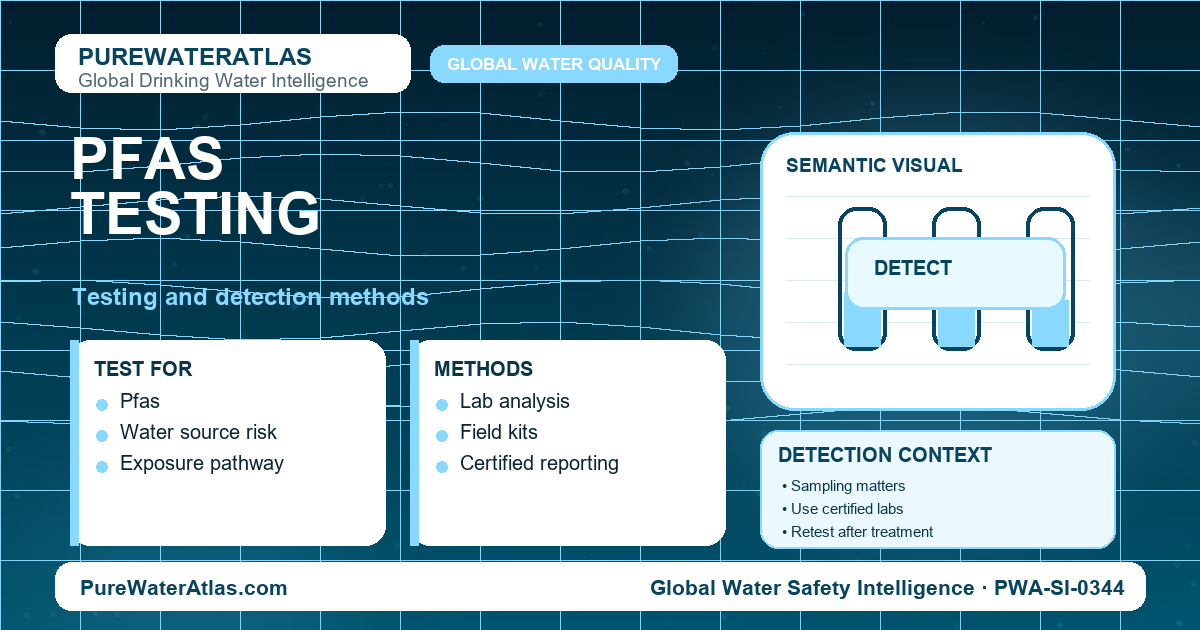
Testing and detection are the core of any meaningful water quality program. Reliable assessment depends on choosing the right parameters, collecting representative samples, preserving them correctly, and using validated analytical methods. This section explains the major approaches used internationally, from field screening to full laboratory analysis.
Basic Categories of Water Testing
Most water quality evaluations include one or more of the following categories:
- Physical tests: temperature, turbidity, color, odor, conductivity, and total dissolved solids.
- Chemical tests: pH, alkalinity, hardness, nitrate, chloride, fluoride, heavy metals, pesticides, organic compounds, and residual disinfectants.
- Microbiological tests: total coliforms, E. coli, enterococci, heterotrophic plate count, and sometimes pathogen-specific detection.
- Advanced screening: PFAS, pharmaceuticals, endocrine-disrupting compounds, radionuclides, and other emerging contaminants.
Water Quality by Country Home Testing
Water quality by country home testing usually involves rapid test strips, color-change kits, handheld meters, or simple bacteriological screening tools. These methods are helpful for consumers who want a preliminary understanding of household water conditions, especially for pH, hardness, chlorine, nitrate, iron, manganese, or total dissolved solids. Some kits also provide screening for lead or bacteria.
Home testing can be useful in several situations:
- Checking whether a private well shows obvious changes over time
- Assessing whether a filter appears to be working as expected
- Screening water after flooding, plumbing repairs, or long storage periods
- Identifying whether more formal lab testing is warranted
However, home kits have limitations. They may provide only approximate ranges, may be affected by user technique, and often cannot detect low contaminant concentrations with the same sensitivity as certified laboratories. They are best viewed as screening tools, not replacements for comprehensive safety assessment.
Water Quality by Country Lab Analysis
Water quality by country lab analysis offers the highest level of confidence when performed by accredited laboratories using standardized methods. Labs can measure contaminants at much lower concentrations and can identify specific substances that are impossible to assess reliably with household kits. Common laboratory techniques include:
- ICP-MS or ICP-OES: for metals such as lead, arsenic, cadmium, and chromium
- Ion chromatography: for nitrate, sulfate, fluoride, and other ions
- Gas chromatography and mass spectrometry: for volatile organic compounds, pesticides, and synthetic chemicals
- Culture-based microbiology: for coliforms, E. coli, and other organisms
- Molecular methods: for targeted pathogen detection or source tracking
Laboratory analysis is especially important for compliance monitoring, legal reporting, epidemiological investigation, and detailed household risk assessment. In many countries, municipal suppliers are required to send regular samples to certified laboratories and maintain records for public review.
Water Quality by Country Sampling Methods
Water quality by country sampling methods are just as important as the analytical instrument used. A highly accurate lab test can still produce misleading data if the sample is collected badly. Representative sampling requires planning around source type, timing, location, and the contaminant of interest.
Common sampling considerations include:
- Grab sampling: a single sample collected at one point in time; useful for spot checks
- Composite sampling: multiple samples combined over time or location; useful for averaging conditions
- First-draw sampling: used in lead and plumbing studies after water sits in pipes
- Flushed sampling: used to evaluate source water after clearing stagnant plumbing water
- Sterile microbiological sampling: requires aseptic technique and prompt transport under controlled temperature
Sampling protocols vary internationally, but the principles are universal. Containers must be appropriate for the analyte, preservatives may be required, and holding times must be respected. For example, microbiological samples often need rapid analysis, while metal samples may require acidification to preserve dissolved concentrations. Field blanks, duplicates, and chain-of-custody procedures help ensure data quality.
Field Instruments and On-Site Detection
Portable devices are increasingly important in global water monitoring. Handheld meters can provide immediate readings for pH, conductivity, dissolved oxygen, oxidation-reduction potential, and chlorine residual. Portable turbidimeters, colorimeters, and digital photometers offer convenient field measurement for many routine parameters. In remote areas, these tools allow faster decision-making and can identify sites that need further laboratory confirmation.
On-site detection is especially useful in emergency response, refugee settings, rural well screening, and rapid public health surveys. It reduces delays and helps teams prioritize where to allocate resources. Still, field measurements must be calibrated correctly and interpreted within the limits of the device.
Water Quality by Country Accuracy
Water quality by country accuracy depends on more than the technology itself. Accuracy is shaped by sample quality, analyst training, instrument calibration, method validation, contamination control, and data interpretation. Countries with robust monitoring systems often use quality assurance and quality control procedures such as:
- Calibration with known standards
- Use of blanks and control samples
- Duplicate or replicate analysis
- Inter-laboratory comparison programs
- Method detection limit verification
- Audits and accreditation requirements
Accuracy also matters in public communication. A result may be scientifically valid yet misunderstood if units, health thresholds, or uncertainty ranges are not explained clearly. For example, a water sample might be below a national standard but still show an increasing trend that warrants attention.
Interpreting Water Quality by Country Test Results
Water quality by country test results should never be interpreted in isolation. A single number must be compared with the relevant national guideline, World Health Organization recommendation, local baseline, and intended water use. Important questions include:
- Is the result above or below the regulatory limit?
- Was the sample representative of normal conditions?
- Is the contamination chronic or temporary?
- Does the result reflect source water, treated water, or water at the tap?
- Are there multiple contaminants interacting to create cumulative risk?
Trend analysis is often more informative than a single test. Repeated measurements reveal seasonal shifts, infrastructure problems, contamination events, or treatment breakdowns. For households, interpreting results may involve deciding whether maintenance, filtration, disinfection, plumbing replacement, or alternative water sources are needed.
Prevention and Treatment
Prevention is generally more effective and affordable than dealing with widespread contamination after it has occurred. Countries with strong water protection strategies usually combine source protection, infrastructure investment, routine testing, and appropriate treatment technologies.
Source Protection
Protecting rivers, reservoirs, and aquifers from contamination is the first line of defense. This may involve controlling industrial discharge, improving agricultural practices, safeguarding recharge zones, maintaining sanitation systems, and managing stormwater. Watershed protection reduces treatment burden and improves long-term resilience.
Municipal Treatment
Centralized systems commonly use coagulation, flocculation, sedimentation, filtration, and disinfection to remove particles and pathogens. Additional steps such as activated carbon adsorption, ion exchange, membrane filtration, or advanced oxidation may be used where specific contaminants are present. Treatment must be matched to local water chemistry and contamination patterns.
Point-of-Use and Household Treatment
Where centralized treatment is absent or unreliable, household systems become essential. These may include boiling, chlorination, ultraviolet disinfection, ceramic filtration, activated carbon filters, reverse osmosis systems, and distillation units. The best option depends on the contaminant. For example, activated carbon may improve taste and reduce some organic chemicals, while reverse osmosis is often more effective for dissolved salts and certain metals.
Readers exploring technology options can find more information in water purification resources and water treatment systems.
Maintenance and Monitoring
No treatment system remains effective without maintenance. Filters clog, UV lamps weaken, membranes foul, and disinfectant residuals decline. Prevention therefore includes ongoing monitoring after installation, not just initial setup. In both homes and public systems, testing should confirm that treatment is achieving the intended result.
Common Misconceptions
Public understanding of water safety is often shaped by appearance, taste, or assumptions about geography. Several misconceptions can lead to poor decisions.
- “Clear water is safe water.” Many harmful contaminants are invisible and odorless.
- “Bottled water is always better.” Bottled water quality varies, and it may not be superior to properly treated tap water.
- “If a country has modern cities, all its water is safe.” Localized contamination can occur anywhere.
- “Home test kits tell the whole story.” They are useful for screening but often cannot replace lab confirmation.
- “Boiling fixes every water problem.” Boiling kills many microbes but does not remove metals, nitrate, or many chemicals.
- “One good test means the water is always safe.” Water quality changes over time, especially with weather, infrastructure issues, and seasonal use patterns.
Correcting these misconceptions is important because effective risk management depends on informed interpretation rather than intuition.
Regulations and Standards
Water quality regulation differs by country, but most systems are built around health-based standards, monitoring obligations, treatment requirements, and public reporting rules. Internationally, the World Health Organization provides widely referenced drinking-water guidelines, while national authorities establish enforceable limits and operational requirements.
Some countries regulate a broad list of contaminants with strict compliance frameworks and transparent consumer reports. Others may still be expanding their regulatory scope or strengthening enforcement capacity. Even where standards exist, implementation can vary depending on laboratory access, infrastructure funding, trained personnel, and political accountability.
Important elements of a strong regulatory system include:
- Clearly defined maximum contaminant levels or guideline values
- Routine monitoring schedules based on population served and risk level
- Accredited laboratory requirements
- Corrective action protocols when limits are exceeded
- Public notification and consumer transparency
- Protection of vulnerable and underserved communities
Standards also influence how international comparisons are made. If countries use different testing frequency, detection limits, contaminant lists, or reporting thresholds, the data may not be directly equivalent. For that reason, researchers often rely on harmonized datasets or benchmark against WHO guideline values when comparing trends globally.
Conclusion
Water quality assessment is far more than a simple pass-or-fail judgment. It is a scientific process that depends on local contamination risks, representative sampling, reliable methods, accurate analysis, and thoughtful interpretation. Effective water quality by country testing helps governments protect public health, helps communities identify environmental threats, and helps households make informed choices about treatment and monitoring.
Because water quality varies across and within countries, no single indicator can describe overall safety. Microbiological contamination, chemical hazards, infrastructure failures, and environmental pressures all require different detection strategies. Water quality by country home testing can provide useful screening, while water quality by country lab analysis offers the detail needed for regulatory compliance and deeper investigation. Strong water quality by country sampling methods improve data reliability, and attention to water quality by country accuracy ensures that findings can be trusted. Most importantly, careful interpretation of water quality by country test results turns raw numbers into practical action.
As global challenges such as urbanization, climate stress, and emerging contaminants grow more complex, water testing will remain one of the most important tools for prevention, treatment, and public confidence. Whether evaluating a municipal supply, a rural well, or a national monitoring program, sound testing and detection methods are central to safe water management worldwide.
Read the full guide: Global Water Quality Guide
Explore more in this category: Global Water Quality Articles