
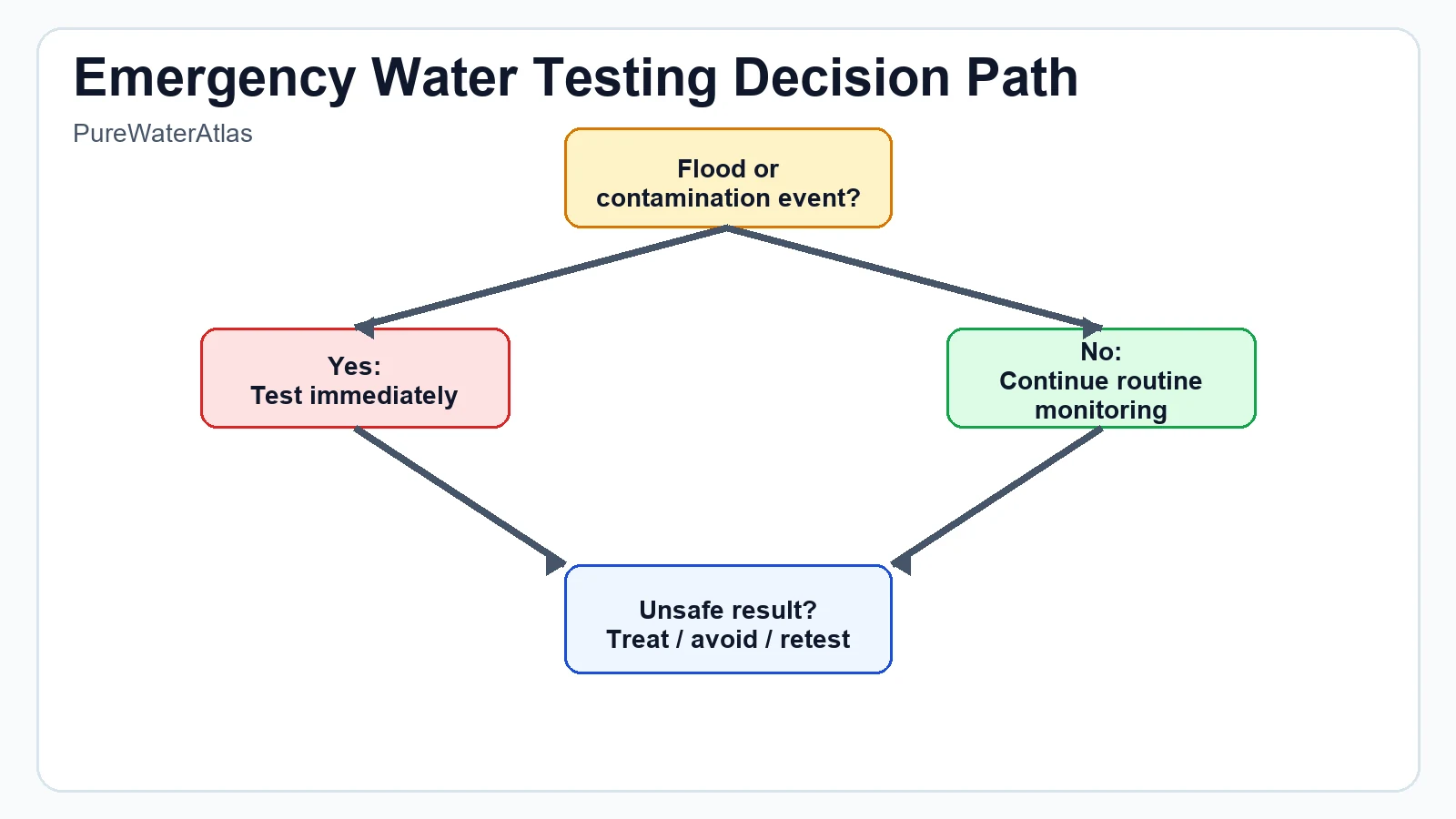
Floods, hurricanes, wildfires, earthquakes, winter storms, and infrastructure failures can rapidly turn a familiar drinking water source into an uncertain one. In these situations, emergency water testing becomes a critical public health tool. Whether the water comes from a municipal distribution system, a private well, a storage tank, or an improvised emergency supply, the question is the same: is it safe to drink, cook with, or use for hygiene? After a disaster, water can be contaminated by sewage, sediment, chemicals, fuel, agricultural runoff, damaged plumbing, and microbial pathogens. Because contaminated water often looks clear and still carries serious health risks, post-disaster decisions should be based on evidence rather than appearance alone. A rigorous but practical approach to emergency water testing helps households, responders, facility managers, and community leaders identify hazards, prioritize treatment, and restore disaster water safety as quickly as possible.
Flood-related contamination is especially complex because water moves through places it normally does not reach. It can inundate septic systems, overtop wastewater plants, mobilize heavy metals from industrial sites, disturb naturally occurring arsenic or manganese in sediments, and wash animal waste into wells and surface waters. This is why flood water contamination is not a single problem but a mixture of microbiological, chemical, and physical risks that vary by location, water source, and timing. A stream that tested acceptable before a storm may become unsafe within hours. A private well that appears intact may still be contaminated through its cap, casing, or surrounding saturated soil. Even municipal systems can face pressure loss, cross-connections, or damaged treatment barriers. For readers seeking broader background on common drinking water hazards, PureWaterAtlas has a useful overview of drinking water contamination types, sources, risks, and prevention.
The central purpose of emergency water testing is to answer a set of urgent, practical questions. Is fecal contamination present? Has disinfectant residual been lost in the distribution system? Has floodwater introduced turbidity high enough to interfere with disinfection? Are petroleum compounds, pesticides, solvents, or metals likely to be present? Does the water need boiling, filtration, disinfection, an alternative supply, or professional remediation? Testing does not replace common-sense precautions such as following boil water advisories, avoiding visibly contaminated sources, and using bottled or properly treated water when advised. But it does provide the evidence needed to move from blanket precautions to source-specific decisions.
Public health agencies consistently emphasize safe drinking water as a foundation of disaster response. The U.S. Environmental Protection Agency provides core information on drinking water systems and emergency response through its ground water and drinking water resources. The World Health Organization also notes that microbiologically unsafe drinking water can transmit diarrheal disease, cholera, dysentery, hepatitis A, typhoid, and other infections through its summary on drinking-water. In an emergency, those risks can rise quickly because sanitation systems are disrupted at the same time that clean water becomes scarce.
Why emergency water testing matters after floods and disasters
After a disaster, the most immediate water safety threats are often microbiological. Sewage backups, overflowing septic systems, animal waste, and stormwater intrusion can introduce bacteria, viruses, and protozoa into drinking water sources. Indicators such as total coliforms and Escherichia coli are widely used because they help identify fecal contamination and treatment failure. E. coli in drinking water is a particularly important red flag because its presence indicates recent fecal input and a meaningful risk that enteric pathogens may also be present. Even if no illness has yet been reported, contamination can spread silently through households and shelters if unsafe water is used for drinking, baby formula, food preparation, brushing teeth, or washing produce.
Chemical contamination may be less visible but can be equally important. Floodwater can carry fuel from damaged tanks, cleaning agents from homes and businesses, agricultural pesticides, fertilizers, and industrial chemicals. In fire-affected disasters, damaged plastic piping and storage materials may release volatile organic compounds. In older buildings or disturbed plumbing systems, lead and copper can rise due to changes in water chemistry and stagnation. Sediment-laden water can also carry iron, manganese, arsenic, or other constituents from geologic materials and corroded infrastructure. This is one reason post flood water quality assessments should not stop at bacterial screening if there is any plausible chemical exposure pathway.
Testing also matters because emergency decisions are often made under uncertainty. People may rely on familiar cues such as clarity, smell, or taste, but these are poor indicators of microbiological safety. Water can contain dangerous pathogens without visible cloudiness, and disinfectants can suppress odors without fully correcting contamination. Conversely, water may look muddy because of sediment but not contain the highest-risk pathogens. Emergency water testing helps separate assumptions from measurable evidence.
Another reason testing is so important is that different water sources recover at different rates. Municipal systems may restore pressure quickly but still need flushing, disinfectant verification, and bacteriological confirmation. Private wells often recover more slowly because saturated ground can continue carrying contaminants toward the well after floodwaters recede. Cisterns and storage tanks may remain unsafe until they are drained, cleaned, disinfected, and retested. Surface water used temporarily in emergencies requires treatment and should generally be considered contaminated unless properly processed. Understanding those differences is central to disaster water safety planning.
How floods and disasters contaminate drinking water
To understand water contamination flood risks, it helps to think in terms of pathways. A hazard must first be present, then mobilized, then transported into the water source, and finally persist long enough to create exposure. Floods are unusually efficient at all four steps.
Microbial pathways
- Sewage overflows from damaged sewers or treatment facilities
- Septic system failure or submergence
- Animal waste washed from farms, yards, and wildlife habitats
- Intrusion into wells through damaged caps, vents, or casings
- Loss of water pressure allowing contaminated water to enter cracked pipes
These pathways can introduce total coliform bacteria, E. coli, enterococci, Salmonella, Campylobacter, norovirus, hepatitis A virus, Giardia, and Cryptosporidium. Not all of these are routinely tested in emergency settings, which is why indicator organisms and source assessment are so important.
Chemical pathways
- Fuel oil, gasoline, diesel, and lubricants from vehicles or tanks
- Pesticides, herbicides, and fertilizers from agricultural land
- Solvents and industrial chemicals from warehouses, workshops, and factories
- Household chemicals such as bleach, detergents, paints, and cleaners
- Metals and corrosion products released from plumbing or disturbed sediments
Chemical hazards may be acute or chronic. Some, such as high nitrate in water used for infant formula, can create immediate concern. Others, such as low-level solvent contamination, may require laboratory analysis and risk assessment before authorities can determine whether a source is usable.
Physical changes that matter
- High turbidity from silt, clay, and organic debris
- Color, odor, and suspended solids
- Changes in pH, conductivity, and dissolved oxygen
- Temperature shifts that affect microbial survival and disinfectant behavior
Physical changes are sometimes dismissed because they do not always represent direct toxicity, but they strongly influence treatment success. High turbidity can shield microorganisms from chlorine and ultraviolet treatment. Sediment can clog filters, interfere with test methods, and indicate that a well or pipe system has been physically compromised.
Which water sources need the most attention
All drinking water sources deserve caution after a disaster, but some are especially vulnerable.
Private wells
Private wells are a major focus of emergency water testing because they are generally not monitored continuously by a utility. Shallow wells, dug wells, wells in floodplains, and wells with damaged caps or poor grading are particularly at risk. Floodwaters can enter directly from the top or infiltrate through saturated soil around the casing. If you depend on a well, a structured approach like this well water testing checklist can help identify the right sequence of inspection, disinfection, and sampling.
Municipal water systems
Public systems usually have more treatment barriers, but they can still be compromised by power loss, pressure loss, main breaks, treatment interruptions, cross-connections, and flooded source water. After major flooding, utilities often issue boil water advisories while they verify pressure, residual disinfectant, turbidity control, and bacteriological results. Residents should not assume restored service automatically means restored safety unless local authorities have clearly lifted restrictions.
Cisterns and storage tanks
Rainwater tanks, rooftop storage, hauled-water tanks, and emergency storage containers can all be contaminated by floodwater, backflow, debris, or poor sanitation during filling. These systems often require draining, cleaning, disinfection, and retesting before use.
Surface water and temporary supplies
Rivers, ponds, canals, and even collected rainwater may be used in emergencies when other options fail. These sources should generally be presumed unsafe without treatment because flood conditions often increase pathogen loads and chemical uncertainty. When no safer source is available, multiple-barrier treatment and cautious testing are essential.
The scientific basis of emergency water testing
Emergency water testing is built around several core principles from environmental microbiology and analytical chemistry.
First, no single test can prove complete safety. Water quality is multidimensional. A negative bacterial screen does not rule out viruses, protozoa, chemicals, or intermittent contamination. Likewise, a normal pH does not indicate the absence of pathogens. This is why testing should be risk-based and matched to the likely contamination scenario.
Second, indicator parameters are used because direct testing for every pathogen is impractical. Total coliforms are broad indicators of sanitary integrity, while E. coli is a more specific indicator of fecal contamination. Turbidity indicates the level of suspended matter and treatment challenge. Free chlorine residual indicates whether disinfectant is present in chlorinated systems, though residual alone does not guarantee safety.
Third, the value of any test depends on proper sampling. Contamination introduced during collection can create false positives, while poor bottle choice, storage, transport, or holding time can invalidate results. This is especially important during a water testing emergency when samples may be taken in stressful, improvised conditions.
Fourth, timing matters. Water quality changes during and after a flood. Immediately after inundation, microbial contamination may dominate. Days later, sediment-associated contaminants or plumbing-related metals may become more relevant. Repeat testing is often necessary, especially when a source is being cleaned, shock chlorinated, flushed, or returned to service in stages.
What to test first in an emergency
In most post-disaster situations, the first tier of testing addresses immediate usability rather than complete characterization. The highest-priority parameters typically include:
| Parameter | Why it matters | Typical emergency use |
|---|---|---|
| Total coliforms | Indicator of sanitary integrity and system contamination | Screening for compromised wells and distribution systems |
| E. coli | Indicator of fecal contamination | Critical decision point for potability |
| Turbidity | Can interfere with disinfection and suggest source disturbance | Field screening and treatment planning |
| Free chlorine residual | Shows whether disinfectant is present in chlorinated systems | Utility verification and household checks |
| pH | Affects corrosion and disinfection behavior | Basic field characterization |
| Nitrate/nitrite | Relevant near agricultural runoff or sewage impacts | Priority for wells and infant-risk scenarios |
| Specific chemicals | Needed when local contamination sources are known | Fuel spills, industrial sites, pesticide exposure |
For households trying to understand whether tap water can be used after an event, it helps to pair local advisories with a broader understanding of how to know if your tap water is safe to drink. In emergencies, however, the threshold for caution is lower because consequences can be immediate and contamination pathways are often multiple.
Field testing versus laboratory testing
Not all emergency water testing is done the same way. Some parameters can be checked rapidly in the field, while others require accredited laboratory analysis.
Field methods
Field testing may include portable meters, strips, colorimetric kits, and presence-absence microbiological tests. These tools can be valuable because they provide fast situational awareness. Responders may use them to screen multiple wells, identify heavily affected zones, or decide where to deploy bottled water and treatment units first.
Common field measurements include turbidity, pH, conductivity, temperature, free chlorine residual, and in some cases nitrate. Portable bacteriological kits may detect total coliforms or E. coli, though quality control and interpretation are essential. If you want a focused explanation of microbiological sampling and methods, PureWaterAtlas provides guidance on how to test bacteria in water.
Laboratory methods
Laboratory testing is necessary when regulatory confidence, defensible decision-making, or chemical characterization is needed. Labs can perform membrane filtration or defined substrate tests for coliforms and E. coli, metals analysis by spectrometric methods, volatile organic compound testing, pesticide screening, and more specialized pathogen assays where available.
Laboratory analysis becomes especially important when:
- There is a known or suspected chemical release
- Floodwater contacted industrial or agricultural facilities
- A well remains positive after disinfection and flushing
- People report unusual odors such as fuel or solvent smells
- The water will be used by vulnerable populations, including infants or immunocompromised individuals
- An official re-opening or return-to-service decision is required
In short, field testing is often useful for rapid triage, while laboratory testing is used for confirmation and for hazards that cannot be reliably screened on site.
How to collect water samples correctly after a flood
Sampling errors are common in emergencies, and they can lead to incorrect decisions. The exact procedure depends on the parameter being tested, but several principles apply broadly.
Before sampling
- Use the correct sterile or preserved bottle provided by the laboratory when possible.
- Label each sample clearly with location, date, time, sampler name, and source type.
- Document recent events such as flooding depth, shock chlorination, flushing, power loss, or repairs.
- Choose a representative tap or collection point. For wells, avoid hoses, swivel faucets, or treatment-device outlets unless the goal is to evaluate that specific point.
For bacteriological samples
- Wash hands and avoid touching the inside of the bottle or cap.
- Remove aerators or screens from the tap if possible.
- Disinfect the tap outlet if recommended by the laboratory or local protocol.
- Run the water for the specified time to obtain a representative sample.
- Fill to the indicated level without overflowing if the bottle contains neutralizing agent for chlorine.
- Keep samples cool and deliver them within the laboratory holding time.
For chemical samples
- Follow bottle-specific instructions because some tests require preservatives or zero headspace.
- Do not rinse containers that already contain preservatives.
- Collect first-draw or flushed samples as instructed, especially for lead and copper assessments.
- Keep chain-of-custody records when results may guide official actions or insurance claims.
Sample integrity is so important that even an excellent test method can produce misleading information if collection is poor. In a true water testing emergency, it is often better to collect fewer high-quality samples than many poorly documented ones.
Interpreting results: what different findings mean
Interpreting emergency water testing results requires context. The same value can have different implications depending on source type, recent treatment, and whether the water is intended for drinking, cleaning, or sanitation.
Total coliforms and E. coli
For drinking water, E. coli should not be present. A positive E. coli result means the water should be considered unsafe for drinking without effective treatment and public health guidance. Total coliforms are broader and may not always indicate fecal contamination, but in a post-disaster setting they are still a strong sign that the source or distribution system has been compromised and needs corrective action.
One negative sample after a positive result may not be enough to restore confidence, especially for wells. Often, inspection, corrective repairs, disinfection, flushing, and repeat testing are needed.
Turbidity
Higher turbidity suggests more suspended particles and potentially reduced disinfection effectiveness. There is no single household emergency cutoff that applies in every situation, but cloudy water should trigger caution because microorganisms can be physically protected by particles. In operational treatment settings, lower turbidity is generally better, and sudden increases after a disaster often signal system disturbance or source contamination.
Free chlorine residual
In chlorinated systems, an adequate disinfectant residual indicates that chlorine is still present in the distribution system. However, residual chlorine does not guarantee the absence of contamination, especially if water is very turbid or intrusion has occurred. It is one indicator among several, not a stand-alone declaration of safety.
Nitrate and nitrite
Elevated nitrate can occur when floodwater carries fertilizer or sewage into groundwater. This is particularly important for infants because high nitrate water should not be used to prepare formula. If nitrate contamination is suspected, laboratory confirmation is preferable.
Chemicals, odors, and sheen
Fuel odors, chemical smells, or visible oily sheen should be treated seriously. Boiling does not make chemically contaminated water safe and can sometimes concentrate certain contaminants as water evaporates. If petroleum or solvent contamination is suspected, stop using the source for drinking and cooking until professional evaluation is completed.
When comparing results to reference values, standards and guidance matter. For a general framework, PureWaterAtlas explains key concepts in water quality standards, which can help readers understand the difference between health-based goals, operational targets, and enforceable regulatory limits.
Immediate protective actions while waiting for results
Testing takes time, and people still need water in the meantime. If post flood water quality is uncertain, protective actions should begin before final results are available.
- Use bottled water from a reliable source whenever possible for drinking, cooking, brushing teeth, and infant formula.
- Follow official boil water advisories exactly as issued.
- If boiling is recommended, bring water to a rolling boil for the time advised by local health authorities, then cool and store it safely.
- Use properly certified point-of-use filters only if they are rated for the relevant hazard; many filters do not remove viruses or dissolved chemicals.
- Do not use water with fuel odor, chemical smell, or visible sheen for drinking or cooking.
- Disinfect storage containers before refilling them.
- Keep treated and untreated water physically separate to avoid mix-ups.
The Centers for Disease Control and Prevention offers practical public health guidance on safe water use through its drinking water resources, which are especially useful during emergencies when hygiene, sanitation, and drinking water safety intersect.
Special considerations for private wells after flooding
Private well owners often face the most uncertainty after floods because there may be no utility performing system-wide monitoring. A flooded well should generally be presumed contaminated until it has been inspected, cleaned or repaired if necessary, disinfected when appropriate, and tested.
Key well inspection points
- Is the wellhead above grade and free from standing water?
- Is the cap secure, screened, and intact?
- Is the casing cracked, corroded, or separated?
- Has floodwater entered the electrical conduit or pit?
- Has erosion changed the land slope so runoff now drains toward the well?
- Are nearby septic systems, livestock areas, or chemical storage locations damaged?
If sediment entered the well, pumping and cleaning may be necessary before disinfection. Shock chlorination is commonly used after microbial contamination, but it should be done correctly because excessive chlorine can damage components and does not solve structural defects. If a well repeatedly tests positive, the underlying pathway may still be open. In that situation, repeating chlorine treatment alone is not enough.
Disaster scenarios that require chemical testing, not just bacterial testing
One of the biggest mistakes in emergency water testing is assuming every flood-related problem is microbiological. Bacterial indicators are essential, but they do not detect solvents, fuels, pesticides, cyanotoxins, or metals. Chemical testing should move higher on the priority list when any of the following are true:
- The flood passed through industrial, mining, or waste disposal areas
- Fuel tanks, vehicles, generators, or heating oil systems were submerged or damaged
- Agricultural land with recent manure or fertilizer application was inundated
- Wildfire damaged buildings, piping, or storage materials before or during flooding
- Water has unusual taste, odor, sheen, or discoloration not explained by sediment alone
- There is a known local history of arsenic, manganese, nitrate, or other groundwater issues
Hydrologic conditions can help explain why contamination appears in some places and not others. The U.S. Geological Survey provides extensive science on groundwater, surface water, and contaminant transport through its water resources program. That broader context is useful because flood impacts are shaped by geology, land use, infrastructure age, and how long water remained in contact with contaminated areas.
How authorities decide when water is safe again
Returning a water source to service after a disaster is not based on one universal rule. Utilities and health departments generally consider multiple lines of evidence, including:
- Restoration of system pressure and physical integrity
- Confirmation that treatment processes are operating properly
- Acceptable disinfectant residual where relevant
- Satisfactory bacteriological results from required sampling points
- Resolution of turbidity or source water disruptions
- Targeted chemical testing when contamination sources are suspected
- Completion of flushing, cleaning, or disinfection protocols
For households, the practical question is often what to do after an unsatisfactory result or advisory. If testing shows contamination, the next steps depend on source type and likely cause. PureWaterAtlas summarizes response options in what to do if your water test fails, which is especially relevant for private wells and small systems.
Common mistakes in post-disaster water testing
Even well-intentioned efforts can go wrong. Some of the most common errors include:
- Assuming clear water is safe
- Using only smell or taste to judge contamination
- Collecting bacteriological samples in non-sterile containers
- Sampling too soon after shock chlorination without following protocol
- Ignoring chemical risks because a bacteria test was negative
- Failing to retest after repairs or repeated flooding
- Using household filters not certified for the actual contaminants present
- Relying on a single negative result from a highly variable source
These mistakes matter because they can create false reassurance. In emergency settings, uncertainty should push decisions toward caution rather than convenience.
Building a practical emergency water testing plan
The best emergency water testing is not improvised from scratch during a crisis. Households, facilities, and communities benefit from a simple written plan prepared in advance.
For households
- Know your water source: public system, well, cistern, or hauled water.
- Keep recent baseline test results if you use a private source.
- Store safe emergency water and sanitation supplies.
- Identify a local certified laboratory before an emergency occurs.
- Keep records of well construction, pump service, and past contamination events.
For facilities and institutions
- Map all water entry points, treatment units, and storage locations.
- Predefine trigger conditions for boil water notices or alternative supplies.
- Stock sample bottles, disinfectants, field kits, and chain-of-custody forms.
- Assign trained personnel for inspection, sampling, and communication.
- Plan for vulnerable populations who require uninterrupted safe water access.
For communities
- Coordinate among utilities, health departments, emergency management, and laboratories.
- Prioritize hospitals, shelters, schools, and long-term care facilities.
- Develop clear public messaging around advisories and lifting criteria.
- Track repeated flood zones and recurring contamination patterns.
Readers who want more technical resources on sampling and analysis can also browse PureWaterAtlasâs broader water testing category for related guidance on methods, contaminants, and result interpretation.
FAQ
Can I drink well water after a flood if it looks clear?
No. Clear appearance does not rule out microbial or chemical contamination. A flooded well should generally be considered unsafe until it has been properly evaluated and tested.
Is boiling enough to make flood-contaminated water safe?
Boiling can inactivate many pathogens, but it does not remove fuels, pesticides, metals, or other chemical contaminants. If chemical contamination is suspected, use an alternative source unless authorities provide different guidance.
What is the first test I should request after flooding?
For most drinking water sources, bacteriological testing for total coliforms and E. coli is the first priority. Depending on local conditions, turbidity, disinfectant residual, nitrate, and chemical testing may also be needed.
How long should I keep testing after a disaster?
Continue until the source has been repaired or disinfected as needed and follow-up samples show acceptable results under local guidance. Repeated or delayed contamination can occur, especially in private wells.
Can home test kits replace a laboratory?
Home kits can be useful for screening, but they do not replace laboratory analysis when regulatory confidence, detailed chemical testing, or official return-to-use decisions are needed.
Conclusion
Emergency water testing is one of the most important steps in protecting health after floods and disasters. It turns uncertain conditions into evidence-based decisions by identifying whether water has been compromised by fecal contamination, sediment, loss of disinfection, or chemical hazards. Because flood water contamination often involves more than one pathway at once, the safest approach is layered: inspect the source, use immediate protective measures, test the highest-priority parameters, interpret results in context, and repeat testing when conditions change. Whether the source is a private well, municipal tap, tank, or temporary supply, careful post-disaster assessment is essential to restore post flood water quality and protect disaster water safety. In short, when water systems are stressed by extreme events, emergency water testing is not optional caution; it is a core part of recovery.
Featured image: Photo by Christian Wasserfallen on Pexels.
Read the full guide: Water Testing Guide
Explore more in this category: Water Testing Articles