
Lead in drinking water is a public health issue that demands careful attention because even low-level exposure can be harmful, especially for infants, children, and pregnant people. Unlike contaminants that change the taste, color, or smell of water, lead is often invisible without testing. That is why lead water testing is one of the most important steps homeowners, landlords, schools, childcare facilities, and property managers can take to evaluate drinking water safety. Understanding how lead gets into water, how it is measured, what test results mean, and what actions to take after detection helps turn a vague concern into a practical risk-management process.
Lead rarely originates in the water source itself. More often, it enters water through corrosion of plumbing materials such as lead service lines, lead solder, brass fixtures, and older valves. Water chemistry strongly influences this process. Acidity, alkalinity, dissolved oxygen, chloride, sulfate, temperature, and disinfectant conditions can all affect whether lead remains bound to pipe surfaces or dissolves into flowing water. In some systems, particulate lead can also break loose when plumbing is disturbed, creating intermittent spikes that may not be captured by a single casual sample. This complexity explains why lead contamination water problems can be difficult to detect without a thoughtful testing strategy.
Because the topic sits at the intersection of chemistry, plumbing, toxicology, and regulation, many people are unsure where to start. Some wonder whether a simple lead test kit is enough. Others want to know if certified laboratory analysis is necessary, or whether a broader heavy metals water test would provide better context. The answer depends on the goal: screening, compliance, diagnosis, confirmation, or follow-up after corrective action. This article explains the science behind lead in drinking water, compares the most common testing methods, outlines how to collect useful samples, and shows how to interpret results in a realistic way.
For readers who want broader background on common drinking water hazards, PureWaterAtlas also covers types, sources, risks, and prevention of water contamination. Here, the focus remains tightly on lead: where it comes from, how to test for it, and how to make water safety lead decisions based on evidence rather than guesswork.
Why lead in drinking water matters
Lead is a toxic metal with no known beneficial role in the human body. Exposure over time can affect neurological development, behavior, learning, cardiovascular health, kidney function, and other systems. The health significance of lead exposure water concerns depends on dose, frequency, age, nutritional status, and other environmental factors, but public health agencies consistently emphasize minimizing exposure as much as possible. Children are especially vulnerable because their developing nervous systems are more sensitive to lead.
One reason lead receives so much attention is that exposure can occur from multiple pathways, including paint, dust, soil, occupational sources, consumer products, and drinking water. In homes with older plumbing, water can become a meaningful contributor to total lead intake. This is especially important when water is used for infant formula, cooking, or beverages consumed daily. Since boiling does not remove lead and may actually concentrate it as water evaporates, testing is the proper first step rather than relying on visual inspection or household assumptions.
Lead-related drinking water concerns also matter because contamination is not evenly distributed. One apartment may test differently from another in the same building. One tap may show a low concentration while another, connected to older plumbing components or low-use lines, shows a higher concentration. Water sitting stagnant in pipes overnight can accumulate more lead than water drawn after flushing. Renovation, meter replacement, plumbing repairs, or changes in municipal treatment chemistry can alter results over time. In short, lead in drinking water is dynamic, localized, and best evaluated by direct measurement.
For foundational public health guidance, the U.S. Environmental Protection Agency provides extensive resources on drinking water protection and regulation, while the Centers for Disease Control and Prevention offers consumer-facing information on healthy drinking water. These sources reinforce a key principle: if lead is a possibility, testing is far more reliable than assumptions.
Where lead in drinking water comes from
In most cases, lead enters drinking water after treated water has already left the treatment plant. It typically comes from the distribution system or building plumbing. The most important potential sources include:
- Lead service lines connecting a water main to a building
- Lead goosenecks, pigtails, or connectors in older systems
- Lead-based solder used in older copper plumbing
- Brass or bronze faucets, valves, fittings, and meters that contain lead
- Galvanized pipes that can accumulate and later release lead particles
- Premise plumbing components in schools, offices, and multi-unit buildings
Even if a utility’s treated water meets distribution system goals, corrosive interactions can still occur inside homes and buildings. Corrosion control treatment can reduce risk, but it does not eliminate the need for tap-specific assessment in older plumbing environments. Disturbances matter too. Construction, service line replacement, valve operation, or high-flow events may dislodge accumulated scale, resulting in temporary particulate lead release.
Lead contamination water patterns often reflect plumbing history. Buildings constructed before lead restrictions became more stringent are at higher risk, though newer properties are not automatically risk-free. Imported fixtures, legacy plumbing sections, mixed-material repairs, and old service connections can preserve risk even in relatively modern structures. If the age and material of plumbing are unknown, testing provides direct evidence where records are incomplete.
The science of lead release: dissolved vs particulate lead
To understand testing methods, it helps to understand what laboratories are trying to measure. Lead in water can appear in at least two major forms: dissolved lead and particulate lead.
Dissolved lead consists of ionic or chemically complexed lead that is truly in solution. This fraction is strongly influenced by pH, alkalinity, orthophosphate treatment, oxidation-reduction conditions, and the nature of mineral scales inside pipes. Dissolved lead may be relatively stable across repeated samples if plumbing conditions remain unchanged.
Particulate lead consists of tiny solid fragments or corrosion scale particles suspended in water. These particles may contain lead phosphate, lead carbonate, lead oxide, or lead-bearing material trapped within pipe scale. Particulate lead is often more variable than dissolved lead. A tap may test low one day and much higher another day if pipe disturbance or flow changes mobilize particles. That variability is one reason expert sampling protocols matter.
Sampling methods can bias results toward one form or the other. A first-draw sample after stagnation often captures water that has contacted plumbing surfaces and may reveal dissolved lead accumulation. High-flow or sequential sampling may help identify where in the plumbing system lead is originating and whether particulate release is occurring. If a lab analyzes an unfiltered sample after acid preservation, total recoverable lead is often reported, representing dissolved plus acid-solubilized particulate fractions. Understanding the exact sample type prevents confusion when comparing results.
Regulatory context and action thresholds
Regulation of lead in drinking water can be confusing because different numbers are used for different purposes. In the United States, the Lead and Copper Rule and its revisions establish requirements for public water systems, including corrosion control, sampling, and action thresholds. For public systems, an action level of 15 micrograms per liter (µg/L), also expressed as 15 parts per billion (ppb), has long played a central compliance role. However, that number should not be misunderstood as a level below which lead poses zero risk. It is a regulatory trigger for system-level action, not a personal health guarantee.
Public health agencies generally emphasize that no amount of lead exposure is desirable. The World Health Organization’s drinking water resources, available through its drinking water fact sheet, frame water safety within a broader preventive public health approach. National and local jurisdictions may also issue school guidance values, remediation targets, or advisory levels that differ from utility compliance metrics.
For consumers interpreting results, this means context matters. A result below 15 ppb may still justify mitigation, especially in homes with pregnant residents or young children. A non-detect result in one sample does not permanently rule out future lead release. Repeated testing, representative sampling, and plumbing investigation may be needed when risk factors are present.
If you need general orientation on acceptable contaminant benchmarks and how they differ across substances, PureWaterAtlas provides a practical overview of safe water levels for contaminants.
When lead water testing is most important
Although any property can benefit from testing, some situations deserve higher priority:
- Homes built before modern lead-reduction plumbing standards
- Properties with suspected or confirmed lead service lines
- Buildings with brass fixtures of uncertain composition
- Schools, childcare centers, and healthcare facilities
- Homes with pregnant residents, infants, or children under six
- Properties after plumbing repairs, renovations, or service line work
- Residences with intermittent discoloration or particle release from taps
- Low-use or seasonal buildings where water sits stagnant for long periods
Testing is also advisable when consumers notice inconsistent prior results or when municipal water treatment changes have been announced. Utilities may provide information about corrosion control or service line inventories, but tap-level lead risk depends on the plumbing between the main and the faucet. If you are unsure how broad your water assessment should be, the site’s guide on how to test drinking water can help place lead testing within an overall sampling plan.
Main methods for testing lead in drinking water
There is no single best method for all situations. Lead water testing methods vary in sensitivity, reliability, turnaround time, cost, and suitability for decision-making. The main categories include laboratory analysis, field screening kits, utility or public health sampling programs, and broad-spectrum metal analysis panels.
1. Certified laboratory analysis
Certified laboratory testing is generally the most reliable option for confirming whether lead is present and at what concentration. Labs may use methods such as inductively coupled plasma mass spectrometry (ICP-MS), inductively coupled plasma optical emission spectrometry (ICP-OES), or graphite furnace atomic absorption spectroscopy (GFAAS), depending on accreditation, method scope, and reporting limits.
Advantages include:
- High analytical sensitivity
- Better precision and quality control
- Documented chain of custody when needed
- Ability to test for multiple metals simultaneously
- Usefulness for follow-up decisions and remediation verification
Limitations include:
- Higher cost than simple screening tools
- Need to follow strict sample collection instructions
- Turnaround time of days to weeks rather than minutes
For households facing a significant concern, a certified lab is usually the preferred approach. This is especially true when results may guide costly interventions such as filter selection, fixture replacement, or service line investigation.
2. At-home lead test kit screening
A lead test kit can be useful for initial screening, but not all kits are equal. Consumer products vary widely in chemistry, detection threshold, and practical performance. Some rely on color-change reactions that may be difficult to interpret at low concentrations. Others are designed primarily for paint or surface testing rather than drinking water. A water-specific product should clearly state its intended use, detection range, limitations, and whether any independent performance validation exists.
Advantages include:
- Convenience and speed
- Lower upfront cost
- Useful for rapid screening or educational purposes
Limitations include:
- Lower sensitivity than accredited laboratory methods
- Potential false negatives or ambiguous readings
- Less useful for documenting compliance or remediation success
- Often poor at capturing variability caused by particulate lead
A home screening kit can help answer whether immediate follow-up is warranted, but it should not be treated as the final word where health decisions are concerned. If a kit indicates lead, or if risk factors are strong even when a kit shows none, laboratory confirmation is wise.
3. Utility or public health program sampling
Some utilities, schools, municipalities, and public health departments offer lead sampling programs. These may include first-draw household sampling, school fixture testing, or service line screening initiatives. Such programs can be very valuable, especially when they use standardized protocols and accredited laboratories.
However, consumers should still ask practical questions: Which taps were sampled? Was the sample first-draw after a defined stagnation period? Was only one sample collected? Was the result representative of kitchen drinking water or some other fixture? Utility data provide useful context, but fixture-specific household testing may still be needed.
4. Multi-metal or heavy metals panels
In many situations, it makes sense to order a heavy metals water test rather than lead alone. A multi-metal panel may include arsenic, copper, cadmium, chromium, nickel, manganese, iron, and others. This broader approach can reveal whether corrosion or source-related issues extend beyond lead. It can also support treatment selection because some filtration media perform differently across metals.
For a focused overview of broader metals analysis, see PureWaterAtlas on heavy metals water testing. If lead is the primary concern, make sure the panel includes an adequately low reporting limit for lead and that the sampling instructions are appropriate for corrosion-related contaminants.
Analytical techniques used by laboratories
From a scientific standpoint, the most common modern methods for lead analysis in water are instrumental techniques capable of detecting trace concentrations in the microgram-per-liter range.
ICP-MS
Inductively coupled plasma mass spectrometry is widely regarded as one of the most sensitive and versatile techniques for trace metals. The sample is introduced into a high-temperature plasma, where atoms are ionized. A mass spectrometer then detects ions based on mass-to-charge ratio. ICP-MS offers very low detection limits and can analyze multiple elements quickly, making it ideal for comprehensive water testing panels.
ICP-OES
Inductively coupled plasma optical emission spectrometry also uses a plasma source, but detection is based on the characteristic light emitted by excited atoms and ions. It is robust and useful for many metals, though detection limits may be somewhat higher than ICP-MS depending on the laboratory setup and matrix.
Graphite furnace atomic absorption
This method atomizes a small sample in a graphite tube and measures light absorption at a wavelength specific to lead. It has historically been important for low-level lead analysis and remains effective in some laboratory programs.
What matters most to consumers is not memorizing the instrument name, but confirming that the laboratory is accredited, the reporting limit is suitable, and the sample handling protocol matches the purpose of testing.
How to collect a water sample for lead testing properly
Sample collection can make or break the usefulness of a lead result. Unlike some contaminants that are fairly uniform in water, lead often depends heavily on stagnation time, flow pattern, and location within the plumbing system. Follow the laboratory or program instructions exactly, but the principles below explain why those instructions matter.
First-draw sampling
A first-draw sample is typically collected after water has remained unused in the plumbing for a defined period, often 6 to 12 hours. This approach is designed to capture lead that may have leached into water while it was sitting in contact with pipes and fixtures. For many household risk assessments, the kitchen cold-water tap is used because it is the primary point of drinking water consumption.
First-draw sampling is useful because it reflects a realistic worst-case scenario for routine use, especially first thing in the morning. However, it may not identify the exact source of lead within the plumbing network.
Flush sampling
A flushed sample is collected after letting water run for a specified amount of time. This may help determine whether lead decreases after stagnant water is cleared. Comparing first-draw and flushed results can indicate whether lead is arising from nearby fixtures, interior plumbing, or possibly a service line farther upstream.
Sequential sampling
Sequential or profile sampling involves collecting multiple consecutive samples from the same tap. Because each sample roughly represents water that occupied a different length of plumbing, this method can help locate where lead is entering the water. It is especially useful for diagnostic work in schools, large buildings, or homes with complex plumbing.
Important collection practices
- Use only the bottles provided by the laboratory or program
- Do not rinse bottles unless instructed
- Follow stagnation requirements closely
- Sample cold water, not hot water
- Avoid removing aerators unless the protocol says to do so
- Label samples clearly with date, time, and location
- Preserve and ship samples as instructed
Hot water is generally not recommended for testing or consumption when lead is a concern because heat can increase metal leaching. For drinking and cooking, cold water is the appropriate source, and it should be tested accordingly.
How to choose the right testing strategy
Choosing a method depends on the question you are trying to answer.
| Testing goal | Best approach | Why |
|---|---|---|
| Quick household screening | Water-specific lead test kit | Fast, inexpensive initial check |
| Reliable confirmation | Certified laboratory first-draw sample | Higher accuracy and lower reporting limits |
| Source diagnosis | Sequential and flushed laboratory samples | Helps identify whether source is fixture, plumbing, or service line |
| Broad corrosion or metals concern | Heavy metals water test panel | Provides wider context for treatment and plumbing conditions |
| Post-remediation verification | Repeat laboratory sampling using same protocol | Allows meaningful comparison before and after corrective action |
For many households, the most practical path is a certified lab first-draw test from the kitchen cold-water tap, followed by additional samples if lead is detected or if plumbing sources need to be pinpointed.
Interpreting lead test results correctly
Interpreting a laboratory report requires attention to units, reporting limits, and sampling conditions. Lead results are usually reported in micrograms per liter (µg/L) or parts per billion (ppb), which are numerically equivalent in dilute drinking water. A result may be shown as:
- A number, such as 2.4 µg/L
- Less than a reporting limit, such as <1.0 µg/L
- Detected but estimated, depending on lab qualifiers
A “less than” result does not mean absolute zero; it means the concentration is below the method’s reporting threshold. Lower reporting limits are more informative when evaluating trace lead. If one test reports <5 ppb and another reports <1 ppb, the second provides better sensitivity.
Also consider sample type. A first-draw result of 8 ppb and a flushed result of 1 ppb suggest the highest contribution may come from nearby plumbing or stagnant water conditions. A first-draw result of 2 ppb followed by later sequential spikes may point to a more distant source. Multiple results often tell a more meaningful story than one isolated number.
Consumers commonly ask whether a result below 15 ppb is “safe.” A better framing is risk reduction. Lower is better for lead. If detectable lead is present, especially in water used by children or for infant formula, many households choose to reduce exposure even if the number is below regulatory action thresholds.
For help learning how to read laboratory terminology, qualifiers, and contaminant tables, see PureWaterAtlas on understanding water test results.
Common reasons lead test results vary
Lead concentrations can fluctuate significantly. Variation does not necessarily mean a lab made an error. More often, it reflects the physics and chemistry of the plumbing system. Common causes include:
- Different stagnation times before sampling
- Changes in water temperature
- Removal or cleaning of faucet aerators
- Disturbance of plumbing or service lines
- Differences in flow rate during sampling
- Intermittent release of particulate corrosion scale
- Changes in water chemistry from the utility
- Sampling from different taps or fixtures
Because variability is normal, one low result should not automatically end investigation if plumbing risk remains high. In some cases, repeated samples collected over time provide a more realistic view of exposure than a single snapshot.
What a positive lead result means for health and safety
A positive result indicates that lead has entered the water at the sampled tap under the sampled conditions. It does not diagnose anyone’s personal health status, and it does not by itself quantify total lead exposure from all possible sources. Still, it is a meaningful environmental finding that warrants action to reduce intake.
Lead exposure water risks are highest when contaminated water is consumed repeatedly over time, particularly by vulnerable populations. Water used for infant formula deserves special caution because formula preparation can transform drinking water into a major exposure route when lead is present. Water used for cooking matters too, since boiling does not remove lead.
Risk communication should remain evidence-based. Detectable lead in water is not a reason for panic, but it is a reason for prompt, practical intervention. The right response depends on the level detected, who uses the water, and the plumbing source.
Immediate steps to reduce exposure while investigating
If lead is suspected or confirmed, several immediate steps can reduce exposure while longer-term solutions are evaluated:
- Use cold water only for drinking, cooking, and formula preparation
- Flush water that has been sitting in pipes before use, if appropriate for your situation
- Use a filter certified for lead reduction at the point of use
- Clean faucet aerators carefully if particles are present
- Use bottled water temporarily for infant formula if advised by local health authorities
- Retest after any major plumbing change or treatment installation
Flushing can reduce lead in some homes, especially when contamination is primarily from indoor plumbing and stagnant water. However, flushing is not universally reliable, particularly where lead service lines or particulate release are involved. Filters certified under relevant lead-reduction standards often provide a more dependable day-to-day control measure when used and maintained correctly.
Long-term solutions when lead is found
Permanent risk reduction usually requires addressing the source. Possible long-term actions include:
- Replacing lead service lines
- Replacing lead-bearing fixtures or valves
- Removing old sections of lead-containing plumbing
- Installing certified point-of-use treatment for lead reduction
- Reviewing corrosion control practices with the utility where applicable
- Implementing routine monitoring at high-risk taps
Partial replacement of lead plumbing can sometimes create complex short-term effects, so follow-up testing after any corrective work is essential. Large buildings may need fixture-by-fixture assessment because the source is not always centralized.
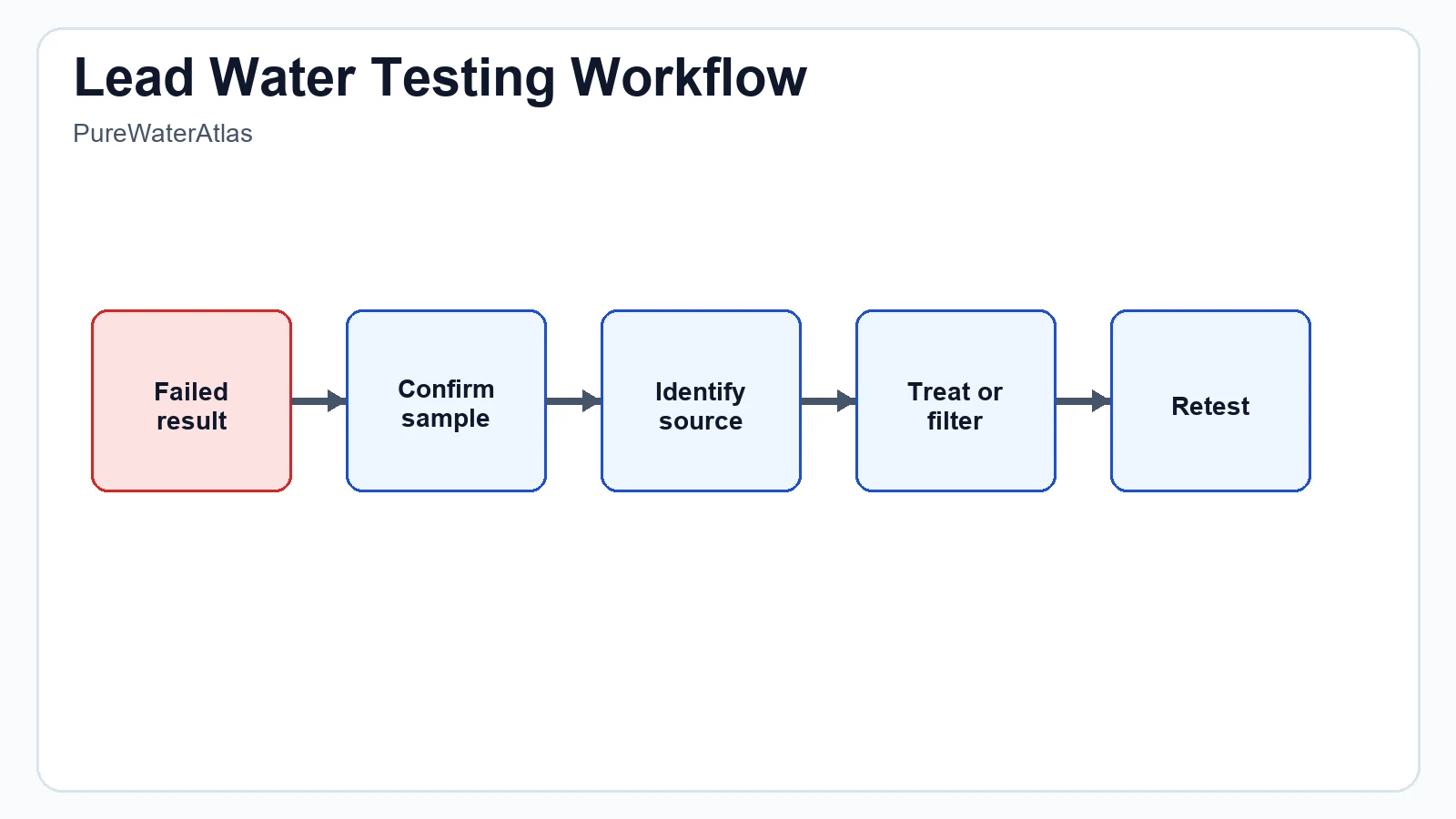
If a result comes back above your comfort level or above applicable guidance, PureWaterAtlas offers a practical next-step resource on what to do if your water test fails.
Lead testing in private wells versus public water systems
Private well owners should understand that lead in well water is usually a plumbing issue rather than a groundwater issue. Lead is uncommon as a natural dissolved contaminant in most groundwater compared with metals like iron, manganese, or arsenic in specific geologic settings. However, once well water enters a home’s pressure tank, piping, and fixtures, corrosion can still introduce lead at the tap. That means private well owners need to test the tap water they actually drink, not simply assume the well source is lead-free.
The U.S. Geological Survey provides broader scientific context on water quality, groundwater, and hydrologic systems through its water resources mission area. For both well users and municipal customers, the central point remains the same: lead testing should focus on the water delivered at the tap.
Special considerations for schools, childcare facilities, and multifamily buildings
Lead control in institutions and larger buildings deserves special attention because water use patterns are often irregular and plumbing networks are complex. In schools and childcare settings, some fixtures may sit unused for extended periods, increasing stagnation and corrosion contact time. Drinking fountains, classroom sinks, kitchen taps, nurse stations, and bottle-filling stations may each perform differently.
Best practice usually includes fixture inventories, routine sampling plans, clear communication with building occupants, and prompt removal from service of taps with concerning results until controls are in place. In multifamily housing, each unit may not have identical plumbing pathways, so representative sampling should be designed carefully rather than assuming one test applies to every residence.
Limitations of testing and the importance of follow-up
Even the best laboratory result is still a snapshot. Lead release can change over time, especially after plumbing work, treatment changes, seasonal shifts, or long periods of stagnation. That is why follow-up matters. Retesting is especially important:
- After replacing fixtures or plumbing
- After installing a treatment device
- After cleaning aerators if particulate buildup was present
- After a utility announces changes in corrosion control or source water
- When vulnerable residents move into the home
Repeated testing should use comparable methods so that results can be interpreted meaningfully. Comparing a first-draw lab sample to a random grab sample from a different tap may create more confusion than clarity.
Best practices for choosing a laboratory or test provider
When selecting a testing service, look for:
- Accreditation or certification for drinking water metals analysis
- Clear sample collection instructions
- Appropriate reporting limits for lead
- Transparent turnaround times and pricing
- Availability of multi-metal panels if broader testing is desired
- Customer support that can explain sample types and reports
Be cautious about providers that market dramatic conclusions without explaining methods, reporting limits, or sample conditions. Good testing is not just about obtaining a number; it is about obtaining a number that accurately answers the question you asked.
FAQ
Can I tell if my water contains lead by taste or color?
No. Lead usually has no obvious taste, smell, or color in drinking water. Testing is the only reliable way to know whether it is present.
Is a home lead test kit accurate enough?
A lead test kit can be useful for screening, but certified laboratory testing is more reliable for confirmation, low-level detection, and decisions about treatment or plumbing replacement.
Does boiling water remove lead?
No. Boiling does not remove lead. If water evaporates during boiling, the lead concentration can actually increase.
What is the safest tap to test?
The kitchen cold-water tap is often the most important because it is commonly used for drinking and cooking. In larger buildings, additional taps may also need testing.
If my result is below 15 ppb, should I still act?
Often yes, especially if infants, children, or pregnant people use the water. The 15 ppb figure is a regulatory action level for public water systems, not a zero-risk threshold for individual households.
Should I test only for lead or order a heavy metals water test?
If corrosion or broader contamination is suspected, a heavy metals water test can be useful. If lead is the main concern, make sure the test has a suitably low reporting limit and a sampling protocol designed for tap lead evaluation.
Conclusion
Lead water testing is essential because lead is invisible, variable, and potentially harmful even at low concentrations. The most reliable approach usually combines good sampling design with accredited laboratory analysis, especially when results will guide decisions about filtration, plumbing replacement, or occupant safety. A simple lead test kit can help with initial screening, but confirmed concerns deserve stronger analytical methods. Whether the issue involves an old service line, lead-bearing brass, solder, or corrosion-related particle release, the path forward starts with measuring the water at the tap people actually use. With a sound testing strategy, careful interpretation, and prompt follow-up, households and institutions can make informed decisions that strengthen water safety lead protection over the long term.



Read the full guide: Water Testing Guide
Explore more in this category: Water Testing Articles