
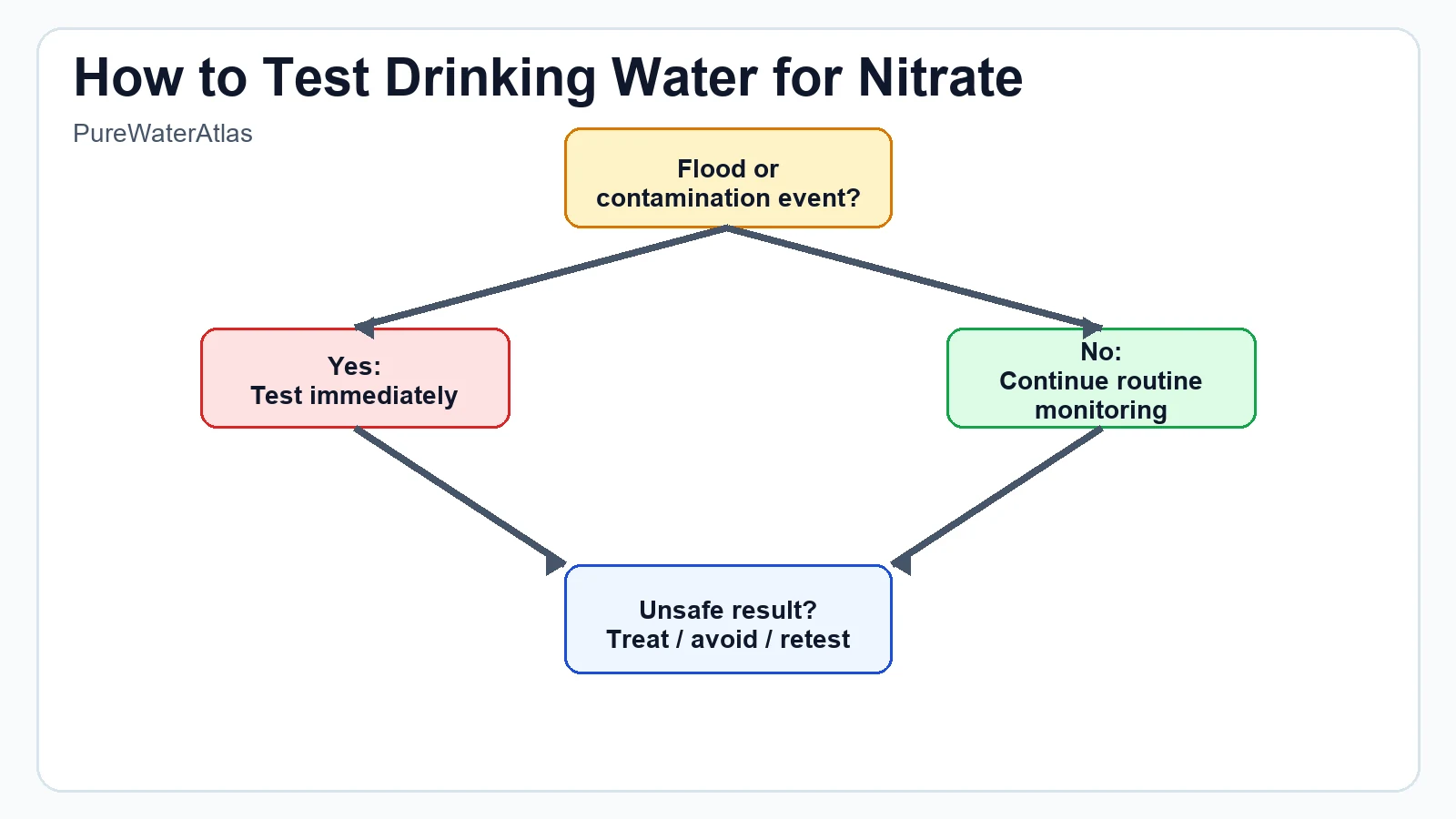
Nitrate water testing is one of the most important parts of evaluating drinking water safety, especially for private wells, rural households, and any water supply influenced by farming, septic systems, or shallow groundwater. Nitrate is colorless, odorless, and tasteless at levels that can still be harmful, which means contamination often goes unnoticed without laboratory analysis or a properly used field test. For homeowners, land managers, and public health-minded readers, understanding how to test for nitrates in drinking water is not just a technical exercise. It is a practical step in reducing preventable health risks, interpreting water quality reports accurately, and deciding when treatment or a follow-up investigation is needed.
Although nitrate occurs naturally at low concentrations in the environment, elevated levels in drinking water are usually a sign of human activity. Fertilizer runoff, manure management, leaking septic systems, wastewater inputs, and other forms of drinking water contamination from different sources can increase nitrate contamination water concerns in both private and public supplies. In agricultural regions, groundwater can accumulate nitrate over years or decades, making testing especially important even if the water looks clear and tastes normal.
What nitrate is and why it is tested in drinking water
Nitrate is a chemical ion made of one nitrogen atom and three oxygen atoms, written as NO3–. It is part of the nitrogen cycle, a natural process in which nitrogen moves through soil, water, plants, animals, microbes, and the atmosphere. In water quality science, nitrate is commonly discussed together with nitrite, another nitrogen compound written as NO2–. Nitrite is usually less stable in oxygen-rich water and often appears as an intermediate during microbial conversion between ammonia and nitrate. Because these compounds are chemically related and have different toxicological implications, nitrate water testing sometimes includes nitrite test water analysis as well.
Testing matters because nitrate is highly soluble in water and does not easily bind to soil in the same way some other contaminants do. That mobility allows nitrate to move through the ground and into aquifers, especially after fertilizer application, rainfall, irrigation, or waste infiltration. Once it reaches groundwater, it may persist long enough to affect wells and springs used for drinking water.
For public water systems, nitrate is regulated and routinely monitored. For private wells, however, the responsibility for testing usually falls on the owner. That difference is critical. A private well can be vulnerable to nitrate contamination water problems without any automatic monitoring requirement, and users may not know there is an issue until a child, pregnant household member, or clinician raises concern.
From a regulatory perspective, the U.S. Environmental Protection Agency sets a Maximum Contaminant Level of 10 mg/L as nitrate-nitrogen for public drinking water, and 1 mg/L as nitrite-nitrogen. Laboratories may report results in different units, so interpretation requires care. In some reports nitrate is listed as nitrate as nitrogen (NO3-N), while in others it is listed as nitrate ion (NO3–). These are not the same number. A result of 10 mg/L nitrate-nitrogen is approximately equivalent to 44 mg/L nitrate ion. This distinction is one of the most common sources of confusion in water nitrate levels reporting.
Why high nitrate levels are a drinking water safety concern
Water safety nitrates concerns exist because ingested nitrate can be converted in the body to nitrite under certain conditions. Nitrite can interfere with the blood’s ability to carry oxygen by oxidizing hemoglobin to methemoglobin. Infants under about six months of age are the classic high-risk group because they are more vulnerable to methemoglobinemia, sometimes called blue baby syndrome. This is the reason nitrate standards in drinking water are strongly tied to infant protection.
Risk is not limited to infants alone, but infant exposure is the primary basis for the drinking water standard. People should not assume that boiling contaminated water makes it safer. Boiling can actually concentrate nitrate as water evaporates. Likewise, standard disinfection does not remove nitrate. Chlorination, ultraviolet treatment, and routine bacterial control methods address microbes, not dissolved nitrate.
The broader health literature on nitrate, nitrite, diet, and disease is complex, and dietary nitrates from vegetables are not the same public health issue as nitrate in untreated drinking water. For drinking water, the most practical message is straightforward: if nitrate levels are elevated, especially in water used for infant formula preparation, the water should be promptly evaluated and managed.
For basic drinking water health information, readers can review the CDC guidance on drinking water and the World Health Organization overview of drinking-water safety. These resources provide broader context, while nitrate-specific decisions still depend on actual test results, the type of water source, and who is consuming the water.
Common sources of nitrate contamination in water
Nitrate contamination water problems usually arise from land use and waste management rather than from the plumbing inside the home. Understanding likely sources helps you decide when testing is most urgent and whether repeat testing is warranted.
Agricultural fertilizer and manure
Agricultural water pollution is one of the best-known contributors to elevated nitrate in groundwater. Nitrogen fertilizers applied to crops can be converted by soil microbes into nitrate, which then leaches downward with infiltrating water. Manure from livestock operations can contribute in the same way. Areas with intensive crop production, irrigation, sandy soils, or shallow aquifers are particularly vulnerable.
Septic systems and wastewater
Failing or overloaded septic systems can release nitrogen compounds into surrounding soil and groundwater. In areas with many homes on small lots, cumulative septic impacts may be substantial. Wastewater lagoons, sewer leaks, and other disposal systems can also be relevant sources.
Natural background and soil processes
Some nitrate occurs naturally from soil organic matter breakdown and atmospheric deposition. In most settings, natural background levels are relatively low compared with levels caused by fertilizer or sewage inputs. Still, local geology and hydrogeology influence what “normal” looks like.
Well construction and shallow groundwater vulnerability
Shallow wells, poorly sealed wells, older dug wells, and wells located downgradient from fields, barns, feedlots, or septic drain fields are more likely to show elevated nitrate. Seasonal rainfall and irrigation patterns can also change water nitrate levels over time, which is one reason a single test is helpful but not always sufficient for long-term assurance.
For national groundwater context, the U.S. Geological Survey water resources program is a useful authority on hydrology, contaminants, and aquifer behavior.
Who should prioritize nitrate water testing
Any household can benefit from periodic water quality screening, but nitrate testing is especially important for certain situations.
- Private well users, because wells are not routinely regulated like public systems
- Homes in agricultural areas where fertilizer or manure is commonly used
- Properties near septic systems, feedlots, or wastewater sources
- Families with infants or pregnant people in the household
- Homes with shallow, older, or recently flooded wells
- Anyone who notices a history of elevated nitrate in neighbors’ water reports or county health advisories
If you rely on a private well, a broader well water testing checklist is useful because nitrate can occur alongside coliform bacteria, pesticides, hardness, iron, manganese, and other region-specific contaminants.
When to test for nitrates in drinking water
There is no single testing schedule that fits every property, but good practice is to test private well water for nitrate at least annually in higher-risk settings. Additional testing is sensible after conditions that may increase contamination risk or change groundwater flow.
Recommended times to test
- When buying a home with a private well
- When a new infant will be using the water
- At least once a year in agricultural or septic-influenced areas
- After well repairs, replacement, or flooding
- After major nearby land-use changes, such as new manure storage or heavy fertilizer use
- When previous results showed rising but still substandard levels
Season matters. In some areas, nitrate peaks after fertilizer application, heavy rain, snowmelt, or irrigation recharge. If a well has a history of borderline results, testing at the same time each year can help identify trends, while occasional off-season testing may reveal worst-case conditions.
Main methods used for nitrate water testing
Several analytical approaches are used to measure nitrate in drinking water. The best choice depends on why you are testing, how accurate the result must be, whether you also need nitrite test water data, and whether the result may guide health-sensitive decisions.
Certified laboratory testing
Laboratory testing is the most reliable method for confirming water nitrate levels. Certified labs use standardized analytical methods, quality control procedures, calibration standards, blank samples, and detection limits designed to produce defensible results. Common methods include colorimetric analysis after chemical reduction, ion chromatography, and automated analyzer techniques.
For any result that may affect infant feeding or major treatment decisions, laboratory analysis is the preferred approach. Home test strips can be useful screening tools, but they should not be treated as equivalent to full laboratory confirmation when accuracy matters most.
Home test strips
Test strips are widely sold for nitrate and sometimes nitrite. They are simple to use, inexpensive, and fast. The user dips the strip into the water sample, waits a specified amount of time, and compares the color against a chart. Some products provide semi-quantitative ranges rather than precise numbers.
These kits can be helpful for screening or for checking whether treatment seems to be working, but they have limitations. Color interpretation can be subjective. Lighting affects readability. Humidity and expired strips can impair performance. Matrix effects from water chemistry may also interfere. If a strip suggests elevated nitrate, or if a sensitive population depends on the water, follow up with a certified lab.
Digital photometers and field kits
More advanced field kits use reagents plus a handheld colorimeter or photometer to estimate nitrate concentration. These can offer better precision than simple strips when properly maintained and calibrated. They are often used by field professionals, farm managers, environmental technicians, and some homeowners who test regularly.
Even then, field methods require careful sample handling, clean cuvettes, correct timing, and awareness of interferences. They are excellent tools in the right hands, but they still do not replace a formal drinking water lab report when a regulatory or clinical-quality decision is needed.
Nitrite-specific testing
Nitrite test water analysis is less commonly requested by homeowners than nitrate testing, but it can be relevant. In most oxygen-rich groundwater, nitrite is usually low because it is rapidly converted to nitrate. Still, nitrite may be measured when there is concern about recent contamination, unusual redox conditions, treatment-system performance, or complete regulatory compliance. Some labs report nitrate, nitrite, and nitrate-plus-nitrite as separate values.
How laboratory nitrate testing works
While homeowners do not need to become analytical chemists, it helps to understand the basics of how labs measure nitrate. Many laboratory methods convert nitrate into a measurable colored compound. In one common approach, nitrate is chemically reduced to nitrite, then reacted with color-forming reagents. The intensity of the resulting color is proportional to concentration and is read by an instrument at a defined wavelength. Other labs may use ion chromatography, which separates ions and measures them instrumentally.
Reliable labs also manage quality control by running standards, duplicates, blanks, and recovery checks. This matters because low-level contamination, reagent degradation, or instrument drift can otherwise distort results. When you submit a drinking water sample, the credibility of the final number depends on both the method and the lab’s quality assurance practices.
If you want a broader overview of sampling and analysis, PureWaterAtlas also covers how to test drinking water properly across different contaminants and methods.
How to collect a drinking water sample for nitrate analysis
Sample collection is often underestimated. A good analytical method cannot rescue a poorly collected sample. Fortunately, nitrate sampling is usually simpler than bacteriological sampling because it does not require the same sterile technique, but accuracy still depends on following instructions closely.
Use the right container
If using a laboratory, follow the lab’s instructions exactly. Many labs provide a clean sample bottle, required volume, labeling instructions, and shipping guidance. Use only the provided container or one explicitly approved by the lab.
Choose the right tap
Collect the sample from a cold-water tap commonly used for drinking, ideally one that is not connected to a treatment device unless you intentionally want to test post-treatment water. If you are evaluating the raw water source, sample before any treatment system when possible.
Flush appropriately
Often, the best practice is to let the cold water run for a few minutes to clear the plumbing and obtain a more representative sample of the well or supply line. Some labs specify the flush time. Follow their instructions.
Avoid contamination
Do not touch the inside of the bottle or cap. Do not rinse the bottle unless the lab tells you to. Fill to the indicated level. Cap tightly. Label the bottle with date, time, location, and any requested identification number.
Keep and ship as directed
Some nitrate samples should be kept cool and delivered promptly. Others may include preservatives supplied by the lab. Again, the key is to follow the lab protocol because holding time and storage conditions affect data quality.
Step-by-step: how to use a home nitrate test kit
Home screening kits vary by manufacturer, so package directions come first. Still, the following process reflects good general practice for nitrate water testing at home.
- Read the instructions fully before opening the kit.
- Check the expiration date and storage condition of the kit.
- Wash and dry your hands to avoid contaminating the strip or sample.
- Use a clean container or the one provided.
- Collect cold water from the chosen tap, often after a short flush.
- Dip the strip for the exact time specified, or add reagents in the correct order if using a vial-based kit.
- Wait the specified development time precisely.
- Compare the color under good neutral lighting, or use the digital reader if included.
- Record the result immediately with units.
- Repeat the test if the instructions recommend duplicates or if the result is unexpectedly high.
For best results, avoid strong colored backgrounds, dim light, or reading the strip too early or too late. If the kit offers a broad range rather than a single number, interpret cautiously. A result that appears close to a health threshold should be confirmed by laboratory testing.
Understanding units and reporting formats
Few issues create more confusion than units. Interpreting nitrate data correctly is essential to avoid false reassurance or unnecessary alarm.
| Reporting format | Meaning | Key comparison value |
|---|---|---|
| mg/L nitrate-nitrogen (NO3-N) | Only the nitrogen portion of nitrate is counted | 10 mg/L is the U.S. drinking water standard |
| mg/L nitrate ion (NO3–) | The full nitrate molecule is counted | About 44 mg/L equals 10 mg/L as nitrate-nitrogen |
| mg/L nitrite-nitrogen (NO2-N) | Only the nitrogen portion of nitrite is counted | 1 mg/L is the U.S. drinking water standard |
Always ask the lab what format they used. A result of 8 mg/L nitrate as nitrogen is below the federal limit but still notable enough to watch, especially in vulnerable settings. A result of 8 mg/L nitrate ion, by contrast, is much lower. Same number, very different meaning.
For additional regulatory background, the EPA drinking water program provides authoritative information on standards, monitoring, and public water system oversight.
How to interpret nitrate test results
Interpreting results involves more than checking whether a number is above or below a line. Trend, source, users of the water, and test method all matter.
Very low results
If nitrate is non-detect or present at very low levels, the immediate concern is low, but that does not guarantee the water is free from all contamination. Wells still require periodic testing for other hazards. Also remember that nitrate levels can change seasonally or over time if nearby land use changes.
Low to moderate results below the standard
Results below the regulatory limit are generally compliant for public drinking water standards, but they can still be useful indicators. A gradual upward trend may suggest increasing influence from agricultural water pollution or wastewater sources. In private wells, rising nitrate can function as an early warning sign even before levels exceed health-based limits.
Results near the standard
Results approaching 10 mg/L as nitrate-nitrogen should be taken seriously, especially if infants may consume the water or if the measurement came from a home kit rather than a certified lab. Confirm with laboratory testing and consider repeating the sample to assess consistency.
Results above the standard
Results above the drinking water limit indicate the water is not acceptable for routine consumption by public water standards unless corrective action is taken. Private well owners should act promptly, especially if preparing infant formula or if vulnerable individuals are present. Confirm the result if needed, identify whether the problem is persistent, and evaluate treatment or alternate water supplies.
If you need help reading a report, PureWaterAtlas provides a guide to understanding water test results, including common unit and interpretation issues.
What to do if nitrate levels are high
If nitrate water testing shows elevated concentrations, the right response depends on the level, the confidence in the result, and who is using the water.
Immediate protective actions
- Do not use high-nitrate water for infant formula preparation.
- Arrange a confirmatory lab test if the initial result came from a screening kit.
- Use an alternative safe water source for drinking and cooking if advised by local health authorities or if levels are clearly elevated.
- Do not rely on boiling to remove nitrate.
Investigate the source
Look at nearby fertilizer use, manure storage, septic condition, recent flooding, and well construction. Sometimes nitrate increases after heavy recharge events; in other cases it reflects a chronic source and aquifer vulnerability. A licensed well professional or local environmental health department may help identify structural problems such as poor well sealing or surface infiltration pathways.
Consider treatment options
Not all water treatment removes nitrate. Effective options typically include reverse osmosis, ion exchange designed for nitrate removal, or distillation. The best choice depends on water chemistry, maintenance capacity, flow needs, waste stream management, and whether the goal is point-of-use treatment for drinking water or whole-house treatment.
Activated carbon by itself is generally not a nitrate removal technology. Standard sediment filters and most softeners do not reliably solve the problem unless specifically designed and operated for nitrate control. Any treatment system should be followed by post-treatment testing to confirm performance.
If you are dealing with a failed result, this guide on what to do if your water test fails can help structure the next steps logically.
How nitrate testing fits into a complete water safety strategy
Nitrate testing is important, but it should not be isolated from the wider picture of water quality. A well may have safe nitrate levels while still containing bacteria, arsenic, pesticides, uranium, lead from plumbing, or other contaminants. Conversely, nitrate can act as a marker that the water source is vulnerable to surface-derived contamination generally.
That is why comprehensive water testing programs often include nitrate alongside coliform bacteria, pH, total dissolved solids, hardness, metals, and region-specific contaminants. Households that want a broader roadmap can explore the water testing category for related guidance on sampling, interpretation, and follow-up decisions.
Special considerations for private wells versus public water systems
Public water systems
Public water systems are subject to federal and state monitoring requirements, treatment standards, reporting obligations, and enforcement mechanisms. Consumers can often review annual water quality reports and should contact the utility if they have questions about nitrate data, units, detection frequency, or source water vulnerability.
Private wells
Private wells do not usually receive automatic oversight. That makes owner awareness essential. The absence of taste, smell, or visible discoloration does not indicate safety. In well-dependent households, routine nitrate water testing is often among the highest-value preventive actions because the contaminant is common, mobile, and invisible.
Limitations of nitrate testing and common mistakes
Even a good test can mislead if the sampling plan or interpretation is poor. The following mistakes are common.
- Assuming clear water means safe water
- Using an expired home test kit
- Misreading units such as nitrate versus nitrate-nitrogen
- Relying on a single old result despite changing land use or seasons
- Testing after a treatment device when the goal was to assess source water
- Assuming boiling removes nitrate
- Ignoring nitrite when a complete nitrogen profile is needed
Another limitation is that nitrate testing alone does not reveal the exact source. Elevated nitrate suggests contamination pathways, but source attribution may require hydrogeologic assessment, isotopic studies, bacterial indicators, land-use review, or repeat sampling over time.
Preventing nitrate contamination where possible
Some nitrate problems are historical or regional and cannot be solved by one homeowner alone, but prevention still matters. Good source protection reduces long-term risk and helps stabilize water nitrate levels.
- Maintain septic systems properly and pump them as recommended
- Keep fertilizers away from wells and apply only as needed
- Manage manure storage to reduce runoff and infiltration
- Protect the sanitary seal and casing of the well
- Direct surface water away from the wellhead
- Inspect older wells for structural vulnerabilities
- Seal abandoned wells that can act as direct contamination conduits
In farming regions, nitrate prevention often requires coordinated land management at a scale larger than one household. Still, individual well testing remains essential because source-control efforts can take years to affect groundwater quality.
FAQ
How often should I test my well for nitrate?
In higher-risk areas, annual testing is a practical minimum. Test more often if you have a shallow well, recent flooding, nearby agricultural activity, septic concerns, or a previous result that was elevated or trending upward.
Can I smell or taste nitrate in drinking water?
No. Nitrate is typically colorless, odorless, and tasteless at levels relevant to health protection. Testing is the only reliable way to know the concentration.
Are home nitrate test strips accurate enough?
They are useful for screening, but they are less reliable than certified laboratory analysis. Any concerning result, especially one near or above a health threshold, should be confirmed by a lab.
Is nitrate the same as nitrite?
No. They are related nitrogen compounds but not identical. Nitrate is NO3– and nitrite is NO2–. Labs may test one or both, and the drinking water standards differ.
Does boiling water remove nitrate?
No. Boiling can increase nitrate concentration because water evaporates while the dissolved nitrate remains.
What treatment removes nitrate from drinking water?
Common effective options include reverse osmosis, nitrate-selective ion exchange, and distillation. Always verify performance with follow-up testing after installation.
Conclusion
Nitrate water testing is a foundational part of responsible drinking water management because nitrate contamination water issues are common, invisible, and potentially serious, particularly for infants and private well users. The most reliable approach is to combine risk-based testing frequency, careful sample collection, correct unit interpretation, and follow-up action when results are elevated. Whether you begin with a home screening kit or go directly to a certified laboratory, the goal is the same: obtain trustworthy data and use it to protect health. In practice, good nitrate testing is not just about getting a number. It is about understanding what that number means, how it may change over time, and what steps are needed to keep drinking water genuinely safe.
Read the full guide: Water Testing Guide
Explore more in this category: Water Testing Articles