
Introduction
Concerns about PFAS in drinking water have grown rapidly as more communities, regulators, and researchers have identified these persistent chemicals in public water systems and private wells. Many homeowners and renters want to know the same thing: are there reliable pfas in drinking water warning signs they can watch for before a problem becomes serious?
The most important educational point is that PFAS contamination often does not behave like traditional water problems. With some water quality issues, people may notice cloudiness, staining, scale buildup, a sulfur smell, or an unusual metallic taste. PFAS are different. In many cases, contaminated water looks, smells, and tastes completely normal. That is why understanding risk indicators, exposure pathways, and proper testing matters so much.
This article explains what PFAS are, where they come from, what health concerns they are associated with, and how to think clearly about symptoms, household clues, and the limits of observation alone. It also covers pfas in drinking water taste and odor, the truth about pfas in drinking water visible signs, likely pfas in drinking water health symptoms, and pfas in drinking water when to test. If you are trying to evaluate your home, school, workplace, or local water supply, the goal is to help you distinguish between evidence-based concerns and common misconceptions.
For broader context on contamination issues affecting water supplies, readers may also find useful resources in water contamination, global water quality, and water science.
What It Is
PFAS stands for per- and polyfluoroalkyl substances, a large group of human-made chemicals used for decades in industrial processes and consumer products. They have been used because of their ability to resist heat, oil, grease, stains, and water. This made them valuable in products such as nonstick cookware, stain-resistant textiles, food packaging, firefighting foams, and certain industrial coatings.
PFAS are often called “forever chemicals” because many of them do not break down easily in the environment. Instead, they can persist in soil, groundwater, rivers, lakes, and even in the human body. That persistence is one reason these chemicals have become such a major public health topic.
When people talk about PFAS in drinking water, they are usually referring to contamination from specific compounds within this large chemical family. Historically, two of the most studied were PFOA and PFOS, but many other PFAS compounds are now being monitored and regulated. As older PFAS were phased out in some uses, replacement chemicals also entered commerce, and researchers continue to study how they behave and what risks they may pose.
A key challenge is that PFAS contamination is chemically complex. Different PFAS compounds can move through the environment differently, remain in water for different lengths of time, and accumulate in people or wildlife to different degrees. That means a complete assessment is rarely as simple as one yes-or-no test result.
If you are new to the topic, a more comprehensive overview can be found in this complete guide to PFAS in drinking water.
Main Causes or Sources
Understanding likely contamination sources is one of the most practical ways to identify pfas in drinking water risk indicators. While PFAS cannot usually be detected with the senses, the presence of nearby source activities can be an important red flag.
Industrial Facilities
Manufacturing plants that produced or used PFAS-containing materials are among the most significant contamination sources. This includes facilities involved in chemical manufacturing, metal finishing, electronics, plating, textile treatment, paper coating, and related industrial processes. Wastewater discharges, spills, air emissions, and improper disposal can all contribute to contamination over time.
Firefighting Foam Use
One of the best-known PFAS sources is aqueous film-forming foam, or AFFF, which has been widely used to suppress fuel fires. Airports, military installations, firefighting training grounds, refineries, and some industrial emergency response sites have used these foams extensively. Where repeated foam application occurred, PFAS may have migrated into soil and groundwater.
Landfills and Waste Disposal Areas
Landfills can receive PFAS-containing waste from homes, businesses, and industry. As rainwater percolates through waste, contaminated leachate can form. If not fully controlled, that leachate may affect nearby groundwater or surface water. Communities near active or closed landfills should consider this an important location-based risk factor.
Wastewater Treatment and Biosolids
Conventional wastewater treatment plants are not designed to fully remove PFAS. As a result, PFAS can pass through treatment systems into discharged water or concentrate in sewage sludge. Where biosolids have been land-applied, contamination may enter soils and potentially affect groundwater or nearby wells.
Private Well Vulnerability
Private wells can be especially concerning because they are not typically monitored as regularly as public systems. If a well is located near an airport, military base, landfill, industrial site, wastewater treatment plant, or agricultural land treated with biosolids, the chance of contamination may be higher. This is one of the clearest examples of pfas in drinking water when to test: if your property is close to a known or potential PFAS source, testing should be strongly considered even if the water appears normal.
Surface Water and Watershed Impacts
Public water systems that draw from rivers, reservoirs, or lakes can also be affected if upstream contamination sources release PFAS into the watershed. In these cases, contamination may reflect regional land use rather than a single nearby source. This is why some communities far from obvious industrial activity still discover PFAS in treated drinking water.
Readers looking for a source-focused explanation can explore PFAS in drinking water causes and sources.
Health and Safety Implications
Questions about health effects often begin with a search for immediate bodily clues. People naturally want to know whether there are recognizable pfas in drinking water health symptoms that indicate exposure. The answer requires some care: PFAS exposure usually does not cause a distinctive short-term symptom pattern that clearly points to contaminated water. Instead, concern is primarily based on long-term exposure and elevated risk over time.
Why Symptoms Are Hard to Identify
Many contaminants can cause obvious acute effects, such as stomach distress from microbial contamination or irritation from chemical spills. PFAS are different. At the levels typically discussed in drinking water, they do not usually produce immediate, unmistakable symptoms after a person drinks a glass of water. That means relying on how you feel from day to day is not a dependable way to determine whether PFAS are present.
This lack of a clear symptom pattern is one reason people may miss the problem entirely. Water can be consumed for years before contamination is discovered through monitoring, environmental investigation, or regulatory action.
Potential Health Concerns
Scientific research has linked exposure to certain PFAS with a range of possible health effects. Not every PFAS compound has been studied equally, and risk depends on factors such as the compound involved, dose, duration of exposure, age, and individual health status. However, areas of concern identified in the scientific literature and public health guidance have included:
- Changes in cholesterol levels
- Impacts on liver function markers
- Reduced immune response, including vaccine response in some studies
- Developmental effects in infants and children
- Pregnancy-related concerns, such as increased risk of certain complications
- Changes in thyroid-related measures
- Increased risk of kidney cancer and testicular cancer for certain well-studied PFAS
Who May Face Higher Concern
Some groups may warrant extra caution when PFAS contamination is suspected or confirmed:
- Pregnant people and those planning pregnancy
- Infants and young children
- People who rely on private wells in high-risk locations
- Communities with known historical industrial or firefighting foam use
- People with long-term daily exposure through drinking, cooking, or formula preparation
What Counts as a Red Flag?
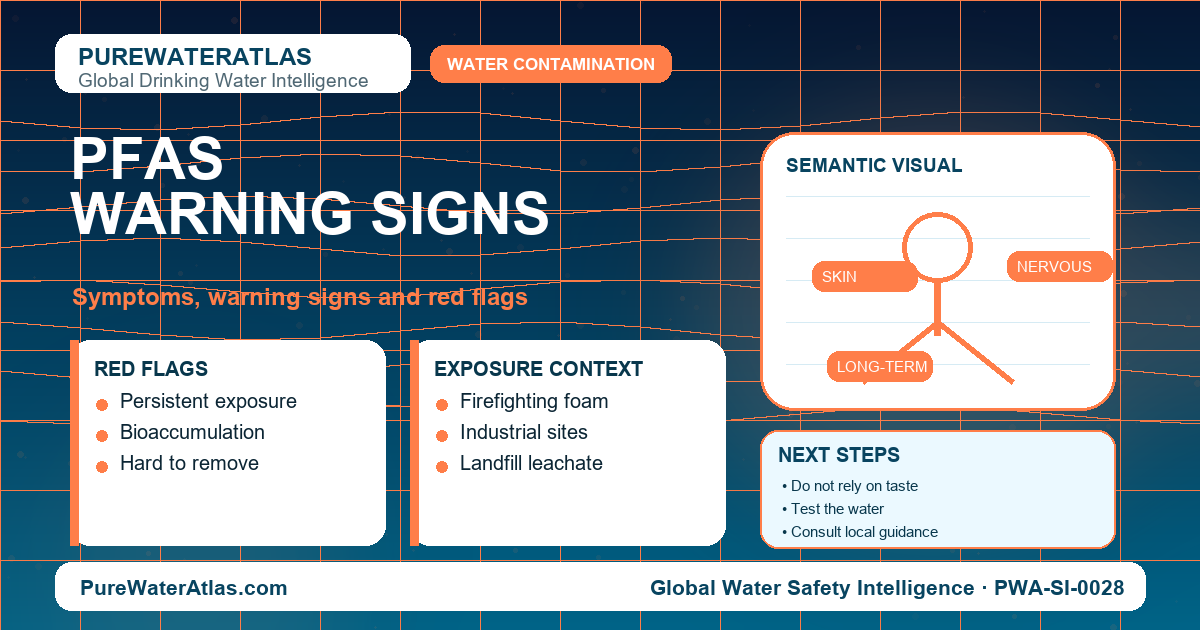
Because health effects are usually not immediate or uniquely identifiable, the most meaningful red flags are often environmental and situational rather than medical. Important examples include:
- Your home is near a military base, airport, landfill, or industrial facility
- Your water supplier has issued notices about PFAS monitoring or exceedances
- Neighbors with private wells have found PFAS contamination
- State or local environmental agencies have investigated PFAS in your area
- Your drinking water source is downstream of a known contamination site
In other words, the strongest pfas in drinking water warning signs are rarely a strange flavor or a sudden symptom. They are patterns of risk, geography, and documented contamination pathways.
For more detail on research and risk interpretation, see PFAS in drinking water health effects and risks.
Testing and Detection
If there is one principle to remember, it is this: PFAS usually must be confirmed through laboratory testing, not by sight, smell, or taste. This has major implications for homeowners, schools, landlords, and local officials.
Can You Detect PFAS by Taste or Smell?
Many people search for information about pfas in drinking water taste and odor. The simple answer is that PFAS contamination generally does not produce a reliable taste or smell at the concentrations relevant to drinking water health concerns. Water with PFAS may taste completely normal. If your water has an unusual taste, odor, or visible residue, that may indicate other water quality issues such as sulfur compounds, chlorine, iron, manganese, organic matter, or bacterial activity, but not necessarily PFAS.
This point is critically important because it prevents false reassurance. Water that tastes fresh and clean may still contain PFAS. Conversely, unpleasant-tasting water is not proof of PFAS contamination.
Are There Visible Signs?
There are usually no dependable pfas in drinking water visible signs in the glass, sink, toilet bowl, or plumbing fixtures. PFAS generally do not create a distinctive color, cloudiness, oily sheen, staining pattern, or sediment that a homeowner can use as a diagnostic clue. If visible issues are present, they may relate to hardness, corrosion, suspended solids, algae, iron bacteria, or other contaminants.
That means the absence of visible changes should never be used to rule out PFAS.
When to Test
Understanding pfas in drinking water when to test is one of the most practical steps a household can take. Testing is especially appropriate when:
- You use a private well near a possible PFAS source
- Your community has reported PFAS detections or is under investigation
- You live near an airport, military installation, industrial facility, landfill, or wastewater discharge area
- You have received notice from your water utility about PFAS monitoring results
- You are buying a home with a private well in a potentially affected area
- You are pregnant, have infants in the home, or want added assurance due to long-term exposure concerns
How Testing Works
PFAS testing should be performed by a qualified laboratory using approved analytical methods. Proper sample collection is important because PFAS are used in many consumer products, and accidental contamination of the sample can occur if procedures are not followed carefully. Laboratories or local health departments may provide instructions about containers, handling, and what products to avoid during sampling.
Tests may screen for only a small number of PFAS compounds or for a broader panel. Since regulations and advisories often focus on specific chemicals, it is important to understand exactly which compounds are included in the test report.
Public Water vs. Private Wells
Public water systems may be required to monitor for PFAS under federal or state rules, and consumers can often review results through annual consumer confidence reports, utility websites, or state databases. Private well owners, however, are usually responsible for arranging and paying for their own testing. This makes awareness especially important for households outside municipal water service.
Interpreting Results
Once test results are available, they should be compared with current federal and state standards, advisories, or maximum contaminant levels where applicable. Interpretation can be complex because standards may differ by jurisdiction and can change as science and regulation evolve. For that reason, residents should use current information from regulators, certified laboratories, or public health agencies rather than relying on outdated charts shared online.
Prevention and Treatment
Once PFAS contamination is suspected or confirmed, the next question is how to reduce exposure. Prevention and treatment strategies operate at both the household and community level.
Reducing Exposure at Home
If your water has elevated PFAS or you are waiting for test results in a high-risk area, practical exposure reduction steps may include:
- Using an alternative drinking water source if advised by health officials
- Using treated water for drinking, cooking, ice, coffee, tea, and infant formula
- Paying attention to all ingestion pathways, not just direct drinking water
- Staying informed through utility notices or local health department updates
Point-of-Use Treatment Options
Certain treatment technologies can reduce PFAS in water, but not all filters are equally effective. Systems commonly discussed include:
- Granular activated carbon (GAC)
- Reverse osmosis (RO)
- Ion exchange systems
Selection depends on the PFAS compounds present, concentrations, water chemistry, maintenance capacity, and whether treatment is needed at a single tap or for the whole home. Look for systems with performance data or certifications relevant to PFAS reduction. Filters must also be maintained and replaced as directed; a neglected system may lose effectiveness.
Whole-System Solutions
At the municipal scale, treatment may involve larger GAC systems, ion exchange media, membrane processes, blending strategies, or changes in source water management. These projects can be expensive, but they are often necessary when contamination affects an entire community water supply.
Source Control
The most effective long-term solution is preventing PFAS from entering the environment in the first place. That may involve:
- Replacing PFAS-containing firefighting foams
- Improving industrial waste handling and discharge controls
- Cleaning up contaminated soil and groundwater
- Monitoring leachate and wastewater streams
- Restricting future releases through policy and procurement choices
Medical Testing vs. Water Testing
Some people consider blood testing for PFAS. While blood tests can show whether exposure has occurred, they generally do not identify the source and may not change the immediate steps needed to reduce drinking water exposure. Environmental testing of the water supply remains the key first step for households evaluating current risk.
Common Misconceptions
PFAS in drinking water is often misunderstood, partly because these chemicals do not fit the usual pattern people expect from contaminated water. Clearing up common myths helps people focus on evidence-based decisions.
Misconception 1: If the Water Looks Clear, It Is Safe
Clear water can still contain PFAS. Clarity is not a reliable indicator. This is why there are usually no trustworthy pfas in drinking water visible signs.
Misconception 2: You Would Notice a Strange Taste or Odor
In most cases, you would not. Questions about pfas in drinking water taste and odor are understandable, but PFAS contamination is typically not detectable through the senses at health-relevant levels.
Misconception 3: Symptoms Will Tell You if You Have Been Exposed
There is no signature symptom that confirms PFAS in drinking water. Potential health effects are associated mainly with long-term exposure and are not usually obvious or unique in the short term.
Misconception 4: Only Industrial Towns Need to Worry
While industrial areas are important, PFAS contamination can also occur near airports, military sites, landfills, wastewater systems, and downstream watersheds. Rural well owners may also face risk depending on local conditions.
Misconception 5: Any Home Filter Will Solve the Problem
Pitcher filters or general-purpose systems may not be designed to reduce PFAS effectively. Treatment should be selected based on verified performance and maintained properly.
Misconception 6: A Single Test Means the Problem Is Permanently Solved
Water quality can change. Follow-up testing may be necessary, especially for private wells or where contamination sources remain active. Retesting schedules should reflect local risk and guidance from qualified professionals.
Regulations and Standards
PFAS regulation is evolving quickly. Over the past several years, governments have moved from advisories and monitoring programs toward enforceable drinking water standards for selected PFAS compounds. This shift reflects growing evidence, improved detection methods, and increased public concern.
Why Standards Matter
Standards provide a benchmark for action. They help utilities determine when treatment or notification is required, help agencies prioritize cleanup, and help residents interpret test results. Without standards, people may struggle to know whether a reported concentration represents a minor trace amount or a level requiring intervention.
Federal and State Roles
In some countries, national agencies set broad rules while states or provinces may adopt additional standards, reporting requirements, or response levels. This can create important differences across jurisdictions. A concentration considered actionable in one state may be treated differently in another, especially during periods when regulations are being updated.
Monitoring and Public Notification
Public water systems may be subject to monitoring schedules and reporting obligations. Residents should read notices from their water utility carefully and check for PFAS-specific updates, not just general water quality summaries. If you are served by a private well, you will usually not receive this type of monitoring unless you arrange it yourself.
What Residents Should Do
If PFAS are a concern in your area, residents can take several practical steps:
- Check state and local environmental agency websites for investigation maps and advisories
- Review utility water quality reports and PFAS announcements
- Ask whether your area has known source zones or ongoing remediation
- Use certified laboratories and current standards when interpreting results
- Stay alert for updates because standards may change over time
Conclusion
The clearest lesson about PFAS is that the absence of obvious sensory clues does not equal safety. The most dependable pfas in drinking water warning signs are usually not found in the glass but in the surrounding context: nearby industrial activity, military or airport operations, landfill proximity, wastewater influence, local government investigations, or confirmed detections in neighboring wells and water systems.
In practical terms, there are usually no reliable pfas in drinking water visible signs, and pfas in drinking water taste and odor are not dependable indicators. Likewise, pfas in drinking water health symptoms are generally not specific enough to diagnose exposure from daily observation alone. That is why understanding pfas in drinking water risk indicators and knowing pfas in drinking water when to test are so important.
If your home or community has recognized source factors, the best response is to verify conditions through proper laboratory testing and compare results with current public health guidance and regulations. Where contamination is found, effective treatment options and exposure reduction strategies are available, but they should be chosen carefully and maintained consistently.
PFAS awareness is ultimately about informed decision-making. By focusing on evidence rather than assumptions, households and communities can respond more effectively, protect vulnerable populations, and make smarter choices about monitoring, treatment, and long-term water safety.
Read the full guide: Water Contamination Guide
Explore more in this category: Water Contamination Articles