Introduction
Agricultural activity helps feed the world, but it can also affect the quality of nearby rivers, lakes, reservoirs, and groundwater. When rain or irrigation water moves across cropland, livestock areas, orchards, and farm infrastructure, it can carry fertilizers, pesticides, sediment, pathogens, and other contaminants into water sources. If those sources are later used for household supply, the result can be a serious drinking water concern. For homeowners, rural well users, small communities, and anyone evaluating home treatment options, understanding agricultural runoff drinking water best filters is an important first step toward safer water.
This article explains what agricultural runoff in drinking water is, where it comes from, why it matters, how to test for it, and which treatment systems are most useful for different contaminants. It also compares major filtration technologies, including agricultural runoff drinking water reverse osmosis systems and agricultural runoff drinking water carbon filters, with a focus on practical selection and maintenance. If you want broader background on contamination topics, see water contamination resources. For a wider overview of this issue, you may also find this complete guide useful.
What It Is
Agricultural runoff in drinking water refers to pollutants from farming and livestock operations that enter a drinking water source. These pollutants can reach both surface water and groundwater. Surface water includes streams, rivers, ponds, lakes, and reservoirs. Groundwater includes aquifers and private wells, especially shallow wells in farming regions.
Runoff is not limited to water visibly flowing over the land after a storm. It can also include:
- Infiltration of chemicals through soil into groundwater
- Leaching of nitrate and other dissolved compounds below the root zone
- Drainage from tile systems that move water from fields to waterways
- Movement of manure, pathogens, and sediment during irrigation return flow
The exact contamination profile depends on the type of agriculture nearby. Row crop farming may contribute nitrate, phosphate, herbicides, and insecticides. Livestock operations may contribute manure, bacteria, viruses, protozoa, ammonia, and elevated organic matter. Specialty agriculture can add fungicides, fumigants, or salts. In some areas, agricultural runoff can also increase turbidity and stimulate algal growth, which indirectly affects taste, odor, disinfection byproducts, and treatment difficulty.
One important point is that agricultural runoff is not a single contaminant. It is a category of contamination sources. That means there is no universal “one-size-fits-all” filter. The best treatment depends on what testing shows in the water.
Homeowners often assume all agricultural contamination behaves the same way, but dissolved nitrate, suspended sediment, pesticide residues, and microbial contamination require very different control strategies. This is why an agricultural runoff drinking water treatment comparison should always begin with identifying the specific contaminants of concern.
Main Causes or Sources
Agricultural runoff enters water supplies through several pathways, and understanding the source helps determine the right treatment and prevention strategy. A more source-focused explanation can be found at causes and sources of agricultural runoff in drinking water.
Fertilizer Use
Nitrogen and phosphorus fertilizers are among the most significant contributors to agricultural water pollution. Nitrogen can convert to nitrate, a highly soluble compound that easily moves through soil and into groundwater. Because nitrate is colorless, odorless, and tasteless at typical concentrations, it may go unnoticed without testing. Phosphorus tends to attach more strongly to soil particles, so it often travels with eroded sediment into lakes and streams.
Pesticides and Herbicides
Modern agriculture uses many chemical agents to control weeds, insects, fungi, and crop diseases. These can include herbicides, insecticides, fungicides, and their breakdown products. Some compounds dissolve in water, while others bind to particles. Their mobility depends on soil type, rainfall patterns, application timing, and the chemical properties of the product itself.
Trace pesticide contamination can be difficult to detect without laboratory analysis, and not all standard household water tests include these compounds. This is one reason many households install carbon or reverse osmosis systems after identifying a specific risk.
Animal Waste and Manure
Livestock operations generate large volumes of manure, and if storage, handling, or land application is poorly managed, waste can reach drinking water sources. Animal waste can introduce:
- Bacteria such as E. coli and Salmonella
- Viruses
- Protozoa such as Cryptosporidium and Giardia
- Nutrients including nitrogen and phosphorus
- Organic matter that supports microbial growth
Private wells located near feedlots, manure lagoons, or heavily manured fields may be especially vulnerable if the well casing, cap, or surrounding seal is compromised.
Sediment and Soil Erosion
Erosion carries fine soil particles into waterways. Sediment itself can make water cloudy, but it also serves as a transport medium for nutrients, pesticides, and microbes. High sediment loads can overwhelm basic filters, reduce disinfection effectiveness, and interfere with downstream treatment equipment.
Irrigation Return Flow and Drainage
In irrigated agriculture, excess water can carry salts, nutrients, and agricultural chemicals back into canals, ditches, and connected water bodies. Tile drainage systems can accelerate the movement of nitrate and other dissolved pollutants from fields into streams.
Seasonal and Weather Factors
Heavy rain after fertilizer or pesticide application often produces the highest runoff risk. Drought can also worsen the problem by concentrating contaminants in shrinking water supplies. Snowmelt, flooding, and changing land use patterns further affect contamination patterns throughout the year.
Health and Safety Implications
The health effects of agricultural runoff depend on which contaminants are present, their concentration, and the length of exposure. More information is available in this guide to health effects and risks. Below are the main categories of concern.
Nitrate and Nitrite
Nitrate is one of the most common agricultural drinking water contaminants, especially in rural wells. Elevated nitrate levels are especially dangerous for infants because they can interfere with oxygen transport in the blood, causing methemoglobinemia, sometimes called “blue baby syndrome.” Pregnant individuals and people with certain health conditions may also be more vulnerable.
Long-term exposure to elevated nitrate has been studied for possible links to other health outcomes, though risk depends on many factors. The key takeaway is simple: nitrate is a high-priority contaminant to test for in farming areas.
Pathogens
Water contaminated by manure or livestock waste can contain disease-causing microorganisms. These may cause gastrointestinal illness, diarrhea, vomiting, fever, or more severe infections in vulnerable individuals. Bacteria and viruses may sometimes be inactivated by disinfection, but protozoa can be more resistant, and ongoing contamination can make treatment more complicated.
Pesticides
Pesticides cover a broad range of compounds with different toxicological profiles. Some affect the nervous system, some may irritate skin or eyes, and some are studied for endocrine, developmental, reproductive, or carcinogenic effects depending on the chemical and exposure level. Because pesticide contamination is chemically diverse, treatment must be matched carefully to the compounds identified in the water.
Excess Nutrients and Algal Byproducts
When nutrient-rich runoff reaches lakes and reservoirs, it can trigger algal blooms. Some blooms produce toxins that may pose health risks if they enter drinking water. Even when toxins are absent, algae can create taste and odor problems and make treatment more difficult.
Sediment and Turbidity
Sediment may seem less alarming than nitrate or pathogens, but high turbidity can shield microorganisms from disinfection and can carry attached contaminants. It also reduces the effectiveness and lifespan of home filters and membranes.
Combined Exposure Matters
In real-world agricultural settings, contaminants often occur together rather than alone. A private well may contain nitrate, coliform bacteria, and pesticide residues at the same time. This is why a treatment plan should consider the full contaminant profile instead of focusing on a single pollutant.
Testing and Detection
Testing is the foundation of any treatment decision. Without testing, it is impossible to know whether the water issue is nitrate, pesticides, bacteria, sediment, or a combination of several contaminants.
What to Test For
Households in agricultural areas should consider testing for:
- Nitrate and nitrite
- Total coliform and E. coli
- Pesticides or herbicides relevant to local land use
- Turbidity or sediment
- Total dissolved solids, hardness, pH, and alkalinity
- Specific contaminants flagged by local health departments or watershed reports
Private Well Testing
Private well owners are usually responsible for their own water quality monitoring. Annual testing for bacteria and nitrate is often recommended, with more comprehensive testing after flooding, nearby land use changes, well repairs, unusual taste or odor changes, or illness concerns.
If pesticides are suspected, a certified laboratory is usually necessary. Basic consumer test strips can be useful for screening nitrate, but they do not replace professional analysis for important decisions.
Public Water Systems
Public systems generally perform regulated monitoring and treatment, but source water quality can still vary. Consumers can review annual water quality reports and ask utilities about source vulnerabilities, seasonal runoff issues, and treatment methods.
Sampling Best Practices
- Use a certified lab when health decisions depend on the results
- Follow sample handling instructions exactly
- Test raw water before selecting equipment
- If treatment is installed, test treated water as well
- Retest periodically to confirm the system continues working
Interpreting Results
Not every contaminant has the same treatment pathway. For example:
- Nitrate is poorly removed by standard carbon filtration alone
- Many pesticides respond well to activated carbon, but not all equally
- Microbes may require UV disinfection, chlorination, or absolute microfiltration
- Sediment should usually be removed before fine treatment stages
This is why testing and treatment design should be linked. Broader scientific context can be found in water science resources and, for microbial concerns, in water microbiology resources.
Prevention and Treatment
Prevention starts at the source, but households still need reliable point-of-entry or point-of-use treatment when contamination is present. The best solution depends on the contaminants identified, water usage needs, budget, and maintenance capacity.
Source Prevention Strategies
Community and watershed-level actions can reduce contamination before it reaches the tap:
- Buffer strips near waterways
- Improved nutrient management plans
- Better manure storage and application timing
- Erosion control measures and cover crops
- Wellhead protection and proper well construction
- Runoff diversion and drainage management
These measures are essential, but they do not always eliminate contamination risks for individual households, especially where groundwater is already impacted.
Choosing the Best Filters by Contaminant Type
When people search for agricultural runoff drinking water best filters, they are usually looking for one clear winner. In practice, the best filter is the one that targets the specific contaminants in the water. Often, this means using multiple technologies in sequence.
Sediment Filters
Sediment filters remove sand, silt, rust, and suspended particles. They are often the first stage in a treatment system because they protect downstream equipment.
- Best for: turbidity, visible particles, protecting carbon and RO systems
- Not effective for: nitrate, dissolved pesticides, bacteria at reliable removal levels unless specially rated
- Common use: whole-house prefiltration
Activated Carbon Filters
Agricultural runoff drinking water carbon filters are widely used because activated carbon can adsorb many organic chemicals that affect taste, odor, and safety. Carbon is often effective against many pesticides, herbicides, and volatile organic compounds, though performance varies by compound, carbon type, contact time, and flow rate.
- Best for: many pesticides, herbicides, tastes, odors, some organic byproducts
- Not reliably effective for: nitrate, many dissolved salts, most minerals
- Important note: carbon does not disinfect water and can become a growth surface if poorly maintained
For households dealing mainly with organic agricultural chemicals, a high-quality carbon filter may be a strong option. However, carbon is often paired with other technologies if nitrate or microbial contamination is also present.
Reverse Osmosis Systems
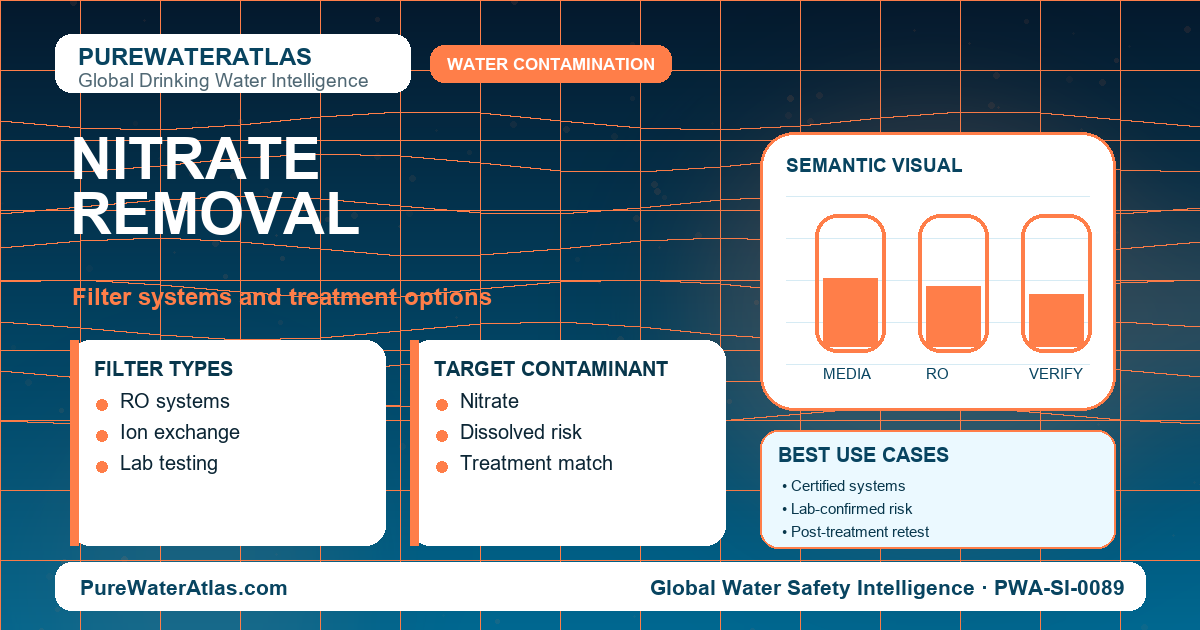
Agricultural runoff drinking water reverse osmosis systems are among the most versatile options for point-of-use treatment. Reverse osmosis forces water through a semipermeable membrane that can remove many dissolved contaminants.
- Best for: nitrate, nitrite, many dissolved chemicals, salts, some metals, broad contaminant reduction
- Usually paired with: sediment and carbon prefilters
- Limitations: slower production, wastewater generation, membrane sensitivity to fouling, usually installed at a single tap rather than whole-house
RO is often one of the best choices when nitrate is a major concern. It may also reduce some pesticides, but because pesticide chemistry varies, performance should be confirmed through system certification and follow-up testing.
Ion Exchange for Nitrate
Specialized anion exchange systems can remove nitrate effectively and are sometimes used for whole-house treatment. They are more targeted than carbon and can be a practical choice where nitrate is the dominant issue.
- Best for: nitrate removal at higher flow rates
- Limitations: not a broad-spectrum solution, requires regeneration and maintenance
Ultraviolet Disinfection
UV systems inactivate many microorganisms by damaging their genetic material. They are useful when bacterial or viral contamination is a concern and the water is clear enough for UV light to penetrate.
- Best for: bacteria, viruses, some protozoa control support
- Limitations: does not remove nitrate, pesticides, sediment, or chemical contaminants
Chlorination and Other Disinfection Approaches
Continuous chlorination can help address microbial contamination in wells, storage tanks, and plumbing. Depending on the situation, it may be followed by carbon filtration to remove chlorine taste and odor.
Distillation
Distillation can remove many dissolved contaminants, including nitrate, but it is slower and more energy intensive than many alternatives. It is generally more common in specialized or low-volume applications.
Agricultural Runoff Drinking Water Treatment Comparison
Below is a practical comparison of major options:
- Sediment filtration: excellent first stage for particles; not enough on its own for dissolved agricultural contaminants
- Activated carbon: strong for many organic pesticides and taste/odor issues; weak for nitrate
- Reverse osmosis: broad contaminant reduction, especially valuable for nitrate; usually point-of-use
- Ion exchange: targeted nitrate removal; less effective as a general-purpose agricultural treatment system
- UV disinfection: addresses microbes but not chemicals
- Multi-stage systems: often the best real-world approach where contamination is mixed
Best System Configurations
Some practical examples include:
- Nitrate only: reverse osmosis at the kitchen sink or a nitrate-selective ion exchange system
- Pesticides and odor: high-capacity activated carbon, often with sediment prefiltration
- Bacteria plus sediment: sediment prefilter followed by UV or chlorination
- Nitrate, pesticides, and sediment: sediment prefilter, carbon prefilter, reverse osmosis, and possibly UV if microbial risk exists
Agricultural Runoff Drinking Water Buying Guide
An effective agricultural runoff drinking water buying guide should focus on evidence, not marketing claims. Before buying a system, consider the following:
- What contaminants were confirmed by testing?
- Is the system certified for those contaminants?
- Will the system be point-of-use or whole-house?
- What is the required flow rate and daily water volume?
- How much maintenance does the system require?
- What are the ongoing cartridge, membrane, salt, lamp, or service costs?
- Does the water chemistry create fouling or scaling risks?
- Will post-treatment testing be done to verify performance?
Look for independently tested or certified systems whenever possible. A “removes contaminants” claim is much less meaningful than a clearly documented reduction standard for nitrate, atrazine, or microbial indicators.
Agricultural Runoff Drinking Water Filter Maintenance
Agricultural runoff drinking water filter maintenance is just as important as the original purchase. A well-designed system can fail if filters are not changed on schedule or if disinfection components are neglected.
- Replace sediment filters before pressure drop becomes severe
- Change carbon cartridges based on rated capacity, not just taste changes
- Monitor RO membrane performance with periodic testing and sanitizer procedures
- Replace UV lamps on schedule, even if they still glow
- Inspect housings, seals, and storage tanks for leaks and biofilm risks
- Sanitize systems when recommended by the manufacturer
- Retest treated water regularly, especially for nitrate and bacteria
Maintenance frequency depends on source water quality. Water with high turbidity, organic load, or hardness may shorten filter and membrane life considerably.
Common Misconceptions
“If the water looks clear, it is safe.”
This is false. Nitrate and many pesticides are invisible in water. Bacteria may also be present without affecting appearance.
“A carbon filter removes everything.”
Activated carbon is valuable, but it does not reliably remove nitrate and is not a complete solution for all agricultural contaminants.
“Reverse osmosis makes testing unnecessary.”
Even high-quality RO systems should be selected based on actual water results and verified through follow-up testing. Membranes can degrade, foul, or underperform if conditions change.
“Boiling water solves farm runoff problems.”
Boiling can kill many microbes, but it does not remove nitrate and may actually concentrate some dissolved contaminants as water evaporates.
“Public water systems eliminate all agricultural concerns.”
Public utilities often provide strong protection, but source water conditions can still influence treatment difficulty, seasonal taste and odor events, and occasional contaminant advisories.
Regulations and Standards
Drinking water regulation varies by country and jurisdiction, but several general principles apply.
Public Water Systems
Municipal and community systems are generally subject to legally enforceable contaminant limits, monitoring requirements, and treatment rules. These often include standards for nitrate, microbial indicators, and certain pesticides.
Private Wells
Private wells are usually not regulated in the same way as public water systems. That means the owner is responsible for testing, maintenance, and corrective action. This gap is especially important in agricultural regions, where well vulnerability can be high.
Treatment Standards and Certification
For home equipment, independent certification can help verify that a product has been tested for specific contaminant reduction claims. Consumers should look for systems certified for the exact contaminants of concern rather than relying on broad advertising language.
Source Water Protection
Environmental regulations may address nutrient management, manure handling, pesticide application, erosion control, and watershed protection. However, compliance at the regional level does not guarantee that every individual well or local source is free from contamination. Household vigilance is still necessary.
Conclusion
Agricultural runoff can affect drinking water through nitrate, pesticides, pathogens, sediment, and nutrient-driven secondary problems such as algal blooms. Because these contaminants behave differently, there is no universal filter that fits every case. The most effective strategy begins with testing, then matches treatment to the results.
For many households, the answer to agricultural runoff drinking water best filters is a multi-stage approach: sediment prefiltration for particles, activated carbon for many organic chemicals, and reverse osmosis for nitrate and broader dissolved contaminant reduction. If microbial contamination is also present, UV or chlorination may be necessary. The best long-term outcome combines source protection, proper well care, certified treatment equipment, and disciplined maintenance.
In short, safe water decisions should be evidence-based. Test first, choose technology based on confirmed contaminants, maintain the system carefully, and retest to verify performance over time.
Read the full guide: Water Contamination Guide
Explore more in this category: Water Contamination Articles