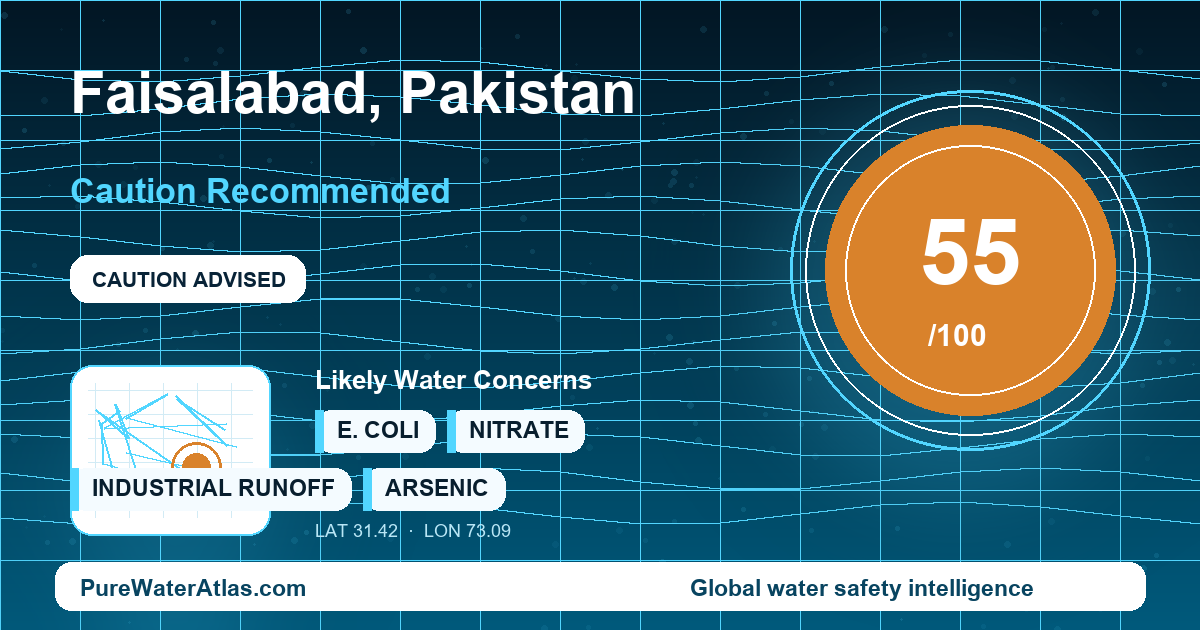
Faisalabad, Pakistan: tap water safety score 55/100 — caution recommended because final water quality can vary by source zone, pressure, storage tanks, private groundwater use, and building plumbing.
Quick Answer
| Overall safety status | Caution recommended. Faisalabad has an organized municipal water utility and major water-supply infrastructure, but ordinary tap water should not be assumed consistently potable at the household tap without treatment. |
|---|---|
| Water safety score | 55/100 — risk level: Caution Recommended. |
| Traveler advice | Visitors should use sealed bottled water or properly treated water for drinking. Untreated tap water is not recommended. |
| Resident advice | Residents should treat water at the point of use, maintain household tanks, and test municipal tap water or private borewell water periodically. |
| Main water identity | Mixed municipal supply: canal-linked surface water context, selected freshwater wellfields or tube wells, treatment plants, reservoirs, pumping stations, and distribution mains. |
| Responsible authority | Water and Sanitation Agency Faisalabad, commonly known as WASA Faisalabad, under the Faisalabad Development Authority and Punjab urban water governance system. |
| Filter recommendation | Most households should use at least sediment prefiltration plus activated carbon and a reliable microbial barrier such as UV or boiling when supply is uncertain. For high-TDS or saline borewell water, RO may be needed after testing. |
Confidence level is moderate. Faisalabad’s water authority and source-water constraints are identifiable, and regional evidence supports the risk profile, but PureWaterAtlas did not find a continuously updated public dashboard showing routine neighborhood-level tap results across the city.
Why Faisalabad Is Different
Faisalabad is not a city where the safety question can be answered only by naming the utility. It is an inland industrial city in Punjab, located in the Rechna Doab region between the Chenab and Ravi river systems, and its modern water situation is closely tied to canal irrigation development. The city developed as a canal-colony settlement and later became one of Pakistan’s major textile and industrial hubs. That history matters for drinking water because rapid urban growth, industrial wastewater pressure, and heavy groundwater demand all affect the city’s water-risk profile.
The most important local distinction is groundwater quality. Faisalabad historically depended heavily on groundwater and tube wells, but much of the urban groundwater is brackish or high in dissolved salts. As a result, the practical water system has relied on selected fresher wellfields, canal-side sources, treatment plants, and household treatment rather than a simple assumption that every local borehole is drinkable.
Another Faisalabad-specific issue is the “final mile.” In many homes, water reaching the glass may not be only utility water from a main. It may pass through private suction pumps, underground storage tanks, rooftop tanks, small filters, and internal building plumbing. These household and building-level conditions can determine whether water remains safe after leaving the municipal system.
Where Does Faisalabad’s Tap Water Come From?
Faisalabad is supplied by a mixed system managed by WASA Faisalabad. The city’s water context includes canal-linked surface water and freshwater wellfield or tube-well sources developed outside the most saline parts of the city. The Rakh Branch Canal and the wider Lower Chenab Canal irrigation system are important to the city’s water story, and major supply projects have aimed to reduce reliance on poor-quality local groundwater by developing more reliable imported or treated sources.
Key infrastructure includes the WASA Faisalabad municipal supply and distribution network, canal-linked raw-water infrastructure, tube wells where groundwater quality is suitable, treatment plants, pumping stations, reservoirs, and transmission mains. At the household level, underground and rooftop tanks are common practical control points for final water quality.
This mixed-source identity is important for residents choosing treatment. A filter selected for salty, high-TDS borewell water may not be the same as a filter selected for municipal water with occasional turbidity or microbial concerns. Faisalabad households should avoid choosing treatment only by taste. Salty, bitter, metallic, or scale-forming water should be tested before selecting a filtration system.
Who Manages Drinking Water in Faisalabad?
Municipal water supply and sanitation services are associated with WASA Faisalabad, operating under the governance context of the Faisalabad Development Authority and the Government of Punjab urban water framework. Drinking-water quality in Pakistan is guided by the National Standards for Drinking Water Quality and public-health guidance from federal and provincial agencies.
In practice, drinking-water safety in Faisalabad depends on more than source treatment. Distribution integrity, residual disinfection, pressure stability, private pumps, storage tanks, and internal plumbing all matter. Intermittent pressure, leakage, and possible cross-connections with drains or sewers are plausible contamination pathways in older or poorly maintained areas. These risks are particularly relevant because many users store water at home, and stored water can lose disinfectant protection or become contaminated if tanks are dirty or uncovered.
PureWaterAtlas treats the city-level evidence with caution. There is enough public information to identify the responsible utility, infrastructure context, source-water constraints, and common local risks. However, the absence of a transparent, continuously updated ward-level or household-tap compliance dashboard means this page should not be read as a claim that all WASA water either meets or fails any specific legal limit in every neighborhood.
Main Local Water Concerns
- Salinity, hardness, and high dissolved solids: Many private or shallow groundwater sources in Faisalabad may have high salinity, hardness, or total dissolved solids. This is a major reason to test borewell water before drinking it or selecting RO treatment.
- Microbial contamination: Intermittent supply, low pressure, leaking pipes, storage tanks, and building plumbing can create pathways for microbial contamination. E. coli in drinking water is the key practical indicator for fecal contamination risk.
- Turbidity and sediment: Sediment or cloudy water may appear after pipe repairs, pressure changes, network flushing, or raw-water variability linked to canal conditions. Learn more about turbidity and sediment in drinking water.
- Industrial and urban wastewater pressure: Faisalabad’s role as a textile and manufacturing center increases concern about wastewater pressure on drains and shallow groundwater, especially where infrastructure is compromised.
- Nitrate risk: Some groundwater settings can be affected by sewage leakage, livestock, fertilizer use, or peri-urban agriculture. Nitrate is especially important for households with infants.
- Groundwater arsenic uncertainty: Arsenic is a known groundwater concern in parts of Punjab. Faisalabad households using private groundwater should test rather than rely on taste or smell. See arsenic in drinking water.
- Building-plumbing metals: Older buildings, corroded internal pipes, old fittings, or poorly installed suction pumps can affect water after it leaves the public main. Lead risk is most relevant at the building-plumbing level.
Season also matters. Monsoon rains can increase runoff, drain overflows, turbidity, and microbial risk where distribution and sewer systems are compromised. Hot weather increases household water storage, which can reduce residual chlorine and encourage microbial regrowth if tanks are not cleaned. Canal closures, maintenance periods, or raw-water variability can also increase reliance on tube wells, tankers, or stored water. After flooding or severe rain, treat tap water as temporarily higher risk unless local authorities confirm safety.
For Travelers
Visitors to Faisalabad should not drink ordinary tap water untreated. Use sealed bottled water from a reliable brand, or water that has been boiled, disinfected, or filtered through a maintained system at a hotel or restaurant. Check that bottle seals are intact, especially during hot months when water consumption is high.
For brushing teeth, bottled or treated water is the safer choice if you are staying briefly, have a sensitive stomach, are immunocompromised, or are traveling with children. Many local residents may use tap water for brushing, but short-term visitors should be more conservative because they are less accustomed to local water and food-handling conditions.
Avoid ice unless you know it was made from treated water. Ice from street vendors, small cafes, or unknown sources is higher risk. In hotels and restaurants, ask directly whether table water, diluted juices, raw salads, and ice are prepared with treated water. Higher-end hotels may use filtered or bottled water, but it should not be assumed without confirmation.
If you develop gastrointestinal illness, switch to boiled or bottled water and avoid untreated water for drinking, brushing, and infant formula. For short-term emergency disinfection, see the PureWaterAtlas boiling water purification guide.
For Residents
Most Faisalabad households should use point-of-use treatment. A practical setup for municipal water is sediment prefiltration, activated carbon for taste and some chlorine-related issues, and a microbial control step such as UV or boiling when supply quality is uncertain. UV can be useful, but it requires adequate prefiltration and maintenance; see the UV water purification guide.
If your home uses borewell water or motor-pumped groundwater, test before choosing equipment. Recommended testing includes TDS, electrical conductivity, hardness, chloride, sulfate, nitrate, arsenic, fluoride, iron, manganese, and microbial indicators. If water is high in TDS or salinity, reverse osmosis may be needed, but it should be selected after testing and maintained properly. Retest after installing RO, UV, or whole-house systems to confirm that treatment is working.
Municipal tap water should be tested at the point of use for E. coli or total coliforms after pipe repairs, flooding, sewer backups, or long supply interruptions. Households with infants, pregnant people, elderly residents, or immunocompromised residents should prioritize microbial testing and a verified disinfection step.
Older buildings require extra attention. Corroded internal pipes, old fittings, poorly installed suction pumps, or stagnant first-draw water can affect safety and taste after the water has left the public main. If water has a metallic taste or discoloration after standing, flush first-draw water and consider testing for lead and other metals.
Storage tanks are a critical Faisalabad control point. Underground and rooftop tanks should be covered, screened, cleaned, and disinfected regularly. A clean public supply can become unsafe in a dirty tank, through open lids, insect or rodent entry, or backflow-prone plumbing.
Relevant Contaminants and Water-Quality Issues
The most practical Faisalabad water-quality issue for travelers and households is microbial risk, especially where pressure, storage, or local plumbing are uncertain. Start with E. coli as the key fecal contamination indicator and chlorine as the main residual disinfectant barrier that can decay during storage.
For visible cloudiness, particles, or post-repair water changes, review turbidity and sediment. For private groundwater, focus on nitrate, arsenic, hardness, TDS, and salinity-related parameters. For old buildings, lead and other plumbing-related metals should be considered when water is discolored, metallic, or has been stagnant in pipes.
How to Verify Your Water Quality
The safest approach in Faisalabad is to verify the water at the point where you actually drink it: kitchen tap, filter outlet, storage-tank outlet, or borewell supply. PureWaterAtlas recommends combining city context with household testing, especially because public neighborhood-level tap results are not available in a transparent, continuously updated dashboard.
- Use the Water Testing guide to decide which microbiological and chemical parameters to check.
- Compare Faisalabad with other destinations using the Global Water Quality Checker.
- Look up specific risks in the Contaminants Search Engine.
- For borewell users, read arsenic testing and detection methods and nitrate testing and detection methods.
- For older buildings, review lead testing and detection methods.
For broader context, PureWaterAtlas also maintains guides on drinking water safety, global water quality, water microbiology, and water treatment systems.
Official and Technical Sources
- WASA Faisalabad — local water and sanitation agency for Faisalabad.
- Faisalabad Development Authority — governance context for WASA Faisalabad and urban development responsibilities.
- Japan International Cooperation Agency Open JICA Reports — project-report repository documenting Faisalabad water-supply improvement context.
- Agence Francaise de Developpement Pakistan — development finance context for urban water and sanitation investment in Pakistan, including projects relevant to Faisalabad service improvements.
- Pakistan Council of Research in Water Resources — national water research context, including common Pakistani drinking-water risks such as microbial contamination, salinity, arsenic, fluoride, and nitrate.
- Punjab Environmental Protection Department — provincial environmental governance context for water pollution control, wastewater, and environmental quality in Punjab.
- World Health Organization Guidelines for Drinking-water Quality — public-health guidance on microbial risk, chemical contaminants, source protection, distribution integrity, and household treatment.
- UNICEF and WHO Joint Monitoring Programme — national-level WASH monitoring context and limitations of household water safety data.
Bottom Line
Faisalabad’s tap water should be treated with caution. The city has a formal WASA-managed water system, canal-linked supply context, selected freshwater wellfields, and major infrastructure investments, but household tap safety can vary because of intermittent pressure, aging distribution areas, private pumps, storage tanks, local salinity problems, and building plumbing. Travelers should use sealed bottled or properly treated water and avoid unknown ice. Residents should maintain tanks, test borewell or household tap water, and use treatment matched to actual test results. For many homes, sediment filtration plus activated carbon and a microbial barrier are sensible; high-TDS or saline groundwater may require RO after testing. The main limitation is data transparency: routine neighborhood-level tap compliance results are not publicly available in a continuously updated dashboard.
Read the full guide: Global Water Quality Guide
Explore more in this category: Global Water Quality Articles