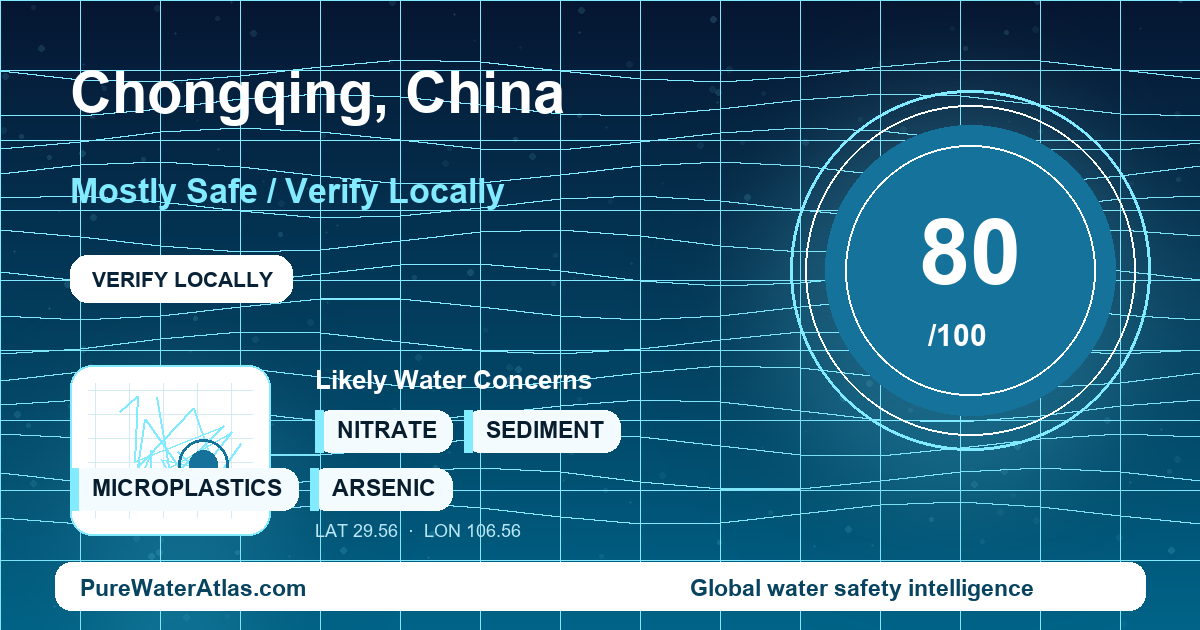
Chongqing’s tap water is centrally treated from major river sources, but high-rise secondary supply systems, rainy-season turbidity, older plumbing, and limited tap-level public data mean residents and visitors should verify conditions locally before drinking it untreated.
Quick Answer
| Overall safety status | Mostly Safe / Verify Locally — water safety score: 80/100. Chongqing’s municipal tap water is generally expected to be treated and disinfected under China’s national drinking-water framework, especially in central urban districts served by formal waterworks. |
|---|---|
| Can tourists drink it? | Short-term visitors should use bottled water, boiled water, or properly filtered hotel water as the lower-risk choice for drinking. Brushing teeth with tap water is usually low-risk in modern hotels, but bottled water is prudent for sensitive travelers. |
| Resident guidance | Residents in modern buildings connected to the municipal network commonly use tap water after boiling. For direct drinking without boiling, consider a certified point-of-use filter and verify building tank maintenance and pipe condition. |
| Main source water | Primarily the Yangtze River and Jialing River for core urban areas, with some outlying districts and counties using separate local rivers, reservoirs, or district-level projects. |
| Main utility and regulators | Urban supply is associated with Chongqing Water Group Co., Ltd., with oversight involving municipal water resources, ecology and environment, and health authorities. |
| Filter recommendation | A home filter is not automatically required for every household, but is sensible for direct drinking, older buildings, storage-tank systems, sediment, metallic taste, infants, pregnant residents, elderly residents, or immunocompromised people. |
Why Chongqing Is Different
Chongqing is not a flat-grid water city. It is built on steep terrain at the confluence of the Yangtze River and Jialing River, and that geography shapes both the source water and the way water reaches individual taps. The city’s core urban drinking-water system depends primarily on these two large rivers, which are treated at municipal waterworks before entering the distribution network. At the same time, Chongqing’s mountainous layout and high-rise development mean that pumping, pressure zones, booster systems, and building-level storage are unusually important.
This distinction matters for safety. Water can leave a municipal treatment plant in acceptable condition but change before it reaches a specific apartment, hotel room, or restaurant tap. In many towers, the final part of the water pathway is not controlled only by the utility; it may pass through underground tanks, rooftop tanks, pumps, valves, and internal building pipes. If these systems are poorly maintained, they can contribute sediment, discoloration, taste and odor issues, microbial regrowth risk, or uncertainty about tap-level quality.
Chongqing is also a major inland industrial, port, and logistics center in the upper Yangtze region. The Yangtze and Jialing rivers are affected by shipping, urban stormwater, construction runoff, industrial activity, and upstream catchment conditions. This does not mean Chongqing’s treated tap water is unsafe by default, but it does make source-water monitoring and treatment resilience important, especially during rainy-season runoff and flood periods.
Where Does Chongqing’s Tap Water Come From?
For the central urban districts, Chongqing’s drinking water is primarily a large-river system. The main raw water sources are the Yangtze River and the Jialing River, which meet in central Chongqing. Municipal river intakes supply waterworks that typically treat turbid river water using conventional processes such as coagulation, sedimentation or clarification, filtration, and disinfection before water is distributed to users.
The broader Chongqing municipality is large, and not every district or county relies on a single citywide intake. Some outlying areas use local rivers, reservoirs, and district-level water-supply projects. This is one reason local verification matters: a resident in a central high-rise, a visitor in a modern hotel, and a household in an outlying district may not be served by identical infrastructure or source-water conditions.
Chongqing’s historical development around the Yangtze-Jialing confluence also places the city within the wider Three Gorges Reservoir region. Source-water management is connected to reservoir operations, river water quality, flood conditions, shipping, urban runoff, and upstream industrial and agricultural pressures. Seasonal changes can raise treatment demands; heavy rain and summer flood periods can increase raw-water turbidity, while hot and humid months can increase microbial regrowth concerns in stagnant plumbing or poorly maintained building tanks.
Who Manages Drinking Water in Chongqing?
The main municipal water-supply enterprise associated with Chongqing’s urban water services is Chongqing Water Group Co., Ltd.. Local oversight also involves several public authorities with different roles. The Chongqing Municipal Water Resources Bureau is relevant to water resources, water projects, hydrological management, and flood-related water issues. The Chongqing Municipal Ecology and Environment Bureau is relevant to river and water-environment quality and pollution-control responsibilities. The Chongqing Municipal Health Commission is relevant to drinking-water sanitation supervision, public-health protection, and health monitoring.
Chongqing’s urban drinking water is governed within China’s national drinking-water quality framework, including the national Standards for Drinking Water Quality, GB 5749-2022. The National Standardization Administration public standards platform provides access to Chinese national standards, and the National Health Commission of the People’s Republic of China provides national public-health context for drinking-water hygiene standards and oversight.
PureWaterAtlas rates Chongqing’s confidence level as medium-high for the identity of the main source-water system and regulators, but medium for tap-level safety. The limitation is important: recent, easily accessible, district-by-district finished-water and building-level tap data are limited in public English-language sources. Citywide source or utility information does not prove the quality of water at every apartment tap after water passes through private plumbing and secondary supply systems.
Main Local Water Concerns
The most important Chongqing-specific concern is not whether the city has formal treatment. It does. The practical concern is variation between treated municipal water and water delivered at the tap, especially in high-rise buildings and older residential blocks.
- Rainy-season turbidity: The Yangtze and Jialing rivers can experience high turbidity during summer runoff and flood periods, increasing treatment demand.
- Sediment and discoloration: Pipe repairs, pressure changes, construction, outages, or building-tank disturbances can cause cloudy, brown, or particle-laden water.
- Secondary water supply: Many towers use pumps, underground tanks, rooftop tanks, and booster systems. If cleaning and disinfection records are unclear, these systems can become a weak link.
- Older internal plumbing: Aging pipes, valves, dead-end lines, and fixtures can increase rust, metals, biofilm, taste issues, and tap-level uncertainty.
- River-source pressures: Chongqing’s role as a major inland port and industrial city means source protection and treatment control remain important.
- Chlorine taste or odor: Chlorination is a normal disinfection control step, and chlorine may be noticeable in a large distribution network.
If tap water becomes visibly discolored, contains particles, smells unusual, or changes suddenly after construction, flooding, tank cleaning, or pipe work, avoid drinking it until it runs clear and local notices or building management information have been checked.
For Travelers
Visitors to Chongqing should not rely on untreated tap water as their primary drinking source unless they have local confirmation from a hotel or host and are comfortable with the building’s plumbing and filtration. The lower-risk default is sealed bottled water, boiled water, or water from a maintained filtration system. This conservative advice is consistent with traveler-health precautions for China from the U.S. CDC Travelers’ Health: China.
Modern hotels commonly provide bottled water or in-room kettles, and boiling water is a common practice in China. Hot tea, boiled water, sealed bottled drinks, and commercially bottled water are safer choices than unverified cold tap water. Brushing teeth with tap water is generally acceptable for many travelers in modern hotels, but bottled water is a reasonable precaution for people with sensitive stomachs, infants, pregnant travelers, or immunocompromised travelers.
Use caution with ice from small restaurants, street vendors, or unknown sources. Ice in reputable hotels and higher-end restaurants is more likely to be made from treated water, but travelers who want to minimize gastrointestinal risk should avoid ice unless the source is clear. Carry bottled water while sightseeing, especially in hot and humid weather. Use sealed bottled or boiled water for medications and infant formula.
For Residents
Residents in modern Chongqing buildings connected to the municipal network can usually use tap water after boiling, which remains common local practice. For direct drinking without boiling, a point-of-use filter is sensible when household risk is higher or when the building’s secondary supply is uncertain.
A practical Chongqing setup often starts with sediment prefiltration and activated carbon to reduce particles, turbidity, chlorine taste, and odor. Reverse osmosis is a stronger option where dissolved metals or other specific contaminants are a concern, but it should be selected based on testing rather than guesswork. Any purifier must be maintained; overdue cartridges can worsen microbial or taste problems.
Residents should ask property management for secondary water-supply tank cleaning and disinfection records, especially in high-rise residential buildings. Tanks should be sealed, cleaned, disinfected, and inspected regularly. Recurring particles, musty odor, building-specific discoloration, or illness clusters are reasons to request maintenance documentation and consider laboratory testing.
Older buildings deserve extra caution. Rusting internal pipes, old valves, long stagnation times, and older fixtures can increase sediment, iron, manganese, taste problems, and in some cases lead or other metal risk. Do not assume citywide water information represents the water at an old apartment tap. After major pipe repairs, outages, flooding, or tank cleaning, flush cold-water taps until the water runs clear before using it for drinking or cooking.
Relevant Contaminants and Water-Quality Issues
Chongqing’s water profile is most closely tied to river-source treatment, distribution conditions, and building-level storage. The following PureWaterAtlas contaminant guides are especially relevant:
- Turbidity in Drinking Water — relevant because Yangtze and Jialing raw water can become more turbid during rainy-season runoff and flood periods.
- Sediment in Drinking Water — useful for understanding cloudy water, particles, discoloration after pipe work, and tank disturbances.
- Chlorine in Drinking Water — relevant because disinfection residuals may create noticeable taste or odor while helping control microbial risk.
- Lead in Drinking Water — relevant for older buildings, fixtures, and internal plumbing where tap-level metals can differ from utility water.
- E. coli in Drinking Water — important when evaluating microbial safety in storage tanks, stagnant plumbing, or post-treatment contamination concerns.
- Manganese in Drinking Water — relevant to discoloration and metal-related aesthetic issues that can occur in distribution or plumbing systems.
For broader background, see PureWaterAtlas guides on Drinking Water Safety, Water Microbiology, and Water Treatment Systems.
How to Verify Your Water Quality
The best way to resolve Chongqing tap-level uncertainty is to verify the specific tap, building, and season. This is especially important in older buildings, high-rise towers with storage tanks, homes with persistent sediment, or households with infants, pregnant residents, elderly residents, or immunocompromised people.
- Test if water is discolored, cloudy, metallic-tasting, or still contains sediment after flushing.
- Ask building management for tank cleaning and disinfection records.
- For direct drinking, consider testing turbidity, residual chlorine, total coliform or E. coli, pH, iron, manganese, lead, and other metals where plumbing age is uncertain.
- Flush taps after outages, repairs, flooding, tank cleaning, or sudden pressure changes.
- Replace filter cartridges on schedule if using a private purifier.
PureWaterAtlas resources that can help include the Complete Guide to Water Testing and Analysis, the Global Water Quality Checker, and the Contaminants Search Engine. Residents concerned about older plumbing can also review Lead in Drinking Water: Testing and Detection Methods and Lead in Drinking Water: Best Filters, Systems and Solutions. For practical treatment choices, see Boiling Water Purification: Complete Guide and UV Water Purification: Complete Guide.
Official and Technical Sources
- Chongqing Water Group Co., Ltd. — local utility identity and formal urban water-supply operations.
- Chongqing Municipal Water Resources Bureau — water resources, hydrological management, projects, and flood-related context.
- Chongqing Municipal Ecology and Environment Bureau — river and water-environment quality and pollution-control responsibilities.
- Chongqing Municipal Health Commission — drinking-water sanitation supervision and public-health monitoring context.
- National Standardization Administration public standards platform — national standards framework including GB 5749-2022.
- National Health Commission of the People’s Republic of China — national public-health and drinking-water hygiene standards context.
- Yangtze River Water Resources Commission — basin-level Yangtze River management, flood, and water-resources context.
- U.S. CDC Travelers’ Health: China — travel-health guidance supporting conservative food and water precautions.
Bottom Line
Chongqing’s centrally treated municipal tap water is generally expected to be treated and disinfected under China’s national drinking-water framework, particularly in the main urban districts supplied by formal waterworks drawing from the Yangtze and Jialing rivers. The key uncertainty is tap-level variation. Chongqing’s steep terrain, high-rise buildings, secondary tanks, booster pumps, older internal pipes, rainy-season turbidity, and limited public neighborhood-level data can affect what reaches a specific faucet. Travelers should default to bottled, boiled, or properly filtered water for drinking. Residents can usually use tap water after boiling, but direct drinking is best supported by building maintenance records, local testing, and a properly maintained point-of-use filter where risk factors exist.
Read the full guide: Global Water Quality Guide
Explore more in this category: Global Water Quality Articles