Quick Answer
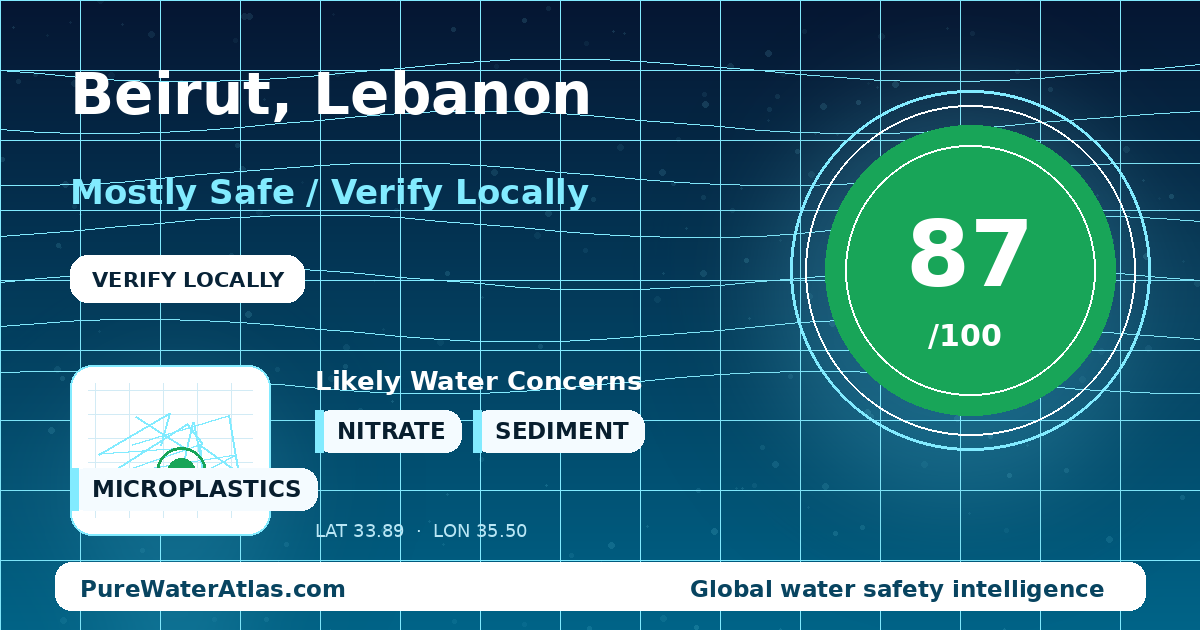
| Overall safety status | Use caution. There is not enough recent, public tap-level compliance evidence to recommend drinking Beirut tap water without confirming the source, building storage and actual tap quality. |
|---|---|
| Can visitors drink the tap water? | Visitors should generally use factory-sealed bottled water or water that has been adequately treated for drinking, brushing teeth, ice and food preparation. |
| Resident advice | Identify whether the tap receives public-network, tanker or well water; inspect and clean building tanks; and obtain laboratory testing at the point of use before relying on it for drinking. |
| Main water source | Historically, most piped supply has come through the Dbayeh treatment system, supplemented by groundwater wells in the Naameh area. The precise current mix may vary. |
| Responsible authority | Beirut and Mount Lebanon Water Establishment, under national oversight led by the Ministry of Energy and Water, with public-health responsibilities also involving the Ministry of Public Health. |
| Filter recommendation | No single filter can be recommended citywide. Use disinfection for a confirmed microbial risk; certified contaminant-specific treatment for measured chemicals; and reverse osmosis only when testing supports a dissolved-salt or specific chemical problem. |
A peer-reviewed Beirut household-water study, using fieldwork conducted in 2019 and published in 2022, describes two principal public-supply areas. About 80% of the city’s piped water was supplied through the Dbayeh treatment system north of Beirut, while groundwater wells in the Naameh area to the south supplied the remainder. Water from these systems was pumped to reservoirs and then released to distribution zones.
The percentage split should be treated as historical rather than a guaranteed current allocation. In April 2024, the Ministry of Energy and Water, BMLWE, UNICEF and development partners inaugurated a rehabilitated Naameh pumping station intended to improve service for more than 300,000 people in Beirut and Mount Lebanon.
Older German government technical documentation identifies the karstic Jeita Spring system as a major raw-water source conveyed to Dbayeh. That documentation also describes historical treatment involving coagulation, sand filtration and chlorination. Because this technical description is old, it establishes the system’s design history but not current treatment performance.
Additional surface water from the Awali system, including water associated with Lake Qaraoun, is part of the Greater Beirut expansion program. The World Bank approved a second Greater Beirut project in January 2025 to finish bulk infrastructure and strengthen treatment at Wardanieh. This page does not assume that the project is complete or that its projected supply mix is already reaching every Beirut neighborhood.
The Beirut and Mount Lebanon Water Establishment is the public utility responsible for water service in Beirut and much of Mount Lebanon. Its stated responsibilities include operating and maintaining networks and reservoirs, distributing potable water, and monitoring the quality of water reaching homes.
The Ministry of Energy and Water sets national policy and oversees the Water Establishments. The Ministry of Public Health also has drinking-water and public-health responsibilities. Lebanon’s non-bottled drinking-water requirements are set through the LIBNOR NL 161 standard.
A critical distinction is that utility responsibility does not eliminate building-level risk. Once water enters a privately managed underground tank, rooftop tank or building plumbing system, its final quality can be affected by storage, maintenance, cross-connections and stagnation.
Intermittent delivery and pressure changes
Beirut does not have reliably continuous water service across all neighborhoods. The 2022 Beirut case study reported zoned delivery and average availability of roughly three hours per day in summer and seven hours per day in winter for its two study neighborhoods. These figures are not a current citywide schedule, but they demonstrate the established pattern of intermittent supply.
Intermittence matters for quality as well as convenience. Empty or low-pressure pipes can be more vulnerable to intrusion where leaks and nearby contamination pathways exist. The planned World Bank program includes pressure monitoring, leak detection, network rehabilitation and reinforcement of chlorine-residual management, indicating that distribution performance remains an active concern.
Underground and rooftop storage
Many Beirut buildings capture public water in a shared underground reservoir, then pump it to smaller rooftop tanks. Tanker or well water may be added when public water is insufficient. The result is that water sold or treated as one source may reach the tap as a mixture.
Dirty tanks, poorly fitting covers, sediment, warm temperatures and long residence times can undermine microbial quality. Building managers should document tank cleaning and disinfection, keep tanks sealed against insects and debris, and prevent non-potable lines from connecting to drinking-water plumbing.
Private wells and coastal salinity
Private groundwater is an important supplementary source in Beirut. Coastal aquifers can be affected by over-pumping and seawater intrusion, producing elevated salinity or total dissolved solids. This is primarily a groundwater and building-supply issue, not evidence that all BMLWE water is saline.
Tanker-water variability
Tankers fill a real supply gap, but quality depends on the original source, tanker cleanliness, any treatment used and handling during delivery. A receipt or supplier assurance is not a substitute for a traceable laboratory result. Tanker water should not automatically be considered potable.
Limited public monitoring data
BMLWE says it monitors water quality, but this research did not locate a current annual compliance report with Beirut-specific finished-water and distribution results. Lebanon’s National Water Sector Strategy 2024–2035 states that Water Establishments were not equipped at that time to implement the complete LIBNOR 2016 drinking-water standard because of laboratory and expertise limitations.
Visitors should take a precautionary approach: use factory-sealed bottled water from a recognizable supplier or water that has been adequately treated. Use the same safe source for drinking, brushing teeth, making ice, preparing infant formula and washing foods that will be eaten raw.
- Check that bottled-water seals are intact.
- Ask whether hotel drinking water is bottled, centrally treated or simply supplied from the building tank.
- Avoid ice unless its water source is confirmed.
- Do not assume clear, odorless water is microbiologically safe.
- If bottled water is unavailable and microbial contamination is the concern, bring clear water to a rolling boil for one minute. Boiling does not remove salts, metals or other dissolved chemicals.
The CDC’s Lebanon traveler page advises travelers to follow safe food-and-water practices and avoid contaminated water. CDC guidance says factory-sealed bottled water is generally the safest option where tap-water safety is uncertain.
- Map the water path. Ask the building manager whether the tap receives BMLWE water, tanker water, a private well or a mixture.
- Check the tanks. Confirm the date and method of the most recent cleaning and disinfection. Inspect covers, vents, overflow screens, sediment and evidence of cross-connections.
- Sample the final tap. A source or tanker certificate does not represent water after storage and building plumbing.
- Test after changes. Retest after a tank-cleaning failure, flood, plumbing repair, prolonged outage, unusual odor or color, or a change of tanker supplier.
- Use certified treatment only for identified risks. Match the device certification and maintenance schedule to laboratory findings.
Residents can consult PureWaterAtlas’s home water-testing guide and the broader water-testing pillar before choosing a laboratory panel or treatment device.
E. coli and fecal indicators
The first priority for intermittently supplied, tank-stored or privately delivered water is microbial safety. E. coli or thermotolerant coliform detection indicates fecal contamination and requires immediate investigation and corrective action. See the PureWaterAtlas profile for E. coli water contamination and its treatment limitations.
A WHO-hosted study found fecal coliforms and parasites in wells, vendor water, shops and preschools in Shatila. It also detected contamination in some samples from a municipal tap. However, samples were collected in 2008–2009 in a refugee-camp water system with unusual infrastructure conditions. The findings support localized concern and the need for testing; they must not be generalized to every Beirut tap today.
Turbidity and sediment
Sediment can enter or accumulate in tanks and may interfere with disinfection. Cloudiness after an outage should be investigated rather than treated as a purely aesthetic problem. If water is discolored, oily or unusually odorous, do not assume boiling will make it safe.
Salinity and dissolved minerals
Private coastal wells may require conductivity, total dissolved solids, sodium and chloride testing because seawater intrusion is possible. Boiling increases the concentration of nonvolatile dissolved salts and is not an appropriate salinity treatment.
Plumbing-related metals
Water can acquire lead, copper or iron from premise plumbing, fixtures, pumps or storage components. This is a building-specific concern; the reviewed evidence does not establish a Beirut-wide lead problem. Older buildings, long stagnation periods, metallic taste or visible corrosion justify first-draw and flushed sampling. PureWaterAtlas’s lead guide explains why testing must precede filter selection.
Future Awali and Qaraoun source-water management
World Bank project documents identify pollution and variable raw-water quality as design concerns for the future expanded surface-water system. Planned measures include daily raw-water monitoring, an early-warning system, powdered activated carbon, laboratory upgrades and stronger chlorination controls. These are source-water and project-level concerns; they are not proof that Qaraoun-derived water is currently present at every Beirut tap.
Use a laboratory capable of recognized drinking-water methods and tell it whether the sample represents public water, a tank, tanker water, a private well or a mixed supply. For a basic Beirut household assessment, prioritize:
- E. coli and total coliforms;
- turbidity, pH and disinfectant residual where chlorinated water is expected;
- electrical conductivity, total dissolved solids, chloride and sodium for private coastal wells;
- nitrate for private wells where sewage or septic influence is plausible;
- lead, copper and iron where premise plumbing or corrosion is a concern;
- additional chemicals selected from the source history rather than a generic maximum-size panel.
Collect separate samples where possible: one as water enters the building, one after the shared tank and one at the kitchen tap. This helps distinguish utility, tanker, storage and plumbing contributions. Do not disinfect a tank immediately before diagnostic sampling unless the purpose is to verify the disinfection result.
The PureWaterAtlas contaminants search engine can help interpret a named laboratory finding. The Global Water Safety Checker provides broader country and city context, but it does not replace testing of a particular Beirut building.
- Confirmed microbial contamination: Stop drinking the water until the source, tank and plumbing are corrected. Boiling is an effective temporary pathogen-control measure for clear water. Properly designed UV requires clear water, correct dose, reliable electricity and maintenance; it leaves no residual protection. Ordinary carbon filters do not reliably disinfect water.
- High turbidity: Correct the source or tank problem and use appropriate particle removal before UV or chemical disinfection. A cloudy-water event may require both investigation and laboratory testing.
- High salinity or dissolved salts: Reverse osmosis may reduce sodium, chloride and total dissolved solids when correctly specified. It requires pretreatment, pressure, maintenance and safe management of reject water. Boiling and ordinary carbon do not desalinate water.
- Lead or another measured metal: Use a device independently certified for that specific contaminant and replace cartridges on schedule. Flushing can reduce stagnation-related exposure but is not a substitute for replacing a persistent plumbing source.
- Odor or chlorine taste only: Activated carbon may improve taste and odor, but it should not be presented as protection from microbes, salts or all chemicals. Poorly maintained carbon media can support microbial growth.
For a broader comparison of methods, see PureWaterAtlas’s water-treatment systems guide and water-treatment category.
- Beirut and Mount Lebanon Water Establishment — About Us
- World Bank — Second Greater Beirut Water Supply Project announcement, 2025
- World Bank/Government of Lebanon — SGBWSP Stakeholder Engagement Plan, 2024
- UNICEF — Naameh pumping-station rehabilitation, 2024
- Lebanon Ministry of Energy and Water — National Water Sector Strategy 2024–2035
- Water — Beirut informal-water systems case study, 2022
- WHO Eastern Mediterranean Health Journal — Shatila drinking-water study
- CDC Travelers’ Health — Lebanon
Beirut’s public water is managed and treated within an official system, but the evidence does not support a blanket statement that every tap is safe to drink. Intermittent delivery, building tanks, private wells, tanker deliveries and mixed supplies create substantial address-level variation. Visitors should use sealed bottled or adequately treated water. Residents should verify the building’s source chain, maintain storage tanks and test water at the final tap before using it as routine drinking water.
Bottom Line
This conclusion is deliberately precautionary because a recent public BMLWE compliance report for Beirut taps was not found. It should be reviewed when current finished-water, distribution and consumer-tap monitoring data become available.
Official and Technical Sources
- EBML | About Us — Beirut and Mount Lebanon Water Establishment
- New World Bank Program to Improve Water Supply and Quality and Advance Water Sector Reforms
- Second Greater Beirut Water Supply Project Stakeholder Engagement Plan — Government of Lebanon and World Bank
- The European Union, Agence Française de Développement and UNICEF reaffirm their support to Lebanon’s water sector — UNICEF Lebanon
- Lebanon’s National Water Strategy 2024–2035 — Lebanon Ministry of Energy and Water
- (Un)Affordability of Informal Water Systems: Disparities in a Comparative Case Study in Beirut, Lebanon
- Drinking water system treatment and contamination in Shatila Refugee Camp in Beirut, Lebanon — WHO Eastern Mediterranean Health Journal
- Lebanon — Traveler View — US Centers for Disease Control and Prevention
Read the full guide: Global Water Quality Guide
Explore more in this category: Global Water Quality Articles