
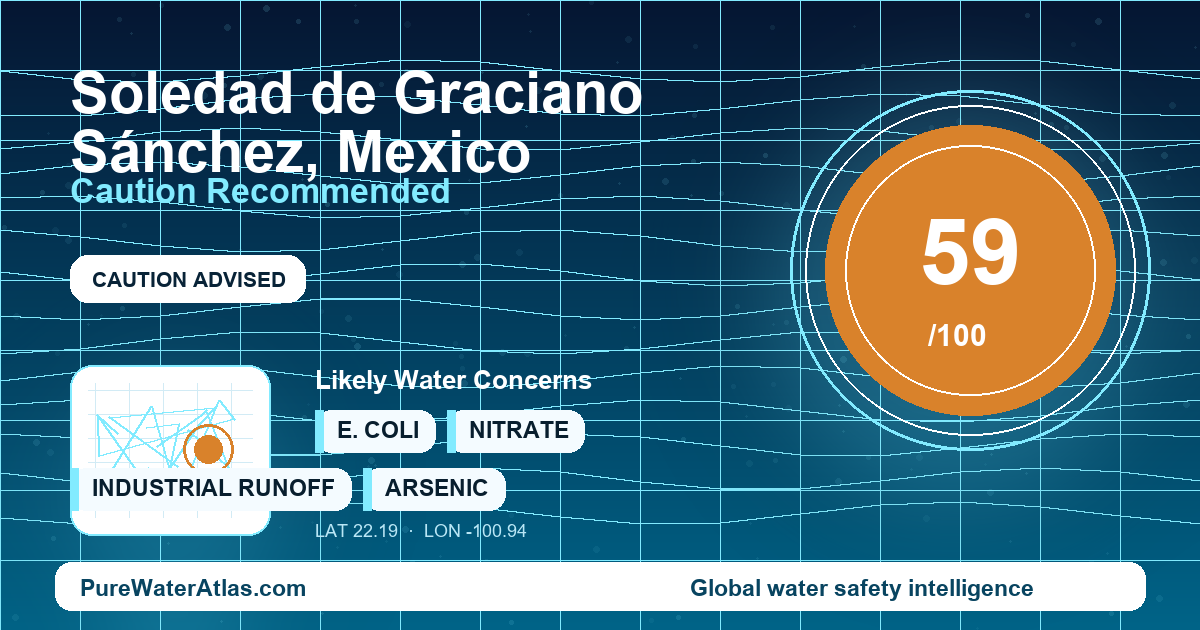
Soledad de Graciano Sánchez, Mexico: tap water safety review for a metropolitan groundwater-dependent supply with intermittent-service, storage-tank, and local verification concerns.
Quick Answer
| Overall safety status | Caution recommended. PureWaterAtlas score: 59/100. Tap water is not automatically unsafe at every address, but unfiltered tap water is a higher-risk choice because of groundwater stress, distribution-system variability, household storage tanks, and limited neighborhood-level public lab data. |
|---|---|
| Traveler advice | Short-term visitors should generally use sealed bottled water, reputable garrafón water, hotel-provided purified water, or water from a maintained purifier for drinking. |
| Resident advice | Treat tap water as a utility supply that should be verified at the kitchen tap. Test, maintain cisterns and tinacos, and use treatment matched to actual results. |
| Main water source | The San Luis Potosí metropolitan system depends heavily on groundwater from the San Luis Potosí Valley aquifer system, with the wider metro also affected by infrastructure such as El Realito when available. |
| Water authority | INTERAPAS, the metropolitan water and sanitation utility serving San Luis Potosí, Soledad de Graciano Sánchez, and Cerro de San Pedro. |
| Filter recommendation | A home filter is advisable for many households, but it should be selected after testing. Sediment plus activated carbon may help taste, particles, and chlorine issues; reverse osmosis or other certified treatment may be needed if testing finds arsenic, fluoride, nitrate, high dissolved solids, or other inorganic contaminants. |
Why Soledad de Graciano Sánchez Is Different
Soledad de Graciano Sánchez is not a standalone water-supply island. It is directly adjacent to the city of San Luis Potosí and is tied into the broader San Luis Potosí metropolitan water system. That matters because the safety and reliability of water at a Soledad kitchen tap can be affected by metropolitan-scale conditions: deep groundwater well performance, pressure management, distribution leaks, pumping operations, storage zones, chlorination points, and operational disruptions in regional supply components.
The city sits in a semi-arid highland basin of central-northern Mexico. In this setting, urban drinking water depends strongly on pumped groundwater and regional water transfers rather than abundant local surface water. The San Luis Potosí Valley aquifer has been identified by Mexican water authorities as a stressed groundwater resource, and the wider metropolitan area has developed supplemental infrastructure such as El Realito to reduce pressure on groundwater. However, recurring aqueduct and operational failures in that supplemental system have repeatedly pushed the metropolitan area back toward emergency wells, distribution adjustments, and water trucking in affected zones.
For consumers, the most important point is local variability. The dataset does not support a claim that every tap in Soledad de Graciano Sánchez fails or meets a specific limit. Instead, the city has credible risk factors that make verification important: groundwater mineralization, possible regional arsenic and fluoride concerns, intermittent pressure, pipe repairs, aging plumbing, and household cisterns or rooftop tinacos. In many homes, the water that reaches the glass may have passed through private storage before it reaches the faucet, so the final quality can depend as much on the building as on the utility network.
Where Does Soledad de Graciano Sánchez’s Tap Water Come From?
Soledad de Graciano Sánchez is supplied through the San Luis Potosí metropolitan drinking-water system. Publicly available information points to dependence on the INTERAPAS metropolitan network and deep groundwater wells drawing from the San Luis Potosí Valley aquifer system rather than a single local river, reservoir, or lake source serving Soledad alone.
The key infrastructure includes the INTERAPAS distribution network, deep wells, pumping stations, pressure zones, storage tanks, chlorination points, and local distribution pipes. At the household level, cisterns and rooftop tinacos are also a practical part of the water system for many residents because they help manage intermittent pressure or supply cuts. These tanks are useful for continuity, but they also create a second water-quality control point inside the property.
The wider metropolitan region is also affected by El Realito dam, aqueduct, and treatment infrastructure. El Realito was developed as a major source-water component for the San Luis Potosí metropolitan area, but it should not be treated as a guarantee of continuous supply in Soledad. When regional infrastructure is unavailable or unreliable, dependence on wells and emergency operating measures can increase. That can change pressure patterns, storage time, mineral taste, and the likelihood of sediment disturbance in parts of the network.
Who Manages Drinking Water in Soledad de Graciano Sánchez?
Drinking water and sanitation services for Soledad de Graciano Sánchez are managed by INTERAPAS, the Organismo Intermunicipal Metropolitano de Agua Potable, Alcantarillado, Saneamiento y Servicios Conexos. INTERAPAS is the main metropolitan utility for San Luis Potosí, Soledad de Graciano Sánchez, and Cerro de San Pedro.
Mexico’s drinking-water quality framework is national. Water for human use and consumption is governed by standards such as NOM-127-SSA1-2021, which establishes sanitary requirements and permissible limits. CONAGUA regulates national water resources and publishes aquifer availability information, while national water indicators are available through the Sistema Nacional de Información del Agua.
The limitation for household decision-making is transparency at the neighborhood level. City-specific operational information exists, but recent consumer-facing laboratory results by Soledad neighborhood, distribution zone, and building type are not consistently published in an easy-to-verify format. For that reason, this guide identifies credible local risks and practical safety steps, but it does not claim that all taps in Soledad de Graciano Sánchez have the same water quality.
Main Local Water Concerns
- Groundwater stress: Dependence on a stressed semi-arid basin aquifer can increase vulnerability to declining well yields, mineralized water, and service interruptions.
- Mineral content and taste: Hardness, total dissolved solids, salinity, and mineral taste are plausible issues for groundwater-derived supplies in the San Luis Potosí Valley.
- Regional arsenic and fluoride relevance: Studies and Mexican groundwater assessments identify arsenic and fluoride as relevant natural groundwater concerns in parts of San Luis Potosí and the broader Mexican highlands. These should be verified by tap-specific testing before making household decisions.
- Intermittent pressure and repairs: Low pressure, leaks, maintenance shutdowns, and pipe work can increase the chance of sediment, turbidity, and reduced disinfectant residual at the tap.
- Household cisterns and tinacos: Stored water can become microbiologically vulnerable if tanks are uncovered, poorly sealed, dirty, exposed, or cleaned too infrequently.
- Older plumbing: Older buildings may have plumbing, solder, brass fixtures, galvanized pipe, or service connections that add metals at the tap even if the water leaving the utility network is adequately treated.
Seasonal conditions can intensify these concerns. Dry-season demand and drought can increase reliance on wells, water trucking, pressure reductions, and household storage. Heavy rain can disturb debris in parts of the distribution system after pipe breaks or low-pressure events. Warm weather can also accelerate chlorine decay in cisterns and rooftop tanks, especially if stored water is used slowly.
For Travelers
For short-term visitors to Soledad de Graciano Sánchez, tap water is not recommended as the default drinking source. Use sealed bottled water, reputable garrafón water, hotel-provided purified water, or water from a well-maintained purifier. This conservative approach is especially important for children, pregnant travelers, immunocompromised travelers, and anyone with gastrointestinal sensitivity.
Many healthy adults brush their teeth with tap water in Mexican cities, but the safer traveler choice in Soledad is bottled or purified water. This is particularly important during service interruptions, after nearby pipe repairs, or if the tap water is cloudy, colored, earthy-smelling, contains visible particles, or lacks a normal disinfectant odor.
Ice in established hotels and restaurants is commonly made from purified water, but visitors should not assume that is true for street stalls or informal vendors. If unsure, ask whether the ice is made from purified water or skip ice. In restaurants, bottled drinks, hot beverages made with boiled water, and commercially purified ice are lower-risk choices.
If staying in a rental or family home, ask whether the tinaco or cistern has been cleaned recently and whether the kitchen tap is filtered. Carry bottled water during hot weather because dehydration risk is real in the San Luis Potosí climate. Travelers can also review conservative food and water precautions from the CDC Mexico Traveler View.
For Residents
Residents should manage Soledad de Graciano Sánchez tap water as a utility supply that may need point-of-use verification and treatment. The most useful first step is testing at the actual kitchen tap, not only at the street line, because storage tanks and indoor plumbing can materially change final water quality.
A practical baseline test should include free chlorine residual, turbidity, pH, conductivity or total dissolved solids, and hardness. If the home uses a cistern, tinaco, water truck deliveries, or has experienced recent outages, include microbiological indicators such as total coliforms and E. coli through a certified laboratory. Because arsenic and fluoride are regionally relevant groundwater concerns in parts of San Luis Potosí and central-northern Mexico, they should be included in at least one baseline test. If infants, pregnant people, or medically vulnerable residents live in the home, include nitrate and metals screening before relying on unfiltered tap water.
Filtration should match the test results. If water is visually clear and microbiologically reliable, sediment prefiltration plus activated carbon may improve particles, taste, odor, and chlorine-related issues. If laboratory results show arsenic, fluoride, nitrate, high dissolved solids, or other inorganic contaminants, consider reverse osmosis or another certified system designed for those specific contaminants. UV can help control microbes only when water is clear and prefiltered; it is not a solution for dissolved metals, salts, arsenic, fluoride, or nitrate.
Clean and disinfect cisterns and rooftop tinacos on a routine schedule, keep lids sealed, prevent animal and insect entry, and avoid drinking directly from stored water after long stagnation unless filtration or disinfection is in place. In older buildings, flush water that has been sitting overnight and consider first-draw and flushed testing for lead and other metals if there is any concern about legacy plumbing or brass fixtures.
Relevant Contaminants and Water-Quality Issues
The most relevant Soledad de Graciano Sánchez concerns are not one single contaminant, but a combination of groundwater chemistry, distribution conditions, and household storage. For disinfection, read PureWaterAtlas on chlorine, especially because residual chlorine can decay in long distribution lines and warm storage tanks. After low-pressure events, outages, or pipe repairs, turbidity and sediment become important warning signs.
For groundwater-derived supplies, residents should understand why arsenic testing may be appropriate in parts of the San Luis Potosí regional context. Where infants, pregnant people, septic influence, or agricultural impacts are possible, nitrate should also be considered. For microbial safety in cisterns, tinacos, intermittent-service homes, and water-truck deliveries, E. coli is a key indicator. In older buildings, lead can be relevant because the final tap quality may be affected by plumbing materials and stagnant first-draw water.
How to Verify Your Water Quality
For Soledad de Graciano Sánchez, verification should be address-specific. Start with the PureWaterAtlas guide to water testing and the broader drinking water safety guide. Use the Contaminants Search Engine to compare symptoms, test results, and treatment options, and check the Global Water Quality Checker for broader country and city context.
If boiling is needed during a suspected microbial event, review Boiling Water Purification: Complete Guide. For point-of-use disinfection, compare limitations using UV Water Purification: Complete Guide. For chemical concerns, see testing guides for arsenic, nitrate, and lead. Treatment selection should follow verified results; the PureWaterAtlas Water Treatment Systems guide explains how to match filters to contaminants.
Official and Technical Sources
- INTERAPAS official website — metropolitan utility information and operational notices for San Luis Potosí, Soledad de Graciano Sánchez, and Cerro de San Pedro.
- CONAGUA: Disponibilidad de agua subterránea por acuíferos — official Mexican aquifer availability and groundwater-management context.
- Sistema Nacional de Información del Agua — national water data portal for Mexican water resources, uses, infrastructure, and indicators.
- NOM-127-SSA1-2021 — Mexican drinking-water quality standard for water for human use and consumption.
- CDC Mexico Traveler View — traveler health guidance supporting conservative food and water precautions.
- WHO Guidelines for Drinking-water Quality — international reference for microbial safety, disinfection, and chemical contaminants.
- WHO/UNICEF Joint Monitoring Programme: Mexico WASH data — country-level water and sanitation context, not a substitute for Soledad tap testing.
Bottom Line
Soledad de Graciano Sánchez tap water deserves a cautious, address-specific approach. The city is part of the INTERAPAS metropolitan system and depends heavily on groundwater from the San Luis Potosí Valley aquifer, with wider supply reliability affected by wells, pressure management, storage, and infrastructure such as El Realito when available. Visitors should use bottled or purified water for drinking. Residents should test at the kitchen tap, maintain cisterns and tinacos, and choose filtration based on actual results. The main concerns are mineralized groundwater, possible regional arsenic and fluoride relevance, sediment and turbidity after interruptions, microbial risk in storage tanks, and metals from older plumbing. Public neighborhood-level lab data are limited, so local testing is the safest decision tool.
Read the full guide: Global Water Quality Guide
Explore more in this category: Global Water Quality Articles