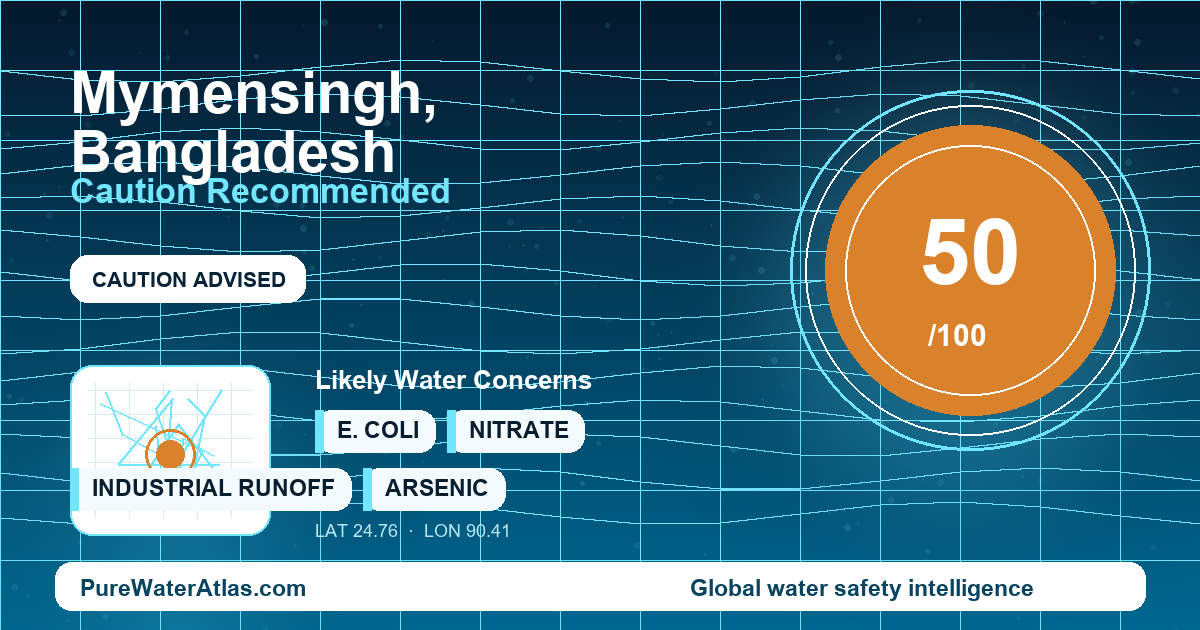
Mymensingh has a likely groundwater-based municipal supply, but public city-level compliance data are limited; treat drinking-water safety as tap-specific, especially where storage tanks, private wells, or intermittent pressure are involved.
Quick Answer
| Overall safety status | Caution recommended. PureWaterAtlas assigns Mymensingh a water safety score of 50/100 because current public, city-level data on microbiology, residual chlorine, arsenic, iron, manganese, and distribution performance are limited. |
|---|---|
| Can travelers drink the tap water? | Not recommended untreated. Short-stay visitors should use sealed bottled water, boiled water, or water treated with reliable filtration plus disinfection. |
| Resident guidance | Residents should treat safety as building- and tap-specific unless they have recent test results. Storage tanks, household filters, private wells, and old plumbing can change water quality after it leaves the source. |
| Main water source | Mymensingh’s urban supply is best characterized as groundwater-dependent, using municipal production tube wells or deep boreholes, with some households also using private tube wells, hand pumps, or stored municipal water. |
| Responsible authority | Mymensingh City Corporation is the local urban authority for municipal services, including water-supply functions. Bangladesh’s Department of Public Health Engineering provides national technical support for water supply and sanitation. |
| Filter recommendation | For municipal water, consider sediment filtration plus activated carbon and UV or boiling for microbial risk. For private wells, test first; arsenic, nitrate, iron, manganese, salinity, and microbial contamination require different treatment choices. |
Why Mymensingh Is Different
Mymensingh is an inland city in north-central Bangladesh on the Old Brahmaputra River. It is not one of Bangladesh’s coastal salinity hotspots, but its drinking-water risk profile is shaped by floodplain geography, monsoon rainfall, drainage pressures, groundwater conditions, and household storage practices. The practical question in Mymensingh is often not simply whether the city has a municipal supply. The more important question is whether the water reaching a specific kitchen tap has passed through clean pipes, a clean rooftop or underground tank, and a maintained household treatment system.
PureWaterAtlas did not find a current public Mymensingh City Corporation water-quality dashboard showing routine neighborhood-level results for E. coli, residual chlorine, arsenic, iron, manganese, turbidity, or pipe-network performance. That absence matters. It does not prove that Mymensingh has unsafe water citywide, but it also means residents and visitors should not infer safety from the existence of piped supply alone.
Bangladesh’s national water history is especially relevant here. Tube wells were widely used to reduce microbial disease from surface water, but the country’s groundwater experience also showed that naturally occurring contaminants, especially arsenic, can vary sharply by aquifer depth and location. Mymensingh should not be treated as automatically arsenic-unsafe citywide, yet private wells and boreholes should be tested rather than assumed safe.
Where Does Mymensingh’s Tap Water Come From?
Mymensingh’s urban drinking-water system is best described as a groundwater-dependent municipal supply. Available city and national water-sector context indicate use of production tube wells or deep boreholes, pump houses, and piped distribution operated through the local city authority’s water-supply function. Many buildings then store water in underground reservoirs or rooftop tanks before it reaches taps. Some households, institutions, and peri-urban users may also rely on private tube wells, hand pumps, or boreholes.
The city developed along the Old Brahmaputra River, but the available evidence does not support describing the current drinking-water system as a fully treated river-water system. Instead, it fits the common model for many Bangladeshi secondary cities: groundwater abstraction, pumping, distribution, and then building-level storage. A current public technical inventory confirming every active source, treatment step, production well, and neighborhood supply zone was not found.
This source pathway creates several points where water quality can change. Water may leave a production well in acceptable condition but become contaminated later through leaking distribution pipes, low-pressure events, floodwater intrusion, dirty tanks, or unsafe household handling. Conversely, private wells may look clear but still require testing for arsenic, nitrate, microbial indicators, iron, manganese, pH, conductivity, and turbidity.
Who Manages Drinking Water in Mymensingh?
Mymensingh City Corporation is the local urban authority responsible for municipal services in the city area, including water-supply functions. At the national level, the Department of Public Health Engineering, under Bangladesh’s Local Government Division, is the key technical agency for water supply and sanitation support, testing, and infrastructure programs outside the Dhaka and Chattogram WASA systems.
Bangladesh drinking-water quality is governed through national standards and public-health engineering practice, with DPHE and local government institutions playing major implementation roles. However, for Mymensingh specifically, PureWaterAtlas did not locate a routinely published city water-quality report equivalent to the annual consumer confidence reports used in some countries. That limits confidence in any blanket statement about current tap-water safety. The most defensible conclusion is caution: verify the exact source, building storage, and tap water you use.
Main Local Water Concerns
Microbial contamination at point of use: The most immediate practical concern for many users is microbial risk after water enters storage or passes through compromised distribution. National Bangladesh household water data and WHO/UNICEF context show that safely managed drinking water can be affected by microbial contamination and handling risks. In Mymensingh, this concern is most plausible where water is stored in rooftop tanks, where pressure is intermittent, or where shallow wells are near drains, latrines, or floodwater.
Arsenic in groundwater: Bangladesh groundwater arsenic is well documented by DPHE, British Geological Survey, and UNICEF-linked sources. Mymensingh should not be labeled as having a confirmed citywide arsenic crisis based on the available dataset, but private tube wells and boreholes need site-specific testing because arsenic varies strongly by aquifer and location.
Iron and manganese: Groundwater supplies in Bangladesh often contain iron and sometimes manganese. These can cause staining, metallic taste, odor, black or reddish deposits, and filter fouling. Visible staining does not prove water is microbiologically unsafe, but it is a strong reason to test and maintain treatment systems.
Turbidity, sediment, and discoloration: Turbidity may increase after pipe repairs, pump cycling, tank disturbance, or monsoon-related intrusion. Cloudy water can reduce the effectiveness of UV disinfection because particles can shield microbes. Turbid water should be settled, filtered, or clarified before disinfection.
Nitrate and sanitation influence: Mymensingh is surrounded by agricultural and densely settled areas. Shallow private wells near latrines, drains, livestock areas, or fertilizer use should be tested for nitrate and microbial indicators, especially where infants or pregnant people drink the water.
Premises plumbing metals: There is no public evidence in the dataset of a citywide lead crisis in Mymensingh. Still, older buildings, brass fixtures, solder, galvanized components, and long stagnation in internal plumbing can contribute metals at the tap. First-draw testing is appropriate in older homes, schools, clinics, hostels, or apartment buildings.
For Travelers
Short-stay visitors should not rely on untreated Mymensingh tap water for drinking. Use sealed bottled water from a reliable source, properly boiled water, or water treated by a credible filtration and disinfection system. If boiling, bring water to a rolling boil and store it in a clean, covered container.
For brushing teeth, use bottled, boiled, or properly filtered water if you are a short-stay visitor, immunocompromised, pregnant, traveling with young children, or prone to stomach sensitivity. This is especially prudent where water has passed through building storage tanks.
Avoid ice unless the hotel or restaurant can confirm that it is made from bottled or treated water. Factory-made ice is generally safer than ice made from unknown tap or storage-tank water, but verification is still the safer approach. Ask specifically about drinking water, ice, salad washing, and beverage preparation rather than assuming that a reputable setting automatically treats all water.
Some higher-end hotels, clinics, and restaurants may use bottled water, dispensers, reverse osmosis, UV, or other treatment. The key is maintenance. A UV unit without pre-filtration, a dirty dispenser, or expired filter cartridges can create false confidence. For practical disinfection guidance, see the PureWaterAtlas guides to boiling water purification and UV water purification.
For Residents
For Mymensingh residents on municipal supply, a household treatment system is advisable unless you have recent, credible tap-specific test results and confidence in storage-tank hygiene. A practical municipal-water setup often includes sediment pre-filtration, activated carbon for taste and some chemical reduction, and UV or boiling for microbial protection. However, UV should be used only after cloudy or sediment-rich water is filtered, because turbidity can interfere with disinfection.
For private wells, do not choose a filter before testing. Arsenic and nitrate often require specialized media, reverse osmosis, or other targeted treatment. Iron and manganese need different control strategies from microbial contamination. A filter that improves taste or color may not remove arsenic, nitrate, or bacteria.
Testing should include, at minimum, arsenic, E. coli or thermotolerant coliforms, iron, manganese, nitrate, electrical conductivity, pH, and turbidity for private wells or boreholes. For municipal tap water, test E. coli or total coliform after storage, turbidity, free residual chlorine if chlorination is used, iron, manganese, and basic chemistry. In older buildings, add lead and other metals testing.
Test both source water and point-of-use water when possible. A clean borehole result does not prove the water coming from a rooftop tank or kitchen tap is safe. Retest after flooding, nearby construction, pump replacement, major pipe repair, changes in taste or color, or unexplained gastrointestinal illness among household members. Use DPHE, a qualified public-health laboratory, a university laboratory, or an accredited private laboratory where available.
Storage tanks are a major point-of-use issue in Mymensingh-style urban housing. Rooftop and underground tanks should be covered, protected from insects and rodents, cleaned and disinfected on a schedule, and inspected after floods or repairs. A filter placed after a dirty tank can become contaminated quickly if cartridges and UV lamps are not maintained.
Relevant Contaminants and Water-Quality Issues
The most relevant Mymensingh drinking-water issue for immediate illness risk is E. coli or related fecal indicator bacteria, especially after storage, flooding, low pressure, or unsafe handling. Chemical testing is also important because the city’s supply model is groundwater-dependent. Arsenic is the national groundwater contaminant that requires the strongest site-specific caution for private wells and boreholes.
Common groundwater and distribution issues include iron, manganese, turbidity, and sediment. Shallow wells near sanitation or agriculture should also be checked for nitrate. In older premises, lead and other plumbing metals should be assessed through first-draw and flushed samples. Where municipal or treated water uses disinfection, understanding chlorine residuals can help interpret whether water remains protected in the distribution and storage pathway.
How to Verify Your Water Quality
The safest approach in Mymensingh is to verify your specific water rather than relying on citywide assumptions. Start with the PureWaterAtlas guide to water testing, then compare any lab results with contaminant profiles in the Contaminants Search Engine. For broader context, use the Global Water Quality Checker before travel or relocation.
If a private well tests positive for arsenic, review arsenic testing and detection methods and arsenic treatment options. For shallow wells near drains, latrines, livestock, or agricultural land, see nitrate testing guidance. For older buildings, schools, clinics, or long-stagnation plumbing, see lead testing methods.
For general decision-making, PureWaterAtlas also recommends the guides on drinking water safety, water microbiology, water treatment systems, and water contamination pathways.
Official and Technical Sources
- Mymensingh City Corporation official website — local city authority for municipal services in Mymensingh, including water-supply functions.
- Department of Public Health Engineering — Bangladesh’s national technical agency for water supply and sanitation support, testing, and infrastructure programs.
- Bangladesh National Drinking Water Quality Survey 2009 — national survey by Bangladesh Bureau of Statistics and UNICEF documenting arsenic and microbial drinking-water challenges; not a current Mymensingh compliance report.
- Arsenic contamination of groundwater in Bangladesh — British Geological Survey and DPHE background on groundwater arsenic and location-specific well testing.
- WHO/UNICEF Joint Monitoring Programme household water data for Bangladesh — national WASH context for drinking-water service levels and safely managed water.
- WHO Guidelines for drinking-water quality — international reference for microbiological and chemical risk assessment where local compliance data are incomplete.
- Department of Environment, Government of Bangladesh — national environmental regulatory context; PureWaterAtlas did not locate a current Mymensingh-specific public compliance table there.
Bottom Line
Mymensingh tap water should be approached with caution, not panic. The city’s supply is best understood as groundwater-dependent, with municipal tube wells or boreholes, piped distribution, and frequent building-level storage. The main risk is uncertainty at the tap: microbial contamination from tanks, pressure loss, flooding, or handling; site-specific groundwater chemistry such as arsenic, iron, manganese, or nitrate; and older-building plumbing metals. Travelers should avoid untreated tap water and use bottled, boiled, or reliably treated water. Residents should test private wells and, where possible, compare source water with kitchen-tap water after storage. Clean tanks, maintained filters, and laboratory testing are more reliable than assumptions about citywide safety.
Read the full guide: Global Water Quality Guide
Explore more in this category: Global Water Quality Articles