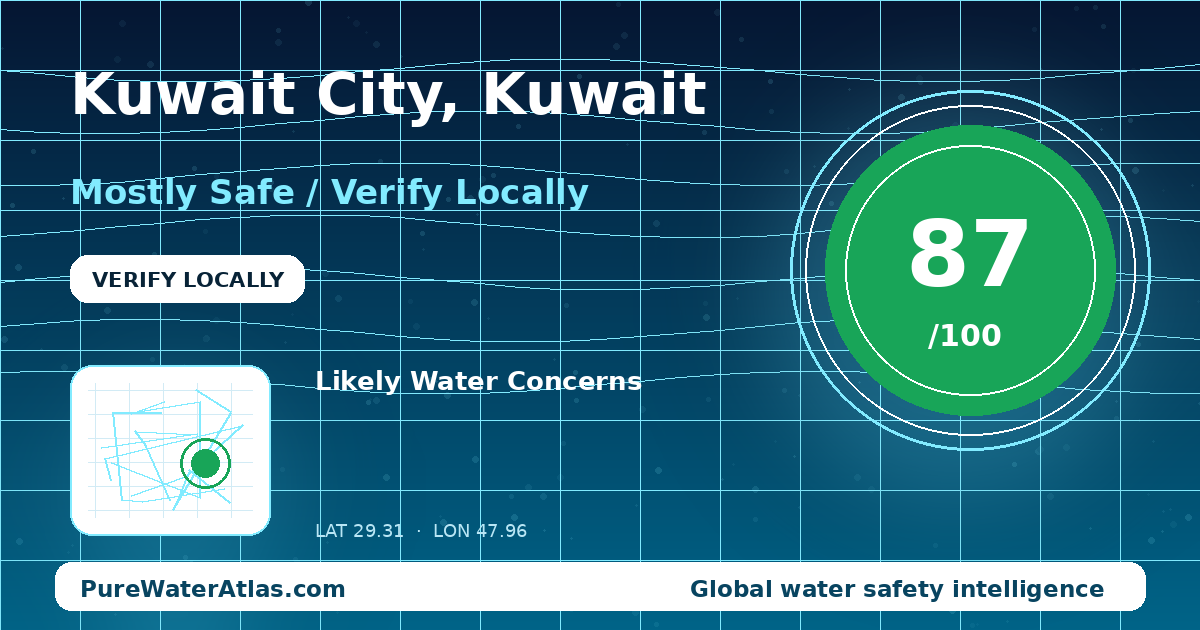
Kuwait City is supplied through Kuwait’s nationally integrated freshwater system, which depends predominantly on desalinated seawater. The Ministry of Electricity, Water and Renewable Energy (MEWRE) states that it monitors drinking water chemically and bacteriologically from production through delivery and operates mixing, blending, chlorination and network-sterilization infrastructure. That represents meaningful utility-level protection in a country with extremely limited renewable freshwater resources, but it is not proof that every hotel, apartment or household tap has identical water quality.
The main unresolved issue is the final part of the journey. Water in Kuwait commonly passes through building storage and private plumbing before reaching an indoor tap. Older Kuwait-wide research found that some trace-metal concentrations increased between the public connection and household fixtures. Tank condition, pipe materials, corrosion, stagnation and maintenance can therefore matter even when the water entering a property has been treated. Because no recent Kuwait City endpoint report with neighborhood-level results was found, PureWaterAtlas does not make a blanket citywide safety claim.
Quick Answer
| Overall safety status | Treated and officially monitored at utility level, but current Kuwait City endpoint data are not publicly available; building tanks and plumbing can affect the final tap. |
|---|---|
| Can visitors drink the tap water? | Verify the building’s tank maintenance and drinking-water setup. If those details are unavailable, factory-sealed bottled water is the lower-uncertainty choice. |
| Resident advice | Maintain tanks, flush stagnant water and test the kitchen tap if plumbing is old, water is discolored or corrosion is suspected. |
| Main water source | Predominantly desalinated seawater, with officially documented groundwater production and mixing or blending operations. |
| Responsible authority | Kuwait Ministry of Electricity, Water and Renewable Energy. |
| Filter recommendation | Test first. Select certified treatment for the contaminant found rather than installing a generic filter. |
Where Does Kuwait City’s Tap Water Come From?
Kuwait has extremely limited renewable freshwater resources, so the municipal system is built around seawater desalination. MEWRE identifies coastal power and water-distillation facilities at Shuwaikh, Shuaiba, Doha East, Doha West, Al-Zour South and Al-Sabiyah. These facilities serve an integrated national system rather than a clearly published, city-only supply zone. It is therefore more accurate to describe Kuwait City as part of the national production and distribution network than to attribute every address to one particular plant.
MEWRE also documents groundwater production, reverse-osmosis treatment of brackish water, and mixing and blending stations. Older technical research describes distilled seawater being blended with a relatively small proportion of brackish groundwater, followed by chlorination and distribution. Blending helps explain why tap-water chemistry cannot be inferred from desalination alone: the final composition can reflect more than one source and several operational stages. The historical blend percentage reported in older research should not, however, be treated as the current Kuwait City supply mix because no recent city-specific ratio was found.
Desalination addresses the lack of abundant freshwater, while subsequent mixing, disinfection, storage and pumping move the water into the public network. Once water crosses into a property, responsibility for its condition may also depend on the building’s storage and plumbing. This division between centralized production and the final building-level route is central to interpreting Kuwait City tap-water questions.
Who Manages Drinking Water?
The responsible public body is Kuwait’s Ministry of Electricity, Water and Renewable Energy. Its Water Operation and Maintenance Sector follows water from production through reservoirs, pumping stations and consumer connections. The ministry says its chemical-works department analyzes water across facilities, manages network washing and sterilization, and operates chlorine and chlorine-dioxide injection infrastructure. Its Water Resources Development Center lists chemical and bacteriological laboratories and says monitoring continues from production to the consumer. MEWRE also describes distribution-network corrosion monitoring.
These operational descriptions show that water-quality management involves more than desalination at the coast. It includes treatment control, disinfection, reservoirs, pumping, network maintenance and laboratory work. The World Health Organization’s Kuwait profile reports 100% national use of safely managed drinking-water services using World Health Statistics 2020 data. That national service indicator is useful context, but it does not answer whether an individual building tank is clean or whether a particular kitchen fixture is releasing metals.
The ministry’s descriptions are therefore informative but not a substitute for current numerical results from the tap in question. The researched public pages did not provide recent Kuwait City sample values, violation histories or neighborhood-level compliance summaries. For a household decision, official system information and building-specific evidence should be considered together.
Main Local Water Concerns
Building storage and premise plumbing
The most important distinction is between water in the public network and water at an indoor tap. A Kuwait-wide study published in 2012 compared samples at external connections with samples collected after water passed through building tanks and plumbing. Indoor concentrations of aluminum, chromium, cobalt, copper, iron, lead, nickel and zinc were higher on average. Iron, lead and nickel exceeded the study’s comparison guidelines in 8.5%, 0.3% and 1% of indoor samples, respectively.
The samples were collected in 2003–2005, so the study cannot establish present-day prevalence or describe every Kuwait City property. It does demonstrate a plausible local pathway: water can change after entering roof tanks, ground reservoirs and private pipes. A well-maintained newer building and an older property with corroded components should not automatically be assigned the same risk. Tank sealing and cleaning, plumbing materials, fixture condition and the length of time water has stood unused all help determine what reaches the glass.
Residents concerned about metals should test rather than rely on taste or appearance. Clear water can still contain dissolved substances, while rust-colored water may point toward iron or disturbed sediment without identifying the complete cause. For more on plumbing-related risk, see the PureWaterAtlas guide to lead in drinking water and the lead home-safety checklist.
Localized pressure reductions and maintenance
MEWRE announced an eight-hour period of weak freshwater pressure during February 2025 maintenance at Hawalli Pumping Station, affecting Hawalli, Al-Shaab and Al-Qadisiyah. This is evidence of a localized planned disruption, not proof of chronic unreliability across Kuwait City. It also illustrates why residents should check current ministry notices when pressure changes suddenly rather than assuming the cause is inside their building.
After pressure loss, network work or building maintenance, watch for persistent discoloration, sediment, unusual odor or continuing pressure problems. Follow any instructions issued by MEWRE or building management. Boiling should not be treated as a universal response: it can control susceptible microbes when correctly used, but it does not remove metals or salinity and may concentrate nonvolatile dissolved substances as water evaporates.
Salinity and chemical composition
A 2015 study of 43 Kuwait tap samples reported that 18.6% exceeded the 200 mg/L chloride comparison value used by the authors. The paper also identified arsenic, boron and zinc findings that the authors considered elevated against some international benchmarks. These are historical, Kuwait-wide findings rather than a current Kuwait City compliance report. They help identify parameters worth considering in a broader laboratory panel, but they do not prove that a present-day tap violates an applicable requirement.
Chloride and other dissolved constituents also require a different treatment approach from bacteria or plumbing metals. A result such as conductivity or total dissolved solids can describe the amount of dissolved material in broad terms, but it cannot by itself identify each substance or determine overall safety. Interpretation should use contaminant-specific results and applicable Kuwait requirements.
For Travelers
Visitors should ask whether their accommodation’s drinking tap is supplied through a private tank, whether the tank is sealed and regularly cleaned, and whether any point-of-use system is professionally maintained. A filter’s presence does not prove that it is effective: its suitability depends on what it is designed to remove and whether cartridges, membranes, storage tanks or lamps receive appropriate maintenance.
When those facts cannot be verified, unopened factory-sealed water offers lower uncertainty for drinking and infant formula. This is a precaution based on the information gap at the building tap, not a claim that every Kuwait City tap is contaminated. Check that the seal is intact and avoid transferring drinking water into containers of uncertain cleanliness.
The CDC’s Kuwait destination page advises travelers to pay attention to food and water hygiene, but it does not specifically declare all Kuwait City taps unsafe. Its broader travel principle is appropriate here: only put tap water in your mouth when you are reasonably certain that it is safe. Never use ordinary tap water for contact lenses or nasal irrigation. Travelers staying for longer periods can ask management for tank-cleaning and treatment-maintenance records instead of relying only on a verbal statement that the water is filtered.
For Residents
Residents should identify the complete route water takes through their building. Ask whether it passes through a ground reservoir, roof tank or both before reaching the kitchen. Roof tanks, ground reservoirs, old galvanized components, corroded fixtures and long periods of stagnation can alter water after it leaves the public system. Keep tanks covered and maintained, and address visible damage or uncertain cleaning history through the responsible building management.
After a long period without use, flush stagnant cold water before collecting water for ordinary consumption. If appearance, odor or taste is abnormal, determine whether the issue affects one fixture, all cold taps, only hot water, or the incoming supply. A problem confined to hot water or a single fitting may have a different building-level source from a condition present throughout the property. This comparison does not replace testing, but it can help explain the situation to management, a laboratory or the authority.
Persistent metallic taste, rust-colored water, repeated sediment or concern about an older building justifies laboratory testing. Households with no obvious problem may still choose testing when they need greater confidence about an uncertain tank or plumbing history. PureWaterAtlas provides a home water-testing overview, while its complete water-testing guide explains why sampling method matters.
Relevant Contaminants and Water-Quality Issues
Priority parameters for a building-level check include E. coli, total coliforms, turbidity, pH, conductivity, disinfectant residual, lead, copper, iron, nickel and zinc. Microbiological indicators and turbidity are particularly relevant when storage-tank hygiene is in question, while first-draw and flushed metal samples can help investigate the influence of fixtures and plumbing. A more comprehensive desalinated-water panel can add chloride, sodium, calcium, magnesium, alkalinity, boron and arsenic.
Do not choose treatment from the contaminant name alone or assume one device solves every possible issue. Carbon may improve chlorine taste but does not reliably remove salts or disinfect water. Reverse osmosis may reduce many dissolved substances but requires regular membrane and tank maintenance. UV can address microbes in clear water but does not remove metals or salinity. Boiling is a temporary microbial control, not a metals or dissolved-salts treatment.
Treatment should follow a reliable test and match the specific concentration, intended use and device capability. Maintenance is part of treatment performance; an unsuitable or neglected system can create false confidence. For confirmed metals, consult the heavy-metals treatment guide. If tap water becomes unexpectedly cloudy, use the cloudy tap water profile to distinguish entrained air from conditions requiring testing.
How to Verify Your Water Quality
- Check current MEWRE notices for maintenance or pressure changes and call 152 for a public-supply problem.
- Ask building management for the tank-cleaning schedule, inspection history and treatment-system maintenance records. Confirm which tank and plumbing route serve the drinking tap.
- Use a qualified laboratory and collect samples exactly as directed. The Kuwait Government Online source also documents a government chemical water-testing service through the Ministry of Public Works.
- For plumbing metals, request both first-draw and flushed sampling if the laboratory supports that protocol. The contrast can provide more useful information than a single unidentified sample.
- For suspected tank contamination, request microbiological indicators, turbidity and disinfectant residual in addition to chemistry.
- Record whether the sample came from cold or hot water, whether the tap was flushed, and whether discoloration or pressure changes were present. Sampling details affect interpretation.
- Compare results with applicable Kuwait requirements or obtain interpretation from the responsible authority. Do not diagnose safety from taste, odor, conductivity or total dissolved solids alone.
Readers can explore possible substances with the PureWaterAtlas Contaminants Search Engine and compare broader country context using the Global Water Quality Checker. The drinking-water safety pillar and drinking-water safety category provide additional interpretation guidance.
Official and Technical Sources
- Water Operation and Maintenance Sector — Kuwait Ministry of Electricity, Water and Renewable Energy
- Planning, Training and Information Systems Sector — Kuwait Ministry of Electricity, Water and Renewable Energy
- Power Stations and Water Distillation Sector — Kuwait Ministry of Electricity, Water and Renewable Energy
- Announcement of Weak Fresh Water in Some Areas During Maintenance Work at Hawalli Pumping Station — Kuwait Ministry of Electricity, Water and Renewable Energy
- Chemical Detection of Water Type – One Sample — Kuwait Government Online
- Health and the SDGs at a Glance in Kuwait — World Health Organization Regional Office for the Eastern Mediterranean
- Physical and Chemical Characteristics of Drinking Water Quality in Kuwait: Tap vs. Bottled Water — Journal of Engineering Research / Springer Nature
- Effects of Household Storage and Plumbing Systems on the Levels of Trace Elements in Desalinated Drinking Water in Kuwait — Journal of Environmental Protection
- Kuwait – Traveler View — US Centers for Disease Control and Prevention
Related Contaminant Profiles
Explore PureWaterAtlas
Bottom Line
Kuwait City’s public water starts with a comparatively robust documented process: desalination, blending, disinfection, distribution management and ministry monitoring. The evidence gap is at the present-day consumer tap. Recent numerical city and neighborhood results were not found, and building tanks and plumbing can introduce conditions that utility-level monitoring does not fully describe.
Visitors should verify their accommodation’s storage and treatment setup or use factory-sealed bottled water when those details are uncertain. Residents should focus on tank maintenance, premise-plumbing condition, changes after pressure or maintenance work, and targeted laboratory testing. The appropriate response depends on evidence from the actual tap—not an assumption that all Kuwait City water is unsafe or that every property needs the same filter.
Read the full guide: Global Water Quality Guide
Explore more in this category: Global Water Quality Articles