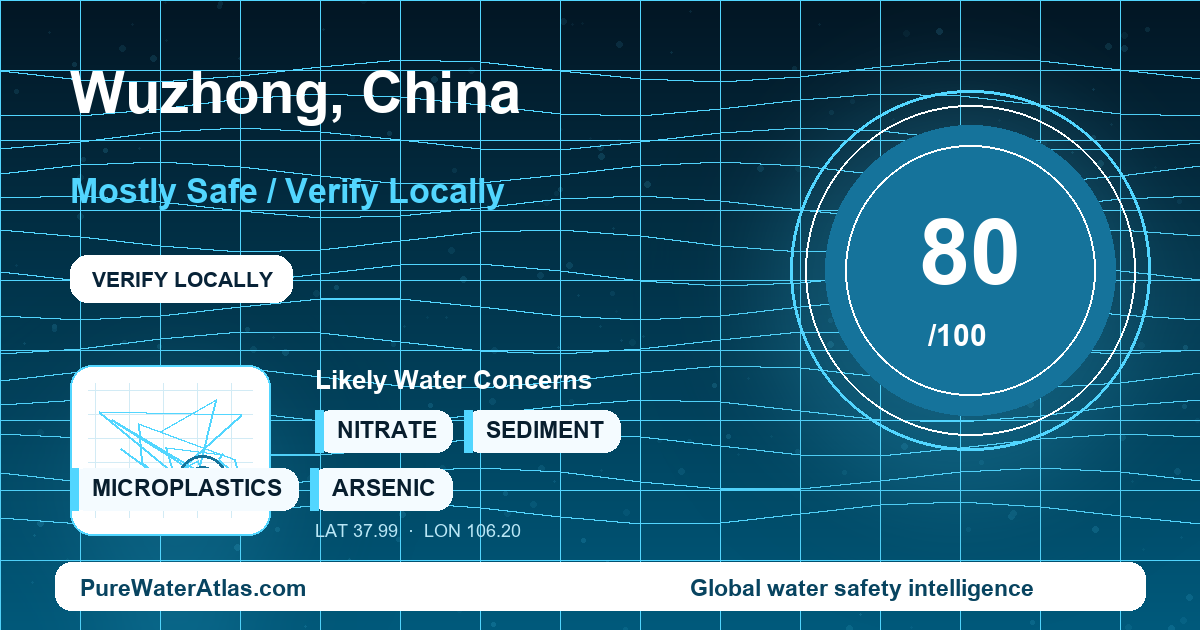
Wuzhong’s urban tap water is best treated as mostly safe when it comes from the municipal network, but visitors and residents should verify local conditions because recent, city-specific finished-water test results are limited in open public sources.
Quick Answer
| Water safety score | 80 / 100 |
|---|---|
| Risk level | Mostly Safe / Verify Locally |
| Can you drink the tap water? | In central urban Wuzhong, municipally supplied water is generally expected to be treated, but drinking it straight from the tap is not the lowest-risk choice unless your hotel, landlord, or local supplier confirms the building supply is potable and well maintained. |
| Traveler advice | Use bottled water, boiled water, or a reliable purifier for drinking. Brushing teeth with tap water in central hotels is usually lower risk for healthy adults, but avoid cloudy, rusty, or rural guesthouse tap water. |
| Resident advice | Boiling municipal tap water for routine drinking is a common practical approach. Residents should check building storage tanks, old internal plumbing, sediment, taste, and any water-supply notices. |
| Main likely source | Treated Yellow River surface water in the Ningxia Yellow River irrigation corridor, with some outlying, county, rural, or legacy systems potentially using groundwater or mixed sources. |
| Local oversight | Wuzhong municipal water-supply and water-affairs or housing authorities, with public-health supervision by the local health commission under China’s national drinking-water standard GB 5749-2022. |
| Filter recommendation | A filter is not automatically required for every centrally supplied home, but sediment and activated carbon filtration can improve clarity and chlorine taste. Consider reverse osmosis only if testing shows high dissolved solids, nitrate, fluoride, arsenic, or other dissolved contaminants. |
Why Wuzhong Is Different
Wuzhong is not a coastal city with a large local reservoir system, and it is not a mountain city supplied mainly by short upland streams. It sits in Ningxia Hui Autonomous Region on the Yellow River plain, in an arid to semi-arid inland setting where the Yellow River is the strategic water source for cities, irrigation, and industry. That local identity matters because Wuzhong’s tap-water risk profile is shaped by Yellow River source-water conditions, irrigation-corridor activity, mineral content, and distribution-system management rather than by a single documented citywide contamination incident.
The central urban supply is most plausibly based on treated Yellow River surface water delivered through the regional Yellow River water-supply and irrigation infrastructure. Wuzhong is also close to Qingtongxia, a major Yellow River water-control and irrigation node. Raw-water quality can therefore be influenced by upstream flows, sediment pulses, irrigation return flows, and reservoir or canal operations. This does not mean Wuzhong tap water is unsafe; it means local verification matters, especially during high-turbidity seasons or when a specific building has storage or plumbing issues.
A second reason Wuzhong is different is administrative variety. A visitor in a central Wuzhong hotel may encounter acceptable municipal water, while outlying Wuzhong-administered areas such as Yanchi, Tongxin, Hongsibu, or rural townships may have different supply arrangements, longer distribution lines, smaller treatment works, groundwater influence, or private-well concerns. A single citywide answer cannot reliably cover every hotel, apartment, village, and secondary storage tank.
Where Does Wuzhong’s Tap Water Come From?
For the Wuzhong urban core, the most likely main raw-water system is treated Yellow River surface water. Ningxia cities, including Wuzhong and nearby Qingtongxia, depend heavily on the Yellow River for municipal use, irrigation, and regional development. Historically, settlement and agriculture in the Wuzhong area grew around Yellow River diversions, canals, and local groundwater in an arid region. That history still matters: older or peripheral communities may have practical water-quality issues associated with mineralized groundwater, local wells, or small-scale rural supply systems, even when the central city is served by a more formal municipal network.
Key infrastructure relevant to Wuzhong includes the Yellow River main channel through the Ningxia irrigation corridor, Qingtongxia water-control and irrigation infrastructure, municipal water-treatment plants and distribution networks serving the urban area, building-level secondary water-supply tanks in some multi-story buildings, and rural drinking-water projects serving outlying counties and townships. The weakest point for an individual user may not be the treatment plant itself. Water can change after treatment as it moves through long pipes, older building plumbing, rooftop or basement tanks, and household fixtures.
Season also affects what residents and travelers notice. Summer rainy-season and Yellow River flood-season conditions can raise turbidity and sediment load, requiring treatment plants to manage coagulation and filtration carefully. Drought or low-flow periods can concentrate salts and dissolved minerals in source waters and local groundwater. Irrigation seasons can increase interaction between agricultural return flows, drainage canals, and regional surface-water quality. In winter, freezing conditions and pipe repairs can lead to localized discoloration, pressure changes, or temporary precautions after maintenance.
Who Manages Drinking Water in Wuzhong?
Wuzhong’s local water supply is overseen through municipal urban water-supply and water-affairs or housing authorities, with public-health supervision by the local health commission. Local utility entities are commonly identified in Chinese sources as Wuzhong municipal tap-water or water-supply company entities, but the exact operating company and service boundary should be confirmed for a specific address. This is important for residents because an apartment on the central network, a rural household, and a property with a separate building storage tank may not face the same practical risks.
China’s national regulatory framework is the Standards for Drinking Water Quality, GB 5749-2022. Monitoring and enforcement roles involve public-health, housing and urban-rural development, water-resources, market-regulation, and ecological-environment agencies. Source-water quality is also connected to Yellow River basin management and Ningxia regional water-resource controls. For Wuzhong, the regulatory framework is clear, but recent open, address-specific finished tap-water results are not easy to find in high-authority English-language sources. This profile therefore classifies Wuzhong as “Mostly Safe / Verify Locally,” not as universally safe in every building or rural district.
Main Local Water Concerns
The main Wuzhong-specific concerns are practical and source-related. Yellow River raw water can carry turbidity and suspended sediment, especially during high-flow, storm-influenced, or flood-season periods. Proper municipal treatment is designed to manage these conditions, but visible cloudiness, unusual sediment, or abrupt changes after pipe work should still be taken seriously at the tap.
Chlorine taste or odor is another common municipal-water complaint. A disinfectant smell does not by itself mean the water is unsafe; it may indicate that residual disinfectant is present in the distribution system. However, strong or unusual odors should be checked locally, especially if they appear suddenly or affect only one building.
Hardness, mineral taste, or elevated dissolved solids are also plausible practical complaints in an arid inland basin. These issues often affect taste, kettle scale, and household comfort more than immediate safety, but specialty treatment should be chosen based on testing rather than assumption. In the broader Yellow River irrigation corridor, agricultural runoff influence may include nutrients or pesticides, but this page does not assert a documented citywide Wuzhong drinking-water exceedance. For rural homes, groundwater, small systems, and agricultural context make testing more important.
Finally, old internal plumbing and secondary storage tanks can degrade water after it leaves the municipal network. Galvanized steel, corroded internal pipes, brass fixtures, long stagnation, rooftop tanks, basement tanks, and intermittent pressure can contribute rust, sediment, metals, microbial regrowth, or unpleasant taste. These are building-specific risks and cannot be ruled out by a city-level safety score.
For Travelers
Short-term visitors should not rely on drinking Wuzhong tap water straight from the tap unless their accommodation specifically confirms that the building supply is potable and well maintained. The lowest-risk practical choice is bottled water, boiled water, or a reliable purifier. This is especially important in smaller hotels, older buildings, rural guesthouses, roadside restaurants, or during periods when the tap water is cloudy, rusty, or visibly sediment-laden.
Brushing teeth with tap water in central Wuzhong hotels using municipal water is generally a lower-risk activity for most healthy adults. Use bottled water for infants, immunocompromised travelers, or anyone who wants a more conservative approach. If the water has visible particles, strong unusual odor, discoloration, or comes from an uncertain rural supply, use bottled or boiled water even for brushing teeth.
Avoid ice from unknown sources. Use ice only in reputable hotels or restaurants that can confirm it was made from boiled, purified, or commercial drinking water. Large hotels and established restaurants are more likely to use municipal water and may provide boiled water dispensers or bottled water. Smaller lodgings, rural homestays, and roadside restaurants require more caution with ice, cold drinks, and uncooked foods washed in water. Travelers can also review the PureWaterAtlas guide to boiling water purification for practical boiling guidance.
For Residents
Residents connected to the central municipal supply can generally use tap water after boiling for routine drinking, which is a common practice in China. A home filter is not automatically required for every Wuzhong household, but it is reasonable where there is sediment, chlorine taste, old-building plumbing, or tank-storage concern. For most apartments, a sediment prefilter plus activated carbon can improve clarity and taste. Reverse osmosis may be considered if testing shows high dissolved solids, nitrate, fluoride, arsenic, or other dissolved contaminants.
Before choosing treatment, residents should request or look for recent water-quality notices from the local supplier, Wuzhong municipal authorities, or the community property manager. In older apartments or buildings with unknown internal plumbing, test first-draw and flushed samples for lead and other metals if there are children, pregnant residents, or long stagnation periods. If a building uses a rooftop or basement secondary water tank, ask for the tank-cleaning and disinfection record. Consider microbiological testing if the water has odor, slime, turbidity, or intermittent pressure.
For homes in rural Wuzhong-administered areas or private-well situations, testing should be broader. Relevant checks include total coliform and E. coli, nitrate, fluoride, arsenic, salinity or TDS, hardness, iron, manganese, and turbidity. After pipe repairs, pressure loss, flooding, or unusual discoloration, flush taps and follow any official boil-water or do-not-drink instructions.
Relevant Contaminants and Water-Quality Issues
Several PureWaterAtlas contaminant profiles are especially relevant to Wuzhong’s Yellow River and building-distribution context. Turbidity in drinking water and sediment in drinking water are directly relevant to Yellow River suspended solids, storm or flood-season raw-water conditions, pipe repairs, and localized distribution disturbance. Chlorine in drinking water helps explain common disinfectant taste and odor in municipal systems.
For older apartments, long stagnation, or uncertain internal plumbing, review lead in drinking water and the guide to lead testing and detection methods. For rural areas, agricultural settings, groundwater, or private wells, nitrate in drinking water, nitrate testing guidance, and agricultural runoff FAQs are useful starting points. Where storage tanks or small supplies are involved, E. coli in drinking water is a key microbial safety indicator.
How to Verify Your Water Quality
Because open, recent, address-specific Wuzhong finished-water data is limited, verification should be local and practical. Start with official notices from the Wuzhong municipal government, the local water supplier, the community property manager, or local health authorities. Ask whether your address is on the central municipal network, whether the building has secondary storage, and when tanks were last cleaned and disinfected.
For a broader safety framework, use the PureWaterAtlas guide to drinking water safety. For sampling strategy and lab selection, see the complete guide to water testing. If a test result identifies a specific contaminant, use the Contaminants Search Engine to research health relevance and treatment options. For treatment comparisons, review water purification methods. Readers comparing Wuzhong with other cities can also use the Global Water Quality Checker.
For category-level research, PureWaterAtlas also maintains resources on Drinking Water Safety, Global Water Quality, Water Testing, and Water Purification. For background on how contamination reaches drinking-water systems, see Water Contamination.
Official and Technical Sources
- Wuzhong Municipal People’s Government – local government portal for Wuzhong public notices, municipal services, water-affairs information, and city context.
- Ningxia Hui Autonomous Region Water Resources Department – regional authority for Ningxia water resources, Yellow River allocation, water-conservancy projects, and rural drinking-water programs.
- Ministry of Ecology and Environment of China – National surface water quality information – national surface-water quality context relevant to river and basin monitoring.
- Yellow River Conservancy Commission of the Ministry of Water Resources – basin-level authority for Yellow River hydrology, sediment, flood-season conditions, and water-resource management.
- National Health Commission of China – national public-health authority associated with drinking-water hygiene standards, including GB 5749-2022.
- State Administration for Market Regulation standard information public service platform – official platform for Chinese national standards, including drinking-water standards and related testing standards.
- CDC Travelers’ Health – China – travel-health guidance supporting caution with untreated tap water, ice, and food/water hygiene.
- WHO Drinking-water fact sheet – international public-health background on safe drinking-water management and microbial safety.
Bottom Line
Wuzhong’s central urban tap water is best classified as mostly safe when supplied by the municipal network, but it should be verified locally. The city’s water identity is tied to treated Yellow River surface water in Ningxia’s irrigation corridor, with practical risks from turbidity, mineral content, chlorine taste, pipe disturbance, old building plumbing, and secondary storage tanks. Travelers should use bottled or boiled water for drinking and avoid unknown ice, especially outside central hotels. Residents can usually boil municipal tap water for routine drinking, but should check supplier notices, building tank maintenance, and test where plumbing, rural supply, or groundwater conditions are uncertain. Current public city-specific finished-water data is limited, so address-level verification remains important.
Read the full guide: Global Water Quality Guide
Explore more in this category: Global Water Quality Articles