
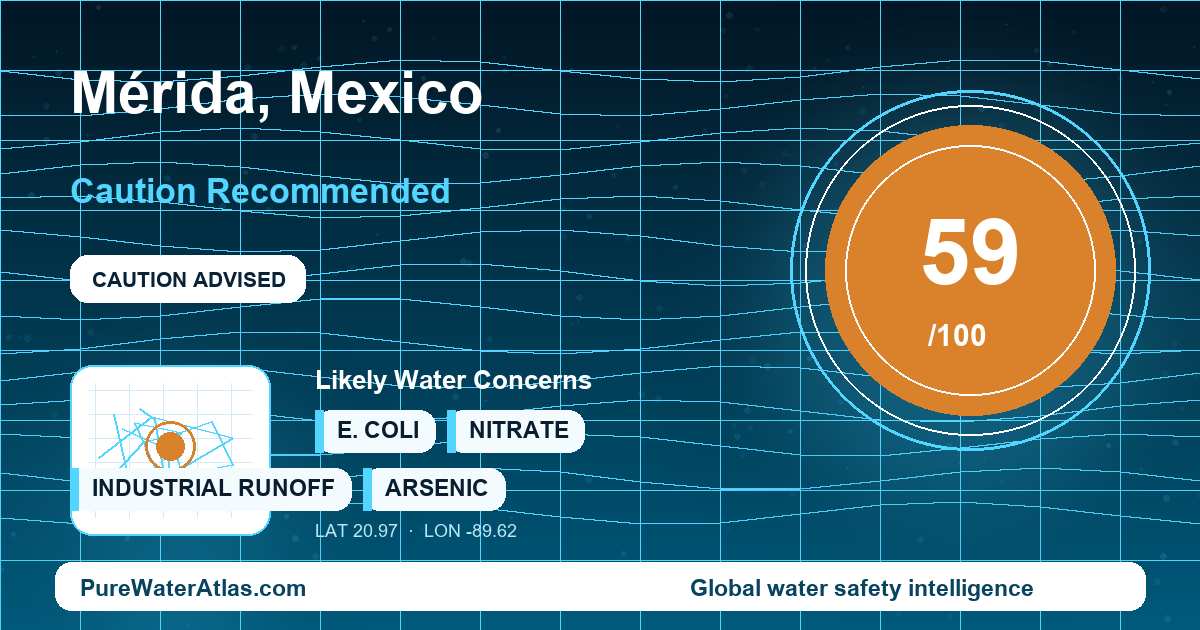
Mérida, Mexico: chlorinated groundwater from the Yucatán karst aquifer, with caution recommended at the tap because building storage tanks, limestone aquifer vulnerability, storm impacts, and limited neighborhood-level public data can affect point-of-use safety.
Quick Answer
| Overall safety status | Caution recommended. Mérida’s municipal supply is primarily chlorinated groundwater, but untreated tap water should not be assumed safe for drinking at every building or hotel. |
|---|---|
| Water safety score | 59 / 100 — risk level: Caution Recommended. |
| Traveler advice | Most short-term visitors should drink sealed bottled water or water verified as purified by reverse osmosis, UV, boiling, or a maintained hotel/restaurant system. |
| Resident advice | Use municipal water as a household supply, but verify drinking-water quality at the kitchen tap, especially if water passes through a cistern or rooftop tank. |
| Main water source | Groundwater from the Yucatán Peninsula karst aquifer; Mérida does not rely on a large permanent surface river system for city supply. |
| Water authority | Junta de Agua Potable y Alcantarillado de Yucatán, commonly known as JAPAY. |
| Filter recommendation | For drinking and cooking, many homes should consider sediment prefiltration plus activated carbon, with UV for microbial protection where water is stored, and reverse osmosis if testing shows nitrate, salinity, high dissolved solids, or other dissolved contaminants. |
Why Mérida Is Different
Mérida is not a typical river-reservoir city. It sits on the flat limestone platform of northern Yucatán, a karst landscape where rainfall infiltrates rapidly through permeable rock, fractures, and cenote-related pathways. That makes groundwater abundant, but it also means surface contamination can move downward more readily than in many non-karst settings. The city’s drinking-water identity is therefore closely tied to the Yucatán Peninsula aquifer: a regional groundwater system that has supplied settlements historically through wells, cenotes, and later drilled municipal well fields.
The practical issue for tap-water safety is not simply whether water is chlorinated before distribution. Mérida’s public water may leave wells and disinfection points in one condition, then pass through distribution mains, pressure zones, household cisterns, rooftop tanks known as tinacos, and indoor plumbing before reaching a kitchen tap. In many buildings, those private storage components can strongly affect taste, sediment, microbial risk, and chlorine residual. A clean, sealed, routinely disinfected tank is very different from a dirty, uncovered, or stagnant one.
This profile uses a cautious interpretation because recent public, neighborhood-level monitoring data for every distribution zone, hotel, apartment building, cistern, and household tap are not readily available. Mérida’s raw-water context and utility identity are well documented, but citywide information cannot prove safety at every point of use.
Where Does Mérida’s Tap Water Come From?
Mérida’s tap water comes overwhelmingly from groundwater in the Yucatán Peninsula karst aquifer. The region has very limited permanent surface drainage and no large permanent surface river supplying the city. Rainfall moves into the limestone aquifer and is tapped through municipal groundwater wells and well fields, then pumped, disinfected, stored, and distributed through the urban water network.
Key infrastructure includes municipal groundwater wells, pumping stations, chlorination or disinfection points, distribution mains, and local pressure zones. Unlike cities with large surface-water treatment plants that treat river or reservoir water through multiple centralized barriers, Mérida’s supply is fundamentally a groundwater-pumping system. That does not automatically mean unsafe water; groundwater can be a strong supply source. But in a karst aquifer, the protection of the source depends heavily on sanitation, land use, sewerage coverage, runoff pathways, well integrity, and ongoing monitoring.
Household infrastructure is also central in Mérida. Many homes and rentals use cisternas and tinacos to manage supply, pressure, and storage. These tanks can collect sediment, lose disinfectant residual, allow microbial regrowth, or become contaminated if covers, screens, overflow protections, or cleaning schedules are poor. For that reason, the water at a tap in one house or hotel may not match the water quality in another building on the same municipal system.
Who Manages Drinking Water in Mérida?
The main public water and sewerage operator serving Mérida and other areas of Yucatán is the Junta de Agua Potable y Alcantarillado de Yucatán, commonly known as JAPAY. Its role includes local service operation, customer supply, and water and sewerage infrastructure in its service areas.
At the national level, drinking water quality in Mexico is governed through health standards including NOM-127-SSA1-2021, Agua para uso y consumo humano. Water-resource oversight involves CONAGUA, and health surveillance roles involve health authorities such as COFEPRIS and state health agencies. CONAGUA also publishes technical groundwater-resource information, including documentation for the Yucatán Peninsula aquifer and broader national context through the Atlas del Agua en México.
For a household decision, however, regulation and utility operation do not eliminate the need for point-of-use verification. Private tanks, internal plumbing, stagnation, old fixtures, and storm-related disruptions can change water quality after it leaves the public system.
Main Local Water Concerns
The main Mérida-specific concerns are tied to karst groundwater vulnerability, household storage, and seasonal conditions rather than a single documented citywide contaminant claim. The Yucatán limestone aquifer is sensitive because wastewater, septic systems, urban runoff, agriculture, and rapid development can reach groundwater more easily than in many areas with less permeable geology. This makes microbial contamination indicators and nitrate especially important where local sanitation or land-use impacts affect groundwater.
- Microbial risk: Karst aquifers, cisterns, private wells, rooftop tanks, flooding, and low-pressure events can increase concern for microbial indicators such as total coliform and E. coli.
- Nitrate: Nitrate can be relevant in groundwater influenced by wastewater, septic systems, fertilizers, and urban or peri-urban land use.
- Hardness and minerals: Mérida water is often described by residents as hard or mineral-rich because it flows through limestone. Hardness is mainly an aesthetic and scaling issue, not proof of unsafe water, but it can affect taste, tea, coffee, appliances, showerheads, and filter maintenance.
- Chlorine variability: Municipal groundwater is typically disinfected, but chlorine residual, taste, and odor can vary by distance in the system and storage-tank condition.
- Turbidity and sediment: Turbidity, discoloration, or sediment may appear after pipe work, repairs, pressure changes, outages, heavy rain, or tank disturbance.
- Premise plumbing: Lead should not be assumed to be a citywide issue, but older buildings, unknown plumbing, imported fixtures, brass parts, and stagnant water justify testing where risk factors exist.
- Regional saltwater pressure: Coastal saltwater intrusion is a known Yucatán Peninsula aquifer pressure, especially closer to the coast. Mérida is inland, but regional extraction and groundwater management remain relevant context.
Seasonality matters. Rainy season and tropical storms can increase flooding, runoff, tank contamination, and damaged-distribution risks. Hurricane-season disruptions can cause low pressure, outages, emergency repairs, and temporary sediment. Hot weather can increase reliance on household storage and worsen microbial regrowth in poorly maintained tanks, while dry-season demand can affect pressure in some areas.
For Travelers
Most short-term visitors should not use untreated Mérida tap water as their primary drinking source. The safer default is sealed bottled water or water that has been reliably purified by reverse osmosis, UV, boiling, or a maintained hotel or restaurant purification system. This is especially important for visitors with no local adaptation and no knowledge of the building’s plumbing, cistern, or rooftop tank maintenance.
For brushing teeth, use bottled or purified water if you are a short-term traveler, pregnant, immunocompromised, traveling with young children, or prone to stomach illness. Many residents may use tap water for brushing, but traveler risk tolerance should be lower because even a small point-of-use issue can disrupt a trip.
For ice, use it only where the restaurant, hotel, or bar indicates it is made from purified water, such as commercially produced hielo purificado. Avoid ice from unknown household or informal street sources. Better hotels and established restaurants in Mérida commonly use purified water for drinking water, ice, and food service, but visitors should still ask rather than assume that a pitcher, dispenser, or ice bucket is safe.
If you are staying in an apartment or rental house, ask whether the kitchen tap has a maintained purifier and when the cistern or tinaco was last cleaned. If uncertain, use sealed bottled water, a trusted refill-station purified source, or boil water at a full rolling boil for microbial safety. For broader travel precautions, see the CDC’s Mexico Traveler View and Food and Water Safety guidance.
For Residents
Residents can generally treat the municipal supply as a usable household water source, but drinking-water decisions should be based on point-of-use conditions. If water passes through a cistern or rooftop tank, the kitchen tap is the important sampling point—not only the service entrance. For many Mérida homes, a practical drinking-water setup is sediment filtration plus activated carbon to reduce particles, improve taste and odor, and manage chlorine-related aesthetics, with UV added where stored water creates microbial concern. Reverse osmosis is worth considering if testing shows elevated nitrate, high dissolved solids, salinity, or other dissolved contaminants.
Testing should include microbiological indicators such as total coliform and E. coli if the home uses a cistern, rooftop tank, private well, or has experienced flooding, service interruptions, or low pressure. Residents should also consider nitrate, conductivity or total dissolved solids, hardness, pH, turbidity, and residual chlorine. In older buildings, renovated properties with unknown plumbing, or homes with imported fixtures or brass components, lead and copper testing is prudent.
Retest after major plumbing work, unusual odor, visible sediment, gastrointestinal illness clusters in the household, severe storms, or utility interruptions. Home strips can help screen for some parameters, but accredited laboratory testing is better when results will guide health decisions. For treatment choices, see PureWaterAtlas guides to UV water purification, nitrate treatment solutions, and water treatment systems.
Storage tanks deserve special attention in Mérida. Cisterns and tinacos should be covered, screened against insects and animals, protected from roof runoff, cleaned and disinfected routinely, and inspected after storms or outages. A dirty rooftop tank can make otherwise disinfected utility water unsafe by the time it reaches the tap.
Relevant Contaminants and Water-Quality Issues
For Mérida, the most relevant PureWaterAtlas contaminant pages are those connected to karst groundwater, household storage, disinfection, and post-distribution changes. Start with E. coli for microbial indicator risk in tanks, private wells, and vulnerable groundwater settings. Review nitrate because wastewater, septic systems, fertilizers, and urban runoff can affect groundwater in karst regions. For aesthetic and operational issues after outages, storms, or tank disturbance, see turbidity and sediment. For disinfected municipal groundwater and taste or odor questions, see chlorine. For older buildings or unknown fixtures, see lead and the detailed guide to lead testing and detection.
How to Verify Your Water Quality
The most reliable way to verify drinking-water safety in Mérida is to test the water you actually drink. For homes, rentals, small hotels, and apartments, that means sampling at the kitchen tap after water has passed through the building’s storage tanks and plumbing. If a purifier is installed, test both raw tap water and treated water when possible so you know whether the system is working.
Use the PureWaterAtlas complete guide to water testing to plan parameters and sampling. For general safety principles, consult Drinking Water Safety. For microbial questions, see Water Microbiology. You can also compare city-level context with the Global Water Quality Checker, browse the Contaminants Search Engine, or review the broader Global Water Quality resource.
Because publicly accessible recent data do not confirm every Mérida neighborhood, cistern, hotel, or household tap, a cautious approach is appropriate. Testing is especially important after storms, flooding, plumbing repairs, low-pressure events, new filter installation, unusual taste or odor, visible sediment, or recurring illness concerns.
Official and Technical Sources
- JAPAY official site — public water and sewerage authority serving Mérida and Yucatán customers.
- NOM-127-SSA1-2021 — Mexican national drinking-water quality standard for water for human use and consumption.
- CONAGUA groundwater availability: Acuífero Península de Yucatán — official aquifer context for the region supplying Mérida.
- CONAGUA Atlas del Agua en México — national water-resource context.
- CDC Mexico Traveler View — traveler health guidance for Mexico.
- CDC Food and Water Safety — guidance on avoiding unsafe water, ice, and foodborne illness while traveling.
- Groundwater resources of the Yucatán Peninsula karst aquifer, Mexico — technical hydrogeology context.
- Water quality in the Yucatán Peninsula karst aquifer and vulnerability to contamination — scientific context on contamination pathways and aquifer vulnerability.
Bottom Line
Mérida’s tap water should be approached with caution for drinking. The city depends on chlorinated groundwater from the Yucatán karst aquifer, a vulnerable limestone system where contamination pathways, sanitation conditions, runoff, and groundwater management matter. The additional point-of-use issue is building storage: cisterns and rooftop tanks can change water quality after it leaves the utility system. Travelers should use sealed bottled or verified purified water for drinking, brushing teeth, and ice unless purification is confirmed. Residents should maintain tanks, test at the kitchen tap, and use appropriate filtration or disinfection based on results. Because recent public neighborhood-level and building-level compliance data are limited, PureWaterAtlas does not claim uniform tap-water safety across Mérida.
Read the full guide: Global Water Quality Guide
Explore more in this category: Global Water Quality Articles