Xi’an tap water is generally treated as municipal potable water, but drinking directly from the tap should be verified locally because building plumbing, high-rise secondary tanks, and temporary distribution events can matter as much as the treatment plant.
Quick Answer
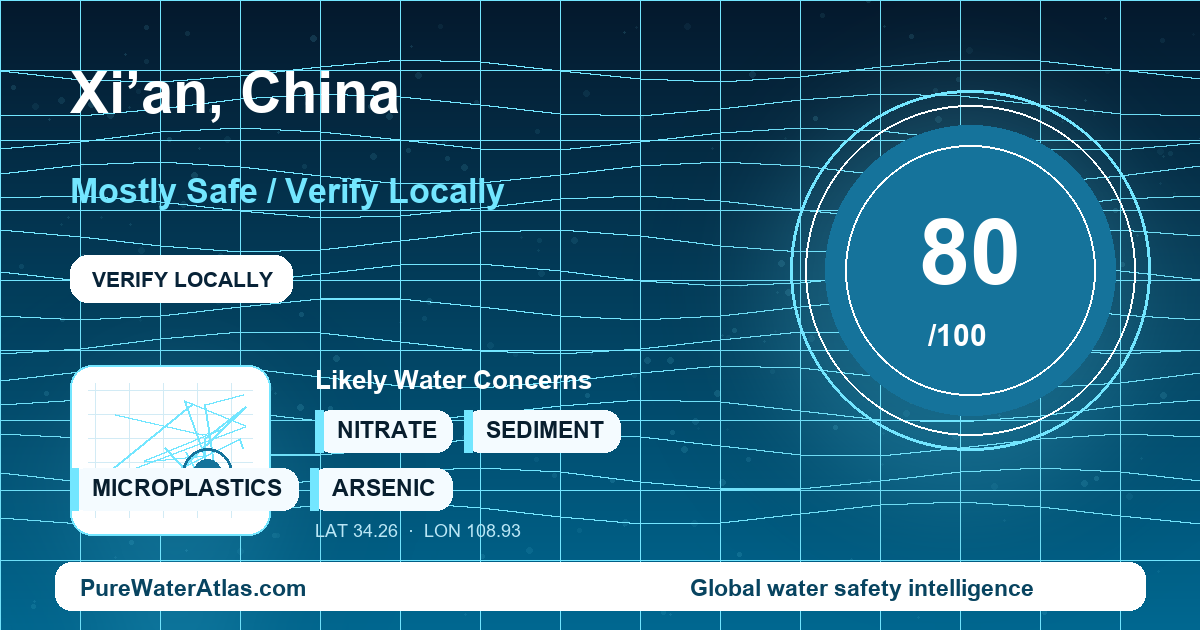
| Overall safety score | 80 / 100 |
|---|---|
| Risk level | Mostly Safe / Verify Locally |
| Can tourists drink it? | Do not assume unboiled tap water is universally safe for visitors. Use boiled tap water, sealed bottled water, hotel-provided purified water, or a verified filtered dispenser for drinking. |
| Resident guidance | Central municipal tap water can generally be used for cooking and washing, but residents should check their building’s internal plumbing and secondary supply tank maintenance. |
| Main source identity | Primarily protected Qinling Mountain surface-water reservoir and diversion systems, especially the Heihe system with Jinpen Reservoir, plus other regional reservoir and diversion supplies such as Shitouhe and Lijiahe depending on service area and operations. |
| Main authority and utility context | Xi’an municipal water supply is associated with Xi’an Water Group and local water-supply operating companies, with oversight linked to the Xi’an Water Affairs Bureau, health authorities, and Chinese drinking-water standards. |
| Filter recommendation | A home filter is not automatically required for every household, but activated carbon can improve chlorine taste and odor, while reverse osmosis should be considered only when testing identifies specific dissolved contaminants or source-water concerns. |
In practical terms, Xi’an’s central water supply is a lower-risk source after boiling for most healthy adults in modern urban districts. The main uncertainty is tap-by-tap: high-rise tanks, old internal pipes, pressure changes, and hotel or apartment maintenance can alter water quality after it leaves the treatment system.
Why Xi’an Is Different
Xi’an is not a coastal city with abundant local water resources. It sits on the Guanzhong Plain near the Wei River basin, north of the Qinling Mountains, and its modern drinking-water identity depends heavily on moving relatively cleaner mountain surface water into a large inland city with high demand. That geography shapes the city’s water-safety profile: the issue is not simply whether water is treated, but how protected reservoir water, regional diversions, treatment plants, distribution mains, and building-level systems work together.
Historically, Xi’an relied much more on local groundwater and urban wells. Long-term urban growth and water stress in the Guanzhong setting made larger surface-water diversion and reservoir systems increasingly important. Groundwater may still be relevant for emergency, backup, peri-urban, or non-centralized supplies, but it should not be assumed to represent the same safety profile as the treated central municipal supply.
The city-specific safety factor most likely to affect an individual tap is the gap between water leaving the treatment plant and water arriving in a hotel room, apartment, restaurant, or older residential compound. High-rise buildings may rely on secondary supply tanks, underground storage, roof tanks, booster pumps, and internal plumbing. If those tanks are not cleaned, sealed, disinfected, and documented, they can introduce sediment, microbial regrowth, or taste and odor issues even when incoming municipal water is adequately treated.
Where Does Xi’an’s Tap Water Come From?
Xi’an’s urban water supply is primarily based on protected surface-water sources from the Qinling Mountains and associated reservoir and diversion systems. The Heihe water diversion and Jinpen Reservoir are central to the city’s drinking-water identity. Regional systems such as Shitouhe and Lijiahe also strengthen supply reliability depending on service area and operational conditions.
The broader Guanzhong region is also supported by the Hanjiang-to-Weihe River water diversion project, which is intended to improve long-term supply security and reduce water-shortage pressure. This matters for Xi’an because the city’s water risks are tied not only to treatment quality, but also to reservoir protection, regional allocation, drought periods, and the resilience of diversion infrastructure.
Key infrastructure relevant to drinking water in Xi’an includes the Heihe diversion and Jinpen Reservoir, regional reservoir sources, urban treatment plants, municipal distribution networks, and the Hanjiang-to-Weihe diversion infrastructure. At the final stage, however, many residents and visitors experience the water through building-level secondary supply systems. These include roof tanks, underground tanks, booster pumps, and internal pipework in high-rise residential and commercial buildings.
Because of this layered supply chain, a single citywide statement cannot prove conditions at a specific tap. A new hotel connected to a well-maintained building system may present a different practical risk than an older compound with stagnant branch lines, old valves, undocumented tank cleaning, or recent pipe work.
Who Manages Drinking Water in Xi’an?
Xi’an municipal water supply is associated with Xi’an Water Group and local water-supply operating companies. Water-sector oversight is linked to the Xi’an Water Affairs Bureau, while health supervision operates under Chinese drinking-water sanitary requirements and national public-health oversight. Environmental and source-water protection context is also relevant through local ecological-environment authorities.
China’s urban drinking water is regulated under national sanitary requirements for drinking water, including GB 5749-2022, the national Standards for Drinking Water Quality. Local implementation involves municipal water administration, health supervision, ecological-environment source-water protection, utility monitoring, and periodic public-health or regulatory inspections.
PureWaterAtlas rates Xi’an with medium-high confidence for the broad water-source identity and general risk profile, but only medium confidence for tap-by-tap safety. The limitation is important: this profile does not claim a verified, current, parameter-by-parameter public dataset for every Xi’an treatment plant, pressure zone, hotel, apartment tower, private well, or building storage tank. For health-sensitive decisions, current utility notices, building tank records, and laboratory testing matter more than citywide generalizations.
Main Local Water Concerns
- Building-level secondary supply: High-rise apartments, hotels, and commercial buildings may use tanks and booster systems. Poor maintenance can contribute to sediment, odor, microbial regrowth, or localized quality complaints.
- Old internal plumbing: Older compounds may have corroded pipes, old valves, legacy fittings, or stagnant branch lines. These conditions can affect metals, particles, taste, and discoloration independently of municipal treatment quality.
- Residual chlorine taste and odor: Visitors may notice chlorinated taste or smell. Chlorine is used as a disinfectant, and many households use carbon filtration mainly for taste improvement. See the PureWaterAtlas guide to chlorine in drinking water.
- Turbidity and sediment: Pipe repairs, pressure changes, road works, seasonal runoff, or tank disturbance may cause temporary cloudiness, particles, or discoloration. Learn more about turbidity and sediment in drinking water.
- Water-supply pressure in the Guanzhong region: Xi’an is a large inland city with limited local water resources, so reservoir operations, drought periods, and regional diversions are part of the long-term risk picture.
- Rural or peri-urban wells: Wells around the wider Xi’an area should not be assumed to match the safety profile of treated central municipal water. Private or non-centralized supplies require separate verification.
Seasonal and operational factors also matter. Summer rainstorms can increase raw-water turbidity in mountain catchments and can disturb urban drainage and distribution conditions during heavy weather. Dry seasons and drought periods can place pressure on reservoir operations. Construction, road works, and pipe maintenance may lead to localized discoloration, air in pipes, sediment, or temporary advisory-style precautions.
For Travelers
Travelers should not treat unboiled Xi’an tap water as automatically safe to drink directly. In modern hotels, tap water is usually acceptable for washing and is often a lower-risk source after boiling, but drinking straight from the tap should be verified with the hotel or host. The safer default for short stays is sealed bottled water, boiled water, or hotel-provided purified water.
Brushing teeth with tap water is usually acceptable in modern urban hotels and apartments. More cautious travelers should use bottled or boiled water if they have a sensitive stomach, are traveling with infants, are pregnant, are immunocompromised, or are staying in an older building with unclear plumbing or tank maintenance.
Ice deserves extra caution. Avoid ice from small or informal venues unless staff can confirm it is made from purified or commercially produced water. Ice in higher-end hotels and established restaurants is lower risk, but it is still reasonable to ask. In restaurants, hot tea, boiled water, sealed bottled drinks, and commercially sealed beverages are lower-risk choices than unverified cold tap water or ice.
During sightseeing, carry bottled water, especially around the Muslim Quarter, the city wall, Terracotta Warriors day trips, and summer heat. If staying in an apartment, let the tap run briefly after stagnation, boil tap water before drinking, and avoid using visibly discolored water until it clears or the building manager explains the cause. For boiling guidance, see Boiling Water Purification: Complete Guide.
For Residents
Residents connected to the central municipal system can generally use Xi’an tap water for cooking, washing, and routine household use. The more important question is whether the building’s internal system is clean, modern, and well documented. Older buildings and secondary supply tanks can create localized risk even when the municipal source and treatment process are sound.
A home filter is not automatically required for every Xi’an household, but it can be practical. A certified activated-carbon filter can improve chlorine odor and taste and may reduce some particles depending on the system design. Reverse osmosis is more appropriate where testing shows elevated dissolved solids, nitrate, arsenic, lead, or another specific contaminant. Filters must be maintained on schedule; an old or neglected cartridge can become a hygiene risk rather than a safety improvement.
Residents in older compounds should consider testing first-draw and flushed samples for lead and other metals if pipe materials are unknown or water sits overnight in internal plumbing. The PureWaterAtlas resources on lead in drinking water, lead testing methods, and lead filtration solutions can help interpret results and treatment options.
If water appears yellow or brown, contains particles, or changes after maintenance, test for turbidity, iron, manganese, and basic physical indicators. If using a private well, rural supply, stored water, or a building tank with poor records, test for total coliform and E. coli. Residents in high-rise buildings should ask the property manager or building committee for secondary tank cleaning and disinfection records.
Relevant Contaminants and Water-Quality Issues
Xi’an’s most relevant tap-water concerns are not presented here as confirmed citywide violations. They are practical issues that can affect local taps, especially where distribution, storage, or building plumbing conditions are uncertain.
- Chlorine: commonly noticed as taste or odor; carbon filters are often used to improve palatability.
- Turbidity: can rise after storms, maintenance, pressure changes, or tank disturbance.
- Sediment: particles may appear after pipe repairs, stagnant plumbing, or poorly maintained storage systems.
- Lead: a building-plumbing concern in older systems or where legacy fittings are present; testing is the only way to verify a specific tap.
- E. coli: especially relevant for wells, stored water, or tanks with poor sanitation records.
- Nitrate: more relevant where testing identifies it, particularly in non-centralized or groundwater-influenced supplies; see also nitrate testing methods.
For microbial-risk context and treatment options, see Water Microbiology, UV Water Purification: Complete Guide, and Water Treatment Systems.
How to Verify Your Water Quality
The most reliable way to verify Xi’an water quality is to combine official notices, building records, and tap-specific testing. Citywide information is useful for understanding the source-water and regulatory context, but it cannot prove the condition of a hotel tap, apartment riser, storage tank, private well, or old internal pipe.
- Check current notices from the local water utility or water affairs authority, especially after maintenance, pipe breaks, heavy weather, or pressure events.
- Ask hotels, landlords, or property managers whether drinking water is boiled, filtered, bottled, or supplied through a maintained secondary tank.
- Request recent tank cleaning and disinfection records for high-rise buildings.
- For older buildings, test both first-draw and flushed samples for metals and physical indicators.
- If using a rural, peri-urban, stored, or well supply, test for microbial indicators such as total coliform and E. coli.
PureWaterAtlas resources that can help include the complete water testing guide, the Global Water Quality Checker, the Contaminants Search Engine, Drinking Water Safety, and Global Water Quality.
Official and Technical Sources
- Xi’an Water Affairs Bureau — municipal authority for water affairs, water resources, flood control, and related water-sector notices in Xi’an.
- Xi’an Water Group — local utility group associated with urban water supply operations, service notices, and water-supply infrastructure information.
- Shaanxi Provincial Department of Water Resources — provincial context for reservoirs, diversions, water-resource management, and allocation affecting Xi’an and the Guanzhong area.
- Ministry of Water Resources of the People’s Republic of China — national context for major water-resource projects and regional diversion infrastructure.
- National Health Commission of the People’s Republic of China — national public-health authority relevant to drinking-water sanitary standards.
- National Public Service Platform for Standards Information — official standards platform where national standards such as GB 5749-2022 can be searched and verified.
- Xi’an Ecology and Environment Bureau — local environmental authority relevant to source-water protection, surface-water environment, and pollution-control notices.
Bottom Line
Xi’an municipal tap water is generally treated and managed as potable water, with a supply identity centered on Qinling Mountain reservoir and diversion systems such as Heihe and Jinpen Reservoir, supported by regional infrastructure. For most healthy adults in modern districts, boiled tap water is a practical lower-risk option. Direct unboiled drinking should be verified locally, especially in hotels, apartments, older compounds, and high-rises with secondary tanks. Travelers should default to bottled, boiled, or hotel-purified water and avoid unverified ice. Residents should focus on building plumbing, tank cleaning records, and targeted testing rather than relying only on citywide statements. The main Xi’an question is not just “is the city water treated?” but “what happened between the treatment plant and this tap?”
Read the full guide: Global Water Quality Guide
Explore more in this category: Global Water Quality Articles