Jakarta tap water is treated through the municipal system, but point-of-use safety depends heavily on distribution conditions, building plumbing, storage tanks, flooding exposure, and whether a property uses PAM Jaya water, groundwater, or a mixed supply.
Quick Answer
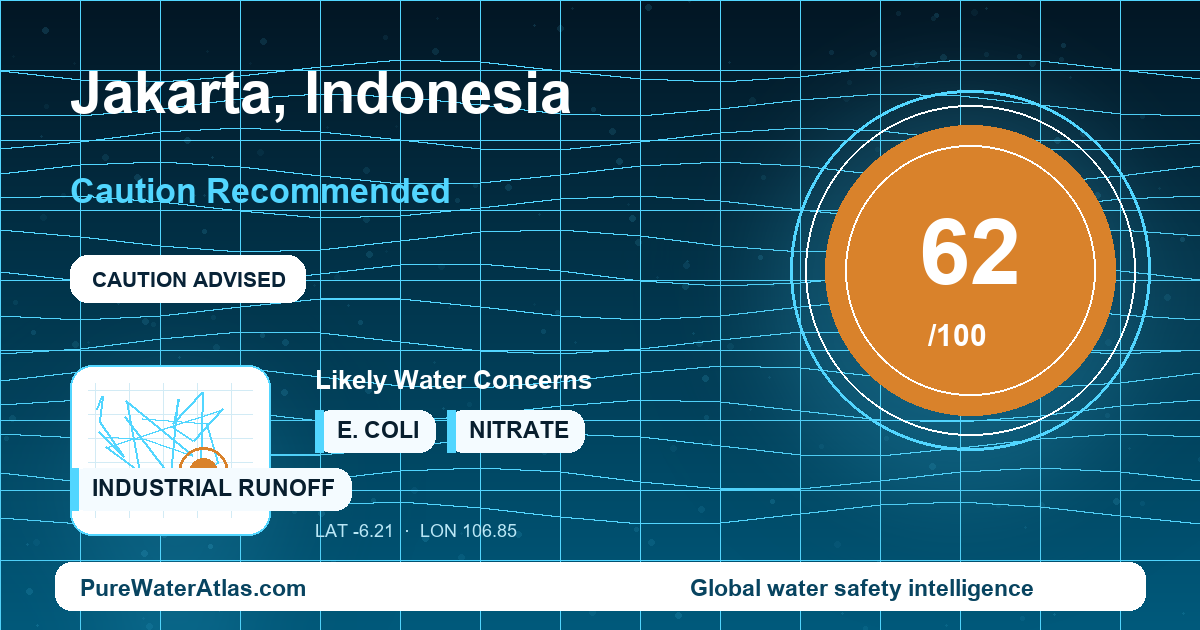
| Water safety score | 62 / 100 |
|---|---|
| Risk level | Caution Recommended |
| Can you drink the tap water? | Not recommended as a default. Jakarta has treated municipal water, but visitors and many households should use sealed bottled water, boiled water, or water from a maintained purification system unless the specific tap is verified for drinking. |
| Traveler advice | Use bottled, boiled, or filtered water for drinking. Do not assume bathroom tap water is safe unless the hotel or restaurant explicitly states that it is treated for drinking. |
| Resident advice | Evaluate the final water at your own tap, especially in older buildings, low-pressure areas, or homes using roof tanks, ground tanks, backup wells, or private groundwater. |
| Main raw-water system | Jakarta depends heavily on imported surface water, especially the Citarum River system through Jatiluhur Reservoir and the West Tarum Canal, with additional regional surface-water sources where available. |
| Water authority | Perumda Air Minum Jaya, commonly known as PAM Jaya. |
| Filter recommendation | For drinking and cooking, many homes should use a maintained point-of-use system: sediment prefiltration plus activated carbon and, depending on local issues, reverse osmosis, ultrafiltration, UV, or boiling. |
Editorial verdict: Caution recommended. Jakarta’s municipal water is treated, but the safety question is not only whether treatment plants exist. The decisive issue is what happens between raw-water source, treatment, distribution pipes, building tanks, internal plumbing, and the actual tap.
Why Jakarta Is Different
Jakarta is a low-lying coastal megacity on the Java Sea, crossed by multiple rivers and canals. Its drinking-water context is shaped by upstream river pollution, tidal and flood exposure, land subsidence, and dependence on raw water imported from outside the city. Unlike a city where most people receive continuously pressurized municipal water directly to the kitchen tap, Jakarta has a more complex point-of-use reality.
In Jakarta, asking “is the tap water safe?” often requires asking “which tap?” A new hotel tower with maintained filtration and disinfection can have a very different risk profile from an older apartment with aging internal plumbing, a rented house using a roof tank, or a property using shallow groundwater. Many users may encounter a mix of municipal water, stored water, tanker water, or private well water depending on building arrangements and district conditions.
This is why PureWaterAtlas rates Jakarta as Caution Recommended rather than a simple “drink” or “do not drink” city. The municipal system matters, but building-level storage and premise plumbing can strongly influence the water that actually reaches a glass.
Where Does Jakarta’s Tap Water Come From?
Jakarta is heavily dependent on imported surface water. A major raw-water source is the Citarum River system through Jatiluhur Reservoir, conveyed toward Jakarta through the West Tarum Canal. Additional raw water is drawn from regional surface-water systems such as the Cisadane system and local canals or rivers where available. However, local rivers face high pollution pressure and are not a simple drinking-water source without treatment.
Key infrastructure in the Jakarta water system includes Jatiluhur Reservoir and the Citarum River basin, the West Tarum Canal, PAM Jaya’s municipal distribution network, and major treatment plants serving the city, including Pejompongan, Buaran, and Pulogadung facilities. These components are central to the supply chain before water reaches homes, offices, hotels, restaurants, and apartment buildings.
The city’s historical water pattern is also important. Jakarta long relied on private wells and groundwater because piped-water coverage did not reach all households and buildings. Heavy groundwater abstraction is linked to land subsidence and seawater intrusion, especially in northern and coastal parts of the metropolitan area. That legacy still affects risk today because some properties continue to use private groundwater, backup wells, or stored water alongside or instead of municipal supply.
The main drinking-water risk in Jakarta is therefore the whole chain: polluted raw water, long-distance canal conveyance, aging or leaky distribution pipes, pressure variation, illegal or poorly maintained connections, and building storage tanks that may not be cleaned regularly.
Who Manages Drinking Water in Jakarta?
Jakarta’s municipal drinking-water company is Perumda Air Minum Jaya, commonly known as PAM Jaya. It is responsible for the city water supply system after the end of the long-running private operator concessions. Historically, Jakarta’s water services were split between western and eastern private operators before PAM Jaya resumed full operational control in 2023.
Drinking-water quality in Indonesia is governed nationally by Ministry of Health environmental health and drinking-water quality requirements, including Regulation of the Minister of Health No. 2 of 2023. Local implementation involves PAM Jaya and relevant DKI Jakarta public health and environmental agencies.
A key limitation for consumers is transparency at the household-tap level. Jakarta’s source-water systems, utility identity, and infrastructure risks are documented, but current, public, zone-by-zone finished-water quality results at individual taps are limited and not consistently available in English. This page does not claim that all PAM Jaya water is unsafe, nor that every neighborhood has the same risk. It reflects the reality that water quality can change after treatment because of distribution pipes, pressure conditions, storage tanks, private building plumbing, and private wells.
Main Local Water Concerns
Jakarta’s most important drinking-water concerns are local and practical rather than abstract. The first is microbial contamination at the point of use, especially where water is stored, pressure is intermittent, plumbing is poorly maintained, or flooding affects tanks and shallow wells. Even treated municipal water can lose protection if it sits in an uncovered, cracked, warm, or rarely cleaned tank.
Raw surface-water quality is another pressure point. Rainy-season runoff can increase turbidity and microbial loading in rivers and canals before treatment. Dry-season lower flows can worsen the concentration of pollutants in some source waters and may increase taste, odor, and salinity concerns in vulnerable groundwater areas. Service interruptions or pressure drops can also raise intrusion risk in compromised pipes and may require flushing or re-treatment before drinking.
Residents and building managers should also watch for sediment, discoloration, taste, and odor problems. These may occur when pipes are disturbed, pressure changes mobilize deposits, or storage tanks are dirty. In groundwater, salinity and seawater intrusion are concerns especially in coastal and northern Jakarta areas. Iron and manganese can cause staining, taste, odor, and operational problems in some groundwater systems. Shallow wells may also face nitrate and microbial risks where sanitation, septic systems, drains, or floodwater influence groundwater.
Potential lead or other metal exposure from old internal plumbing, fixtures, solder, or premise plumbing is a reasonable testing priority in older buildings. However, Jakarta-specific public lead-at-tap datasets are limited, so it would be inaccurate to claim a citywide lead problem based on the available information.
For Travelers
Short-term visitors should not drink untreated tap water in Jakarta as a default. Use sealed bottled water, boiled water, or water that has been filtered and disinfected through a maintained system. This is especially important in budget accommodation, older buildings, and any property where the water source or storage system is unclear.
For brushing teeth, the conservative advice is to use bottled, boiled, or filtered water if you have a sensitive stomach, are traveling with children, are pregnant, are immunocompromised, or are staying in older or budget accommodation. Many travelers may use tap water for brushing without obvious illness, but the lower-risk choice is treated water.
Be selective with ice. Use ice only in reputable hotels, restaurants, and cafes that state they use purified water or commercial ice. Avoid unknown ice from street vendors or informal settings because ice can bypass boiling and may be made from unsafe water.
Higher-end hotels and international restaurants often use treated water systems, bottled water, or commercial ice, but this is a property-level practice rather than a citywide guarantee. Ask: “Is the drinking water filtered?” and “Is the ice made from purified or commercial water?” If the answer is unclear, choose sealed bottled drinks or hot beverages made with boiled water.
For longer stays, carry sealed bottled water or use a reliable purifier. A kettle can be useful: bring water to a rolling boil, then cool it in a clean, covered container. Avoid refilling bottles from bathroom taps unless the building has a documented drinking-water treatment system.
For Residents
Residents connected to PAM Jaya should still evaluate the final water at the tap. The risk is higher in older buildings, low-pressure areas, homes using roof tanks or ground tanks, and properties with backup wells or private groundwater. A municipal supply that was treated before distribution can become less safe if stored in a tank that is cracked, uncovered, rarely cleaned, exposed to pests, or vulnerable to floodwater.
For drinking and cooking, a maintained point-of-use system is advisable for many Jakarta homes. A practical setup is sediment prefiltration followed by activated carbon, with reverse osmosis, ultrafiltration, UV, or boiling chosen according to the main concern. Sediment filtration helps with particles; activated carbon can improve taste and some chemical characteristics; UV can reduce microbial risk in clear water; reverse osmosis may be relevant where dissolved contaminants or salinity are concerns. Filters must be maintained because an old or overloaded filter can become a contamination source.
If you use a private well or backup groundwater, test at least for E. coli or total coliform, nitrate, salinity or total dissolved solids, iron, manganese, pH, turbidity, and conductivity. If you use municipal water stored in a roof tank or ground tank, test microbial indicators after the tank, not only before it. Clean and disinfect tanks on a schedule, and make sure they are sealed, screened, and protected from floodwater and pests.
Older buildings deserve special attention. Corroded internal pipes, old fixtures, dead-end plumbing, rooftop tanks, booster pumps, and stagnant sections can introduce sediment, metals, bacteria, or taste and odor problems after water leaves the municipal main. After floods, pressure loss, plumbing repairs, tank contamination, unusual odor, or discoloration, do not drink directly until the system is flushed, disinfected if needed, and checked.
Relevant Contaminants and Water-Quality Issues
Jakarta’s most practical contaminant concerns are linked to microbial safety, particles, storage, groundwater, and premise plumbing. Start with E. coli in drinking water, because microbial contamination is the key point-of-use risk where tanks, wells, flooding, or pressure loss are involved. Turbidity is also important because storm runoff and polluted surface-water sources can increase particle loading and treatment challenges.
Discoloration or visible particles may relate to sediment in drinking water, pipe deposits, dirty tanks, or pressure changes. Treated municipal water may contain chlorine residual, so chlorine in drinking water is relevant both for residual protection and taste complaints. In older buildings, lead in drinking water is a premise-plumbing concern to evaluate through testing rather than assumption.
For households using shallow wells or backup groundwater, review nitrate in drinking water, especially where sanitation, drains, septic systems, or floodwater may influence groundwater. Iron and manganese are also relevant to some groundwater because they can cause staining, taste, odor, and treatment-system problems.
How to Verify Your Water Quality
The most reliable way to answer the Jakarta tap-water question is to test the water that comes out of your own tap after your building’s tanks, pumps, and plumbing. Taste, smell, and color are useful warning signs but cannot confirm microbiological safety or rule out dissolved contaminants.
For a general decision framework, see Drinking Water Safety. For sampling strategy and lab-test planning, use the PureWaterAtlas Water Testing guide. If microbial risk is your main concern, the Water Microbiology guide explains bacteria, viruses, and point-of-use risks. For treatment choices, review Water Purification Methods.
Useful practical resources include the Boiling Water Purification guide, the UV Water Purification guide, Lead Testing and Detection Methods, and Nitrate Testing and Detection Methods. You can also use the Contaminants Search Engine to look up Jakarta-relevant issues and the Global Water Quality Checker to compare Jakarta with other destinations.
Official and Technical Sources
- PAM Jaya official website — municipal water company for Jakarta and primary source for utility identity, services, and system updates.
- Indonesian Ministry of Health Regulation No. 2 of 2023 via BPK legal database — national regulatory basis for environmental health and drinking-water quality requirements.
- Asian Development Bank, West Tarum Canal Rehabilitation Project — documentation for the West Tarum Canal, a major raw-water conveyance system supplying Jakarta.
- NASA Earth Observatory: Jakarta and land subsidence — explains Jakarta land subsidence and the role of groundwater extraction.
- CDC Travelers’ Health: Indonesia — supports conservative food and water precautions for travelers.
- World Health Organization Guidelines for Drinking-water Quality — international baseline for microbial, chemical, treatment, and distribution-system risks.
- WHO and UNICEF Joint Monitoring Programme data portal: Indonesia — national household water, sanitation, and hygiene context.
- Asian Development Bank: Citarum River pollution and restoration coverage — documents pollution pressure and cleanup efforts in the Citarum basin.
Bottom Line
Jakarta tap water should be approached with caution. The city has treated municipal water supplied through PAM Jaya, and major raw-water infrastructure includes the Citarum-Jatiluhur system and West Tarum Canal. However, safety at the glass depends on distribution reliability, pressure, building plumbing, storage tanks, flooding exposure, and whether a property uses municipal water, groundwater, or a mixed supply. Travelers should use sealed bottled, boiled, or verified filtered water and avoid unknown ice. Residents should test private wells, monitor stored municipal water after tanks, maintain filters, and clean tanks regularly. The available evidence supports caution rather than a blanket claim that every Jakarta tap is unsafe or safe.
Read the full guide: Global Water Quality Guide
Explore more in this category: Global Water Quality Articles