
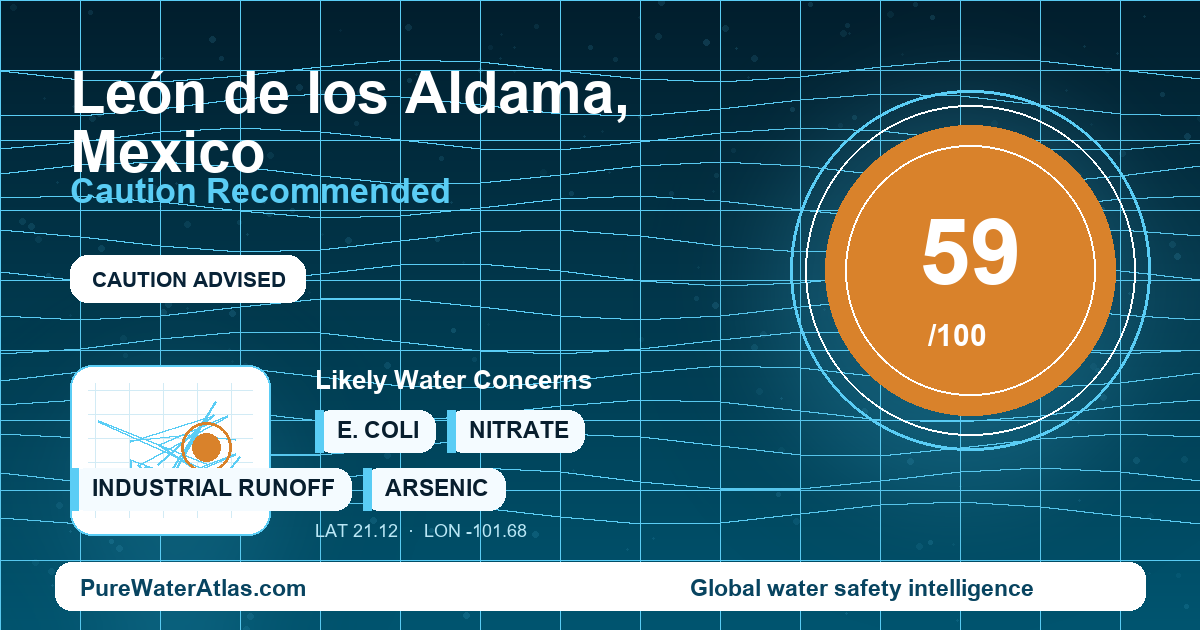
León de los Aldama, Guanajuato has a managed municipal groundwater supply operated by SAPAL, but travelers and residents should treat drinking water with caution because aquifer stress, building storage tanks, older plumbing, and limited public neighborhood-level tap results can affect what reaches the faucet.
Quick Answer
| Overall safety status | Caution Recommended — PureWaterAtlas score: 59/100. León has an organized public utility and disinfected municipal groundwater, but tap-level conditions can vary by building and current neighborhood-level laboratory data are not easy to verify in one public dataset. |
|---|---|
| Can tourists drink the tap water? | Not recommended as a default. Short-stay visitors should use sealed bottled water or clearly filtered water for drinking. |
| Resident advice | Residents should treat the supply as managed, but not assume every tap is equal. A maintained point-of-use filter, periodic cistern or tinaco cleaning, and occasional lab testing are prudent. |
| Main water source | Predominantly groundwater from the Valle de León aquifer system and associated municipal wellfields. |
| Water authority | SAPAL, the Sistema de Agua Potable y Alcantarillado de León, operates the local water and sewer service. CONAGUA manages national water resources and aquifer information. |
| Filter recommendation | A home filter is advisable for drinking and cooking, especially where there is tank storage, older plumbing, sediment, hardness, taste concerns, or vulnerable household members. |
Why León de los Aldama Is Different
León de los Aldama is not a city whose ordinary household water supply is defined by a large nearby river or a single visible surface reservoir. Its public supply is mainly a pumped groundwater system in the Bajío region of Guanajuato. That makes the local drinking-water question different from a surface-water city: the most important issues are aquifer management, well operation, disinfection, pressure zones, distribution pipes, and what happens inside homes and buildings after water leaves the municipal system.
The city is in an inland semi-arid to sub-humid setting where urban growth, industry, and agriculture all compete for groundwater. León is associated with the broader Lerma-Santiago hydrologic setting and the Turbio River basin, but potable water is primarily groundwater rather than direct river water. This matters because groundwater can have user-noticeable mineral characteristics, such as hardness or total dissolved solids, even when it is disinfected and microbiologically managed.
León is also a major footwear and leather-goods city. The industrial history around tanning and urban wastewater makes basin protection and wastewater treatment important local issues. However, this should not be misread as proof that chromium or any specific industrial contaminant is present in municipal tap water. A contaminant conclusion requires a specific laboratory result from the relevant source or tap.
The most practical city-specific difference for many households is storage. Cisternas and rooftop tanks, known locally as tinacos, are common in homes and apartment buildings because of pressure management, storage needs, or service reliability. Even if water leaves SAPAL infrastructure disinfected, a dirty, uncovered, stagnant, or biofilm-lined tank can materially change water quality before it reaches the kitchen faucet.
Where Does León de los Aldama’s Tap Water Come From?
León de los Aldama is supplied predominantly by groundwater pumped from the Valle de León aquifer system and associated municipal wellfields. That water is then disinfected and distributed through municipal tanks, pumping systems, reservoirs, and pressure zones. Because León is a large urban area with topographic variation and extensive distribution infrastructure, the route from wellfield to faucet can involve multiple operational steps before water reaches a home or hotel.
The core drinking-water infrastructure includes municipal groundwater wells and wellfields operated or coordinated by SAPAL, pumping stations, pressure zones, storage tanks, and distribution reservoirs. At the building level, many properties add their own cisterns or rooftop tinacos. These building-level systems are not a minor detail: they can determine whether the water at a particular tap is clear and safe enough for its intended use.
León has long faced pressure from groundwater overextraction and has historically pursued outside surface-water alternatives, including the El Zapotillo and Río Verde transfer concept. Because that project has been politically and legally contested and its role for León has changed over time, the practical current picture remains a city heavily dependent on groundwater management, well operation, and conservation.
Wastewater collection and treatment infrastructure is also important in León because it helps protect the local basin. But wastewater treatment infrastructure should not be confused with direct drinking-water supply. The ordinary household tap-water identity of León remains a groundwater-based municipal system, not a direct reuse system.
Who Manages Drinking Water in León de los Aldama?
The local water and sewer utility is Sistema de Agua Potable y Alcantarillado de León, commonly known as SAPAL. SAPAL is the main public-facing authority for León residents checking service information, local water-quality communications, and operational notices. The utility also maintains a water-quality information page at SAPAL calidad del agua.
At the national level, CONAGUA is the federal water authority responsible for water concessions, aquifer availability, and national water management. CONAGUA’s technical documentation on the Valle de León aquifer is especially relevant for understanding the groundwater system that underpins the city’s supply. Broader national water data are available through the Sistema Nacional de Información del Agua.
Mexican drinking-water quality is regulated under NOM-127-SSA1-2021, the official standard for water for human use and consumption. This profile does not claim verified full compliance at every faucet in León because a single current, easily auditable neighborhood-by-neighborhood public laboratory dataset at consumer taps is not available in the supplied record. That limitation is important: water quality can change inside buildings because of cisterns, tinacos, stagnation, old pipes, and poor filter maintenance.
Main Local Water Concerns
- Groundwater stress: León depends heavily on the Valle de León groundwater system. Declining availability and high demand make long-term aquifer management and conservation central to the city’s water security.
- Mineral taste, hardness, and dissolved solids: In a groundwater-based city, hardness, mineral taste, total dissolved solids, chloride, sulfate, and conductivity can be noticeable household issues, even when water has been disinfected.
- Building-level storage: Cisternas and tinacos can introduce sediment, bacteria, insects, stagnant water, and biofilm if they are not sealed, cleaned, and disinfected regularly.
- Distribution and pressure changes: Long distribution lines, repairs, pressure management, and outages can cause cloudy water, sediment, or changes in chlorine taste. After repairs or low-pressure events, users should flush taps and avoid drinking the water until it runs clear.
- Potential geogenic contaminants: Arsenic, fluoride, and other dissolved minerals can be relevant groundwater concerns in parts of central and northern Mexico, but the correct approach in León is testing, not assumption.
- Industrial and urban basin pressure: León’s leather and footwear history is relevant for source-water protection and wastewater management. It is not, by itself, proof of a specific contaminant exceedance at the tap.
Season also matters. During the rainy season, roughly June through September, runoff, sewer stress, localized flooding, and pipe-work disturbance can increase the chance of sediment or microbial concerns in affected areas. During dry periods and drought, demand on groundwater may increase and low-pressure events or greater reliance on stored water can become more relevant.
For Travelers
For most tourists in León de los Aldama, tap water is not recommended as the default drinking water. Use sealed bottled water or water that a hotel, restaurant, or host can clearly confirm has been filtered or purified and handled hygienically. Tap water is generally more acceptable for showering and handwashing than for direct drinking, especially for visitors not used to local water systems.
For brushing teeth, many healthy adults can use tap water if they avoid swallowing it. More cautious travelers, children, and immunocompromised visitors should use bottled or filtered water for brushing. If staying in an apartment or long-stay rental, ask whether water passes through a cistern or rooftop tank and whether that tank has been cleaned recently.
Use caution with ice. Ice is safer in established hotels, chain restaurants, and venues that state they use purified water. Avoid ice from informal stands or places where the water source and handling are unclear. Many hotels and restaurants in Mexican cities use garrafón, filtered, or purified water for guests, but do not assume the water or ice is purified unless confirmed.
Carry sealed water, especially in hot weather. Avoid drinking from bathroom taps, and if the building has had an outage, repair, flooding, pressure drop, or visible sediment, use bottled or properly treated water until the water is clear and the source is verified. For emergency microbial concerns, see PureWaterAtlas’s Boiling Water Purification: Complete Guide.
For Residents
Residents should think of León’s tap water as a managed municipal groundwater supply, but not as identical at every address. The water leaving utility infrastructure may not match the water coming out of a kitchen faucet after passing through a building cistern, tinaco, old internal pipes, or stagnant plumbing.
A home filter is advisable for drinking and cooking water, especially if the household notices hardness, mineral taste, sediment, discoloration, or chlorine changes. For broad protection, many residents consider reverse osmosis or a certified multi-stage point-of-use system, but the best filter choice should follow actual test results where possible. PureWaterAtlas’s guide to Water Treatment Systems can help match treatment to the problem being measured.
Testing is especially prudent for homes with infants, pregnancy, immunocompromised residents, kidney disease concerns, or elderly residents. Test at the kitchen tap, not just at the building entry point. If water is stored in a cistern or rooftop tank, test for total coliform and E. coli, especially after odors, flooding, repairs, or long stagnation. Test hardness, total dissolved solids, chloride, sulfate, and conductivity to understand groundwater mineralization and taste issues.
Consider arsenic and fluoride testing if using a private well, non-SAPAL source, or if vulnerable people are in the household. Consider lead testing in older buildings or after plumbing replacement, especially where old solder, brass fixtures, galvanized plumbing, or unknown internal lines may be present. Lead is not identified here as a citywide groundwater-source issue, but building plumbing can create exposure at a specific tap.
Cisterns and tinacos should be sealed, cleaned, and disinfected regularly. A contaminated tank can defeat municipal disinfection by adding bacteria, sediment, insects, or biofilm near the point of use. If the tank condition is unknown, do not drink the tap water without treatment.
Relevant Contaminants and Water-Quality Issues
Several water-quality topics are especially relevant for León de los Aldama because of its groundwater source, distribution system, and common building storage:
- Chlorine: important because disinfected municipal water relies on residual disinfection, and chlorine taste or odor changes are common user observations after operational changes.
- Turbidity: relevant after pipe work, rainy-season disturbance, pressure changes, tank sediment, or service interruptions.
- Sediment: useful for households seeing particles from old plumbing, storage tanks, or distribution repairs.
- E. coli: a key microbial indicator when cisterns, tinacos, flooding, or loss of disinfection are suspected.
- Arsenic: included because some groundwater systems in central and northern Mexico can face geogenic trace-metal concerns; local testing is needed before drawing conclusions.
- Nitrate: relevant for groundwater protection in urban-agricultural basins and private-well evaluation.
- Lead: most relevant at the building-plumbing level in older properties, not as a presumed citywide aquifer issue.
For broader context, see PureWaterAtlas resources on Drinking Water Safety, Water Microbiology, and the Water Contamination category.
How to Verify Your Water Quality
The most reliable way to know whether a specific León tap is suitable for drinking is to test that tap under real household conditions. City-level information supports the identity of the utility, the groundwater dependence, and the aquifer-stress context. The data limitation is that current, public, neighborhood-by-neighborhood consumer-tap results are not presented in one easily downloadable record. Building storage and plumbing can also change water quality after municipal delivery.
Use an accredited Mexican laboratory or recognized water-quality laboratory. For plumbing-related metals, collect both first-draw and flushed samples. For microbial concerns related to tanks, collect samples according to laboratory instructions and test for total coliform and E. coli. If you receive a lab report, use the PureWaterAtlas Contaminants Search Engine to look up each contaminant, and consult the Complete Guide to Water Testing and Analysis for sampling strategy.
For specific testing topics, see Lead in Drinking Water: Testing and Detection Methods, Arsenic in Drinking Water: Testing and Detection Methods, and Nitrate Contamination in Drinking Water: Testing and Detection Methods. To compare León with other places, use the Global Water Quality Checker.
Official and Technical Sources
- SAPAL, Sistema de Agua Potable y Alcantarillado de León — local water and sewer operator for León.
- SAPAL water quality and service information — utility-facing source for local water-quality communications and notices when available.
- CONAGUA: Valle de León aquifer availability document — technical federal source for the groundwater system underlying León’s supply.
- CONAGUA Sistema Nacional de Información del Agua — national water information portal.
- NOM-127-SSA1-2021 — official Mexican drinking-water standard.
- Gobierno de México: CONAGUA — federal water authority.
- CDC Travelers’ Health: Mexico — conservative traveler health guidance for food and water precautions.
- WHO Guidelines for Drinking-water Quality — international guidance on microbial risk, chemical contaminants, and safe distribution and storage.
Bottom Line
León de los Aldama’s tap water should be approached with caution, not panic. The city has a formal municipal utility, SAPAL, and its public supply is mainly disinfected groundwater from the Valle de León aquifer system. The reasons for caution are local and practical: groundwater stress, possible mineral taste or hardness, limited public neighborhood-level tap data, and significant building-level variation from cisternas, tinacos, old plumbing, stagnation, and maintenance. Tourists should use sealed bottled or clearly purified water for drinking and be careful with ice. Residents should maintain storage tanks, use an appropriate point-of-use filter for drinking and cooking, and test the actual kitchen tap when vulnerable people, older buildings, private wells, odors, sediment, or post-outage conditions are involved.
Read the full guide: Global Water Quality Guide
Explore more in this category: Global Water Quality Articles