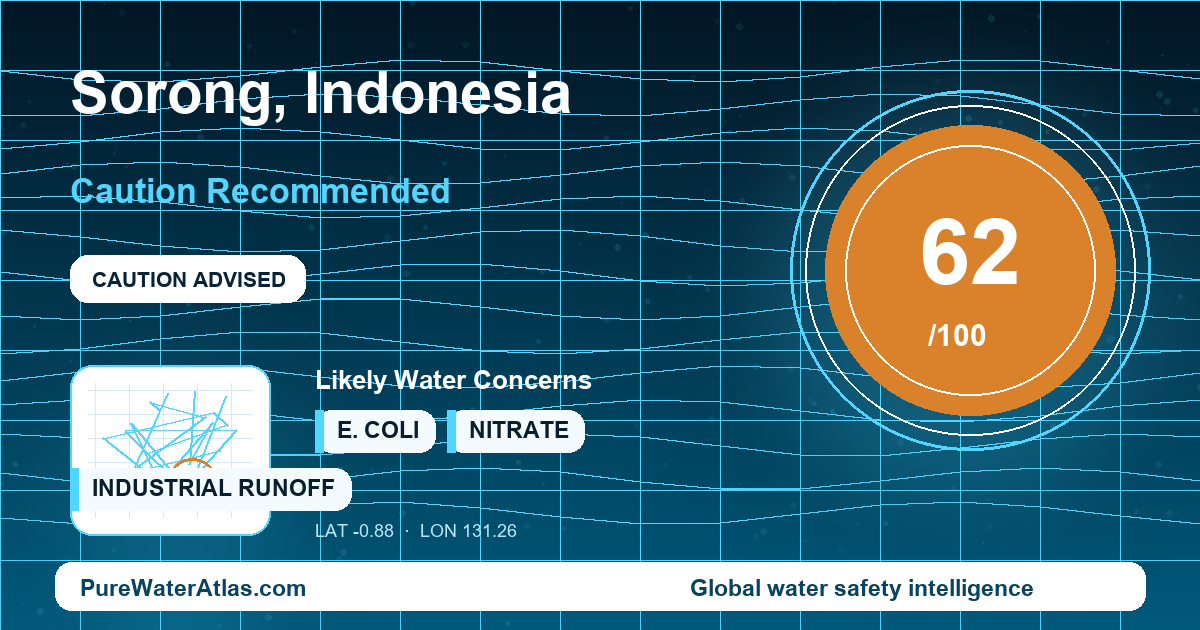
Sorong, Indonesia: caution recommended for tap water because municipal supply exists, but public tap-level quality data is limited and local risks include intermittent service, storage tanks, turbidity, shallow wells, and post-treatment contamination.
Quick Answer
| Water safety score | 62 / 100 |
|---|---|
| Risk level | Caution Recommended |
| Can visitors drink Sorong tap water? | No, not as a default. Visitors should use sealed bottled water, boiled water, or water from a clearly maintained filtration and disinfection system. |
| Resident guidance | Residents connected to Perumda Air Minum Tirta Remu should treat water used for drinking unless they have recent test results from their own tap. |
| Main water identity | Sorong’s public supply is associated with surface-water based SPAM systems, including Sorong-area raw-water and regional supply development, plus older Remu/Klasaman-related local catchment context. |
| Water authority | Perumda Air Minum Tirta Remu is the local drinking-water utility for Kota Sorong. |
| Filter recommendation | Recommended for drinking water: sediment prefiltration plus disinfection by boiling or UV. Add activated carbon for taste; use reverse osmosis only where testing shows high salinity, nitrate, arsenic, or other dissolved contaminants. |
Editorial verdict: caution recommended. Sorong has a formal municipal water provider and government-backed surface-water supply projects, but recent consumer-facing water-quality results at city taps are not readily available. The practical risk is not only the treatment plant; it is also what happens in pipes, pressure zones, household storage tanks, shallow wells, and building plumbing after treatment.
Why Sorong Is Different
Sorong is a coastal port city at the western gateway to Papua and Raja Ampat. That setting matters for drinking-water safety. A traveler may arrive for a short stay before continuing to the islands, while residents may use a mix of municipal piped water, stored water, refill-water depots, bottled water, rainwater, tanker water, or private wells. These sources are not interchangeable from a safety perspective.
The city has a formal utility, Perumda Air Minum Tirta Remu, but Sorong’s fast urban growth, low-lying coastal areas, hilly pressure zones, and mixed formal and informal water arrangements make distribution reliability and household storage especially important. Even where water is treated at a plant, intermittent service, low pressure, aging pipe sections, illegal or poorly sealed connections, and storage tanks can create a pathway for microbial contamination or sediment intrusion before the water reaches the tap.
This is why PureWaterAtlas does not classify ordinary Sorong tap water as a “drink directly” source for visitors. The data available is enough to identify the local utility, regulatory framework, and main infrastructure risks, but not enough to verify routine citywide compliance at the tap for E. coli, turbidity, chlorine residual, metals, nitrate, or salinity indicators.
Where Does Sorong’s Tap Water Come From?
Sorong’s public water supply is associated with surface-water based SPAM systems serving the city. The local context includes Sorong-area raw-water and regional SPAM development, including the Warsamson raw-water supply context in Sorong Regency, as well as older local surface-water catchments historically tied to the Remu and Klasaman area. The local utility name, Tirta Remu, reflects this water identity.
When the municipal system is operating as designed, the public supply depends on raw-water intake and transmission infrastructure, water treatment installations, and distribution networks. Treatment may include coagulation, sedimentation, filtration, and chlorination. After treatment, water moves through reservoirs, booster pumps, pressure zones, and distribution pipes serving a hilly coastal city.
The most important practical point is that source and treatment do not fully determine what comes out of a household tap. Sorong households and buildings often use storage tanks to manage low-pressure or intermittent supply. If tanks are uncovered, poorly screened, exposed to floodwater, or not cleaned and disinfected routinely, they can become a contamination point even when municipal water was treated earlier. Non-network households may rely on shallow groundwater, rainwater storage, tanker water, bottled water, or commercial refill depots, each requiring its own safety check.
Who Manages Drinking Water in Sorong?
The local piped drinking-water utility is Perumda Air Minum Tirta Remu Kota Sorong. Local public-health oversight is connected to the Sorong city health office and Indonesian Ministry of Health standards, while infrastructure development is supported through national and regional public-works agencies.
Indonesia’s drinking-water and environmental-health standards are set nationally, including Ministry of Health Regulation No. 2 of 2023. Public water supply systems are governed through the SPAM framework under Government Regulation No. 122 of 2015 on SPAM. These standards and frameworks matter, but they do not by themselves prove that every Sorong tap is currently potable.
The main evidence gap is public access to recent, routine, tap-level monitoring results. City-level institutions can be identified through the utility, Pemerintah Kota Sorong, and Badan Pusat Statistik Kota Sorong, but consumer-facing datasets showing recent E. coli, turbidity, residual chlorine, metals, nitrate, salinity, and disinfection performance at neighborhood taps are not readily available. For that reason, this guide avoids claiming that Sorong tap water either meets or fails specific legal limits citywide.
Main Local Water Concerns
- Microbial contamination: Intermittent pressure, household storage tanks, shallow wells, and non-network sources can allow fecal indicator organisms such as E. coli or total coliform. This is the highest-priority concern for drinking-water safety in Sorong because pathogens can cause acute illness even when water looks clear.
- Turbidity and sediment after heavy rain: Sorong’s surface-water context and tropical rainfall mean raw-water turbidity can rise during storms. High turbidity increases treatment demand and can interfere with disinfection if treatment is not well controlled. Disturbed pipes and tanks can also produce visible sediment.
- Variable chlorine residual: Chlorine residual helps protect treated water in the distribution system. If residual is too low at the tap, microbial protection may be inadequate. If chlorine taste is strong, households may store water in open containers, which can reduce safety.
- Salinity or brackish taste in coastal wells: Sorong’s coastal setting makes shallow wells vulnerable to seawater intrusion, tidal influence, over-pumping, or poor well construction. This concern is more relevant to private wells than to treated municipal surface water. Well users should test conductivity, TDS, and chloride before using the water for drinking.
- Iron, manganese, color, and staining: Private groundwater can contain naturally elevated iron and manganese, causing metallic taste, orange staining, black staining, or treatment problems. These are often aesthetic at moderate levels, but testing is needed if the water is used for drinking.
- Nitrate in wells: Households using shallow wells should test nitrate, especially where infants, pregnant people, or immunocompromised residents use the water. Nitrate risk is source-specific and cannot be assessed by taste or appearance.
- Lead from building plumbing: Lead service-line prevalence in Sorong is not well documented, but older internal plumbing, brass fixtures, solder, and imported fittings can contribute lead at the tap. This is building-specific, so first-draw and flushed testing is the practical safeguard.
Seasonal conditions can change the risk profile. Heavy rainfall can wash contamination into streams, flood wells, and disturb pipe sediment. Dry periods can reduce source yield, worsen intermittency, increase storage dependence, and concentrate dissolved minerals in private wells. Coastal flooding or tidal influence can contaminate shallow wells and poorly sealed ground tanks with saline or microbiologically unsafe water.
For Travelers
Do not drink ordinary tap water in Sorong untreated. This is especially important for short-stay visitors, because travelers usually cannot verify the building’s plumbing, storage-tank cleaning history, recent service interruptions, or point-of-use treatment maintenance. Use sealed bottled water, properly maintained hotel refill stations, boiled water, or a reliable purifier rated for bacteria and protozoa.
For brushing teeth, bottled or boiled water is the lower-risk choice. This is strongly recommended if you are immunocompromised, pregnant, traveling with small children, prone to stomach illness, or moving quickly onward to Raja Ampat where access to medical care and replacement supplies may be less convenient. Healthy adults in reputable hotels may choose to brush with tap water, but that is still a risk decision, not a confirmed safety guarantee.
Be cautious with ice. Use ice only if it is commercial tube ice or served by a reputable hotel or restaurant that states it uses treated water. Avoid crushed street ice of unknown origin. In hotels and restaurants, ask whether drinking water comes from sealed bottles, a maintained dispenser, boiled water, or a point-of-use treatment system. A lobby dispenser in a higher-end hotel may be safer than a bathroom tap, but maintenance still matters.
Carry bottled water on arrival in Sorong, especially if you are transiting to Raja Ampat. If reliable bottled water is unavailable, boil water for at least one minute. If water is visibly cloudy, first pass it through a clean cloth or sediment filter, then boil or use UV treatment on clear water. For technique details, see the PureWaterAtlas Boiling Water Purification Guide and UV Water Purification Guide.
For Residents
For Sorong residents, home treatment is recommended for water intended for drinking. A practical household setup is a washable sediment prefilter, activated carbon for taste and chlorine-related taste issues, and a final disinfection step such as boiling or UV. Reverse osmosis can be useful where well testing shows high salinity, nitrate, arsenic, or other dissolved contaminants, but it should be selected based on actual test results rather than guesswork.
Residents connected to Perumda Air Minum Tirta Remu should test or treat their own tap water if they plan to drink it regularly. Useful checks include E. coli and total coliform, especially after pipe repairs, flooding, tank cleaning, or long service interruptions. Measure turbidity and residual chlorine at the point of use if relying on municipal water for drinking.
For shallow wells or boreholes, test electrical conductivity, TDS, chloride, pH, nitrate, iron, manganese, and hardness. If the water is used by infants, pregnant people, or immunocompromised residents, prioritize microbial testing and nitrate. If water has a metallic taste, black staining, orange staining, salty taste, fuel odor, or unusual color, use an accredited laboratory rather than relying only on a home test strip.
Old building plumbing deserves separate attention. Do not assume internal plumbing is safe because the city source is treated. Lead, copper, nickel, and other metals can come from fixtures and fittings. Let stagnant water run before use, use cold water for cooking, and test if the building is old, recently renovated with unknown materials, or has metal-tasting water. For building-specific lead sampling, see Lead in Drinking Water: Testing and Detection Methods.
Storage tanks are a major household control point in Sorong. Keep tanks covered, screened, and above floodwater; clean and disinfect them routinely; prevent roof runoff, insects, geckos, rodents, and dust from entering; and do not treat tank water as potable unless microbial safety is confirmed.
Relevant Contaminants and Water-Quality Issues
The most relevant Sorong water-quality issue is microbial safety, especially where service is intermittent or water is stored. Start with E. coli and total coliform testing, then interpret those results together with turbidity and disinfectant residual. High turbidity can shield microbes and make boiling, UV, or chlorination less reliable unless sediment is removed first.
For visual or taste problems, compare symptoms with sediment, iron, and manganese. For wells near the coast, include salinity indicators such as conductivity, TDS, and chloride, even though those are not the same as microbial safety. For vulnerable households, nitrate is important because it cannot be detected reliably by taste or smell. In older buildings, lead requires direct sampling at the tap.
For broader background, see PureWaterAtlas guides on Drinking Water Safety, Water Microbiology, and Water Treatment Systems.
How to Verify Your Water Quality
The safest way to verify drinking water in Sorong is to test the water from the actual point of use: the kitchen tap, storage-tank outlet, dispenser, well, or refill source. A city utility connection does not automatically describe water quality after building plumbing and storage.
- For municipal tap water: test E. coli, total coliform, turbidity, and residual chlorine. Add lead testing if the building is old or plumbing materials are unknown.
- For stored water: test after tank cleaning, flooding, long stagnation, or service interruptions. Microbial tests are the priority.
- For private wells: test E. coli, total coliform, conductivity, TDS, chloride, pH, nitrate, iron, manganese, and hardness.
- For unusual taste, odor, or color: use an accredited laboratory and do not rely only on appearance or home strips.
PureWaterAtlas resources that can help include the Complete Guide to Water Testing and Analysis, the Contaminants Search Engine, and the Global Water Quality Checker. Related categories include Drinking Water Safety, Water Testing, Water Microbiology, and Water Purification.
Official and Technical Sources
- Perumda Air Minum Tirta Remu Kota Sorong — local municipal drinking-water utility for Kota Sorong. Caveat: operational notices and quality results may not be consistently available in a centralized consumer-confidence format.
- Badan Pusat Statistik Kota Sorong — official city statistics agency providing demographic, housing, and infrastructure context. Caveat: BPS statistics describe access and infrastructure more than finished tap-water compliance.
- Pemerintah Kota Sorong — municipal government source for local identity, public services, and health context. Caveat: municipal websites may not publish complete laboratory datasets for drinking-water quality.
- Kementerian PUPR, Direktorat Jenderal Cipta Karya — national public-works and drinking-water infrastructure authority for SPAM policy and development. Caveat: infrastructure project information does not prove quality at every consumer tap.
- Balai Wilayah Sungai Papua Barat, Kementerian PUPR — regional water-resources authority relevant to raw-water resources and infrastructure in the Sorong and West Papua region.
- Indonesian Ministry of Health Regulation No. 2 of 2023 — national drinking-water and environmental-health standard.
- Government Regulation of Indonesia No. 122 of 2015 on SPAM — legal framework for Indonesian drinking-water supply systems.
- CDC Travelers’ Health: Indonesia — country-level travel health guidance supporting conservative food and water precautions when potable-water verification is uncertain.
- WHO Guidelines for Drinking-water Quality — global technical guidance for microbial safety, turbidity, residual disinfectant, distribution, and storage.
Bottom Line
Sorong tap water should be approached with caution. The city has a recognized municipal utility, Perumda Air Minum Tirta Remu, and surface-water based SPAM infrastructure, but recent public tap-level compliance data is limited. For visitors, the safe default is sealed bottled water, boiled water, or a verified treated dispenser—not ordinary bathroom tap water. For residents, the main priorities are microbial safety, turbidity control, residual disinfection, storage-tank hygiene, and source-specific testing for wells. A sensible household system is sediment filtration plus boiling or UV, with carbon or reverse osmosis added only where test results justify it. Because building plumbing, tanks, wells, and service interruptions can change water quality locally, Sorong water should be verified at the actual point of use.
Read the full guide: Global Water Quality Guide
Explore more in this category: Global Water Quality Articles