Oaxaca de Juárez has a formal public water system, but intermittent service, storage tanks, aging distribution lines, and variable private handling mean untreated tap water is not the safest drinking choice for most visitors or households.
Quick Answer
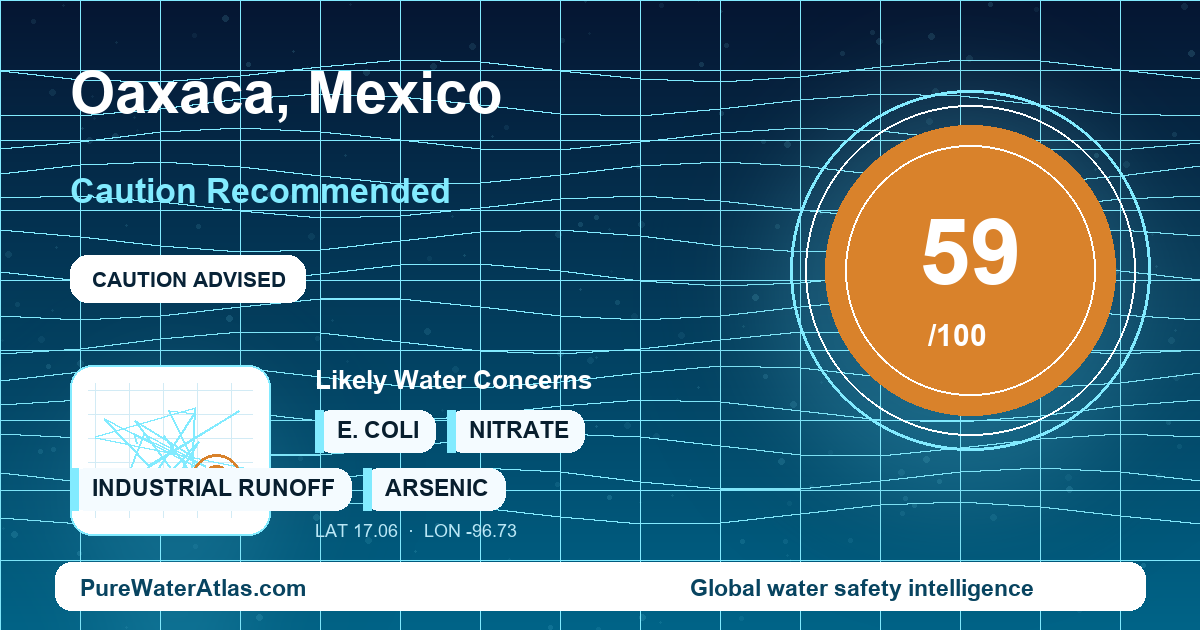
| Overall tap water status | Caution recommended. PureWaterAtlas score: 59/100. Oaxaca has identifiable public water infrastructure, but final water quality can be affected after treatment by low-pressure events, household cisterns, rooftop tinacos, building plumbing, and delivered or stored water. |
|---|---|
| Can tourists drink it? | Not recommended untreated. Visitors should use sealed bottled water, reputable garrafón water, or water that has been boiled or filtered and disinfected. Ask whether water and ice are agua purificada. |
| Resident advice | Treat tap water as a utility water source that usually needs a final household barrier for drinking and cooking, especially where cisterns, tinacos, pipas, private wells, or old plumbing are involved. |
| Main water source context | Oaxaca de Juárez is supplied by a mixed local system of groundwater wells, springs, and infiltration-gallery or surface-influenced sources in the Central Valleys and nearby foothill areas, not by one large reservoir. |
| Water authority | Servicios de Agua Potable y Alcantarillado de Oaxaca, commonly known as SAPAO, is the main public water operator associated with Oaxaca de Juárez service. |
| Filter recommendation | For drinking: sediment prefiltration plus activated carbon, with either UV disinfection or reverse osmosis depending on testing results and household risk. Maintenance is essential. |
Why Oaxaca Is Different
Oaxaca’s tap-water question is not simply “is the city water treated?” The more practical question is: what happens to the water between the source, the distribution network, the building tank, and the glass? Oaxaca de Juárez sits in the Valles Centrales of Oaxaca, an inland highland basin where drinking-water challenges are tied to groundwater availability, seasonal rainfall, watershed conditions, urban growth, and infrastructure performance rather than coastal salinity or seawater intrusion.
The city has long depended on nearby foothill and valley water sources, including spring zones around San Felipe del Agua and neighboring Central Valley communities. As the urban area has grown, drought pressure and limited local availability have made pumping, storage, and intermittent distribution more important parts of the real water picture. In many homes, rentals, and small buildings, the water used at the kitchen may have passed through several stages after leaving the public network: street mains, a cistern, a rooftop tinaco, building plumbing, and sometimes a garrafón dispenser.
This is why PureWaterAtlas rates Oaxaca as Caution Recommended rather than giving a simple “safe” or “unsafe” label. The available evidence supports a cautious drinking-water recommendation, but it does not prove that every neighborhood has the same water quality or that all municipal water is unsafe at all times.
Where Does Oaxaca’s Tap Water Come From?
Oaxaca de Juárez is supplied mainly by a mixed local system rather than by a single large imported reservoir. Publicly available local information and operational notices point to municipal and state-operated production wells in the Oaxaca Central Valleys area, spring and infiltration-gallery type sources in northern and surrounding foothill zones where available, pumping stations, transmission lines, and urban storage tanks.
The system is sectorized, and water service in many areas is intermittent. This matters for water safety because pipes that are not continuously pressurized can be more vulnerable to intrusion through leaks or compromised joints. When service returns after an interruption, changes in pressure can also disturb sediment or discoloration in pipes or storage systems.
Household storage is therefore not a minor side issue in Oaxaca; it is a major part of actual drinking-water access. Many properties use cisterns, rooftop tinacos, and garrafón or purified-water delivery. A clean, covered, disinfected storage tank can reduce practical risk. A dirty or poorly sealed tank can become the point where otherwise treated water becomes unsafe.
Who Manages Drinking Water in Oaxaca?
The main public water operator for Oaxaca de Juárez is Servicios de Agua Potable y Alcantarillado de Oaxaca, usually referred to as SAPAO. SAPAO is a state-level operating body serving the Oaxaca metropolitan area. Local roles may also involve municipal authorities and state water agencies depending on the infrastructure and service area.
At the national level, drinking water quality in Mexico is regulated under federal sanitary rules, including NOM-127-SSA1-2021, the federal standard for water for human use and consumption. Public-health surveillance and sanitary oversight involve the Secretaría de Salud and COFEPRIS. Water-resource context, concessions, aquifers, hydrologic information, and drought monitoring are linked to CONAGUA and national water-information systems.
The main limitation for consumers is transparency at the neighborhood level. There is enough public information to identify the operator, regulatory framework, general source context, and practical risks. However, recent point-by-point compliance results, chlorine residual maps, contaminant detections, and neighborhood-level water-quality data are not consistently published in an easily accessible format.
Main Local Water Concerns
The leading local concern in Oaxaca is intermittent distribution. When service is provided by sectors or on a tandeo-style schedule, low pressure and empty pipes can increase the chance of intrusion through leaks. Even when the supply is chlorinated, water may then spend days in a cistern or rooftop tinaco before use. During that time, chlorine residual can decline, especially if the tank is dirty or exposed to heat, dust, insects, or animal access.
- Microbial vulnerability: Intermittent service, low-pressure events, cisterns, rooftop tanks, and poorly protected private handling can increase risk from organisms such as E. coli and other indicators of fecal contamination.
- Sediment and turbidity: Rainy-season runoff, pipe repairs, pressure changes, and tank disturbance can contribute to visible particles, discoloration, or elevated turbidity. Learn more about sediment in drinking water.
- Loss of chlorine residual: Stored water may have less disinfectant at the tap than it had in the network. This makes chlorine residual testing useful when households rely on municipal disinfection.
- Old building plumbing: Lead is not established as a citywide Oaxaca problem in the dataset, but older buildings can still have site-specific risks from legacy materials, corroded fixtures, solder, brass components, or stagnant internal plumbing. See lead in drinking water.
- Private wells and delivered water: Water from private wells, pipas, or small local systems can vary in quality and should not be assumed safe without testing. In valley and agricultural settings, nitrate is one of the parameters worth checking.
Season also matters. Dry-season scarcity can increase reliance on storage, pipas, and intermittent schedules. Rainy-season storms can increase turbidity and microbial loading in surface-influenced sources and damaged distribution areas. Tourist-season demand can place additional strain on hotels, rentals, and local storage systems, making maintenance of filters and tanks more important.
For Travelers
Most travelers should not drink untreated tap water in Oaxaca. Use sealed bottled water, reputable garrafón water, or water that has been boiled or treated with an appropriate filter and disinfection step. Carrying a refillable bottle is still practical, but fill it from purified-water stations, sealed containers, or a trusted filter system rather than directly from an unknown tap.
For brushing teeth, risk-tolerant travelers may choose to use tap water, but cautious travelers should use purified or bottled water. This is especially advisable for young children, pregnant travelers, immunocompromised people, and anyone prone to stomach illness.
Ice is generally safest when it is made from purified water. Established restaurants, hotels, and cafes in tourist areas commonly use purified water and ice, but the safest habit is to ask for hielo de agua purificada if uncertain. Avoid homemade ice in informal settings unless the source is known.
Hotels and restaurants in Oaxaca often manage water separately from the municipal tap by using purified water for drinking and ice. Still, do not assume. Ask whether drinking water is agua purificada. In short-term rentals, check whether the kitchen tap is directly connected to municipal water, a filter, a garrafón pump, or a rooftop tank.
If you must use tap water in an emergency, bring it to a rolling boil for at least 1 minute, then store it in a clean covered container. Boiling is useful for microbial risk, but it does not remove metals, nitrate, salts, or chemical contaminants. For more detail, see the PureWaterAtlas boiling water purification guide.
For Residents
For Oaxaca residents, the most realistic approach is to treat public tap water as a utility supply that often needs final household treatment for drinking and cooking. A practical setup is sediment filtration to protect equipment, activated carbon for taste and some disinfection byproduct reduction, and either UV disinfection or reverse osmosis depending on test results and household risk. UV is most appropriate when water is already clear and filtered; see the UV water purification guide. Reverse osmosis may be more appropriate where dissolved solids, nitrate, arsenic, fluoride, or other inorganic concerns are identified, but it requires maintenance and wastewater management.
Testing should be tied to actual Oaxaca risk points. Test for total coliform and E. coli after service interruptions, flooding, plumbing work, or cistern contamination. Measure free chlorine residual at the tap if you rely on municipal disinfection; very low residual after storage can indicate the need for better tank hygiene or final disinfection. Test turbidity and visible sediment when water changes color after repairs, rains, or pressure changes.
For private wells, pipas, or properties at the edge of the public service area, testing should include nitrate, arsenic, fluoride, hardness, total dissolved solids, iron, manganese, and basic microbiology. For older homes, schools, and rentals with unknown plumbing, consider first-draw and flushed lead testing rather than assuming the plumbing is safe. PureWaterAtlas has separate resources on lead testing methods and nitrate testing methods.
Cisterns and rooftop tinacos deserve special attention in Oaxaca. Keep tanks covered, screened from insects and animals, cleaned and disinfected on a routine schedule, and protected from cross-connections. If a tank has visible sediment, algae, insects, odor, or has been filled by unknown pipa water, do not drink from it without treatment and testing.
Relevant Contaminants and Water-Quality Issues
The most relevant Oaxaca drinking-water issues are not limited to one contaminant. They are connected to intermittent supply, stored water, older plumbing, seasonal turbidity, and variable private sources.
- E. coli in Drinking Water — relevant to cisterns, rooftop tanks, low-pressure events, and traveler gastrointestinal risk.
- Turbidity in Drinking Water — relevant when storms, pipe work, or pressure changes make water cloudy or discolored.
- Sediment in Drinking Water — relevant to stored water, aging pipes, and water delivered after interruptions.
- Chlorine in Drinking Water — relevant because disinfectant residual can decline during storage in cisterns and tinacos.
- Lead in Drinking Water — relevant as a building-level plumbing concern in older structures, not as a proven citywide Oaxaca finding.
- Nitrate in Drinking Water — relevant for private wells or shallow groundwater in agricultural and urbanized valley settings.
For broader context on source-water vulnerability in valley settings, see Agricultural Runoff in Drinking Water.
How to Verify Your Water Quality
The most reliable answer for a specific Oaxaca home, rental, restaurant, school, or hotel is testing at the point where the water is actually consumed. That means testing after the cistern, after the tinaco, after the building plumbing, and after any filter or dispenser that people use for drinking.
Start with the PureWaterAtlas guide to water testing and the broader drinking water safety guide. If microbiological risk is the concern, review Water Microbiology. If you are choosing equipment, use the Water Treatment Systems guide.
You can compare Oaxaca with other destinations using the Global Water Quality Checker, or look up individual parameters in the Contaminants Search Engine. For country and city context, see Global Water Quality and the Global Water Quality category.
Official and Technical Sources
- Servicios de Agua Potable y Alcantarillado de Oaxaca — Government of the State of Oaxaca; public water and sewerage operator information for Oaxaca city service.
- Calidad del agua para uso y consumo humano — COFEPRIS; federal public-health information on surveillance of water for human use and consumption.
- NOM-127-SSA1-2021, Agua para uso y consumo humano — Diario Oficial de la Federación; Mexico’s federal drinking-water quality standard.
- Comisión Nacional del Agua — CONAGUA; national water authority for water resources, aquifers, concessions, and drought context.
- Sistema Nacional de Información del Agua — CONAGUA; hydrologic and aquifer information system.
- Monitor de Sequía en México — Servicio Meteorológico Nacional and CONAGUA; official drought monitoring relevant to scarcity and storage reliance.
- Oaxaca de Juárez municipal geographic information — INEGI; geographic and demographic reference for Oaxaca de Juárez and the Central Valleys setting.
- Mexico Traveler View — U.S. Centers for Disease Control and Prevention; traveler health guidance supporting cautious water and hygiene practices.
- Guidelines for Drinking-water Quality — World Health Organization; international reference on microbial risk, turbidity, disinfection, and multi-barrier water safety.
Bottom Line
In Oaxaca de Juárez, untreated tap water is not the best drinking choice for most visitors, and residents should not assume that water quality at the utility connection is the same as water quality at the glass. The city relies on mixed local sources, pumping, storage, and sectorized distribution, with intermittent service common enough to make post-treatment contamination a realistic concern. Cisterns, rooftop tinacos, old plumbing, pipas, and private wells can all change the final risk profile. Use purified water for travel, and for homes consider sediment filtration, carbon, and UV or reverse osmosis based on testing. Because neighborhood-level water-quality data are limited, the safest answer is practical caution and verification at the point of use.
Read the full guide: Global Water Quality Guide
Explore more in this category: Global Water Quality Articles