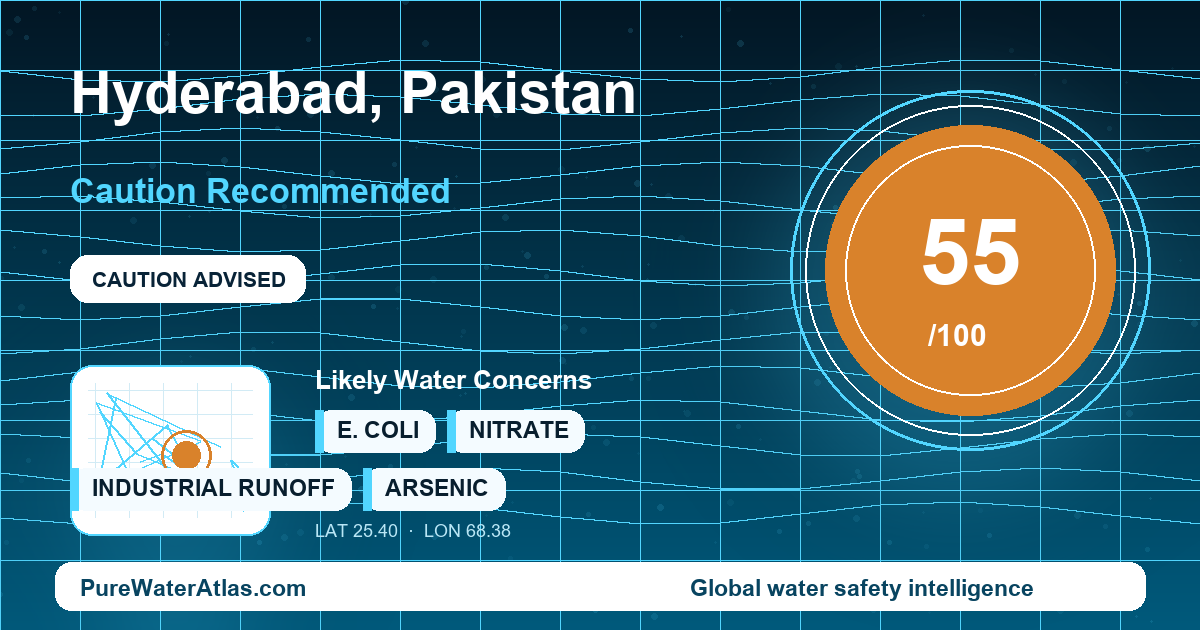
Hyderabad, Sindh relies mainly on Indus River canal-fed surface water near Kotri Barrage, but intermittent distribution, sewerage ingress risk, household storage, and limited recent public tap-testing data mean untreated tap water should be approached with caution.
Quick Answer
| Overall safety status | Caution recommended — PureWaterAtlas water safety score: 55/100. Public evidence does not support advising visitors or high-risk residents to routinely drink untreated tap water in Hyderabad. |
|---|---|
| Can visitors drink the tap water? | No, not as a default. Travelers should use sealed bottled water, boiled water, or water treated by a reliable hotel, restaurant, or household system. |
| Resident advice | Residents should treat drinking water at the point of use unless they have recent, location-specific test results from the actual household tap after storage. |
| Main water source | Primarily Indus River surface water delivered through the canal and barrage system around Kotri Barrage, then pumped to municipal treatment and distribution infrastructure. |
| Responsible authority | Water and Sanitation Agency Hyderabad, operating under Hyderabad Development Authority, Government of Sindh. |
| Filter recommendation | Usually yes for drinking water: sediment filtration plus disinfection such as UV, ultrafiltration, or boiling. Consider reverse osmosis only where testing confirms high TDS, salinity, arsenic, nitrate, or other dissolved contaminants. |
Why Hyderabad Is Different
Hyderabad is a major city in Sindh on the east bank of the Indus River, close to Kotri Barrage. Its drinking-water profile is shaped by that geography. The city is not primarily a groundwater city in the way some inland settlements are; its core municipal supply depends heavily on Indus River surface water moved through canal-fed infrastructure. That makes river conditions, canal disturbance, treatment performance, and distribution integrity central to drinking-water safety.
The most important Hyderabad-specific concern is not simply that the source is a river. Surface water can be treated safely when treatment is consistent and distribution is protected. The practical risk in Hyderabad is the full pathway from canal intake to household glass: raw-water turbidity, pumping interruptions, aging or leaking mains, low-pressure conditions, illegal suction pumps, nearby sewerage, and household storage tanks can all affect the water that finally reaches a tap.
Many households in Hyderabad store water in underground or rooftop tanks because supply is not always continuous. This means a household tank can become a critical control point. A covered, clean, disinfected storage tank with protected vents and no drain or sewage backflow risk may preserve water quality; an uncovered or rarely cleaned tank can recontaminate water even if it left the municipal system in better condition.
PureWaterAtlas classifies Hyderabad as Caution Recommended because the city’s water source and utility identity are clear, and the regional risks are well documented, but recent neighborhood-level, consumer-facing compliance results are not consistently available online. Conditions can vary by pressure zone, season, pipe condition, storage-tank hygiene, private borewell use, tanker source, and building plumbing.
Where Does Hyderabad’s Tap Water Come From?
Hyderabad’s municipal tap water is supplied mainly from Indus River surface water delivered through the canal and barrage system around Kotri Barrage. Raw water is abstracted from canal-fed sources serving Hyderabad and then pumped through local treatment, filtration, storage, and distribution infrastructure before reaching homes and businesses.
The city’s key drinking-water infrastructure includes Kotri Barrage and associated Indus irrigation canals, Hyderabad Development Authority Water and Sanitation Agency intake and pumping assets, municipal filter plants, pumping stations, storage reservoirs, distribution mains, and the many underground and rooftop tanks used by households and buildings. Areas served include Hyderabad City, Latifabad, Qasimabad, and adjoining service areas.
Historically, Hyderabad relied on the Indus and local wells, but much of lower Sindh has brackish or poor-quality groundwater. This is why the Indus canal system remains the critical drinking-water source for the city. It also means water quality can differ sharply between municipal treated water, private boreholes, tanker water, and mixed household sources. A household using a borewell or tanker supply should not assume its water has the same risk profile as municipal treated water.
Season matters. Monsoon and flood periods can increase turbidity, suspended sediment, and microbial pressure in raw surface water. Dry-season low flows in the Indus system can worsen taste, salinity, concentration of pollutants, and supply stress in parts of Sindh. Summer heat increases demand and can worsen bacterial growth in storage tanks that are uncovered or rarely cleaned. Power outages and pumping interruptions can reduce pressure and increase the chance of contamination entering damaged distribution lines.
Who Manages Drinking Water in Hyderabad?
Municipal water and sanitation services in Hyderabad are associated with the Water and Sanitation Agency Hyderabad, operating under the Hyderabad Development Authority, Government of Sindh. The Hyderabad Development Authority’s official website is available at hda.gos.pk.
Pakistan’s drinking water is generally benchmarked against national drinking-water quality standards and public-health guidance from federal and provincial institutions. Relevant bodies include the Pakistan Council of Research in Water Resources, which publishes water-quality monitoring and research reports; the Pakistan Standards and Quality Control Authority, which is relevant to national standards and bottled-water standards; the Pakistan Environmental Protection Agency; and the Sindh Environmental Protection Agency, which is relevant to pollution control and environmental water-quality issues in Sindh.
A key limitation for consumers is that routine, current, ward-level or household-level Hyderabad tap-water compliance data are not consistently published in an accessible online format. National and provincial evidence helps identify likely risks, but it cannot prove that a specific tap in Hyderabad is safe today. For that reason, household testing and point-of-use treatment are especially important for residents who want a reliable answer.
Main Local Water Concerns
The main water-quality concerns in Hyderabad are linked to surface-water treatment, intermittent distribution, storage, and alternative sources such as private bores or tankers.
- Microbial contamination: The most important health risk is contamination by disease-causing organisms, indicated by organisms such as E. coli and total coliforms. Risk increases where sewerage enters damaged pipes, where supply pressure drops, after pipe breaks, or inside unclean storage tanks.
- Turbidity and sediment: Indus canal water can carry more suspended material during monsoon rains, floods, canal maintenance, or river disturbance. High turbidity can interfere with disinfection and may increase the need for effective filtration. Visible sediment is also a practical sign that pre-filtration may be needed.
- Variable chlorine residual: Chlorine residual can decline as water moves through intermittent distribution mains and then sits in household storage. A low or absent residual at the tap can indicate reduced protection against microbial regrowth.
- Salinity and high TDS: Where households use private groundwater, shallow bores, tanker sources, or mixed supplies, salinity, high total dissolved solids, and unpleasant taste may be more significant than in fully treated municipal water.
- Groundwater-related arsenic and nitrate: Possible arsenic risk is mainly a concern for private borewell or groundwater use in parts of Sindh. Nitrate can also matter near leaking sewers, septic systems, drains, or agricultural influence, especially for shallow groundwater sources.
- Building-level plumbing metals: Lead and other metals are more building-specific than citywide. Older internal plumbing, old fittings, stagnant water, and undocumented repairs can increase exposure risk.
For Travelers
Visitors should not drink untreated tap water in Hyderabad as a default. Use sealed bottled water from a reliable brand, boiled water, or water treated by a reputable hotel or restaurant system. Check that bottled-water caps are intact and, in restaurants, prefer sealed bottles opened at the table.
For brushing teeth, conservative advice is to use bottled or treated water, especially for short-term visitors, children, pregnant travelers, elderly travelers, and anyone with a sensitive stomach or weakened immune system. Tap water may be acceptable for washing hands and bathing, but swallowing untreated water should be avoided.
Avoid ice from unknown street vendors or small outlets. In higher-end hotels and established restaurants, filtration, RO, UV, or bottled water may be used, but this should not be assumed. Ask specifically whether drinking water and ice are made from treated or bottled water. When uncertain, skip ice and avoid drinks diluted with unknown water.
Hyderabad’s hot climate also makes hydration planning important. Carry sealed bottled water in hot weather. Use boiled or otherwise treated water for oral rehydration salts and infant formula. Do not rely on taste or clarity as proof of safety; clear water can still contain microbial contamination.
For Residents
For Hyderabad residents, point-of-use treatment is usually recommended for drinking water unless recent test results show the household tap and storage system are consistently safe. The practical baseline is sediment control followed by reliable disinfection. A common setup is a sediment pre-filter followed by UV, ultrafiltration, or boiling for microbial risk. See PureWaterAtlas guides to boiling water purification and UV water purification for practical treatment details.
Reverse osmosis should not be chosen only because the city has a caution rating. RO is most relevant where testing confirms high TDS, salinity, arsenic, nitrate, or other dissolved contaminants. RO units also require maintenance; if they produce very low-mineral water, users should consider appropriate remineralization or a balanced diet.
Testing should be done at the actual drinking-water tap after the household storage tank, not only at the municipal connection. Priority microbiology tests are E. coli and total coliforms, especially after pipe repairs, flooding, sewage overflow, or tank cleaning. Basic indicators should include turbidity, TDS or electrical conductivity, pH, residual chlorine, hardness, and observations of odor or color.
If a household uses a private borewell, tanker water, or a mixed source, testing should also include arsenic, nitrate, fluoride, chloride, sulfate, sodium, iron, and manganese. Households concerned about groundwater arsenic can use the PureWaterAtlas guide to arsenic testing and detection. Where sewage leakage, shallow groundwater, or agricultural influence is suspected, see the guide to nitrate testing.
Older buildings need extra attention. Corroded internal pipes, old fixtures, roof tanks, and undocumented plumbing repairs can contaminate water after it leaves the public main. Flush stagnant taps before use and test first-draw and flushed samples for lead or other metals if plumbing materials are uncertain. The PureWaterAtlas guide to lead testing in drinking water is useful for these situations.
Storage tanks are a major household control point in Hyderabad. Keep tanks covered, screen vents, prevent sewage or drain backflow, clean and disinfect tanks on a routine schedule, and test the water after cleaning. Do not judge tank safety by clarity alone.
Relevant Contaminants and Water-Quality Issues
For Hyderabad, the most relevant PureWaterAtlas contaminant and water-quality profiles are those connected to sewage ingress, canal-fed surface water, intermittent distribution, storage, and groundwater alternatives. Start with E. coli for microbial safety, because it is a key indicator of fecal contamination and unsafe storage or distribution. Review turbidity and sediment for Indus canal conditions, monsoon effects, visible particles, and pre-filtration needs.
Chlorine is important because residual disinfectant can decline before water reaches the household tap, especially in intermittent systems and storage tanks. For households using borewells, tankers, or mixed sources, arsenic and nitrate deserve attention because these risks are source-specific and cannot be ruled out by looking at the water. In older buildings, lead is a plumbing-level risk rather than a confirmed citywide tap-water condition.
How to Verify Your Water Quality
The safest way to answer “Is my Hyderabad tap water safe?” is to test the water you actually drink. Use the PureWaterAtlas complete guide to water testing and analysis to plan sampling and understand which tests matter. For broader safety context, see Drinking Water Safety, Water Microbiology, and Water Treatment Systems.
If you are comparing Hyderabad with other destinations, use the Global Water Quality Checker and the Global Water Quality guide. If a lab report identifies a contaminant you do not recognize, use the Contaminants Search Engine.
Testing is especially important after flooding, monsoon-related turbidity changes, pipe repairs, sewage overflows, changes in supply source, storage-tank cleaning, filter installation, media replacement, or UV lamp replacement. Retest after corrective action to confirm that the fix worked.
Official and Technical Sources
- Hyderabad Development Authority — official local authority site for HDA, under which WASA Hyderabad is the municipal water and sanitation service provider.
- Pakistan Council of Research in Water Resources water quality reports — national research body publishing water-quality monitoring reports and evidence on drinking-water contamination patterns in Pakistan.
- Water Quality Status in Pakistan 2020 — PCRWR national water-quality report providing context on microbial and chemical risks; it should not be treated as proof of safety at every Hyderabad tap.
- Pakistan Standards and Quality Control Authority — federal standards body relevant to Pakistan drinking-water quality standards and bottled-water standards.
- Pakistan Environmental Protection Agency — federal environmental authority associated with national environmental and drinking-water quality standards and guidance.
- Sindh Environmental Protection Agency — provincial environmental regulator relevant to pollution control and environmental water-quality issues in Sindh.
- WHO and UNICEF Joint Monitoring Programme Pakistan data — national WASH dataset for Pakistan, useful for background but not a substitute for city-specific tap testing.
- UNICEF Pakistan Water, Sanitation and Hygiene — public-health context on WASH challenges in Pakistan.
- Asian Development Bank Sindh Cities Improvement Investment Program — development-sector context on urban water and sanitation infrastructure challenges in Sindh cities.
Bottom Line
Hyderabad’s tap water should be treated with caution. The city depends mainly on Indus River canal-fed surface water near Kotri Barrage, managed through WASA Hyderabad under the Hyderabad Development Authority, but the main risk is what can happen during distribution and storage. Intermittent supply, low pressure, aging mains, sewerage ingress, high turbidity during monsoon or canal disturbance, and unclean rooftop or underground tanks can affect water by the time it reaches a household tap. Visitors should use sealed bottled, boiled, or reliably treated water and avoid uncertain ice. Residents should test the actual drinking tap after storage and use sediment filtration plus disinfection, adding RO only when dissolved-contaminant testing justifies it.
Read the full guide: Global Water Quality Guide
Explore more in this category: Global Water Quality Articles