Multan, Pakistan: groundwater-based municipal supply, household storage risks, and practical drinking-water safety guidance for visitors and residents.
Quick Answer
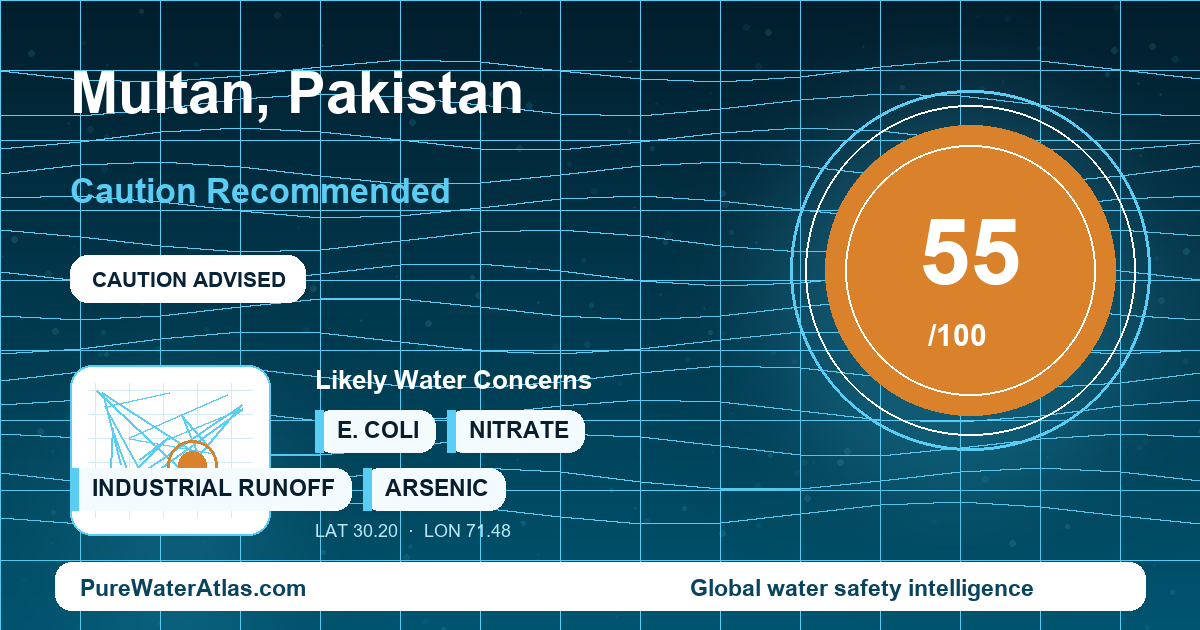
| Overall safety status | Caution recommended. Tap water in Multan should be treated as conditionally usable, not reliably drinkable straight from the tap. PureWaterAtlas score: 55/100. |
|---|---|
| Can tourists drink it? | Not recommended untreated. Short-term visitors should use sealed bottled water, hotel-provided treated water, boiled water, or a reliable purifier. |
| Resident advice | Do not assume every household tap is safe. Use point-of-use treatment for drinking and cooking, clean storage tanks, and test periodically for bacteria, TDS, hardness, nitrate, arsenic, and relevant metals. |
| Main water source | Predominantly groundwater from the Indus Basin alluvial aquifer, pumped through municipal tube wells. |
| Local water authority | Water and Sanitation Agency Multan, commonly known as WASA Multan, within Punjab’s urban water and sanitation governance structure. |
| Filter recommendation | A simple taste filter is not enough. Treatment should match test results: sediment filtration and activated carbon for particles and taste, UV or boiling for microbes, and reverse osmosis where high TDS, nitrate, or arsenic are confirmed. |
Why Multan Is Different
Multan’s tap-water safety question is not the same as in a city served mainly by a large centralized surface-water treatment plant. Multan is located in southern Punjab on the Indus Basin alluvial plain near the Chenab River system, and its municipal drinking-water supply is understood to rely predominantly on groundwater pumped through tube wells. That makes the city’s practical risk profile strongly dependent on local groundwater chemistry, tube-well operation, chlorination, distribution pressure, pipe condition, and what happens inside each building before the water reaches the glass.
The most important point for Multan is variability. Two households on the same street can have different drinking-water risk: one may receive municipal supply stored in a clean, covered tank, while another may rely on a private bore, an unclean rooftop tank, a poorly sealed underground tank, or a community filtration point with uncertain maintenance. Older inner-city premises and rapidly expanded peri-urban areas can also differ in pipe age, service connections, tank hygiene, and exposure to sewerage or drainage problems.
Because public, current, neighborhood-level tap-water compliance data for Multan is limited, this profile does not claim that all Multan tap water is safe or unsafe. The better conclusion is more practical: untreated tap water should not be considered reliably drinkable everywhere in the city, especially for visitors, infants, pregnant people, immunocompromised residents, or households using private bores without testing.
Where Does Multan’s Tap Water Come From?
Multan’s municipal supply is understood to come mainly from groundwater abstracted through municipal tube wells. These tube wells draw from the broader Indus Basin alluvial aquifer system, a major groundwater environment used historically for domestic supply in southern Punjab. Groundwater can be naturally protected in some settings, but it is not automatically safe. In Multan’s urban environment, water quality may be affected by mineralized groundwater pockets, irrigation return flow, sewerage load, private boreholes, leakage, and the condition of distribution infrastructure.
The city’s key drinking-water infrastructure includes municipal tube wells, distribution mains, service connections, overhead or ground-level storage in parts of the network, and household underground and rooftop storage tanks. Some premises also use private bore wells, which may have water quality that is different from the municipal supply. Public or community filtration points may exist in some areas, but their safety depends on maintenance, disinfection, and timely filter replacement.
For everyday users, the “final mile” is often the decisive factor. Even if water leaves a tube well or municipal system in acceptable condition, it can deteriorate through intermittent pressure, pipe leakage, sewer proximity, stagnant plumbing, dirty tanks, or storage during hot weather. Low or interrupted pressure can allow contaminated water to enter damaged pipes, particularly where water lines and sewerage infrastructure are close or poorly maintained.
Who Manages Drinking Water in Multan?
Drinking-water supply, sewerage, and drainage functions in Multan are associated with the Water and Sanitation Agency Multan, commonly referred to as WASA Multan, under the Government of Punjab urban water and sanitation structure. The Multan Development Authority provides relevant administrative and urban development context for municipal service structures.
Pakistan’s drinking-water quality context is generally assessed against the National Standards for Drinking Water Quality and public-health guidance from national and provincial bodies. Relevant institutions include the Pakistan Council of Research in Water Resources, the Pakistan Environmental Protection Agency, Punjab public-health and environmental bodies, and the local utility responsible for operation.
However, Multan does not appear to have a routinely updated public tap-water dashboard comparable to some high-income municipal systems. That matters because citywide descriptions cannot substitute for tap-level results. Actual quality can vary by tube-well field, distribution zone, pipe condition, supply pressure, private bore use, storage tank condition, and building plumbing.
Main Local Water Concerns
Microbial contamination is the most immediate health concern in Multan where sewage intrusion, stagnant tanks, inadequate disinfection, or low-pressure events occur. Bacteria such as E. coli and total coliforms are especially relevant after line breaks, monsoon flooding, sewer overflows, or long household storage periods.
High TDS, salinity, hardness, and taste issues can occur in southern Punjab groundwater. These issues may not always cause acute illness, but they affect taste, scaling, appliance performance, and suitability for people who need low-sodium water. Testing for TDS, conductivity, hardness, chloride, sulfate, sodium, pH, and alkalinity is important when water tastes salty, bitter, or leaves heavy scale.
Arsenic is a recognized groundwater concern in parts of Punjab and the Indus Basin. Arsenic cannot be detected by taste, smell, or appearance, and boiling does not remove it. Private bore users and long-term residents should rely on laboratory testing rather than visual inspection.
Nitrate can enter groundwater from wastewater leakage, septic influence, and agricultural activity. Nitrate is especially important for infants and pregnant people, and boiling does not remove it. If a household uses bore water or is near sewer leakage, septic sources, or agricultural influence, nitrate testing is a priority.
Sediment, turbidity, and brown water may appear after pipe repairs, tank disturbance, low-pressure events, or bore-well pumping. Turbidity can interfere with disinfection, while sediment can signal distribution deposits, disturbed tank material, or intrusion.
Residual chlorine inconsistency is also relevant. Chlorine can control microbial risk only when properly dosed and maintained through the network. A strong chlorine smell is not proof of complete safety, and no smell is not proof of danger. Testing is needed for certainty.
Lead and other metals are not the best-evidenced citywide source-water concern for Multan, but older plumbing, brass fittings, solder, pumps, or storage components can contribute metals at the building level. Lead risk is best evaluated with first-draw and flushed samples from the actual household tap.
For Travelers
Short-term visitors should avoid drinking untreated tap water in Multan. Use factory-sealed bottled water from reputable brands, professionally treated hotel water, water that has reached a full boil, or a reliable purifier. The main short-term concern is gastrointestinal illness from microbial contamination, particularly when water has passed through uncertain storage tanks or distribution conditions.
Use bottled or treated water for brushing teeth if you are visiting briefly, immunocompromised, pregnant, traveling with young children, or staying in budget accommodation where tank maintenance is uncertain. Tap water may be acceptable for washing hands and showering, but avoid swallowing it.
Avoid ice unless you can confirm it was made from bottled or treated water. Ice from street vendors or unknown restaurant sources can be an exposure route because freezing does not reliably make contaminated water safe. In hotels and restaurants, ask whether drinking water is bottled, boiled, or filtered. Prefer sealed bottles opened in front of you.
During Multan’s hot weather, carry oral rehydration salts and enough safe water. Be cautious with unsealed containers, refilled bottles, and cold drinks prepared with unknown water or ice. Hot beverages are safer only when the water has reached a full boil; warm water is not equivalent to boiling. For more detail on emergency microbial treatment, see Boiling Water Purification: Complete Guide.
For Residents
For most Multan households, a point-of-use drinking-water treatment system is advisable unless recent laboratory testing confirms that water at the kitchen tap and after the storage tank is safe. A taste-improving filter alone is not enough if the issue is arsenic, nitrate, high TDS, or microbial contamination.
A practical setup should be based on test results. Sediment filtration can reduce particles. Activated carbon can help with taste and some chemical concerns. UV treatment or boiling targets microbes but does not remove dissolved chemicals. Reverse osmosis is commonly selected where TDS, nitrate, or arsenic are confirmed, but it should be maintained carefully and ideally verified with post-treatment testing. For technology selection, see Water Treatment Systems and UV Water Purification: Complete Guide.
Residents should test for E. coli and total coliforms at the kitchen tap and after the storage tank, especially after monsoon flooding, sewer problems, or pipe repairs. If water tastes salty, bitter, or causes scaling, test TDS, electrical conductivity, hardness, chloride, sulfate, sodium, pH, and alkalinity. If using a private bore, test arsenic through a certified laboratory. Test nitrate where infants, pregnant people, or immunocompromised residents drink the water, or where sewer leakage, septic sources, or agricultural influence may affect groundwater.
Older buildings in Multan deserve special attention. Aged internal pipes, old valves, unrecorded repairs, low-pressure connections, and old tanks can change water quality after it enters the property. Underground and rooftop tanks should be covered, sealed against insects and runoff, cleaned and disinfected periodically, and protected from sewage seepage or roof drainage. In hot weather, stagnant tank water can lose disinfectant residual and support microbial growth.
Relevant Contaminants and Water-Quality Issues
The most relevant PureWaterAtlas contaminant profiles for Multan are E. coli for sewage-related microbial risk, turbidity and sediment for brown water and disturbed pipes or tanks, arsenic for groundwater testing, nitrate for sewage and agricultural influence, chlorine for disinfection residual, and lead for older building plumbing risk.
If testing confirms arsenic or nitrate, use contaminant-specific guidance rather than a general filter claim: Arsenic in Drinking Water: Testing and Detection Methods, Arsenic in Drinking Water: Best Filters, Systems and Solutions, Nitrate Contamination in Drinking Water: Testing and Detection Methods, and Nitrate Contamination in Drinking Water: Best Filters, Systems and Solutions. For old plumbing concerns, see Lead in Drinking Water: Testing and Detection Methods.
How to Verify Your Water Quality
The safest way to make a household decision in Multan is to test the water you actually drink. Collect samples from the kitchen tap, after the household storage tank, and, if relevant, directly from a private bore or filtration point. Retest after installing a filter, after major plumbing changes, after pipe repairs, and after flooding or sewer problems. A neglected filter can become a microbial source, so maintenance records matter as much as installation.
Use the PureWaterAtlas Water Testing guide for sampling strategy and interpretation, the Contaminants Search Engine to research specific risks, and the Global Water Quality Checker to compare Multan with other city and country profiles. For broader context, see Drinking Water Safety, Water Microbiology, and Water Contamination.
Official and Technical Sources
- Water and Sanitation Agency Multan — local utility identity and water, sewerage, and drainage service context.
- Multan Development Authority — administrative and urban development context for Multan municipal services.
- Pakistan Council of Research in Water Resources — national drinking-water monitoring and groundwater-quality research context.
- Pakistan Environmental Protection Agency — National Standards for Drinking Water Quality context.
- World Health Organization Guidelines for Drinking-water Quality — public-health framework for microbial and chemical drinking-water risks.
- CDC Pakistan Traveler View — traveler-oriented food and water hygiene guidance.
- WHO/UNICEF JMP Data for Pakistan — national drinking-water and sanitation service-level context.
- Punjab Housing, Urban Development and Public Health Engineering Department — provincial water, sanitation, and public-health engineering context.
Bottom Line
Multan tap water should be treated with caution. The city relies mainly on groundwater pumped through municipal tube wells, but safety at the drinking point depends on chlorination, pressure, pipe integrity, sewer proximity, private bores, and household storage tanks. Visitors should not drink untreated tap water and should use sealed bottled, boiled, or properly treated water, including for brushing teeth when tank hygiene is uncertain. Residents should use point-of-use treatment for drinking and cooking unless recent lab results show the tap and storage tank are safe. The most important tests for Multan households are E. coli and coliforms, TDS and hardness indicators, nitrate, arsenic, and building-level metals where plumbing is old or unknown.
Read the full guide: Global Water Quality Guide
Explore more in this category: Global Water Quality Articles