
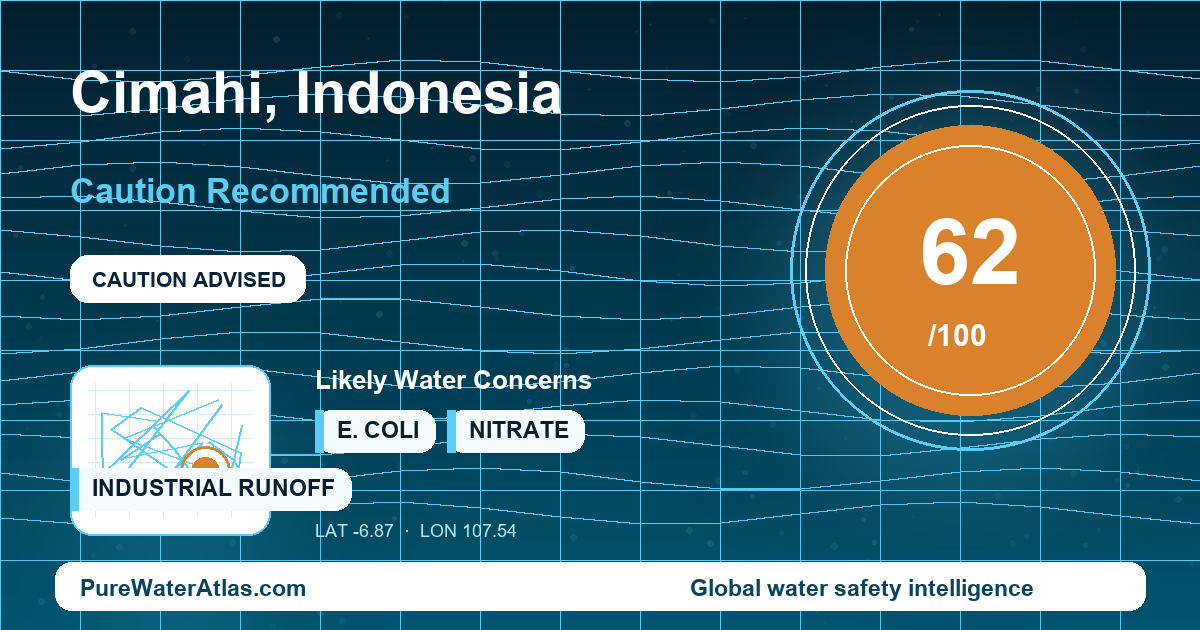
Cimahi, West Java: a Bandung-basin city where managed piped water, household storage tanks, wells, and refill-water sources can all affect what is safe to drink at the tap.
Quick Answer
| Water safety score | 62 / 100 |
|---|---|
| Risk level | Caution Recommended |
| Can you drink the tap water? | Use caution. Most visitors and many residents should not drink untreated tap water in Cimahi unless their specific building has reliable treatment, clean storage, and recent satisfactory test results. |
| Traveler advice | Use sealed bottled water, reputable gallon water, boiled water, or verified filtered water. Avoid unknown ice and untreated bathroom tap water. |
| Resident advice | Use tap water for washing and bathing where supply is managed, but treat and periodically test water used for drinking, especially if it passes through rooftop tanks, ground tanks, pumps, older plumbing, or a private well. |
| Main water identity | Cimahi is served in part by a regional piped-water system associated with Perumda Air Minum Tirta Raharja, alongside practical household use of wells, storage tanks, and commercial refill or gallon water. |
| Primary authority | Perumda Air Minum Tirta Raharja for key piped-water service context; Cimahi city and health authorities for local public-health oversight; Indonesia’s Ministry of Health for national drinking-water quality requirements. |
| Filter recommendation | A point-of-use barrier is recommended for drinking: sediment filtration where water is cloudy, activated carbon for taste and chlorine, and boiling, UV, ultrafiltration, or reverse osmosis depending on test results and household risk. |
Editorial verdict: Caution recommended. Cimahi has an official piped-water system serving parts of the city, but public city-specific tap-water monitoring data is limited. Many households use mixed sources, including storage tanks, wells, refill-water depots, or gallon vendors. The safest default is to treat tap water before drinking unless you have recent results for your own tap or building.
Why Cimahi Is Different
Cimahi is not a coastal resort town and not a remote mountain village. It is a compact, high-density inland city immediately west of Bandung, inside the Bandung basin and the wider Citarum River catchment. That geography shapes its drinking-water risk profile. Salinity intrusion is not the main local issue in the way it can be for coastal aquifers. In Cimahi, the more relevant questions are watershed pollution, rainy-season runoff, turbidity, shallow-well vulnerability, distribution conditions, and what happens to water after it enters a building.
The city also has a long military and industrial history and sits within one of Indonesia’s most intensively urbanized watersheds. The broader Citarum basin is nationally recognized for pollution-control and watershed-restoration efforts, which matters when regional surface-water resources or shallow groundwater are part of the local water picture. This does not mean every Cimahi tap is unsafe, but it does mean that source, treatment, storage, and plumbing details matter.
A practical complication is that Cimahi is part of the Bandung urban area but administratively separate from Bandung city. A traveler may hear one answer from a hotel, another from a landlord, and another from a local water vendor. The most accurate advice is source-specific: confirm whether your building uses direct utility water, stored utility water, a private well, delivered gallon water, or a refill-water depot.
Where Does Cimahi’s Tap Water Come From?
Cimahi’s piped water is associated primarily with Perumda Air Minum Tirta Raharja, a public drinking-water utility serving Bandung Regency and parts of the surrounding Bandung metropolitan area, including Cimahi service connections. The broader Bandung Raya supply context includes upland spring water and treated surface-water resources linked to regional catchments and the Citarum watershed setting.
Publicly accessible documents do not provide a simple household-by-household raw-water split for Cimahi. For that reason, this profile does not claim that a given home receives a specific percentage of spring water, surface water, or groundwater. The safer and more accurate description is that Cimahi has a managed regional piped-water system supplemented in practice by private wells, household tanks, pumps, internal plumbing, refill-water depots, and gallon-water vendors.
The “last mile” is especially important in Cimahi. Even when water leaves a treatment system in acceptable condition, intermittent pressure, pipe breaks, repairs, household pumps, old building plumbing, rooftop tanks, and ground storage tanks can change quality before someone drinks it. Sediment, insects, dust, low-use pipe sections, or poorly sealed tank openings can all undermine safety at the point of use.
Who Manages Drinking Water in Cimahi?
The key public drinking-water utility associated with Cimahi-area piped service is Perumda Air Minum Tirta Raharja. Local public-health supervision is connected to the Cimahi city government and health office, while national drinking-water quality requirements are set under Indonesia’s Ministry of Health framework.
Indonesia’s current national hygiene, sanitation, and drinking-water quality framework is set through Ministry of Health Regulation No. 2 of 2023. Water-supply infrastructure and SPAM drinking-water systems are also influenced by the Ministry of Public Works and Housing through the Direktorat Air Minum, Cipta Karya.
Important limitation: easily accessible public datasets showing recent Cimahi neighborhood-level tap results for microbiology, metals, disinfection residual, turbidity, and household storage conditions were not found for this profile. Therefore, PureWaterAtlas does not claim that every Cimahi tap meets, or fails, any specific drinking-water parameter. The confidence level is moderate: the utility identity, regulatory framework, and regional watershed context are well supported, but building-level and neighborhood-level water quality remain unresolved without direct testing.
Main Local Water Concerns
The main drinking-water concerns in Cimahi are practical and source-specific rather than a single citywide contaminant claim. The most important issue is microbial risk from untreated private wells, poorly maintained rooftop or ground tanks, contaminated refill containers, or building plumbing that allows water quality to deteriorate after treatment. For travelers, this is the reason untreated tap water is not recommended as a default drinking source.
Rainy-season conditions can increase raw-water turbidity, runoff, and microbial loading in surface-water sources and urban drains. During or after heavy rain, road works, flooding, or pipe repairs, residents may notice cloudy water or sediment pulses. Visibly cloudy water should not be consumed untreated; taps should be flushed, sediment should be allowed to settle or be filtered, and drinking water should be boiled or otherwise disinfected if microbial safety is uncertain.
Chlorine taste or odor may occur in treated piped water. A chlorine smell is not automatically a sign that water is unsafe; residual disinfectant can be part of maintaining microbiological control. However, taste acceptability often drives households toward carbon filtration, gallon water, or boiling.
Groundwater and older plumbing can raise other concerns. Iron or manganese may cause reddish, brown, blackish, or metallic staining and should prompt testing if persistent. Shallow wells in dense neighborhoods may be vulnerable to nitrate or general urban contamination, especially near septic systems or drains. Older buildings with unknown plumbing should also be treated cautiously because internal pipes, solder, brass fittings, valves, and low-use lines can influence water before it reaches the glass.
For Travelers
Most short-term visitors should not drink untreated tap water in Cimahi. Use sealed bottled water, reputable gallon water, boiled water, or water from a purifier that is clearly maintained. This advice is especially important for children, pregnant travelers, immunocompromised travelers, and anyone with a sensitive stomach or no prior exposure to local microbes.
For brushing teeth, bottled or treated water is the safer default during short stays. If your accommodation provides drinking water, ask whether it is boiled, filtered, or supplied from sealed gallons. In hotels, kettle-boiled water is generally a safer choice than bathroom tap water, provided the kettle and containers are visibly clean.
Avoid ice from street vendors or unknown sources. Ice in higher-end hotels or restaurants may be made from treated water, but if the source cannot be verified, skipping ice is the lower-risk choice. Choose hot drinks prepared with fully boiled water, and carry sealed water for day trips around Cimahi and Bandung.
If you use a travel filter, choose one designed for bacteria and protozoa. If viral risk is a concern, combine filtration with boiling or another disinfection method. For more detail on emergency and travel use, see the PureWaterAtlas guide to boiling water purification.
For Residents
Residents connected to a managed piped supply can often use tap water for bathing, washing, and general household use, but drinking water deserves an extra safety barrier unless your specific tap has recent satisfactory results. A practical household approach is layered: sediment prefiltration where water is cloudy, activated carbon for taste and chlorine, and a microbial barrier such as boiling, UV, ultrafiltration, or reverse osmosis depending on test results and household risk tolerance.
If your home uses a private well, testing is more important than guessing. At minimum, test for E. coli or total coliforms, nitrate, turbidity, iron, manganese, pH, conductivity, and basic minerals. Add arsenic or other metals if local geology, past results, or professional advice suggests concern. If babies, pregnant people, elderly residents, or immunocompromised people drink the water, prioritize microbiological testing and use boiled or otherwise disinfected water until results are clear.
Storage tanks are a major control point in Cimahi homes and buildings. Clean rooftop and ground tanks regularly, keep lids sealed, protect vents and overflows from insects and rodents, and disinfect tanks after maintenance or contamination events. A safe treatment plant cannot compensate for a dirty household tank.
Older buildings should not be assumed safe at the tap. If plumbing materials are unknown, consider testing first-draw and flushed samples for lead and other corrosion-related metals, especially where old solder, brass fittings, valves, or low-use lines may be present. See PureWaterAtlas resources on choosing water treatment systems and UV water purification for selecting a household setup.
Relevant Contaminants and Water-Quality Issues
The most relevant Cimahi issue for drinking-water safety is microbial contamination. Learn more about E. coli as an indicator of fecal contamination, especially for private wells, storage tanks, and refill-water handling. For broader microbial context, see Water Microbiology.
During heavy rain, repairs, or intermittent supply, turbidity and sediment can make treatment less reliable and signal disturbance in the system. Treated piped water may also have noticeable chlorine taste or odor, which affects acceptability but is not automatically unsafe.
For private wells and older buildings, the key issues to investigate are not identical to utility-water concerns. Nitrate is relevant for shallow wells in dense areas influenced by sanitation or runoff. Iron and manganese are relevant where water stains fixtures, looks reddish or blackish, or tastes metallic. Lead is not identified here as a proven Cimahi-wide source problem, but it is relevant to older internal plumbing and should be tested where materials are unknown.
How to Verify Your Water Quality
Because public neighborhood-level monitoring data for Cimahi is limited, the best verification is testing your actual water source. A household connected to piped water should test when supply is intermittent, after plumbing work, after tank maintenance, when water has unusual odor or color, or when vulnerable residents will drink it. A private well should be tested more comprehensively and periodically because well conditions can differ sharply even within the same city.
Start with microbiology if the question is “Can we drink this?” Test for E. coli or total coliforms, especially where water is stored in tanks or comes from a well. Add turbidity and basic chemistry if water is cloudy or variable. If staining, metallic taste, or black deposits occur, test for iron, manganese, and corrosion-related metals. If the building is older, consider first-draw and flushed lead testing; the PureWaterAtlas guide to lead testing and detection explains that approach. For shallow wells, see nitrate testing and detection.
For a broader framework, use the PureWaterAtlas guides to Drinking Water Safety and Water Testing. You can also compare destinations through the Global Water Quality Checker or research specific substances in the Contaminants Search Engine. Related PureWaterAtlas categories include Drinking Water Safety, Water Testing, Water Purification, and Water Contamination.
Official and Technical Sources
- Perumda Air Minum Tirta Raharja official website — public drinking-water utility associated with Cimahi-area piped water service.
- Cimahi City Government official website — municipal source for local governance, public services, and announcements.
- BPS Kota Cimahi — official statistics source for Cimahi demographics, urban density, and city context.
- Citarum Harum program website — official watershed-restoration and pollution-control context for the Citarum basin.
- Ministry of Health Regulation No. 2 of 2023 — Indonesian national regulation covering environmental health standards, including drinking-water quality requirements.
- Direktorat Air Minum, Cipta Karya — Ministry of Public Works and Housing portal for SPAM drinking-water infrastructure and policy.
- World Health Organization drinking-water fact sheet — public-health reference for microbial contamination and safely managed drinking water.
- U.S. CDC Indonesia traveler health information — traveler guidance supporting caution with untreated water, ice, and food-and-water exposure risks.
Bottom Line
Cimahi’s tap water should be approached with caution for drinking. The city has managed piped-water service associated with Perumda Air Minum Tirta Raharja, but many real-world drinking sources include storage tanks, wells, pumps, older plumbing, refill depots, and gallon water. Because recent, public, neighborhood-level tap results for Cimahi are not consistently available, the safest advice is source-specific: verify your building’s water source and treatment. Travelers should use bottled, sealed gallon, boiled, or verified filtered water and avoid unknown ice. Residents should maintain tanks, treat drinking water, and test wells or suspicious taps for microbes, turbidity, nitrate, metals, and plumbing-related issues where relevant.
Read the full guide: Global Water Quality Guide
Explore more in this category: Global Water Quality Articles