
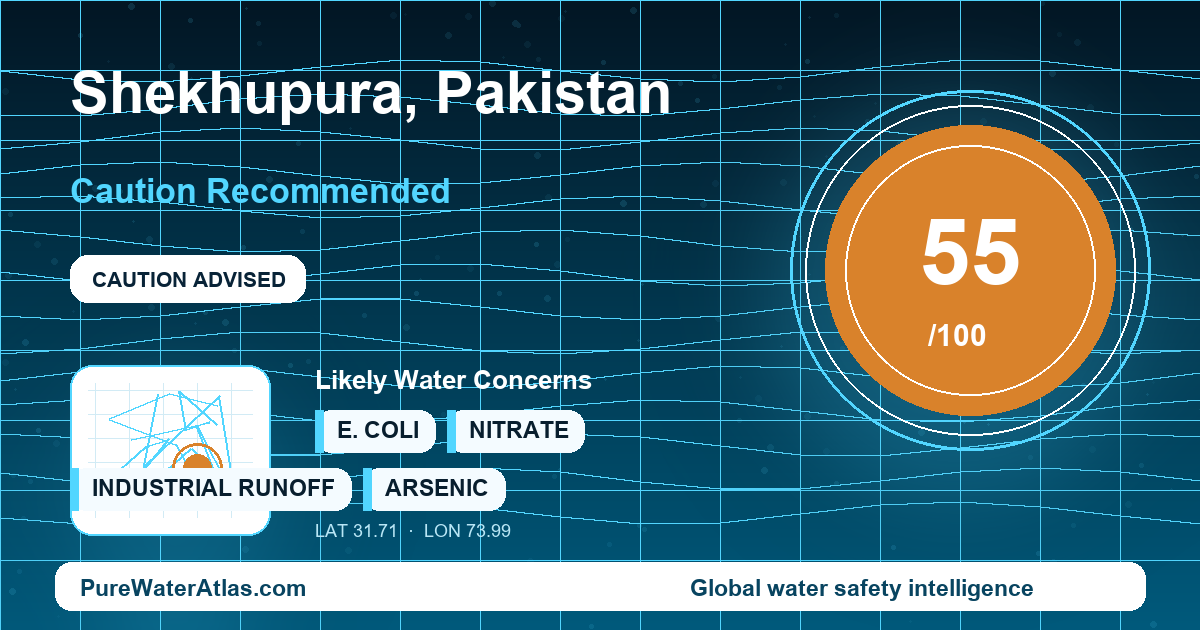
Shekhupura, Pakistan: groundwater-based urban supply with intermittent-delivery, storage-tank, microbial, salinity, and private-bore testing concerns.
Quick Answer
| Overall safety status | Caution recommended. Shekhupura tap water should be treated as conditionally usable, not reliably potable at the tap without treatment or recent household testing. |
|---|---|
| PureWaterAtlas score | 55 / 100 — risk level: Caution Recommended. |
| Traveler advice | Do not drink ordinary untreated tap water. Use sealed bottled water, boiled water, or verified RO/UV-treated water for drinking, brushing teeth, and ice. |
| Resident advice | Base decisions on testing at the actual tap. Many homes should use a maintained point-of-use system, especially where private bores, tanks, suction pumps, or older plumbing are involved. |
| Main water source | Predominantly groundwater from municipal tube wells and private bores in the Punjab alluvial aquifer. |
| Local authority context | Urban supply is under local municipal responsibility, commonly referenced as Municipal Corporation Sheikhupura or the relevant local-government body. No clearly documented dedicated WASA-style Shekhupura utility was identified in the available dataset. |
| Filter recommendation | Sediment prefiltration plus UV or ultrafiltration for microbial risk; reverse osmosis where testing shows high TDS, salinity, nitrate, arsenic, fluoride, or other dissolved contaminants. |
Confidence: medium for source-water identity and general risk profile; low to medium for current tap quality because recent, public, city-wide compliance results and continuous residual-chlorine data for Shekhupura are not readily available.
Why Shekhupura Is Different
Shekhupura is an industrial and agricultural city in Punjab, northwest of Lahore, located in a canal-irrigated alluvial plain. That setting makes groundwater the practical drinking-water source for much of the city, but it also means water quality can vary sharply from one locality, bore depth, and household storage system to another. A visitor in a hotel, a household connected to a municipal tube-well zone, and a resident using a private bore may all be drinking very different water.
The main question in Shekhupura is therefore not simply “does the city have groundwater?” It is whether the water remains safe through the entire chain: tube well, distribution pipe, intermittent pressure conditions, household suction pump, underground tank, rooftop tank, filter, and kitchen tap. Intermittent supply and low pressure can increase intrusion risk where pipes are old or leaky and where sewerage lines or urban drains are nearby. Storage tanks can also become a major contamination point if they are uncovered, dirty, warm, or poorly disinfected.
Historically, households in Shekhupura and surrounding Punjab settlements relied heavily on hand pumps, open wells, and shallow private groundwater sources before piped municipal and electric tube-well systems expanded. That legacy still matters. Private bores, commercial filtration points, tank storage, and purchased water remain common practical responses where households do not fully trust or consistently receive municipal water.
Where Does Shekhupura’s Tap Water Come From?
Shekhupura’s drinking-water supply is understood to be predominantly groundwater-based. The city draws on municipal tube wells and private bores in the Punjab alluvial aquifer. The wider district lies in an irrigated Ravi-Chenab doab setting, where shallow groundwater can be influenced by canal recharge, agriculture, leaking sewers, industrial drainage, and local hydrogeology. Surface canals in the area are primarily irrigation infrastructure and should not be assumed to be treated drinking-water sources.
The key water infrastructure affecting household safety includes municipal groundwater tube wells, piped urban distribution zones, private domestic and commercial bore wells, household underground and rooftop storage tanks, public or commercial filtration points, and bottled or dispenser water used by many families. Urban drains and sewerage lines are also part of the practical risk picture because they can create cross-contamination pathways where water pipes are depressurized or damaged.
Because the supply is groundwater-based, taste can be misleading. Salty taste, hardness, scaling, poor soap lathering, brown water, or sediment may signal high dissolved minerals, iron, pipe rust, tank deposits, or turbidity. But some of the most important contaminants, including arsenic, nitrate, and some microbial hazards, cannot be reliably judged by taste, smell, or appearance.
Who Manages Drinking Water in Shekhupura?
The primary urban service authority is the local municipal government, commonly referenced as Municipal Corporation Sheikhupura or the relevant municipal/local-government body under Punjab’s Local Government and Community Development framework. For rural and peri-urban water-supply schemes, Punjab Public Health Engineering Department involvement may be relevant. Punjab Environmental Protection Department regulates environmental pollution issues, while PCRWR is a key national water-quality research and monitoring body.
Drinking-water quality in Pakistan is generally benchmarked against Pakistan’s National Standards for Drinking Water Quality and WHO guideline concepts. However, the existence of standards does not prove that every Shekhupura tap consistently meets them. In this city, household plumbing, tank hygiene, intermittent pumping, pressure interruptions, private bores, and post-supply storage can change water quality after it leaves a municipal tube well.
A major data limitation is that recent, public, city-wide Shekhupura compliance results and continuous residual-chlorine data were not identified in the supplied dataset. For residents, that means local decisions should depend on water testing at the actual point of use rather than on assumptions about the source or on taste alone.
Main Local Water Concerns
- Microbial contamination: Intermittent supply, low pressure, leaky pipes, nearby sewerage, and unclean roof or underground tanks can allow bacterial contamination. This is the most practical day-to-day safety concern for many households.
- Variable chlorine residual: If chlorination is inconsistent or chlorine is lost in storage, water may not remain microbiologically protected at the tap. Absence of residual chlorine can indicate weak protection in the distribution or storage system.
- High TDS, salinity, hardness, and taste problems: Punjab groundwater can vary from fresh to brackish over short distances. Scaling, salty taste, and poor soap lathering may suggest mineral issues, but neighborhood-level values should not be assumed without testing.
- Arsenic and fluoride: Punjab aquifers have documented regional geogenic risks. These contaminants are especially important for private-bore users because boiling does not remove them and they cannot be reliably detected by taste.
- Nitrate: Agricultural surroundings, septic leakage, and wastewater pressure make nitrate a sensible test parameter, especially where water is used for infant formula or by pregnant residents.
- Sediment, turbidity, iron, and discoloration: Tube-well pumping, pipe repairs, rusting pipes, and tank sediment can create visible particles or brown water. Turbid water can also reduce UV effectiveness.
- Industrial contamination pressure: Shekhupura is part of a heavily industrialized Punjab corridor. Industrial wastewater can affect drains and shallow groundwater if poorly managed, although this does not prove contamination in every drinking-water source.
Seasonal conditions can make these risks more pronounced. During the monsoon period, typically July to September, heavy rain can increase sewer overflow, drain contamination, turbidity, and intrusion risk. During hot weather and power-outage periods, higher demand, intermittent pumping, and warm storage tanks can reduce disinfectant residual and encourage microbial growth. After pipe repairs, road works, or pump shutdowns, flushing, boiling, and temporary caution are prudent until water runs clear and testing is acceptable.
For Travelers
Short-stay visitors should not drink ordinary untreated tap water in Shekhupura. Use sealed bottled water, boiled water, or water from a clearly maintained RO/UV system. This advice also applies to brushing teeth, taking medicines, and preparing infant formula. Children, pregnant travelers, immunocompromised travelers, and people prone to stomach illness should be especially cautious.
Avoid ice unless the hotel or restaurant can confirm it is made from treated water. In small roadside restaurants, assume ice may be unsafe. Prefer sealed bottles opened at the table, hot tea or coffee made with boiling water, and cooked foods served hot. Check bottle seals and avoid refilled bottles.
If forced to use tap water, bring it to a rolling boil and let it cool in a clean, covered container. Boiling is useful for microbial risk, but it does not remove arsenic, nitrate, salinity, high TDS, or most dissolved chemical contaminants. For emergency technique and limitations, see the PureWaterAtlas boiling water purification guide.
For Residents
For many Shekhupura households, a home treatment system is advisable unless recent testing at the actual tap shows safe microbiology, acceptable TDS and minerals, and no priority contaminants. Do not buy a filter based only on taste. If testing shows the main issue is microbes and turbidity is controlled, sediment prefiltration plus UV or ultrafiltration may be suitable. If testing shows high TDS, salinity, arsenic, nitrate, or fluoride, reverse osmosis or a targeted certified system is more appropriate. PureWaterAtlas has a practical overview of water treatment systems for comparing UV, RO, carbon, and sediment options.
Residents should test water at the point of use, not only at the bore or municipal connection, because tanks and building plumbing can change water quality. Priority tests include E. coli, total coliforms, free chlorine residual where chlorination is expected, turbidity, TDS or electrical conductivity, pH, hardness, and visible sediment. Private-bore users should also test arsenic, nitrate, fluoride, iron, manganese, and salinity at least once, and retest after drilling a new bore or noticing a change in taste or appearance.
Homes with infants, pregnant residents, kidney disease patients, or immunocompromised residents should prioritize E. coli, nitrate, arsenic, and TDS testing before using tap water for drinking or formula. If an RO system is installed, test treated water periodically and maintain membranes, cartridges, and storage tanks; unsafe post-filter storage can recontaminate otherwise treated water.
Older buildings deserve extra caution. Lead contamination is not well mapped publicly for Shekhupura, but older buildings can have galvanized pipes, brass fittings, old solder, or corroded plumbing. If water has been standing overnight, flush the tap before use, avoid using hot tap water for drinking or cooking, and consider lead testing where plumbing is old or renovations have disturbed pipes.
Underground and rooftop tanks are a major household control point. Keep tanks covered and insect-proof, clean and disinfect them regularly, prevent sewer or drain backflow, and avoid dipping unclean containers into stored water. If tank water smells, has algae, contains sediment, or loses chlorine rapidly, treat and test before drinking.
Relevant Contaminants and Water-Quality Issues
The most relevant Shekhupura contaminant profiles are E. coli in drinking water, because intermittent supply and storage tanks can create microbial risk; turbidity, because cloudy water can follow monsoon intrusion, repairs, or tank sediment; and sediment, because tube-well pumping, pipe rust, and storage deposits are common operational issues.
Groundwater users should also understand arsenic, nitrate, and chlorine. Arsenic and nitrate are important because they are not solved by boiling and cannot be reliably identified by taste. Chlorine is important because residual disinfectant helps protect water in distribution and storage, but it may be variable or lost before the tap. For older homes, see lead in drinking water.
How to Verify Your Water Quality
The most reliable answer for a Shekhupura household is a current lab test from the water actually used for drinking. Start with the PureWaterAtlas guide to how to test drinking water. If a report lists unfamiliar parameters, use the Contaminants Search Engine to interpret them.
For private-bore decisions, the most important deeper reads are arsenic testing and detection methods and nitrate testing and detection methods. If nitrate is confirmed, review nitrate filter and treatment options. If microbial risk is the main issue and turbidity is controlled, the UV water purification guide can help evaluate whether UV is appropriate.
For broader context, see Drinking Water Safety, Water Microbiology, and Water Contamination. Travelers comparing destinations can use the Global Water Quality Checker.
Official and Technical Sources
The supplied dataset did not include a separate external_sources array with Shekhupura-specific recent lab reports. The official and technical context below reflects the authorities and standards bodies identified in the dataset and should be used for verification, public notices, standards, and regulatory context:
- Punjab Local Government and Community Development Department — local-government framework relevant to municipal water service responsibility.
- Punjab Public Health Engineering Department — relevant for rural and peri-urban water-supply schemes in Punjab.
- Punjab Environmental Protection Department — provincial environmental pollution regulation context.
- Pakistan Council of Research in Water Resources — national water-quality research and monitoring body.
- World Health Organization drinking-water guidance — international guideline context used alongside national standards concepts.
Bottom Line
Shekhupura’s tap water should be approached with caution. The city relies mainly on groundwater from municipal tube wells and private bores, but the safety of water at the kitchen tap can be changed by intermittent supply, leaky pipes, sewer proximity, rooftop or underground tanks, and household plumbing. Visitors should use sealed bottled water or verified treated water and avoid untreated tap water and uncertain ice. Residents should test their own tap water, especially for E. coli, chlorine residual, TDS, turbidity, nitrate, arsenic, fluoride, and key minerals. A maintained sediment plus UV or ultrafiltration system may address microbial risk, while RO is more appropriate where dissolved contaminants or high salinity are confirmed.
Read the full guide: Global Water Quality Guide
Explore more in this category: Global Water Quality Articles