
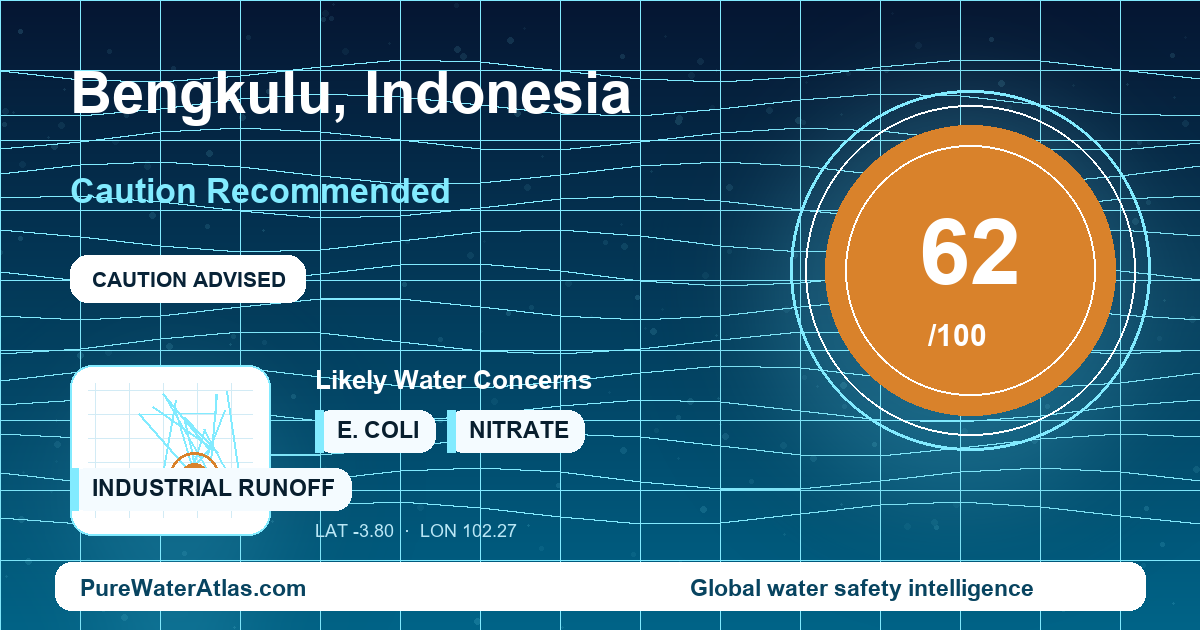
Bengkulu, Indonesia: a coastal Sumatra water-safety profile for travelers and residents using municipal supply, wells, storage tanks, refill-water depots, or household treatment.
Quick Answer
| Overall tap-water status | Caution recommended. Bengkulu has a formal municipal water utility and surface-water treatment infrastructure, but recent, neighborhood-level tap-water laboratory results are not consistently available in a public, easily verifiable format. |
|---|---|
| Water safety score | 62 / 100 — practical use is possible with treatment, but untreated drinking is not recommended. |
| Traveler advice | Do not drink untreated tap water in Bengkulu. Use sealed bottled water, properly boiled water, or water treated by a reliable purifier. Be especially cautious with children, pregnant travelers, short-stay visitors, and anyone with a sensitive stomach. |
| Resident advice | Treat tap water intended for drinking unless you have recent test results confirming safety at your own tap. Test private wells and stored water after flooding, supply interruptions, or tank cleaning. |
| Main water context | Bengkulu is best understood as a surface-water-based municipal system with local river/intake and treatment plant infrastructure, alongside wells, refill-water depots, packaged water, and household storage. |
| Water authority | Perumda Air Minum Tirta Hidayah Kota Bengkulu, historically referred to in some public contexts as PDAM Kota Bengkulu, with oversight by city, provincial, health, public works, and environmental authorities. |
| Filter recommendation | A practical setup is sediment prefiltration followed by activated carbon and a reliable disinfection step such as boiling, UV, or another validated purifier. Well users may need testing before choosing reverse osmosis, iron/manganese treatment, or other systems. |
Why Bengkulu Is Different
Bengkulu is a coastal provincial capital on the west coast of Sumatra facing the Indian Ocean. Its drinking-water risk profile is not the same as a high-capacity capital-city utility with abundant published compliance reports. Bengkulu’s practical risk picture is shaped by coastal lowlands, river catchments, heavy rainfall, flood-prone periods, surface-water treatment, intermittent distribution concerns, household storage, and the continued use of wells and refill-water depots by some households.
The most important point is that Bengkulu’s risk is not defined by one verified citywide chemical contaminant. The available evidence instead supports a more practical assessment: treated water leaving a plant may not represent the quality of water arriving at every household tap, especially where water pressure changes, supply is intermittent, pipes are repaired, or water is stored in roof tanks or ground tanks. This is why the correct answer for Bengkulu is not a simple “safe everywhere” or “unsafe everywhere.” The evidence supports caution recommended.
Outside the formal piped network, local households may use dug wells, bore wells, rainwater storage, packaged water, or refill-water depots. In a low-lying coastal city, shallow groundwater can be more vulnerable to salinity, high total dissolved solids, iron, manganese, sanitation influence, and flood impacts than a properly treated and protected municipal supply. Refill-water depots can be useful, but their safety depends on maintenance of filters, UV lamps, treatment equipment, and containers.
Where Does Bengkulu’s Tap Water Come From?
Bengkulu’s public drinking-water supply is best understood as a municipal surface-water system supported by intakes, treatment plants, pumping, storage, and distribution infrastructure. Official Indonesian infrastructure references for the area emphasize regional SPAM development for Kota Bengkulu, Bengkulu Tengah, and Seluma, including the SPAM Regional KOBEMA program associated with raw-water development from the Nelas River system. Existing urban supply also depends on local river/intake and IPA treatment plant infrastructure serving the city.
Key local infrastructure includes the Perumda/PDAM municipal distribution network serving parts of Kota Bengkulu, surface-water intakes, IPA water treatment facilities, transmission and raw-water infrastructure connected to the SPAM Regional KOBEMA planning context, pumping and storage assets, and household-level tanks that can affect final tap quality. The regional KOBEMA planning context matters because it shows that raw-water capacity and distribution expansion have been recognized as important water-supply issues for the Bengkulu area.
Season matters in Bengkulu. During rainy periods, runoff can increase turbidity, color, organic matter, and microbial load in surface water before treatment. Flooding can contaminate wells, septic-adjacent groundwater, and household storage tanks. During dry periods, reduced dilution can worsen taste, odor, salinity indicators in shallow groundwater, or supply continuity. After pipe repairs, pressure drops, or service interruptions, users should flush taps and treat water before drinking.
Who Manages Drinking Water in Bengkulu?
The local municipal water provider is Perumda Air Minum Tirta Hidayah Kota Bengkulu, historically referred to in some public contexts as PDAM Kota Bengkulu. Drinking-water oversight also involves the Bengkulu City government, local health authorities, provincial environmental agencies, and national ministries responsible for public health and public works.
Indonesia’s drinking-water health requirements are set nationally by the Ministry of Health. The current national framework includes Permenkes No. 2 Tahun 2023, which defines environmental health standards and water-related health requirements. Public works infrastructure for SPAM systems falls within the Ministry of Public Works and Housing framework, while local implementation and monitoring involve city and provincial agencies and the municipal utility.
For users, the key limitation is transparency at the tap. Some institutional and infrastructure information is available, including the local utility context and SPAM Regional KOBEMA planning. However, recent, public, neighborhood-specific laboratory results for Bengkulu tap water are not consistently available in a form that allows exact compliance claims for every district, building, or household. That limitation is central to this page’s recommendation: rely on treatment and testing rather than assuming every tap is potable.
Main Local Water Concerns
The main Bengkulu concerns are tied to surface-water quality, seasonal runoff, the distribution network, household storage, wells, and limited public access to tap-level data. The most likely day-to-day complaints and risks are visible sediment or discoloration after rain, chlorine taste where disinfection is present, uncertain quality from roof tanks, and variable well or refill-water quality.
- High turbidity and sediment after heavy rain: Surface-water sources can carry more suspended material during rainy periods or upstream disturbance. Turbid water can reduce treatment performance if not managed correctly and can make household disinfection less reliable.
- Microbial risk in distribution and storage: Even if water is treated, intermittent networks, pressure drops, plumbing repairs, or household tanks can create opportunities for contamination. This is especially important where water is stored before use.
- Catchment pressure: Urban runoff, sanitation leakage, agriculture, and upstream land-use activity can affect river basins serving Bengkulu. Raw-water protection is therefore important, not just treatment at the plant.
- Private well variability: Some shallow coastal groundwater can have salinity, high TDS, iron, manganese, or sanitation-related contamination. Floods can make this worse.
- Refill-water depot variability: Depot water depends on maintenance of treatment equipment, UV systems, filters, and containers. A depot is not automatically safe just because the water looks clear.
- Limited public tap-level data: Without recent test results from your own neighborhood or tap, it is safer to treat drinking water and test where possible.
For Travelers
Travelers should not drink untreated tap water in Bengkulu. Use sealed bottled water, water that has been fully boiled, or water treated by a reliable purifier that can address microbiological risk. This advice is conservative but appropriate because visitors often have less tolerance for unfamiliar water, and because building-level storage tanks or plumbing can affect final water quality.
For brushing teeth, many healthy adults may tolerate small accidental exposure, but cautious travelers should use bottled or boiled water. This is especially sensible during stomach illness, after flooding, or in budget accommodation where water may pass through storage tanks of unknown condition. Avoid swallowing shower water.
Use ice only when it is made from commercial purified water or served by a reputable hotel or restaurant. Avoid informal ice if the water source is unclear. In hotels and restaurants, ask whether drinking water and ice are made from purified water; do not assume tap water is potable simply because the establishment is modern. Hot drinks are generally safer when made with water that has been fully boiled.
For infant formula, use sealed bottled water where appropriate or water that has been boiled and cooled safely. Check that bottled-water caps are intact before drinking. International travel-health guidance such as the CDC Travelers’ Health page for Indonesia supports conservative water precautions where potability is uncertain.
For Residents
Residents connected to the municipal system should treat water intended for drinking unless they have recent results confirming safety at the tap. A practical Bengkulu household setup is a sediment prefilter followed by activated carbon and a reliable disinfection step such as boiling, UV, or another validated purifier. Sediment filtration is important because visible particles and turbidity can interfere with disinfection and reduce user confidence.
Private wells need more caution. If your home uses a dug well, bore well, or mixed source, test before choosing treatment. Useful test parameters include total coliform, E. coli, turbidity, color, pH, free chlorine residual if municipal water is chlorinated, TDS or conductivity, chloride or other salinity indicators, iron, manganese, nitrate, and basic microbiology. Wells near septic systems, shallow groundwater, agricultural activity, or flood-prone areas deserve special attention.
There is no verified evidence that Bengkulu has widespread lead service lines, so lead should not be presented as a confirmed citywide problem. However, older buildings can still contain brass fittings, solder, galvanized pipe, or fixtures that contribute metals. If water sits overnight in older plumbing, if infants or pregnant residents use the water, or if there is a metallic taste, consider first-draw and flushed testing for lead and other metals.
Household storage tanks can become the weak point in Bengkulu’s drinking-water chain. Keep tanks covered, screen vents, clean and disinfect them periodically, and prevent floodwater entry. A tank should not be treated as proof of safety; stored water should still be disinfected or passed through a validated point-of-use system before drinking.
Relevant Contaminants and Water-Quality Issues
The most relevant Bengkulu water-quality issues are microbiology, turbidity, sediment, chlorine taste, and well-related minerals or nutrients. For illness risk, start with E. coli in drinking water, because fecal contamination is the key concern for wells, tanks, intermittent distribution, and traveler stomach illness. For rainy-season water changes, see turbidity in drinking water and sediment in drinking water.
Where municipal disinfection is present, some users may notice chlorine taste or odor; PureWaterAtlas explains that issue in chlorine in drinking water. For wells or water that stains fixtures or tastes metallic, review iron in drinking water and manganese in drinking water. For shallow wells influenced by sanitation or agriculture, nitrate in drinking water is relevant. For older-building plumbing concerns, use lead in drinking water as a building-level testing guide, not as evidence of a confirmed Bengkulu-wide lead problem.
How to Verify Your Water Quality
The most reliable way to make a household decision in Bengkulu is to test the water actually used for drinking. Collect point-of-use samples from the kitchen tap, dispenser, tank outlet, well, or refill-water source. Repeat testing after floods, tank cleaning, plumbing repairs, pressure drops, or long supply interruptions. If you use a purifier, test before and after treatment to confirm that the device is solving the actual problem.
PureWaterAtlas resources that are especially useful for Bengkulu include the complete guide to water testing and analysis, the broader drinking water safety guide, and the water microbiology guide. If you need to choose treatment, compare options in water purification methods, boiling water purification, and UV water purification.
For specific test findings, use the PureWaterAtlas Contaminants Search Engine. For city comparisons, use the Global Water Quality Checker. Residents with wells can also review nitrate testing and detection methods, while older-building residents can consult lead testing and detection methods.
Official and Technical Sources
- Kementerian Kesehatan Republik Indonesia, Permenkes No. 2 Tahun 2023 — national drinking-water and environmental health requirements.
- Kementerian Pekerjaan Umum dan Perumahan Rakyat, SPAM Regional KOBEMA Bengkulu — official public works context for the KOBEMA regional water-supply system serving Kota Bengkulu, Bengkulu Tengah, and Seluma.
- Balai Wilayah Sungai Sumatera VII Bengkulu — official river-basin and water-resources management context relevant to raw-water protection.
- Badan Pusat Statistik Kota Bengkulu — city geography, population, administrative, and public-service context.
- Pemerintah Kota Bengkulu — local government source for municipal services and institutional context.
- Dinas Lingkungan Hidup dan Kehutanan Provinsi Bengkulu — provincial environmental context for catchments, river-water quality, and land-use impacts.
- CDC Travelers’ Health, Indonesia — international travel-health guidance supporting bottled, boiled, or treated water where safety is uncertain.
- WHO/UNICEF Joint Monitoring Programme, Indonesia household drinking-water data — national WASH context, not a replacement for Bengkulu tap-level testing.
Bottom Line
Bengkulu tap water should be treated as caution recommended for drinking. The city has a formal municipal provider and surface-water treatment infrastructure, including regional SPAM planning for the Bengkulu area, but recent public tap-level laboratory data are limited. The practical risks are seasonal turbidity, sediment after heavy rain, microbial vulnerability in intermittent networks and storage tanks, flood impacts, and variable shallow-well or refill-water quality. Travelers should use sealed bottled, boiled, or reliably purified water and avoid unclear ice. Residents should treat drinking water, maintain tanks, and test wells or household taps for microbiology, turbidity, TDS/salinity indicators, iron, manganese, nitrate, pH, and metals where older plumbing is a concern.
Read the full guide: Global Water Quality Guide
Explore more in this category: Global Water Quality Articles