
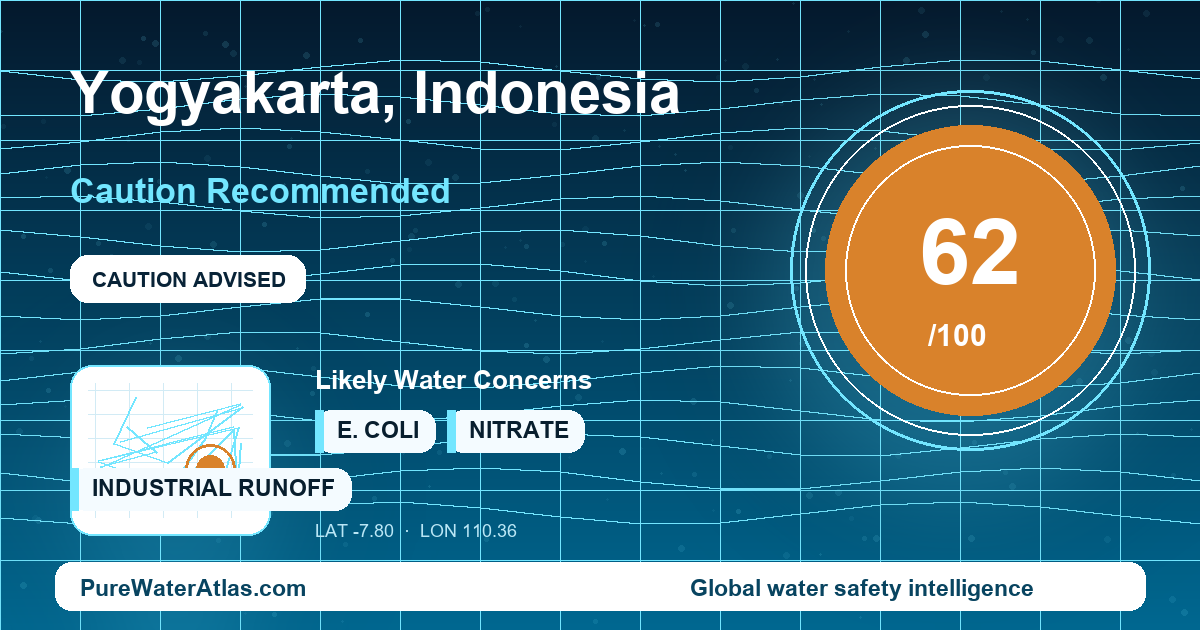
Yogyakarta, Indonesia: municipal PDAM supply, volcanic groundwater context, private-well variability, and why caution is recommended before drinking from the tap.
Quick Answer
| Overall safety status | Caution recommended. Yogyakarta has an organized municipal piped-water utility, but available public evidence is not strong enough to advise visitors or new residents to routinely drink unboiled tap water straight from the faucet. |
|---|---|
| Water safety score | 62 / 100 — risk level: Caution Recommended. |
| Traveler advice | Most short-term visitors should use sealed bottled water, properly boiled water, or water treated with a reliable purifier. Do not assume hotel or bathroom tap water is drinkable just because it looks clear. |
| Resident advice | PDAM water can generally be used for washing and household purposes, but drinking water should normally be boiled, dispensed from a trusted refill system, or filtered and disinfected. Private wells should be tested before drinking use. |
| Main water identity | Mixed urban supply: PDAM Tirtamarta Kota Yogyakarta piped water, groundwater and spring-fed sources associated with the Yogyakarta-Sleman volcanic aquifer system, private wells, refill depots, bottled water, and building storage tanks. |
| Local authority | Perumda Air Minum Tirtamarta Kota Yogyakarta, commonly known as PDAM Tirtamarta, operates the municipal water utility. Drinking-water health standards are set nationally by Indonesia’s Ministry of Health. |
| Filter recommendation | For drinking, use boiling or validated disinfection when potability is uncertain. A sediment prefilter and activated carbon may improve taste and particles for PDAM users, but private-well treatment should be chosen only after testing. |
Why Yogyakarta Is Different
Yogyakarta’s drinking-water situation is shaped by its location on the southern flank of Mount Merapi and by its dense inland urban form. The city sits within a water setting strongly influenced by Merapi volcanic aquifers, urban groundwater abstraction, and rapid land-use change across the Sleman-Yogyakarta-Bantul urban corridor. Rivers and urban river corridors such as the Code, Winongo, and Gajah Wong are also part of the local water landscape, especially for drainage, runoff, and wider watershed context.
The important point for a visitor or new resident is that Yogyakarta is not a place with no water utility. It has a formal municipal piped-water network operated by PDAM Tirtamarta Kota Yogyakarta. The caution comes from what happens between the source, the distribution network, building plumbing, storage tanks, and the glass. In many Indonesian households, piped water is not treated as ready-to-drink at the faucet even where municipal treatment is present. In Yogyakarta, that practical reality matters because the final point of consumption can vary by building.
The city also has a long history of reliance on wells and spring water. Permeable volcanic deposits made groundwater and springs central to domestic water use, but urban densification has increased the exposure of shallow groundwater to septic tanks, drains, wastewater pathways, paved-surface runoff, and river-corridor pollution. This is why the most practical safety questions are usually microbiological safety, private-well vulnerability, storage-tank hygiene, and seasonal turbidity rather than a single citywide toxic contaminant.
Where Does Yogyakarta’s Tap Water Come From?
Yogyakarta’s drinking-water system is a mixed urban supply. The municipal piped system is operated by PDAM Tirtamarta Kota Yogyakarta and is commonly associated with groundwater and spring-fed sources from the Yogyakarta-Sleman volcanic aquifer system. Broader metropolitan supply planning also involves regional surface-water infrastructure in the Yogyakarta urban area, including inter-district systems for the greater Kartamantul urban area.
Key infrastructure includes the PDAM Tirtamarta municipal piped-water network, groundwater wells and spring-fed source areas linked to the Yogyakarta-Sleman volcanic aquifer, urban distribution pipes, local reservoirs, service connections, and household or building storage tanks. In addition, many homes, guesthouses, boarding houses, small businesses, and institutions may rely partly or fully on private shallow or deep wells, refill-water depots, bottled water, or in-building storage.
This mixed supply pattern creates different risk profiles. Municipal water may have treatment and distribution controls, but consumer safety can still depend on pipe condition, pressure stability, service connections, internal plumbing, and storage tanks. Private wells are more building-specific: a well near septic tanks, dense housing, drains, animal keeping, or wastewater pathways may need microbiological and nitrate testing before drinking use. A refill dispenser or depot may be convenient, but it should be trusted, maintained, and periodically checked rather than judged only by taste or clarity.
Who Manages Drinking Water in Yogyakarta?
The local municipal water utility is Perumda Air Minum Tirtamarta Kota Yogyakarta, commonly known as PDAM Tirtamarta. It provides the main official utility identity and local water-service context for Kota Yogyakarta. The Pemerintah Kota Yogyakarta is also relevant for city-level public services, sanitation, health, infrastructure, and local government context.
Indonesia’s drinking-water quality framework is national. Health-based requirements are set under Ministry of Health regulation, including Permenkes No. 2 Tahun 2023 on environmental health quality standards and health requirements. Local utilities and local agencies are expected to operate within this framework, while local health and environmental agencies have roles in inspection, public-health surveillance, sanitation, and source-water protection.
There is an important data limitation. Public city-level information is available for the utility, government context, national regulations, and regional water-resource setting. However, routine, independently verifiable, neighborhood-level tap-water results for Yogyakarta are not consistently published in a format that allows a precise claim that every tap is safe to drink. Because water quality at the glass can vary by building plumbing, tanks, private wells, boiling practices, filtration, and season, this assessment uses a cautious verdict rather than an absolute safe-or-unsafe claim.
Main Local Water Concerns
Microbial contamination is the most important practical concern. For untreated tap water, private wells, poorly maintained storage tanks, and water stored in open or dirty containers, the key safety question is whether disease-causing microbes could be present. If water is not reliably disinfected, E. coli in drinking water is one of the most relevant indicators to test for, especially for wells and stored water.
Shallow wells can be vulnerable. In dense urban neighborhoods, shallow groundwater may be affected by nearby septic tanks, drains, wastewater infiltration, or runoff pathways. This makes E. coli and nitrate in drinking water relevant priorities for private-well users. Nitrate testing is especially important where infants or pregnant people may consume the water.
Rainy-season conditions can increase uncertainty. During the wet season, commonly around November to March, runoff, drain overflow, turbidity, and contamination pressure can increase, particularly for shallow wells or poorly protected sources. Heavy rain after dry periods can wash fecal contamination and debris into drains and rivers. Higher turbidity can also reduce the effectiveness of disinfection if water is not properly treated.
Groundwater chemistry and building plumbing matter. Iron and manganese can occur in groundwater in parts of volcanic and alluvial aquifer systems. These are often aesthetic or operational issues, but staining, metallic taste, black particles, or brown sediment should be investigated with testing. See PureWaterAtlas profiles on iron, manganese, and sediment. Older or poorly maintained plumbing can also add uncertainty at the tap, including sediment release and possible metal pickup from fixtures, solder, brass components, or aging pipes. Lead is not identified here as a confirmed citywide Yogyakarta problem, but it is relevant for old-building point-of-use testing.
For Travelers
Most short-term visitors should not drink Yogyakarta tap water straight from the faucet. Use sealed bottled water, water that has been properly boiled, or water treated with a purifier rated for microbes. This advice is especially important for travelers who are not adapted to local food and water conditions, young children, pregnant travelers, immunocompromised people, and anyone with a sensitive stomach.
For brushing teeth, many healthy adults can use tap water if they avoid swallowing it, but a more cautious choice is bottled or boiled water. For children, pregnant travelers, and immunocompromised travelers, bottled or boiled water is the better default for brushing teeth.
Use caution with ice. Ice in reputable hotels, international restaurants, and busy established cafes is often made from treated or purchased water, but this is not guaranteed. Avoid ice from street stalls or places where the source is unclear. In hotels, guesthouses, homestays, cafes, and boarding houses, ask whether drinking water comes from sealed bottles, a maintained dispenser, boiled water, or a certified filtration system. Bathroom tap water should not automatically be assumed drinkable even when it is clear and odorless.
A practical routine is to carry a refillable bottle but fill it only from trusted dispensers, sealed bottled water, boiled water, or a reliable purifier. If you develop traveler diarrhea, switch strictly to sealed bottled or boiled water and seek medical advice if symptoms are severe, persistent, bloody, or accompanied by fever. For background travel-health precautions, see the CDC Travelers’ Health guidance for Indonesia.
For Residents
Residents using PDAM water can generally treat it as a household utility supply, but drinking water should normally be boiled, dispensed from a trusted refill system, or filtered and disinfected unless the specific building has verified potable water treatment and safe storage. For PDAM users, a sediment prefilter plus activated carbon can improve taste, chlorine odor, and particles. However, these steps do not automatically solve microbial risk if potability is uncertain. Microbial safety requires boiling, UV, ultrafiltration, or another validated disinfection step. For treatment options, see PureWaterAtlas guides to boiling water purification, UV water purification, and broader water purification methods.
Homes using private wells should test before using the water for drinking. At minimum, test for E. coli or total coliform at least annually and after flooding, nearby septic work, or changes in taste, odor, or color. Test nitrate if the well is shallow or near septic tanks, dense housing, agriculture, animal keeping, or drainage channels. Also test turbidity, pH, electrical conductivity, hardness, iron, and manganese to understand groundwater chemistry and choose the correct treatment. Nitrate, microbes, iron, manganese, hardness, and turbidity require different solutions, so selecting a filter without test data can miss the real problem.
Older houses, boarding houses, guesthouses, schools, and small hotels deserve extra attention. Aging pipes, dead-end plumbing, corroded fixtures, unknown materials, and rooftop tanks can change water quality after it leaves the utility network. Let stagnant water run briefly before non-drinking use, do not use first-draw water for infant formula, and consider first-draw and flushed testing for lead and other plumbing-related metals if the building history is unknown.
Storage tanks are a major point-of-use risk in Yogyakarta. Even treated municipal water can become unsafe if held in dirty tanks, open containers, or poorly sealed roof tanks. Tanks should be covered, protected from insects and animals, cleaned on a schedule, and disinfected after maintenance or contamination events.
Relevant Contaminants and Water-Quality Issues
The most relevant Yogyakarta issue is microbiological safety, especially for untreated tap water, private wells, and stored water. Start with E. coli and the broader PureWaterAtlas guide to water microbiology. For shallow wells near septic systems, wastewater, drains, or dense housing, review nitrate and the guide to nitrate testing and detection.
For rainy-season or distribution-related issues, turbidity and sediment are important because cloudy or particle-laden water can signal source disturbance, pipe disturbance, tank problems, or reduced disinfection performance. For taste and treated-water perception, chlorine is relevant because residual disinfectant can affect odor and taste while also serving a microbial-control role. For groundwater aesthetics and household treatment selection, review iron and manganese. For older buildings, unknown fixtures, or first-draw water, see lead and lead testing methods.
How to Verify Your Water Quality
The safest way to decide whether a specific Yogyakarta tap is drinkable is to verify the actual point of use. For residents, that means testing the water after it has passed through the building plumbing and any storage tank, not only relying on source-water assumptions. PureWaterAtlas’ complete guide to water testing explains how to choose tests and interpret results. The drinking water safety guide provides a general framework for deciding whether tap water is safe.
If you are comparing Yogyakarta with another destination, use the Global Water Quality Checker. To look up specific substances or indicators mentioned in this profile, use the PureWaterAtlas Contaminants Search Engine. Relevant PureWaterAtlas categories include Drinking Water Safety, Global Water Quality, Water Testing, and Water Microbiology.
Official and Technical Sources
- Perumda Air Minum Tirtamarta Kota Yogyakarta — local municipal water utility and official water-service context.
- Pemerintah Kota Yogyakarta — official city-government portal for local public services, sanitation, health, and infrastructure context.
- Badan Pusat Statistik Kota Yogyakarta — official city statistics for population, housing, infrastructure, and service context.
- Kementerian Kesehatan Republik Indonesia, Permenkes No. 2 Tahun 2023 — national environmental health quality standards and health requirements.
- Balai Besar Wilayah Sungai Serayu Opak, Kementerian PUPR — regional river basin and water-resources authority for the Yogyakarta area.
- CDC Travelers’ Health, Indonesia — travel-health guidance supporting conservative food and water precautions.
- World Health Organization Guidelines for Drinking-water Quality — international reference for microbial and chemical drinking-water risk management.
- UNICEF and WHO Joint Monitoring Programme for Water Supply, Sanitation and Hygiene — country-level WASH context, not neighborhood-level Yogyakarta tap testing.
Bottom Line
Yogyakarta’s tap-water verdict is caution recommended, not because the city lacks a water utility, but because safety at the glass depends heavily on local plumbing, storage tanks, private wells, final disinfection, and seasonal conditions. PDAM Tirtamarta operates the municipal piped-water system, and the city benefits from important volcanic groundwater and spring-fed water resources. However, public neighborhood-level tap-water compliance data are not consistently available, and many buildings use tanks, wells, refill systems, or mixed supplies. Travelers should use sealed bottled, boiled, or properly purified water. Residents should boil or disinfect drinking water unless potability is verified, test private wells for microbes and nitrate, and keep storage tanks clean and sealed.
Read the full guide: Global Water Quality Guide
Explore more in this category: Global Water Quality Articles