
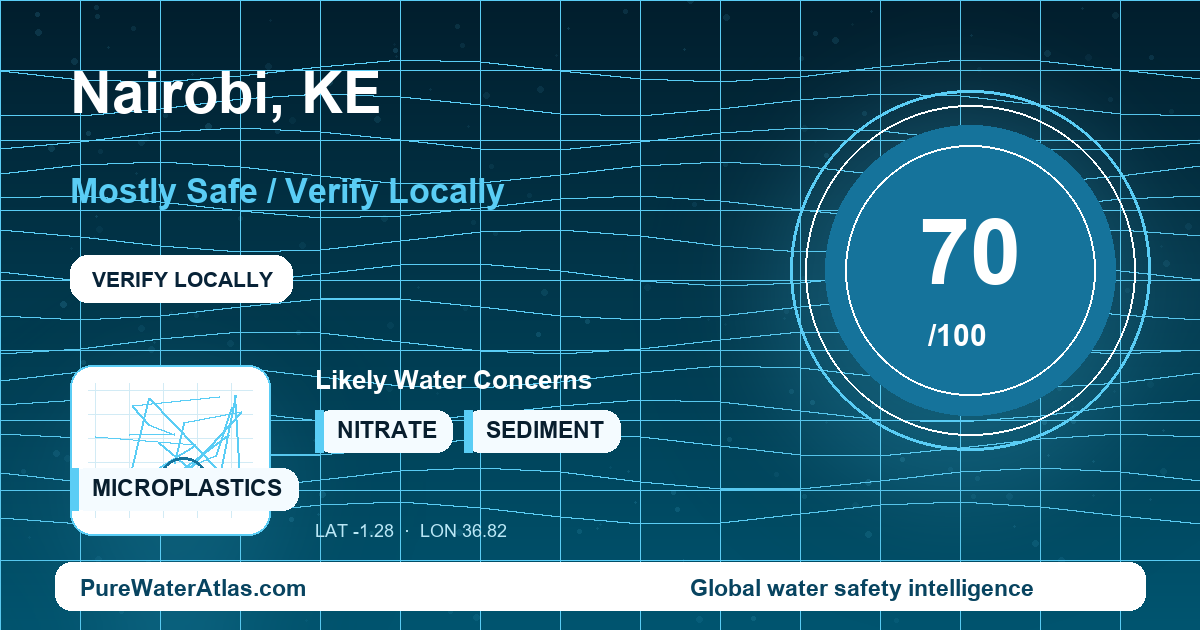
Nairobi tap water is generally lower risk when it comes directly from the treated municipal system, but final safety depends heavily on local pressure, storage tanks, building plumbing, boreholes, and tanker water.
Quick Answer
| City | Nairobi, Kenya |
|---|---|
| PureWaterAtlas safety score | 70 / 100 |
| Risk level | Mostly Safe / Verify Locally |
| Overall status | Nairobi municipal tap water is best classified as mostly safe when it comes directly from the Nairobi City Water and Sewerage Company treated supply and the building plumbing and storage tanks are well maintained. The main risk is variability, not a single confirmed citywide contaminant. |
| Traveler advice | Short-stay visitors should use sealed bottled water, boiled water, or properly filtered water as the lower-risk default. Tap water may be acceptable in reputable hotels and restaurants with treated municipal supply and maintained storage, but verify locally. |
| Resident advice | Municipal connections can often be used after checking local conditions, but apartment tanks, roof tanks, underground tanks, old plumbing, boreholes, and tanker-supplied water need testing and maintenance. |
| Main sources | Upland surface-water sources north of Nairobi, especially the Thika/Ndakaini system, Sasumua Dam, Ruiru Dam, and Kikuyu Springs, with Northern Collector Tunnel Phase 1 augmentation from upper catchment rivers. |
| Water authority | Nairobi City Water and Sewerage Company is the main municipal water service provider. WASREB regulates Kenya’s water services sector. |
| Filter recommendation | A filter is not automatically required for every municipal connection, but sediment filtration plus activated carbon is practical for many homes. Add UV or validated disinfection where microbial risk is suspected. Boreholes should be treated only after laboratory testing. |
Why Nairobi Is Different
Nairobi’s drinking-water risk profile is shaped by a specific local contradiction: the city depends mainly on upland catchments outside the urban core, yet many users receive water through an urban distribution and building-storage system affected by intermittent supply. Nairobi is a high-elevation inland city, and its municipal supply relies heavily on catchments in the Aberdare Range and surrounding central Kenya highlands rather than on the polluted urban rivers flowing through the city. That helps reduce some direct urban-source risk at the raw-water intake.
The main safety question in Nairobi is often what happens after treated water leaves the treatment and distribution system. Demand growth, rationing, pressure changes, non-revenue water, aging network sections, and long storage periods can create conditions where water quality changes before it reaches the glass. Low or negative pressure can draw contamination into pipes through leaks, and stored water can lose disinfectant residual or become contaminated if tanks are dirty, uncovered, cracked, or supplied by unverified vendors.
This is why two taps in Nairobi can have different risk even if they are connected to the same municipal network. A well-maintained office, hotel, or apartment block with clean covered tanks may have lower microbial risk than a building with stagnant roof tanks, cross-connections, or unreliable supply. Private boreholes and tanker water add another layer of variability because groundwater and vendor practices can differ substantially across the city.
Where Does Nairobi’s Tap Water Come From?
Nairobi’s municipal water identity is built around upland surface-water sources and older spring and reservoir systems. Nairobi City Water and Sewerage Company lists major sources including the Thika/Ndakaini system, Sasumua Dam, Ruiru Dam, and Kikuyu Springs. Older supply sources such as Kikuyu Springs and Ruiru were later supplemented by larger reservoir systems including Sasumua and Thika/Ndakaini as the city expanded.
The Thika/Ndakaini system is associated with the Ngethu Water Treatment Works, while Sasumua, Ruiru, and Kabete/Kikuyu-related treatment and distribution infrastructure also form part of the wider Nairobi supply system. The Northern Collector Tunnel Phase 1 was developed to augment Nairobi’s bulk water supply by transferring water from upper catchment rivers including Maragua, Gikigie, and Irati into the Nairobi supply system. Its role is important because it shows that Nairobi’s water safety and reliability are tied not only to treatment performance but also to regional source-water availability, rainfall patterns, and catchment conditions.
In practical terms, Nairobi’s water does not simply move from a dam to a household tap in a sealed, uninterrupted path. Many buildings use underground tanks, rooftop tanks, booster pumps, and private storage because supply can be intermittent. During rationing or low-reservoir periods, households may store water longer than usual or buy water from vendors. Those steps can be useful for reliability, but they also create control points where microbial contamination, sediment, or loss of chlorine residual can occur.
Who Manages Drinking Water in Nairobi?
The main municipal water service provider for Nairobi is Nairobi City Water and Sewerage Company. Its public information identifies Nairobi’s principal water sources and customer service notices, including the utility’s listed water sources. Athi Water Works Development Agency is important for bulk infrastructure development, including the Northern Collector Tunnel Phase 1. Nairobi City County is the county-level owner and policy stakeholder.
Kenya’s urban water services are regulated by the Water Services Regulatory Board, known as WASREB. WASREB licenses and monitors water service providers and publishes sector performance information through its Impact Reports. Water resources are regulated through national water institutions, including the Water Resources Authority, which provides broader context for catchment and water-resource management.
A key limitation for consumers is that public, current, tap-level water quality data by Nairobi neighborhood, apartment block, or final tap is limited. Official sources document the system, sources, and regulatory framework, but they do not prove that every tap in every building is safe at all times. Final safety can change after the utility meter because of storage tanks, booster pumps, old plumbing, boreholes, rationing, and tanker deliveries.
Main Local Water Concerns
The most important Nairobi concern is microbial risk where supply is intermittent, pipes are depressurized, tanks are poorly maintained, or water is supplied by unverified tankers or vendors. If treated water loses chlorine residual during long storage, or if contaminated water enters pipes during low-pressure events, the risk shifts from normal treated municipal water to a more uncertain household supply.
Rainfall and drought also matter. During the long-rain and short-rain periods, raw-water turbidity and runoff pressure can increase in the source catchments. After heavy rain, pipe repairs, or network disturbances, some users may see turbidity, sediment, or discolored water. During drought and low reservoir levels, rationing can worsen and households may rely more on storage, boreholes, and vendors. Flooding or drainage failures can increase contamination risk around shallow wells, poorly sealed boreholes, and damaged distribution lines.
Private boreholes require special caution. Nairobi borehole water quality can vary by location and construction, and concerns may include fluoride, nitrate, salinity or high total dissolved solids, iron, manganese, and microbiological contamination. These are not treatment choices to guess at; they require laboratory testing. Lead or copper from premise plumbing is also possible in older buildings, but this should not be treated as a proven citywide Nairobi problem without site-specific testing.
For Travelers
For most travelers, the safest default in Nairobi is sealed bottled water, boiled water, or water treated through a reliable filter or purifier. Short-stay visitors should not assume every tap is safe, because building storage and intermittent supply can change risk even where the underlying municipal supply is treated. This is especially important for people with sensitive stomachs, children, pregnant travelers, elderly travelers, and immunocompromised travelers.
In reputable hotels, restaurants, and offices with treated municipal water and maintained storage, tap water may be acceptable for brushing teeth and hot drinks. Cautious travelers should still use bottled or boiled water for drinking, and should use bottled or boiled water for brushing teeth after outages, visible discoloration, or stomach illness. When boiling water, use a rolling boil for at least 1 minute.
Use ice only in reputable hotels, restaurants, or cafes that can confirm it is made from treated or bottled water. Avoid ice from street vendors or unverified sources. Higher-end hotels and established restaurants may manage water through municipal supply, storage, filtration, or bottled service, but guests should ask whether drinking water and ice are filtered, boiled, or bottled. Do not assume apartment rentals or small guesthouses maintain tanks to the same standard.
If using a travel filter, choose one that handles bacteria and protozoa. If the source is uncertain, from storage, tanker, or borehole supply, add disinfection or use a purifier designed for viruses. The CDC Travelers’ Health page for Kenya supports cautious food and water practices for travelers.
For Residents
Nairobi residents connected to the municipal network can often use tap water after confirming current local conditions, but the home or building system deserves attention. A home filter is not automatically required for every municipal connection, yet it is often practical because water may be stored, rationed, or disturbed by pipe repairs. For municipal water, a sediment prefilter plus activated carbon can improve clarity, taste, and chlorine-related odor. Where microbial risk is suspected, UV or another validated disinfection step can help, provided the water is first clarified enough for the disinfection system to work properly.
For private boreholes, do not choose treatment based on taste alone. Test first, because fluoride, nitrate, salinity, iron, manganese, hardness, and microbes require different solutions. At minimum, borehole users should test for E. coli, total coliforms, fluoride, nitrate, nitrite, total dissolved solids, hardness, iron, manganese, chloride, sulfate, and any locally advised metals such as arsenic where relevant.
Stored household or apartment water should be tested for E. coli and total coliforms, especially after tank cleaning, plumbing work, flooding, or repeated outages. Checking free chlorine residual at the tap when supply returns after rationing or long storage can also be useful. If water changes color, taste, or smell, test turbidity, pH, conductivity or total dissolved solids, and basic appearance.
Older buildings can add risk after water leaves the municipal main. Possible issues include corroded internal pipes, lead-containing fittings or solder in legacy plumbing, cross-connections, dead-end pipe sections, and dirty underground or roof tanks. If the building is old or water has a metallic taste, test first-draw and flushed samples for lead and copper and flush stagnant water before use.
Storage tanks are one of Nairobi’s most important control points. Tanks should be covered, screened from insects and animals, protected from runoff, cleaned and disinfected periodically, and inspected after supply interruptions. If a tank is cracked, uncovered, visibly dirty, or supplied by tankers, treat the water before drinking and test for microbial contamination.
Relevant Contaminants and Water-Quality Issues
The most relevant Nairobi issue is E. coli in drinking water, because intermittent supply, dirty tanks, flooding, and unverified tanker or borehole water all increase microbial concern. Turbidity and sediment are also important when heavy rain, source-water changes, pipe repairs, outages, or tank disturbance cause cloudy or brown water.
Chlorine is relevant because residual disinfectant helps indicate whether treated municipal water has maintained protection through distribution and storage. If chlorine residual is absent after long storage or rationing, microbial testing becomes more important.
For private boreholes, nitrate, iron, and manganese are practical testing priorities, along with fluoride, salinity, hardness, and microbial indicators. Lead is mainly a premise-plumbing concern in older buildings and should be evaluated through site-specific testing rather than assumed citywide.
How to Verify Your Water Quality
The best way to verify Nairobi tap water is to test the water you actually drink, not only the municipal source. For residents, this means sampling after the building tank, at the kitchen tap, and, where relevant, before and after any household treatment system. For boreholes, use a certified laboratory and test both microbial and chemical parameters before selecting treatment.
PureWaterAtlas resources can help you choose the right verification path. Start with the Water Testing guide, then use the Contaminants Search Engine to understand specific findings. The Global Water Quality Checker provides broader location-based context, while the Drinking Water Safety, Water Microbiology, and Water Treatment Systems guides explain how to interpret risk and choose treatment.
Useful treatment references include Boiling Water Purification for outages and uncertain microbial quality, UV Water Purification for stored municipal or borehole water after filtration, lead testing methods for older buildings, and nitrate testing methods for borehole users.
Official and Technical Sources
- Nairobi City Water and Sewerage Company – Water Sources: identifies Nairobi’s listed municipal water sources including Thika Dam, Sasumua Dam, Ruiru Dam, and Kikuyu Springs.
- Nairobi City Water and Sewerage Company – official website: confirms the municipal water service provider responsible for Nairobi water supply and customer notices.
- Athi Water Works Development Agency – Northern Collector Tunnel Phase 1: documents the water-supply augmentation project transferring water from upper catchment rivers.
- Water Services Regulatory Board Kenya – Impact Reports: provides regulatory and utility performance context for Kenyan water service providers.
- Water Services Regulatory Board Kenya: confirms WASREB’s role as Kenya’s water services regulator.
- Water Resources Authority Kenya: provides context for regulation and management of Kenya’s water resources and catchments.
- CDC Travelers’ Health – Kenya: supports cautious food and water safety guidance for visitors.
- WHO Guidelines for Drinking-water Quality: used for general microbial safety, turbidity, disinfection, and household treatment framing, not as proof of Nairobi tap-level compliance.
- UNICEF and WHO Joint Monitoring Programme – Kenya country data: provides national WASH context, not a replacement for Nairobi tap testing.
Bottom Line
Nairobi tap water should be viewed as mostly safe but locally variable. Treated municipal water from Nairobi City Water and Sewerage Company is generally the lower-risk source when it reaches a well-maintained building system, but final tap quality can change because of intermittent supply, pressure loss, old pipes, roof and underground tanks, boreholes, tankers, heavy rain, and drought-related storage. Travelers should default to sealed bottled, boiled, or properly filtered water, especially outside reputable hotels and restaurants. Residents should focus on tank hygiene, microbial testing, chlorine residual checks, and borehole laboratory analysis before choosing treatment. The main Nairobi risk is not a confirmed citywide chemical problem; it is the variability between source, distribution, building storage, and the final tap.
Read the full guide: Global Water Quality Guide
Explore more in this category: Global Water Quality Articles