
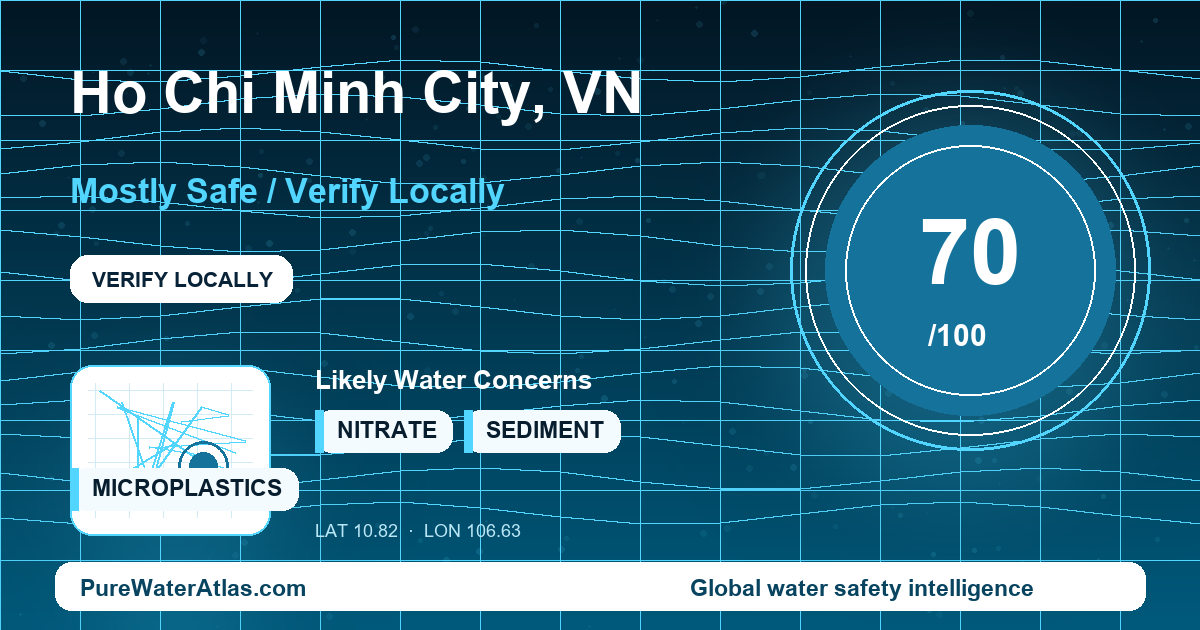
Ho Chi Minh City has a large treated municipal water system, but final tap safety depends heavily on local plumbing, storage tanks, and building-level maintenance.
Quick Answer
| Overall status | Mostly Safe / Verify Locally — PureWaterAtlas score: 70/100. Centrally treated municipal water is generally suitable for domestic use where building connections, tanks, and plumbing are well maintained, but drinking untreated tap water directly is not the conservative choice for short-term visitors. |
|---|---|
| Traveler advice | Use sealed bottled water, properly filtered water, or boiled water for drinking unless your hotel or host confirms a maintained filtration or boiling system. Tap water is usually acceptable for showering and handwashing. |
| Resident advice | Residents commonly reduce risk by boiling or using point-of-use treatment, especially in older buildings, homes with roof or underground tanks, or apartments with uncertain plumbing. |
| Main water sources | Treated surface water from the Dong Nai River and Saigon River systems, including supply associated with the Thu Duc and Tan Hiep treatment systems. |
| Main authority | Saigon Water Corporation, commonly known as SAWACO, with drinking-water oversight involving Vietnamese health authorities under national clean-water regulations. |
| Filter recommendation | A filter is not automatically required for every municipal connection, but sediment prefiltration plus activated carbon is practical for daily drinking use. UV or reverse osmosis may be appropriate where testing or local conditions show microbial or dissolved-contaminant concerns. |
Why Ho Chi Minh City Is Different
Ho Chi Minh City is not a simple “safe or unsafe” tap water case. The city has a large treated municipal water system, supplied mainly by the Dong Nai and Saigon river basins, and SAWACO is the main municipal water corporation serving the urban area. At the same time, Ho Chi Minh City is a low-lying metropolis in the Saigon-Dong Nai river system near the tidal estuary zone of southern Vietnam. That geography makes river-water quality, seasonal runoff, flooding, and dry-season salinity intrusion relevant to drinking-water resilience.
The most useful way to think about tap water in Ho Chi Minh City is to separate three stages: raw river water, treated utility water, and water at the actual building tap. Treatment plants may produce water that meets national clean-water requirements at utility control points, but the water a person receives in an apartment, hotel, office, or older house can be affected by distribution pipes, pressure events, repairs, booster pumps, roof tanks, underground tanks, and internal plumbing.
This is why many hotels, serviced apartments, cafes, and offices in Ho Chi Minh City use bottled water, dispenser systems, or point-of-use filtration even while connected to the municipal network. That local practice does not prove that all municipal water is unsafe. It reflects caution about final-tap quality and the practical difficulty of verifying every building’s storage and plumbing conditions.
Where Does Ho Chi Minh City’s Tap Water Come From?
Ho Chi Minh City’s municipal water supply is based mainly on treated surface water from the Dong Nai River and Saigon River systems. The Dong Nai source feeds the Thu Duc water treatment plant cluster, while the Saigon River source is associated with the Tan Hiep system and related western and northwestern supply infrastructure. Kenh Dong and other surface-water assets also serve outlying or developing districts.
The city’s water infrastructure includes treatment plants, transmission mains, the SAWACO distribution network, and a large number of building-level systems. In practice, rooftop tanks, underground tanks, booster pumps, hoses, and internal building pipes can materially affect the water that comes out of the kitchen or bathroom tap. This is especially important in apartments, older houses, mixed-use buildings, and properties that have experienced pressure interruptions, flooding, or recent repair work.
Groundwater historically played an important role for households, peri-urban districts, and some supply schemes in Ho Chi Minh City. City and national policy have increasingly emphasized reducing groundwater abstraction because of land subsidence, aquifer stress, and water-quality concerns. Private wells and old building-level groundwater systems should not be assumed safe without testing.
Who Manages Drinking Water in Ho Chi Minh City?
SAWACO, the Saigon Water Corporation, is the main municipal water supply corporation for Ho Chi Minh City. Water quality oversight also involves Vietnamese health authorities, including Ho Chi Minh City health agencies, under national clean-water regulations.
Vietnam’s domestic drinking-water quality is governed by national clean-water technical regulations, including QCVN 01-1:2018/BYT issued by the Ministry of Health. Source-water protection and river pollution issues also involve environmental authorities at city and national level. Public users should distinguish between treated-water standards at utility points and the water that emerges from a specific tap after passing through local pipes, pumps, tanks, and fixtures.
Data limitations matter here. Ho Chi Minh City has identifiable water sources, treatment infrastructure, utility responsibility, and regulatory context. However, publicly accessible, current, neighborhood-level finished-water results and building-level tap data are limited, especially in English. This guide does not claim that every ward, hotel, apartment tower, or household tap has the same quality.
Main Local Water Concerns
The main concerns in Ho Chi Minh City are not limited to treatment-plant performance. The city’s water risks include source-water pressure, distribution integrity, seasonal stress, and building-level storage or plumbing problems.
- Surface-water pollution pressure: The Saigon and Dong Nai river basins are affected by urban wastewater, industrial zones, transport corridors, agricultural runoff, and upstream development. These pressures make source-water monitoring and treatment reliability important.
- Rainy-season turbidity and runoff: Heavy rain can increase raw-water turbidity and organic-matter loads in river sources. It can also increase flood-related contamination risks around buildings and storage systems.
- Dry-season salinity intrusion: During dry seasons, drought periods, and low upstream flow conditions, salinity intrusion can become a greater operational concern in southern river systems.
- Distribution and premise-plumbing risk: Old pipes, local low-pressure events, repairs, stagnant plumbing, illegal connections, and poorly cleaned storage tanks can degrade water quality after treatment.
- Residual chlorine taste or odor: Chlorine taste is common in disinfected municipal water. It is not by itself evidence that water is unsafe, but it can affect taste and may lead households to use activated carbon filters.
- Private wells: Groundwater or mixed supplies require separate verification. They may carry different microbiological or chemical risks from treated municipal water.
For Travelers
For short-term visitors, the conservative answer is: do not rely on untreated tap water as your main drinking-water source in Ho Chi Minh City unless your hotel or host confirms that the water is filtered, boiled, or otherwise maintained for drinking. Use sealed bottled water, properly filtered water, or boiled water. Check that bottle seals are intact, especially when buying water in hot, busy areas.
Tap water is usually acceptable for showering and handwashing. Many travelers use it for brushing teeth, but the lower-risk choice for young children, pregnant travelers, immunocompromised travelers, and people with sensitive stomachs is to use bottled or filtered water for brushing as well.
Ice is best treated as a source-specific decision. Ice in established hotels, higher-standard restaurants, and cafes is often made from commercial ice or treated water. Avoid ice from informal street vendors if the water source and handling are unclear. In hotels and restaurants, ask whether drinking water is bottled, boiled, or filtered; do not assume bathroom tap water is intended for drinking.
Because Ho Chi Minh City is hot and humid, carry water during the day. If you develop diarrhea, oral rehydration salts can help replace fluids and electrolytes. Avoid drinking from taps after flooding, visible discoloration, unusual odor, or building water outages until local conditions are confirmed.
For Residents
Residents can often use municipal tap water after boiling or point-of-use treatment, especially in apartments or houses with uncertain internal plumbing or storage tanks. A home filter is not automatically required for every municipal connection, but it is a practical risk-reduction step if you drink tap water daily, live in an older building, rely on roof or underground tanks, have infants or medically vulnerable residents at home, or notice sediment, color, odor, or intermittent supply.
A typical resident setup is sediment prefiltration plus activated carbon for particles, taste, and chlorine. UV treatment can be useful where microbial risk is the main concern after sediment control. Reverse osmosis may be appropriate where testing shows dissolved-contaminant concerns or where a household uses a private well or mixed source. For treatment selection, see the PureWaterAtlas guide to Water Treatment Systems, the Boiling Water Purification Guide, and the UV Water Purification Guide.
Older building concerns should be handled carefully. There is no verified public evidence that every old building in Ho Chi Minh City has a lead problem, so that should not be overclaimed. However, older premise plumbing, stagnant water, corroded fixtures, old fixtures, brass components, solder, or unknown pipe materials can degrade tap quality. Flush stagnant taps, avoid using hot tap water for cooking, and test if plumbing materials are unknown.
Storage tanks are one of the most important practical control points. Roof tanks and underground tanks should be covered, screened, cleaned on a schedule, protected from floodwater and pests, and checked after pressure interruptions. A contaminated tank can make otherwise treated municipal water unsafe at the tap.
Relevant Contaminants and Water-Quality Issues
The most relevant Ho Chi Minh City water-quality issues are tied to disinfected municipal water, river-source fluctuations, storage tanks, premise plumbing, and private wells.
- Chlorine is relevant because municipal water is disinfected and may have a noticeable taste or odor. Residual chlorine also helps protect water in the distribution system.
- Turbidity matters because Saigon and Dong Nai river sources can experience rainy-season runoff and suspended-particle fluctuations.
- Sediment is relevant after pipe repairs, tank disturbance, old plumbing, or visible particles at the tap.
- E. coli is a key microbial indicator for tanks, private wells, flooding, pressure loss, and premise-plumbing contamination.
- Lead is relevant for older buildings or unknown plumbing materials, without assuming a citywide lead-pipe problem.
- Nitrate is most relevant for private wells, groundwater-influenced supplies, or peri-urban areas affected by runoff or sanitation issues.
- Arsenic is relevant where households use private groundwater or unverified non-municipal supplies.
How to Verify Your Water Quality
The most reliable test point is the actual kitchen tap, not only the building inlet. Building plumbing and tanks can change water quality after municipal treatment. For a practical Ho Chi Minh City household screen, include free chlorine residual, turbidity, pH, electrical conductivity or TDS, and visual sediment. If the building has storage tanks, recent flooding, pressure loss, or recurring stomach-illness concerns, use a certified or reputable laboratory for E. coli or total coliform testing.
Consider metals testing in older buildings or after plumbing renovations. The PureWaterAtlas guide to Lead in Drinking Water: Testing and Detection Methods is useful for homes with unknown fixtures or pipe materials. If using a private well or mixed source, test for microbiological contamination, arsenic, nitrate, iron, manganese, salinity indicators, and any locally relevant industrial contaminants. See Arsenic in Drinking Water: Testing and Detection Methods and Nitrate Contamination in Drinking Water: Testing and Detection Methods.
For broader help, use the Water Testing guide, the Drinking Water Safety framework, the Water Microbiology guide, the Contaminants Search Engine, and the Global Water Quality Checker. Retest after tank cleaning, major pipe repairs, flooding, unexplained taste or odor changes, or switching water sources.
Official and Technical Sources
- SAWACO official website — Saigon Water Corporation; used to identify the main municipal water corporation serving Ho Chi Minh City.
- Ho Chi Minh City Water Supply Project — Asian Development Bank; used for treated water infrastructure and expansion context.
- Ho Chi Minh City Adaptation to Climate Change — Asian Development Bank; used for low-lying geography, flooding, climate, and salinity-intrusion context.
- Vietnam: Toward a Safe, Clean, and Resilient Water System — World Bank; used for national and urban water-management context, including pollution, groundwater, and resilience issues.
- WHO/UNICEF JMP country data for Viet Nam — used for national drinking-water service context, not as a substitute for building-level tap testing.
- Vietnam Traveler View — U.S. Centers for Disease Control and Prevention; used for conservative traveler food and water precautions.
- Vietnam Ministry of Health legal framework reference — used for regulatory context on QCVN 01-1:2018/BYT and national clean-water rules.
Related PureWaterAtlas sections: Drinking Water Safety, Global Water Quality, Water Testing, and Water Purification.
Bottom Line
Ho Chi Minh City’s treated municipal water system is substantial and mainly supplied by the Dong Nai and Saigon river basins, with SAWACO as the main utility. The conservative safety interpretation is that tap water is generally suitable for domestic use where the connection, plumbing, and tanks are well maintained, but short-term visitors should drink sealed bottled, filtered, or boiled water. Residents who drink tap water daily should verify quality at the actual kitchen tap, especially in older buildings or homes with roof or underground tanks. The biggest practical uncertainty is not only the treatment plant; it is what happens in the distribution system and inside the building before water reaches the glass.
Read the full guide: Global Water Quality Guide
Explore more in this category: Global Water Quality Articles