
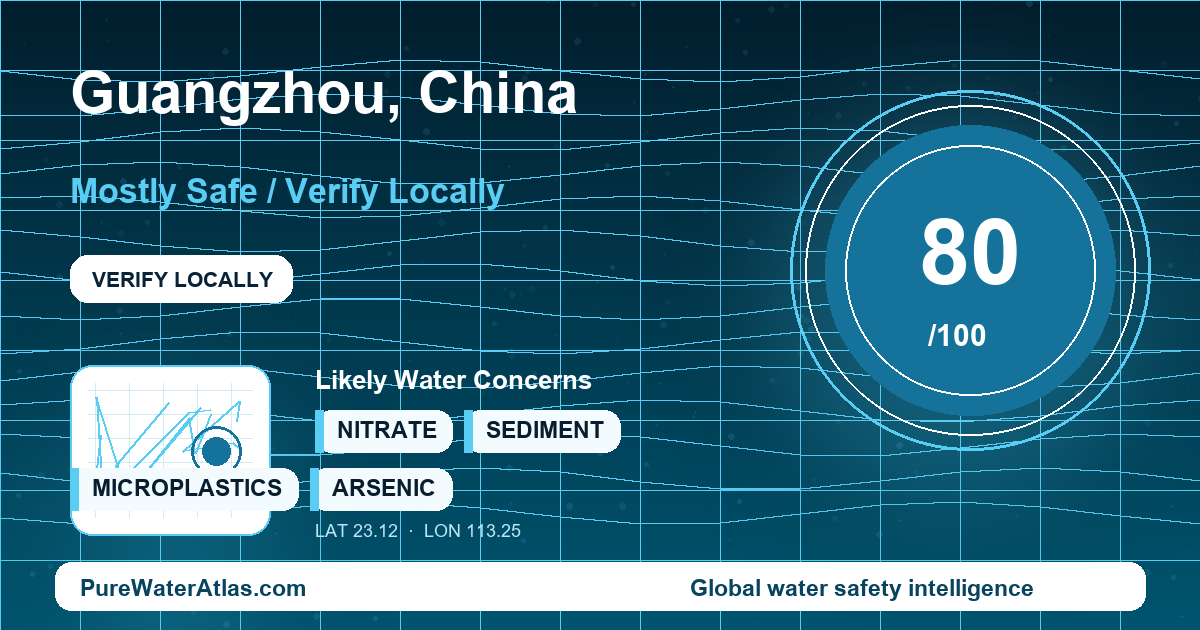
Guangzhou has a modern Pearl River Delta surface-water supply, but the safest answer depends on the building, secondary storage tanks, internal plumbing, and current local notices.
Quick Answer
| City | Guangzhou, China |
|---|---|
| PureWaterAtlas safety score | 80 / 100 |
| Risk level | Mostly Safe / Verify Locally |
| Can you drink it straight from the tap? | Do not make unboiled tap water your default drinking source unless your hotel, landlord, building manager, or local water notice confirms it is suitable at that tap. |
| Best traveler choice | Use sealed bottled water, properly boiled tap water, or water from a well-maintained purification dispenser. |
| Best resident choice | Boil tap water for drinking where appropriate, verify building-side storage and plumbing, and consider a certified point-of-use filter if taste, sediment, old pipes, or sensitive household members are concerns. |
| Main raw-water identity | Treated surface water from the Pearl River basin, including Dongjiang/East River, Xijiang/West River diversion infrastructure, and northern source waters such as the Liuxi River and associated reservoirs. |
| Main authorities | Guangzhou Water Affairs Bureau, Guangzhou Water Supply Co., Ltd. and related district suppliers, local health authorities, Guangdong ecological-environment authorities, and Pearl River basin agencies. |
| Filter recommendation | Not automatically required for every home, but practical in many Guangzhou apartments. Match the filter to tap testing, building age, tank condition, and maintenance capacity. |
Guangzhou’s municipal system is generally a lower-risk option than untreated local water. The main uncertainty is not whether the city treats water, but what happens after treated water leaves the plant: long distribution routes, district pressure zones, high-rise secondary supply tanks, pumps, rooftop or basement storage, and old internal pipes can all affect the final kitchen tap.
Why Guangzhou Is Different
Guangzhou sits in the Pearl River Delta, a humid subtropical, highly urbanized river-estuary system shaped by monsoon rainfall, upstream river flows, tidal influence, dense transport activity, and industrial development. That geography makes Guangzhou different from a city supplied by a single protected mountain reservoir or a deep groundwater aquifer. Its drinking-water question is tied to a large regional river basin and to the condition of the building where the water is finally used.
The city has invested in diversified surface-water supply rather than relying casually on the urban Pearl River channel. Guangzhou’s modern supply strategy includes protected source areas, upstream intakes, raw-water diversion projects, reservoirs, treatment plants, and municipal distribution infrastructure. This makes the city system more resilient than a single-source supply, but it also means that the source reaching a specific household can vary by district, plant, and operating conditions.
The practical Guangzhou-specific issue is final-point quality. A treatment-plant outlet may meet regulatory requirements, while an apartment tap may still be affected by a dirty secondary storage tank, stagnant water after service interruption, corroded building pipes, sediment from aging fixtures, or plumbing materials inside an older compound. For that reason, PureWaterAtlas rates Guangzhou as Mostly Safe / Verify Locally, not as a universal “drink directly everywhere” destination.
Where Does Guangzhou’s Tap Water Come From?
Guangzhou relies primarily on treated surface water from the Pearl River basin rather than groundwater. Key raw-water systems include the Dongjiang, also called the East River system; the Xijiang, or West River system, through diversion and supply infrastructure; and local northern source waters such as the Liuxi River and associated reservoirs for parts of the municipality. The exact raw-water blend reaching a home depends on district, water plant, operating conditions, and supply routing.
Historically, Guangzhou developed around the Pearl River. Over time, heavy urbanization, industrial pressure, storm runoff, and regional wastewater burdens in the Pearl River Delta made protected upstream sources and stricter drinking-water source protection increasingly important. Modern supply planning has therefore emphasized better-protected raw-water locations, source diversification, river-diversion projects, and reservoirs.
Important water infrastructure for Guangzhou includes Xijiang raw-water diversion and conveyance infrastructure bringing West River water into the municipal supply system, Dongjiang/East River supply arrangements serving the Pearl River Delta, Liuxi River and reservoir-linked source areas for northern Guangzhou, municipal water treatment plants using conventional treatment and disinfection, and a large distribution network with district pressure zones. In high-rise buildings, water may then pass through secondary systems such as rooftop tanks, basement tanks, booster pumps, and internal plumbing before it reaches the tap.
This last stage matters. In many Guangzhou buildings, especially apartment towers and older compounds, the weak point is not the raw-water source or the existence of treatment. It is the condition and maintenance of the building-side system between the municipal main and the kitchen faucet.
Who Manages Drinking Water in Guangzhou?
The principal city-level water management body is the Guangzhou Water Affairs Bureau. Municipal water supply service is associated with Guangzhou Water Supply Co., Ltd. and related district suppliers. Public-health oversight involves local health authorities, including the Guangzhou Municipal Health Commission. Source-water protection and environmental monitoring involve Guangzhou and Guangdong ecological-environment authorities, including the Department of Ecology and Environment of Guangdong Province, and basin-level Pearl River water agencies such as the Pearl River Water Resources Commission.
Urban drinking water in Guangzhou is governed under China’s municipal drinking-water and sanitation requirements, including the national Standards for Drinking Water Quality, GB 5749-2022. National environmental and health context is provided by agencies such as the Ministry of Ecology and Environment of the People’s Republic of China and the National Health Commission of the People’s Republic of China.
Data limitations matter. Guangzhou has official water authorities and city-level infrastructure information, but complete, current, English-language, neighborhood-level point-of-use data are not always available for every plant, district, hotel, high-rise tank, or apartment tap. Compliance at a plant or within the municipal network should not be treated as proof that every building’s internal water is identical.
Main Local Water Concerns
- Monsoon turbidity and runoff: From May to September, rainy-season storms, typhoons, and upstream runoff can increase raw-water turbidity and treatment demands. Temporary changes in taste, odor, or sediment may occur after severe weather or distribution disturbance.
- Dry-season and tidal stress: Late autumn and winter dry periods can increase concern about low river flow and salinity intrusion in parts of the Pearl River Delta supply region, especially toward downstream estuarine areas.
- Urban and industrial basin pressure: The Pearl River basin is influenced by dense urbanization, industrial activity, shipping, storm runoff, and land development. Monitoring and source protection are important for nutrients, ammonia-nitrogen, organic pollution indicators, metals, and emerging contaminants, although household exposure cannot be inferred without tap-specific testing.
- Disinfectant taste: Residual chlorine or chlorine-like disinfectant taste can be noticeable in treated Guangzhou tap water, especially in warm weather or after operational changes.
- Building sediment and rusty water: Rust-colored water, sediment, metallic taste, or particles are often more consistent with local pipes, internal plumbing, valves, or storage tanks than with a citywide source-water problem.
- Old plumbing metals: Corroded fittings, galvanized pipes, brass components, solder, and rarely legacy lead-containing materials can contribute metals at the tap even when plant water meets standards.
- Secondary storage tanks: High-rise rooftop or basement tanks can create microbial and sediment risk if they are not sealed, cleaned, inspected, and disinfected on schedule.
For Travelers
For short-term visitors, the safest practical answer in Guangzhou is to use sealed bottled water, properly boiled tap water, or water from a well-maintained purification dispenser for drinking. Do not rely on unboiled tap water as your default drinking source unless your hotel or host confirms potable tap use and there is no building or local advisory.
Brushing teeth with tap water is generally a lower-risk practice in reputable urban hotels and modern apartments if the water is clear, has no unusual odor, and there is no notice about service interruption. However, travelers with sensitive stomachs, infants, immunocompromised people, or anyone staying in older or poorly maintained buildings should use bottled or boiled water for brushing as well.
Use caution with ice. Ice in major hotels, international restaurants, and venues that confirm purified-water ice is lower risk than ice from street stalls or places where the water source is unclear. In hot and humid weather, carry bottled water and do not wait until you are in a crowded market or transit area to find a safe source.
Major hotels and established restaurants commonly provide bottled water, boiled water, or filtered dispensers. If your room has a kettle, boiling tap water is a practical risk-reduction step. Apartment rentals and budget guesthouses require more caution because their building tank maintenance and internal plumbing may not be visible to the guest.
For broader travel precautions, see the CDC Travelers’ Health page for China and PureWaterAtlas’ Boiling Water Purification: Complete Guide.
For Residents
For Guangzhou residents, the right approach depends heavily on the specific building. A home filter is not automatically required for every residence, but it is practical for many households. A certified activated-carbon filter can improve chlorine taste and reduce some organic compounds. A sediment prefilter can help with particles and protect appliances. Reverse osmosis may be considered where residents want broader reduction of dissolved salts, metals, nitrate, PFAS, or other trace contaminants. Any system must be maintained; neglected cartridges can lose performance or create their own problems.
Residents in older buildings or compounds should be more cautious. Corroded internal pipes, galvanized steel, aging valves, unknown fittings, and legacy materials can add sediment, iron, manganese, copper, or lead-related risk at the tap. Flushing after stagnation may improve taste and reduce some stagnant-water effects, but it does not replace laboratory testing where lead or other metals are a concern.
High-rise residents should also ask the property manager for the most recent secondary water-supply tank cleaning and disinfection record. Rooftop tanks, basement tanks, and booster systems should be sealed, inspected, cleaned, and disinfected on schedule. Dirty, musty, suddenly turbid, or rusty water should be reported and investigated rather than ignored.
Recommended resident testing in Guangzhou includes first-draw and flushed samples when the building is old, has rusty pipes, unknown pipe materials, children, pregnant residents, or immunocompromised household members. Basic observations such as odor, color, turbidity, chlorine residual, and temperature are useful after service interruptions or tank maintenance. If problems persist, use a certified laboratory for lead, copper, iron, manganese, arsenic, nitrate, and microbial indicators.
Relevant Contaminants and Water-Quality Issues
Guangzhou’s treated municipal water can have a noticeable disinfectant taste, making chlorine in drinking water relevant for taste and residual-disinfection questions. Rainy-season storms, typhoon runoff, and disturbed source waters make turbidity important, while old pipes, tank sediment, and distribution disturbances make sediment in drinking water a common point-of-use concern.
For older apartments and buildings with unknown plumbing, lead in drinking water should be considered a plumbing-related risk rather than assumed from source-water conditions. The PureWaterAtlas guide to lead testing and detection methods is especially relevant for families with children or pregnant residents.
Because secondary tanks can affect microbial quality if poorly maintained, E. coli in drinking water is relevant as an indicator for fecal contamination and microbial safety. Pearl River basin runoff pressure also makes nitrate and its testing methods useful topics. In a highly urbanized and industrialized river-basin context, PFAS and PFAS testing may be relevant for residents who want evidence rather than assumptions.
How to Verify Your Water Quality
To verify Guangzhou tap water, start locally: check notices from the Guangzhou Water Affairs Bureau, the water supplier, your property manager, and your building’s tank-maintenance records. After storms, pipe work, service interruptions, or tank cleaning, watch for sudden odor, discoloration, turbidity, sediment, or metallic taste.
For household decisions, use PureWaterAtlas’ Water Testing complete guide to plan tap sampling, and consult the Contaminants Search Engine for specific substances mentioned in Guangzhou water concerns. The Drinking Water Safety guide explains how to decide whether a tap is safe enough for drinking, while the Water Treatment Systems guide can help match filters to test results. For comparison with other destinations, use the Global Water Quality Checker.
If microbial risk is suspected from building tanks or private equipment, residents may also compare treatment options such as filtration, boiling, and UV water purification. For broader context on source-water and plumbing issues, see PureWaterAtlas’ Water Contamination resource.
Official and Technical Sources
- Guangzhou Water Affairs Bureau — city water management, water-supply administration, infrastructure, and official local water notices.
- Guangzhou Water Supply Co., Ltd. — municipal water supply service, treatment and supply operations, and customer-facing information where published.
- Guangzhou Municipal Health Commission — public-health oversight context and health-related drinking-water information.
- Department of Ecology and Environment of Guangdong Province — regional environmental monitoring and source-water protection context.
- Pearl River Water Resources Commission — Pearl River basin water resources management, hydrology, drought, flood, and supply-security context.
- Ministry of Ecology and Environment of the People’s Republic of China — national environmental water-quality policy and drinking-water source protection context.
- National Health Commission of the People’s Republic of China — national drinking-water health standards and GB 5749-2022 regulatory context.
- CDC Travelers’ Health: China — traveler-focused food and water precautions.
- WHO Guidelines for Drinking-water Quality — international public-health basis for drinking-water safety, microbial risk, disinfection, chemical contaminants, and household water safety principles.
Bottom Line
Guangzhou’s municipal drinking-water system is modern, surface-water based, and generally managed under Chinese drinking-water requirements, with raw-water supply drawn from Pearl River basin systems such as the Dongjiang/East River, Xijiang/West River diversion infrastructure, and northern sources including the Liuxi River and reservoirs. The practical safety question is the final tap. High-rise tanks, booster systems, old pipes, corrosion, sediment, and storm-related disturbances can change water quality after treatment. Visitors should use bottled, boiled, or verified purified water for drinking. Residents should verify building tank maintenance, test old or suspect plumbing, and choose filters based on actual tap conditions rather than assumptions.
Read the full guide: Global Water Quality Guide
Explore more in this category: Global Water Quality Articles