
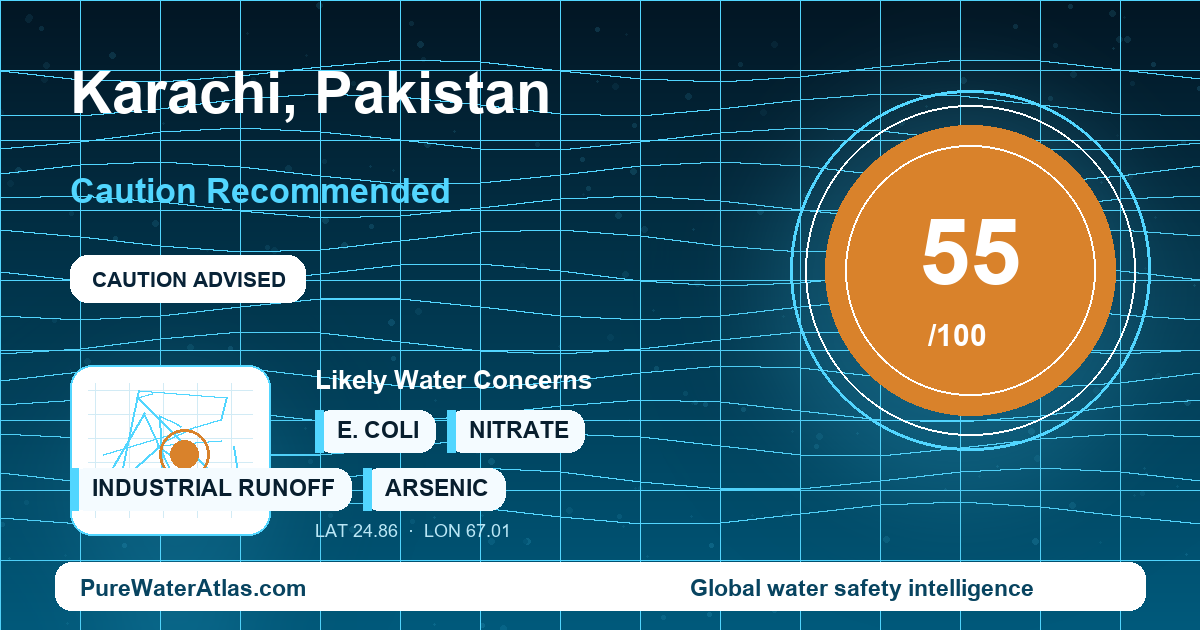
Karachi, Pakistan: a coastal megacity dependent on long-distance Indus-system surface water, major pumping and treatment infrastructure, intermittent distribution, household storage tanks, and variable point-of-use safety.
Quick Answer
| City | Karachi, Pakistan |
|---|---|
| Water safety score | 55 / 100 |
| Risk level | Caution Recommended |
| Can you drink the tap water? | Karachi tap water should be treated as caution-to-avoid for direct drinking unless it has been properly treated and safely stored at the point of use. |
| Traveler advice | Short-term visitors should not drink untreated tap water. Use sealed bottled water from reputable brands, hotel-provided treated water, or water that has been boiled or disinfected and then stored safely. |
| Resident advice | Residents should treat tap water as source water that often needs final household-level protection, especially where water passes through sumps, rooftop tanks, suction pumps, old plumbing, or private filters. |
| Main water source | Primarily surface water from the Indus River system via the Kalri Baghar Feeder and Keenjhar Lake system, with Hub Dam as an important supplementary source for parts of the city when available. |
| Main authority | Karachi Water and Sewerage Corporation, formerly Karachi Water and Sewerage Board. |
| Filter recommendation | Usually yes for drinking use: sediment prefiltration plus disinfection or a maintained RO/UV system where appropriate, guided by TDS, salinity, turbidity, microbial risk, and laboratory results. |
Why Karachi Is Different
Karachi is not a city where tap-water safety can be judged only by asking whether a treatment plant exists. The city has major treated-surface-water infrastructure, but the practical risk at the kitchen tap is shaped by the whole route water travels after treatment: bulk transmission, stressed distribution mains, intermittent pressure, possible cross-contamination with drains and sewers, suction pumps, underground sumps, rooftop tanks, household filters, and storage bottles.
Karachi is a coastal megacity on the Arabian Sea with limited dependable local freshwater. Because saline coastal aquifers, industrial growth, rapid urban expansion, and limited reliable freshwater within the city have constrained local options, Karachi’s drinking-water identity is built around long-distance surface-water conveyance from the Indus system. That dependence makes the operational condition of pumping stations, transmission mains, filtration facilities, service reservoirs, and neighborhood distribution especially important.
The key local issue is variability. Water leaving a treatment facility may not reflect the water finally consumed in an apartment, house, office, school, or restaurant. Many Karachi households store water because supply is intermittent. Storage can be protective when tanks are clean, sealed, and disinfected, but it can also become a contamination point when tanks have sediment, open lids, cracks, insects, birds, or nearby sewage seepage. For this reason, PureWaterAtlas rates Karachi as “Caution Recommended,” not as universally safe and not as uniformly unsafe at every tap.
Where Does Karachi’s Tap Water Come From?
Karachi’s municipal supply is primarily based on surface water from the Indus River system. Water is conveyed toward the city through the Kalri Baghar Feeder and Keenjhar Lake system, then moved through bulk transmission and pumping infrastructure serving Karachi. The Dhabeji pumping station and bulk transmission mains are a critical corridor for moving water into the city. Karachi water-sector planning documents also reference treatment and filtration facilities such as Pipri, Gharo, North East Karachi, and other filtration or treatment assets.
Hub Dam is also an important supplementary source for parts of Karachi, particularly western and northern supply zones when storage and allocation permit. Because availability varies, some neighborhoods may experience different supply patterns from others. The city also has a large distribution network with intermittent supply, service reservoirs, pumping stations, consumer storage tanks, and private tanker distribution.
The K-IV Greater Karachi Bulk Water Supply Project is intended to add major bulk supply from the Indus system. However, additional bulk water is not the same thing as guaranteed safe drinking water at every consumer tap. Until new supply is commissioned, proven through the distribution system, and paired with reliable treatment, pressure management, and local plumbing control, households still need point-of-use precautions.
Who Manages Drinking Water in Karachi?
The main public water-supply and sewerage utility for Karachi is the Karachi Water and Sewerage Corporation, formerly Karachi Water and Sewerage Board. Its role includes service delivery in a city where water and sewerage challenges are closely linked: when sewer systems, drains, and water pipes are in poor condition or located close together, intermittent water pressure can increase the risk of contaminated water entering distribution lines.
Pakistan’s drinking-water quality is guided by national drinking-water standards and public-health policies, with provincial and local responsibilities in Sindh. Relevant institutions include Government of Sindh bodies for oversight, the Sindh Environmental Protection Agency for environmental regulation, the Pakistan Council of Research in Water Resources for water-quality research and monitoring context, and the Pakistan Standards and Quality Control Authority for national quality specifications and bottled-water standards context.
A major limitation for consumers is that recent, routine, neighborhood-level public reporting of treated-water and consumer-tap results is limited. Karachi has enough documented evidence to identify its sources, utility, infrastructure stress, and contamination pathways, but not enough routinely published block-by-block compliance data to say that every tap is safe or unsafe. Building plumbing, storage tanks, tanker use, pressure events, pipe breaks, and nearby sewer problems can all change the result at a specific tap.
Main Local Water Concerns
The most important Karachi concern is microbial contamination risk from sewage intrusion. Intermittent supply can create low-pressure or depressurized conditions. In a stressed network with leaks, illegal connections, damaged pipes, or cross-connections with drains and sewers, contaminated water can enter the pipe system. This is why the presence or absence of E. coli or thermotolerant coliforms is one of the most important tests for any Karachi household that plans to drink tap water.
High turbidity and visible sediment can occur after pipe repairs, pressure changes, service interruptions, or disturbance in rooftop or underground tanks. Turbidity is not just an appearance issue: cloudy water can reduce the reliability of disinfection and may indicate that storage tanks or distribution lines need attention.
Variable chlorine residual is another local concern. In long distribution systems, disinfectant protection can decline before water reaches the consumer, especially where supply is intermittent and water is stored in tanks. A free chlorine residual at the tap can be a useful indicator of recent disinfection protection, although it does not replace microbial testing.
Karachi households using private groundwater, borewells, mixed sources, or tanker water face additional uncertainty. Some private groundwater and tanker sources may have high total dissolved solids, salinity, hardness, chloride, sulfate, nitrate, or other source-specific issues, particularly near coastal or over-pumped aquifers. Tanker-water quality can vary because filling points, source identity, tanker cleanliness, and household storage practices vary.
Possible metal exposure is mainly a building-plumbing issue rather than a confirmed citywide claim for every Karachi tap. Older internal pipes, corroded plumbing, brass fixtures, old valves, and poorly maintained tanks can contribute metals such as lead at the point of use. Citywide lead-at-tap data are not consistently published, so older buildings should use testing rather than assumptions.
Season also matters in Karachi. Summer heat increases water demand and may worsen shortages, storage duration, and tanker dependence. Monsoon rainfall can overload drains and sewers, raising cross-contamination risk where water lines are leaky or depressurized. Power outages or pumping interruptions can reduce pressure and interrupt treatment or distribution reliability. Dry periods and low reservoir availability can increase reliance on alternative supplies.
For Travelers
Most travelers should not drink untreated tap water in Karachi. Use sealed bottled water from reputable brands, treated water provided by a reliable hotel, or water that has been boiled or disinfected and then stored in a clean, closed container. Check bottle seals before drinking, and prefer bottles opened in front of you.
Use bottled, boiled, or otherwise treated water for brushing teeth, especially for children, pregnant travelers, immunocompromised travelers, and anyone with a sensitive stomach. Avoid ice unless you can confirm it was made from treated water by a reputable hotel or restaurant. Street-vendor ice and unverified ice are higher risk because the source water and handling conditions may be unknown.
Higher-end hotels and established restaurants in Karachi may use treated or bottled water, but do not assume. Ask whether drinking water and ice are filtered, bottled, or otherwise treated. Be cautious with drinks prepared with unknown water and with raw foods washed in unknown water if you are risk-averse.
Boiling is a strong option for microbial risk and is covered in the PureWaterAtlas Boiling Water Purification Guide. However, boiling does not remove salinity, metals, nitrate, arsenic, or many chemical contaminants. If gastrointestinal illness occurs, oral rehydration salts can be useful while seeking appropriate medical guidance.
For Residents
For many Karachi residents, home treatment is usually needed if the water will be consumed. A practical setup is staged: sediment prefiltration for visible particles, activated carbon where taste, odor, or chlorine-related issues are present, and either UV disinfection or reverse osmosis depending on microbial risk, TDS, salinity, and laboratory results. UV can be appropriate when water is relatively clear and systems are maintained; see the PureWaterAtlas UV Water Purification Guide. RO may be appropriate where TDS, salinity, or mixed-source uncertainty is a problem, but system selection should be guided by testing.
Filters must be maintained. A neglected cartridge, dirty storage tank, or poorly serviced purifier can become a contamination source. If water is stored after treatment, the storage container must be clean, covered, and protected from hands, insects, and recontamination.
Rooftop tanks and underground sumps are major Karachi control points. Keep lids sealed, prevent bird and insect entry, clean and disinfect tanks on a schedule, inspect for cracks and sewage seepage, avoid direct suction from municipal mains where prohibited, and flush sediment after repairs or long outages. In many buildings, the quality of the private storage system may matter as much as the quality leaving the utility plant.
Older apartment blocks and houses deserve extra attention. Corroded internal pipes, old valves, repaired lines, and storage tanks are not part of routine utility treatment-plant monitoring. Do not assume water that met standards upstream remains safe at the kitchen tap. If children, infants, or pregnant people consume the water, consider first-draw and flushed testing for lead and other plumbing-related metals. The PureWaterAtlas guide to lead testing and detection methods explains why sampling location and timing matter.
Relevant Contaminants and Water-Quality Issues
Karachi’s most relevant tap-water issues are not one single contaminant but a combination of microbial, operational, storage, and source-uncertainty risks. E. coli is the most important screening organism when sewage intrusion or unsafe storage is suspected. Turbidity and sediment matter because cloudy water and particles can signal tank disturbance, pipe repairs, or reduced disinfection reliability. Chlorine residual is useful for judging whether disinfectant protection may still be present at the tap.
For households using borewell, tanker, or mixed water, source-related testing becomes more important. Nitrate can be relevant where groundwater is affected by sewage or other contamination pathways, and is especially important for infant-risk screening. The PureWaterAtlas nitrate testing guide gives more detail. Arsenic is relevant for groundwater screening in Pakistan and for uncertain non-municipal sources; see the arsenic testing guide. Lead is most relevant where old building plumbing or corroded fixtures may affect tap water.
How to Verify Your Water Quality
The safest way to answer “is my Karachi tap water safe?” is to test the specific water you drink, not just the city source. For household drinking use, test for E. coli or thermotolerant coliforms, especially after gastrointestinal illness, sewer overflow, monsoon flooding, pipe breaks, long outages, or failed tank cleaning. Also check turbidity, pH, electrical conductivity or TDS, residual chlorine, odor, and color when supply quality changes.
For borewell, tanker, or mixed-source homes, add TDS, hardness, chloride, sulfate, nitrate, arsenic, and microbiology. In older buildings, test first-draw and flushed samples for lead and other metals if children, pregnant people, or infants consume the water. Where possible, use an accredited laboratory or a recognized university, public-health, or environmental laboratory. Sampling both the incoming line and the kitchen tap or storage tank can help identify whether the problem is in the municipal supply, building plumbing, or private storage.
PureWaterAtlas resources that can help include the Water Testing Guide, the Drinking Water Safety Guide, the Water Microbiology Guide, and the Water Treatment Systems Guide. You can also compare broader context using the Global Water Quality Checker and research specific substances in the Contaminants Search Engine. For broader country and city context, see Global Water Quality.
Official and Technical Sources
- Karachi Water and Sewerage Corporation — primary public water and sewerage utility for Karachi.
- World Bank: Karachi Water and Sewerage Services Improvement Project, P164704 — project record documenting service challenges, utility reform, infrastructure investment, and improvement priorities.
- World Bank: Second Karachi Water and Sewerage Services Improvement Project (KWSSIP-2), P171422 — ongoing investment context for Karachi water and sewerage services.
- WAPDA: Greater Karachi Bulk Water Supply Scheme K-IV — official information on the K-IV bulk water supply project.
- Pakistan Council of Research in Water Resources — national water-quality research and monitoring context.
- Pakistan Standards and Quality Control Authority — national quality specifications and bottled-water standards context.
- Sindh Environmental Protection Agency — provincial environmental oversight relevant to pollution control and water-quality context.
- CDC Travelers’ Health: Pakistan — travel-health guidance supporting cautious use of bottled, disinfected, or safely treated water.
- WHO Guidelines for Drinking-water Quality — global public-health framework for microbial, chemical, and operational drinking-water safety.
- UNICEF and WHO Joint Monitoring Programme for Water Supply, Sanitation and Hygiene — global WASH monitoring context for Pakistan.
Bottom Line
Karachi tap water should not be treated as reliably drinkable straight from the tap without household-level safeguards. The city depends mainly on Indus-system surface water conveyed through major infrastructure, with Hub Dam supplementing some zones, but the main risk is what happens after treatment: intermittent pressure, aging and leaky distribution, sewer cross-contamination, private storage tanks, tanker uncertainty, and limited neighborhood-level public reporting. Travelers should use sealed bottled or reliably treated water and avoid unverified ice. Residents should maintain tanks, test water when conditions change, and use appropriate filtration and disinfection. The most defensible answer for Karachi is caution: verify your specific tap before drinking it untreated.
Read the full guide: Global Water Quality Guide
Explore more in this category: Global Water Quality Articles