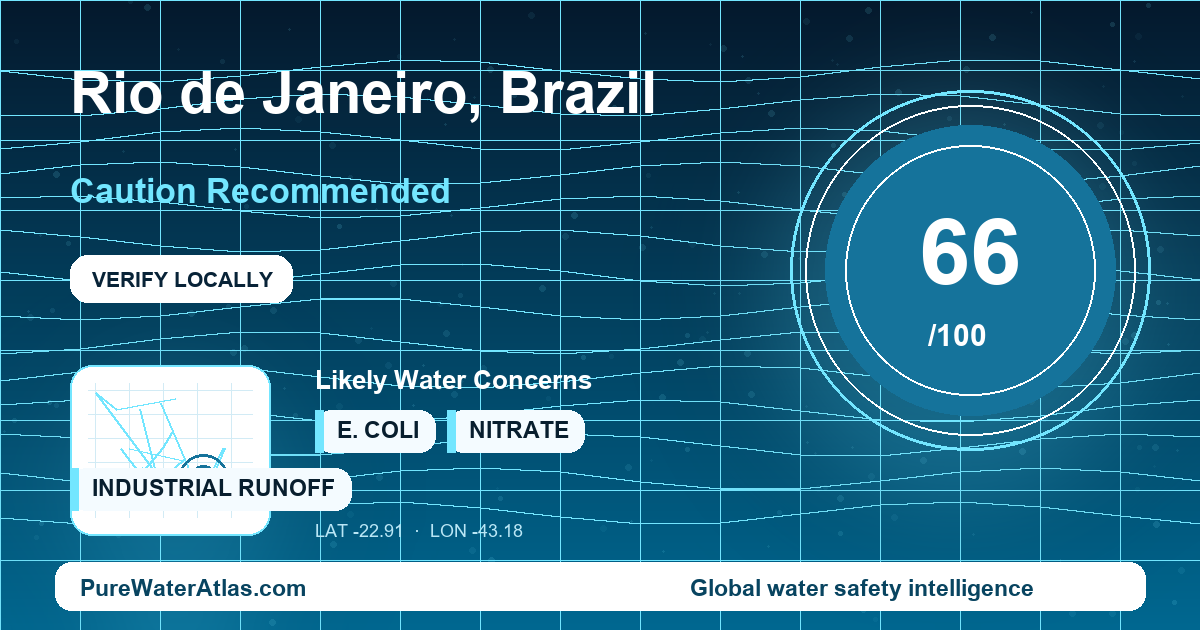
Rio de Janeiro’s tap water is treated for potable use, but source-water stress in the Guandu system, periodic odor and turbidity complaints, long distribution networks, and private building tanks make caution the most defensible choice.
Quick Answer
| Overall status | Caution Recommended — PureWaterAtlas water safety score: 66/100. |
|---|---|
| Can you drink the tap water? | Rio de Janeiro’s treated municipal water is produced for drinking, but visitors should usually choose sealed bottled water or properly filtered water for drinking, especially if they have a sensitive stomach, are pregnant, immunocompromised, or traveling with infants. |
| Traveler advice | Tap water is generally acceptable for brushing teeth in established hotels and restaurants if it is clear and has no unusual odor. Do not drink it if it is cloudy, discolored, has sediment, smells strong, or follows a service interruption. |
| Resident advice | Residents should treat building plumbing and storage tanks as real risk points. A certified point-of-use filter, regular caixa d’água or cisterna cleaning, and targeted testing are sensible in older buildings or where taste, odor, turbidity, or pressure problems recur. |
| Main water source | The Guandu system, strongly influenced by transferred water from the Paraíba do Sul basin and supported by the Ribeirão das Lajes system. |
| Water authority | Bulk treatment is associated with CEDAE. Retail service varies by concession area, including Águas do Rio in much of the city and Iguá in Barra da Tijuca and Jacarepaguá. |
| Filter recommendation | A certified carbon block filter is useful for chlorine, taste, and odor; add sediment prefiltration where particles occur. Reverse osmosis is only a targeted option where testing shows dissolved metals, nitrate, salinity, or other dissolved contaminants. |
Why Rio de Janeiro Is Different
Rio de Janeiro is a coastal city, but its drinking water is not desalinated seawater. The city’s main supply depends heavily on inland river-basin transfers and the Guandu system. That makes upstream land use, sewage control, polluted tributaries, river-basin management, and treatment-plant performance central to the safety of water reaching the city.
PureWaterAtlas rates Rio de Janeiro as Caution Recommended, not because the city lacks a major treatment system, but because the full path from source to tap is complex. Water may leave a treatment plant meeting potable-water standards, then travel through long metropolitan mains, reservoirs, pumping systems, local pipes, and finally into private rooftop or underground storage tanks. A safe treatment-plant result does not automatically prove identical water quality at every apartment faucet.
One locally important example is the widely reported 2020 taste and odor crisis associated with geosmin and source-water conditions in the Guandu system. Geosmin is mainly an aesthetic compound, but the episode highlighted how algal growth, sewage-impacted tributaries, and stressed raw water can challenge treatment processes and public confidence. For residents, the practical question is often not only whether the Guandu plant can produce potable water, but whether the building’s own storage tank and internal plumbing preserve that quality.
Where Does Rio de Janeiro’s Tap Water Come From?
The dominant drinking-water supply for Rio de Janeiro is the Guandu system. Raw water is drawn from the Guandu River system, which is strongly influenced by water transferred from the Paraíba do Sul basin through regional hydropower and diversion infrastructure. The Ribeirão das Lajes system also provides important source-water support to the broader metropolitan supply.
The key bulk-treatment facility is the Guandu water treatment plant, operated by CEDAE. After treatment, water moves through large treated-water mains, reservoirs, pumping systems, and local distribution networks before reaching neighborhoods and buildings. In many apartment buildings and homes, the final step is not the public pipe itself but a private storage system: rooftop tanks, underground tanks, caixas d’água, or cisternas.
This is why two taps in the same city can have different practical risk profiles. A newer building with well-maintained tanks and stable pressure may have lower household risk than an older building with stagnant water, sediment accumulation, poorly sealed tanks, or internal plumbing corrosion. Heavy rain, pipe work, pressure changes, and local distribution disturbances can also produce temporary turbidity or sediment complaints.
Historically, Rio relied more heavily on local mountain and hillside sources, including systems associated with Tijuca and nearby forested catchments, and later on systems such as Acari and Lajes. That history matters because modern Rio is not simply supplied by a local spring or a small protected upland reservoir. It is supplied by a large engineered metropolitan transfer, treatment, and distribution network.
Who Manages Drinking Water in Rio de Janeiro?
Bulk water production for the main metropolitan system remains associated with CEDAE, Companhia Estadual de Águas e Esgotos do Rio de Janeiro. CEDAE’s information on the Sistema Guandu supports the identification of the Guandu system as the key treatment and supply infrastructure for the metropolitan area.
Retail distribution and customer service in the municipality are now split among concessionaires in different service areas. Águas do Rio is relevant for much of the city, while Iguá Rio de Janeiro is relevant for the Barra da Tijuca and Jacarepaguá concession area. Users should verify the correct local operator for their address before checking service interruptions, advisories, or customer water-quality communications.
Brazil’s drinking-water quality framework is national. The Ministry of Health’s Vigiagua program and Portaria GM/MS 888/2021 define potable-water surveillance and quality requirements. Source-water and environmental issues involve INEA, while state-level concession oversight involves agencies such as AGENERSA. Basin-level and water-resources context is also supported by institutions such as AGEVAP and Comitê Guandu and Brazil’s national water agency, ANA.
Main Local Water Concerns
The most important local concerns in Rio de Janeiro are not limited to one contaminant. They involve the interaction between stressed raw water, treatment-process demands, distribution infrastructure, and private building systems.
- Guandu source-water pressure: The Guandu basin is affected by urban sewage, industrial activity, and polluted tributaries in the metropolitan area. This makes source-water management central to finished-water reliability.
- Taste and odor episodes: Earthy or musty water complaints can occur during source-water or algal episodes involving compounds such as geosmin. These events are often aesthetic, but they can signal broader treatment stress and public concern.
- Turbidity and visible particles: Heavy rain, pipe work, pressure changes, or local distribution disturbances can produce cloudy water, sediment, yellow or brown color, or visible particles.
- Aging and variable infrastructure: Some areas or buildings may experience older pipes, intermittent service, pressure drops, or cross-connection risks. Low-pressure events are especially important because they can increase distribution-system vulnerability.
- Building storage tanks: A neglected caixa d’água or cisterna can accumulate sediment, biofilm, insects, or microbial contamination after water has already left the public network.
- Old internal plumbing: Older fixtures, valves, solder, or pipes can add metals, sediment, or metallic taste at the tap, even when the public supply is treated.
Season also matters. Heavy summer rains can increase raw-water turbidity and wash sewage, sediment, and urban runoff into rivers and drainage channels. Warm periods can favor algal growth and contribute to taste and odor episodes. High tourist-season demand may stress building storage systems in hotels, rentals, and older apartment blocks if tanks are not well maintained.
For Travelers
Drinking: Short-term visitors should generally use sealed bottled water or properly filtered water for drinking in Rio de Janeiro. This is especially important for travelers with sensitive stomachs, pregnant travelers, infants, and immunocompromised people. Avoid tap water if it is cloudy, discolored, has visible sediment, has a strong odor, or follows a service interruption.
Brushing teeth: Brushing teeth with tap water is generally acceptable for most travelers staying in reputable hotels or serviced apartments, provided the water looks clear and has no unusual odor. Use bottled water for infants, immunocompromised travelers, or basic accommodation where tank maintenance is uncertain.
Ice: Ice in reputable restaurants and hotels is usually lower concern when made from treated water or commercial ice. Avoid ice from informal vendors or places where water handling is uncertain. If you want a conservative approach, order drinks without ice.
Hotels and restaurants: Ask whether the building uses municipal water, whether tanks are cleaned regularly, and whether drinking water is filtered. In restaurants, bottled water is the conservative option. Sparkling water is useful when you want to reduce the chance of receiving a refilled bottle.
Boiling: Boiling can reduce microbial risk, but it does not remove chemical tastes, metals, sediment, geosmin, salinity, PFAS, nitrate, or most dissolved chemicals. For more context, see the PureWaterAtlas Boiling Water Purification: Complete Guide.
For Residents
A home filter is not universally mandatory in Rio de Janeiro, but it is a sensible risk-reduction measure for many households. It is especially useful in older buildings, homes with roof tanks, households with infants or immunocompromised people, and addresses with repeated odor, taste, turbidity, sediment, or pressure problems.
A practical setup is a certified carbon block filter for chlorine taste, odor, and some aesthetic concerns, combined with sediment prefiltration where visible particles occur. Reverse osmosis may be considered only where testing indicates dissolved metals, nitrate, salinity, or other dissolved contaminants. Filters should be maintained on schedule; an old cartridge can become a water-quality problem rather than a solution.
Residents in older buildings should consider point-of-use testing if there is metallic taste, discoloration, staining, or suspected lead-suspect plumbing. First-draw samples can differ from flushed samples, so anyone investigating metals should use a laboratory sampling plan rather than relying only on a cheap strip test.
Private building tanks are a major control point. Rooftop and underground tanks should be sealed, screened, structurally sound, and cleaned on a regular schedule. After tank cleaning, repairs, flooding, long stagnation, backflow concern, sewage intrusion concern, or a long outage, flush the plumbing and consider microbiological testing before using the water for drinking.
Relevant Contaminants and Water-Quality Issues
Several PureWaterAtlas contaminant profiles are especially relevant to Rio de Janeiro’s local water situation. Chlorine is relevant because treated municipal supplies use disinfectant residuals, and residents may notice chlorine taste or odor. Turbidity matters because heavy rain, pipe disturbance, and source-water events can increase cloudiness. Sediment is relevant for older building tanks, distribution disturbances, and visible particles.
Microbial risk is most important after tank failures, cross-connections, pressure losses, flooding, sewage intrusion concerns, or non-utility water use. See the PureWaterAtlas profile on E. coli and the broader guide to Water Microbiology. For older buildings and internal plumbing concerns, review Lead, Iron, and the article Lead in Drinking Water: Testing and Detection Methods.
If a household is choosing a treatment device, the broader PureWaterAtlas guide to Water Treatment Systems can help match a filter type to the actual problem. UV systems may be useful for some microbial-control scenarios, but they do not remove dissolved chemicals or metals; see UV Water Purification: Complete Guide.
How to Verify Your Water Quality
Rio de Janeiro has official sources for system identity, concession structure, national standards, and source-water governance, but public information is not always presented as a single, easy neighborhood-by-neighborhood drinking-water dashboard. Finished-water quality can vary between the treatment plant, street network, and building tap. PureWaterAtlas therefore does not claim that every faucet in Rio is either safe or unsafe.
Start by checking the correct local operator for your address: Águas do Rio or Iguá, depending on the concession area. Look for service interruptions, pressure problems, maintenance notices, or local advisories. Then consider the building itself: tank condition, cleaning schedule, plumbing age, recent outages, and whether neighbors have similar complaints.
For testing strategy, use the PureWaterAtlas Water Testing guide. Test for E. coli or total coliform after suspected tank contamination, flooding, backflow, sewage intrusion, or long outages. Test turbidity, color, chlorine residual, and basic microbiology if water frequently arrives cloudy, yellow, brown, or with visible particles. Consider lead, copper, iron, and manganese testing when water is metallic, discolored, stains fixtures, or comes from old internal plumbing.
You can also browse the Contaminants Search Engine, compare broader guidance in the Global Water Quality Checker, and read the PureWaterAtlas pillar guide on Drinking Water Safety. Related category hubs include Global Water Quality, Drinking Water Safety, Water Testing, and Water Contamination.
Official and Technical Sources
- CEDAE — state water company associated with Rio de Janeiro bulk water production.
- CEDAE – Sistema Guandu — official utility information on the Guandu system.
- Águas do Rio — retail water and sanitation concessionaire for much of Rio de Janeiro.
- Iguá Rio de Janeiro — concessionaire for the Barra da Tijuca and Jacarepaguá service area.
- Ministério da Saúde – Vigiagua — national public-health surveillance framework for drinking water.
- Portaria GM/MS 888/2021 — Brazilian national potable-water regulation.
- INEA — state environmental authority relevant to source-water and watershed context.
- AGEVAP and Comitê Guandu — basin-level source-water and water-resources context.
- ANA — national water agency for Brazilian water resources and water security context.
- AGENERSA — state regulator relevant to water and sanitation concession oversight.
Bottom Line
Rio de Janeiro’s municipal water is treated for potable use, with the Guandu system forming the backbone of metropolitan supply. PureWaterAtlas still rates the city as Caution Recommended because source-water stress, past taste and odor events, turbidity complaints, long distribution infrastructure, and building-level tanks can affect what reaches the tap. Travelers should usually drink sealed bottled or trusted filtered water, while using tap water for brushing teeth only when it is clear and from reputable accommodation. Residents should focus on practical controls: verify the correct local operator, maintain caixas d’água and cisternas, use a certified filter where appropriate, and test after outages, contamination concerns, old-plumbing issues, or recurring discoloration.
Read the full guide: Global Water Quality Guide
Explore more in this category: Global Water Quality Articles