
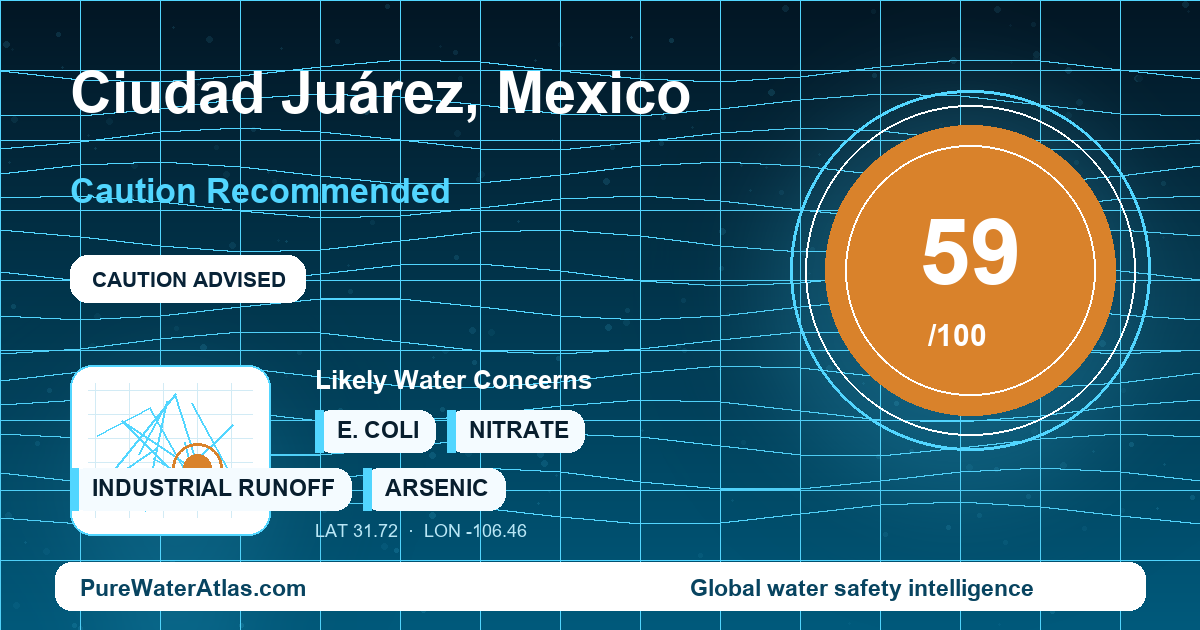
Ciudad Juárez, Chihuahua, is a groundwater-dependent desert border city where municipal treatment exists, but aquifer stress, mineralized water, pressure events, building storage tanks, and limited neighborhood-level public data make caution the safest drinking-water position.
Quick Answer
| Overall safety status | Caution recommended. PureWaterAtlas score: 59/100. Ciudad Juárez has an organized municipal utility and chlorinated groundwater supply, but public, current, neighborhood-specific water-quality results are not easy to verify. |
|---|---|
| Can visitors drink the tap water? | Not recommended as the default. Short-term visitors should use sealed bottled water, reputable purified water, or a verified filtered hotel source for drinking. |
| Resident guidance | Residents connected to the JMAS municipal system can use tap water for many domestic purposes, but drinking-water confidence is improved by tank maintenance, flushing after outages, and certified point-of-use treatment. |
| Main water source | Primarily groundwater from regional transboundary aquifers, especially the Hueco Bolson or Bolsón del Hueco system, with additional supply from the Conejos-Médanos well field. |
| Water authority | Junta Municipal de Agua y Saneamiento de Juárez, commonly JMAS Juárez. |
| Practical filter recommendation | Sediment prefiltration plus activated carbon for chlorine, taste, and odor; reverse osmosis where dissolved salts, hardness, salinity, arsenic, nitrate, or groundwater inorganics are concerns. UV may help only after filtration where cistern or tinaco hygiene is uncertain. |
Why Ciudad Juárez Is Different
Ciudad Juárez is not a typical river-treatment-plant city. It is a large desert border city in northern Chihuahua, directly across from El Paso, Texas, in an arid basin where municipal growth, industry, climate pressure, and groundwater management are central to water safety. The city’s drinking-water identity is groundwater-dominant rather than based on a conventional Río Bravo or Rio Grande surface-water treatment plant.
That matters because the main concerns are not framed here as a single confirmed, citywide acute contamination event. Instead, the risk profile is shaped by long-term aquifer pumping stress, mineralized groundwater, many wells and pressure zones, service interruptions, and building-level storage systems. In practical terms, water quality can be affected by the chemistry of individual well fields, distribution conditions after repairs or low pressure, and the condition of household or hotel tanks and internal plumbing.
For that reason, PureWaterAtlas rates Ciudad Juárez as Caution Recommended rather than “safe without qualification.” Municipal water may be disinfected, but a visitor drinking from an older hotel bathroom tap, a resident using a poorly maintained rooftop tinaco, and a household with old plumbing are not facing exactly the same risk.
Where Does Ciudad Juárez’s Tap Water Come From?
Ciudad Juárez is supplied primarily by groundwater pumped from regional transboundary aquifers. The best documented source identity is the Hueco Bolson, also known in Spanish as the Bolsón del Hueco, beneath the El Paso-Ciudad Juárez area. Additional supply has been developed from the Conejos-Médanos well field and associated transmission infrastructure to reduce pressure on the older urban aquifer source.
The city’s water infrastructure includes municipal production wells operated by JMAS Juárez, groundwater well fields in the Hueco Bolson area, the Conejos-Médanos groundwater supply project, pumping stations, chlorination points, storage tanks, pressure zones, and a broad distribution network. After municipal delivery, water may also pass through household or building-level tinacos, cisterns, and internal plumbing before reaching the kitchen tap.
This layered system is important. A groundwater source can be disinfected at the utility level and still arrive at a tap with taste, odor, sediment, or microbial concerns if pressure drops, pipes are disturbed, or building tanks are not maintained. It also means one neighborhood or building can have a different user experience from another, especially after line repairs, outages, or changes in pressure.
High-authority border water project documentation describes the long-term dependence on the Hueco Bolson aquifer and the need for the Conejos-Médanos project because of overextraction and deterioration of water quality in the older supply area. That context does not prove that every tap in Ciudad Juárez is unsafe, but it does explain why groundwater stress and water chemistry are central to the city’s drinking-water profile.
Who Manages Drinking Water in Ciudad Juárez?
The local drinking water and sanitation utility is Junta Municipal de Agua y Saneamiento de Juárez, commonly called JMAS Juárez. Residents should use JMAS Juárez as the primary source for service notices, repairs, outages, payment and customer guidance, and local utility information.
Drinking water quality in Mexico is regulated under federal health standards for water for human use and consumption, including NOM-127-SSA1-2021. Water-resource concessions and aquifer availability are linked to CONAGUA. State water-sector oversight is also relevant through Chihuahua institutions.
A key limitation for consumers is transparency at the neighborhood level. There is reliable public information on the utility identity, the groundwater-based supply system, and the Conejos-Médanos project. However, recent distribution-zone laboratory results, current contaminant concentrations by neighborhood, and building-level storage conditions are not consistently available in one easy public source. Users should therefore verify current advisories and, where drinking-water decisions matter, test the water at the actual tap.
Main Local Water Concerns
- Groundwater overextraction: Ciudad Juárez is in an arid border basin where declining aquifer levels and long-term pumping stress are major water-management issues.
- Mineralized groundwater: Salinity, hardness, chloride, sulfate, and elevated total dissolved solids can affect taste, scaling, and the need for household treatment.
- Localized turbidity or sediment: Cloudy, brown, or gritty water can occur after pipe repairs, pressure changes, flushing, or disturbance in storage systems.
- Building-level microbial risk: Cisterns and rooftop tinacos can introduce contamination if they are not sealed, cleaned, and disinfected.
- Old internal plumbing: Older buildings may add rust, sediment, lead from fixtures or solder, or other metals after water leaves the municipal system.
- Groundwater inorganics worth verifying: Arsenic, fluoride, nitrate, and related parameters should be checked by laboratory testing where household risk is higher. This profile does not claim a uniform citywide exceedance without current public results.
- Seasonal pressure: Extreme summer heat increases demand and can stress pumps, pressure zones, and household storage. Outages or low-pressure events should be treated seriously.
Boiling can help address microbial concerns during a boil-water advisory, but it does not remove salts, arsenic, nitrate, lead, hardness, or most dissolved minerals. For a deeper explanation, see PureWaterAtlas’ Boiling Water Purification: Complete Guide.
For Travelers
Drinking: Visitors should not rely on tap water as the default drinking source in Ciudad Juárez. Use sealed bottled water, reputable purified water, or a hotel-provided filtered source if you have reliable confirmation that both the filter and building storage are maintained.
Brushing teeth: Short-term visitors, immunocompromised travelers, young children, and anyone staying in older lodging should use bottled or filtered water for brushing teeth. Many residents may use tap water for brushing, but traveler stomach sensitivity and uncertainty about building tanks justify caution.
Ice: Use ice only where it is clearly made from purified water. In established hotels and restaurants, ask for purified ice or hielo purificado. Avoid uncertain ice from informal sources or street vendors.
Hotels and restaurants: Reputable hotels and restaurants commonly use purified water for drinking and ice, but it is still wise to ask. Do not assume every property maintains tanks, filters, and plumbing equally well.
Heat and hydration: Ciudad Juárez’s desert climate makes carrying water especially important in hot weather. Carry sealed water, avoid drinking from bathroom taps in older buildings, and treat brown, cloudy, or low-pressure water as unsuitable for drinking until flushed and verified. Traveler guidance from the CDC Travelers’ Health Mexico page also supports caution with water and ice exposure.
For Residents
Residents connected to the JMAS Juárez municipal system should monitor local advisories and use tap water according to current service conditions. For drinking and cooking, a home treatment system is prudent where taste, hardness, salinity, old plumbing, or tank storage are concerns.
A practical household setup is sediment prefiltration, activated carbon, and reverse osmosis for drinking water. Sediment filtration helps protect downstream devices and reduce particles. Carbon improves chlorine taste and odor. Reverse osmosis can reduce dissolved salts and many inorganic contaminants that are relevant in groundwater settings. See PureWaterAtlas’ guide to Water Purification for treatment-method comparisons.
If a home uses a cistern or rooftop tinaco, maintenance is part of drinking-water safety. Tanks should be sealed, protected from dust and animals, cleaned and disinfected on a schedule, and inspected after outages or unusual water appearance. UV can be useful where microbial risk from tanks is a concern, but it should be installed after sediment filtration and maintained correctly; see UV Water Purification: Complete Guide.
Older homes and apartments deserve extra attention. Corroded internal pipes, galvanized lines, lead-bearing fixtures, solder, rust, and accumulated sediment can affect water after it leaves the municipal system. Let stagnant water run before drinking, use only cold water for cooking, and test both first-draw and flushed samples if metals are a concern.
Relevant Contaminants and Water-Quality Issues
Several PureWaterAtlas contaminant profiles are especially relevant to Ciudad Juárez’s groundwater and building-storage context. Chlorine in Drinking Water is relevant because municipal groundwater is disinfected and users may notice chlorine taste or odor. Turbidity in Drinking Water and Sediment in Drinking Water are relevant after repairs, pressure changes, storage-tank disturbance, or older-pipe corrosion.
Lead in Drinking Water is most relevant as a building-plumbing issue, not as a claimed citywide source-water finding. For groundwater chemistry, residents may also want to understand Arsenic in Drinking Water, Nitrate in Drinking Water, and E. coli in Drinking Water. These links should be used as risk-education resources; actual conditions require current testing at the property or distribution zone.
How to Verify Your Water Quality
The most reliable way to make a Ciudad Juárez drinking-water decision is to combine official notices with tap-specific testing. When moving into a home, after plumbing replacement, after repeated outages, or after recurring cloudy, salty, metallic, sulfur-like, or discolored water, use an accredited laboratory where possible.
A useful test panel includes total coliform and E. coli, turbidity, free chlorine residual, pH, conductivity or total dissolved solids, hardness, chloride, sulfate, nitrate, arsenic, fluoride, lead, iron, and manganese. If the home has a cistern or tinaco, test both the water entering the property and the kitchen tap. This helps separate municipal supply issues from building-storage or internal-plumbing issues.
For sampling strategy, see How to Test Drinking Water. For specific contaminants, use the PureWaterAtlas Contaminants Search Engine. Travelers comparing risk across destinations can also use the Global Water Quality Checker. For broader safety context, see Drinking Water Safety and Water Contamination.
Residents concerned about metals or groundwater inorganics may also find these practical guides useful: Lead in Drinking Water: Testing and Detection Methods, Arsenic in Drinking Water: Testing and Detection Methods, Nitrate Contamination in Drinking Water: Testing and Detection Methods, and Arsenic in Drinking Water: Best Filters, Systems and Solutions.
Official and Technical Sources
- Junta Municipal de Agua y Saneamiento de Juárez — official local water and sanitation utility.
- North American Development Bank: Conejos-Médanos Water Supply Project, Ciudad Juárez, Chihuahua — documents the Conejos-Médanos project and Hueco Bolson supply-stress context.
- USGS Scientific Investigations Report 2009-5118: Hydrogeologic Framework and Groundwater Flow in the Hueco Bolson — technical hydrogeologic context for the transboundary aquifer.
- CONAGUA: Consulta de disponibilidad media anual de agua en acuíferos — official Mexican aquifer availability resource.
- Diario Oficial de la Federación: NOM-127-SSA1-2021 — Mexican federal drinking-water quality standard.
- CDC Travelers’ Health: Mexico — traveler health guidance relevant to drinking water and ice precautions.
- International Boundary and Water Commission — institutional context for U.S.-Mexico border water management.
Bottom Line
Ciudad Juárez tap water should be approached with caution for drinking. The city has a formal municipal utility, JMAS Juárez, and a chlorinated groundwater-based supply, but its desert border setting, stressed aquifers, mineralized groundwater, many wells and pressure zones, and widespread building-level tanks make tap quality more variable than a simple “safe or unsafe” label suggests. Visitors should use sealed bottled or verified purified water, including for ice and often for brushing teeth. Residents should monitor JMAS notices, maintain cisterns and tinacos, flush after outages, and consider sediment filtration, carbon, and reverse osmosis for drinking water. Because current neighborhood-level public lab data are limited, property-level testing is the best way to confirm actual tap conditions.
Read the full guide: Global Water Quality Guide
Explore more in this category: Global Water Quality Articles