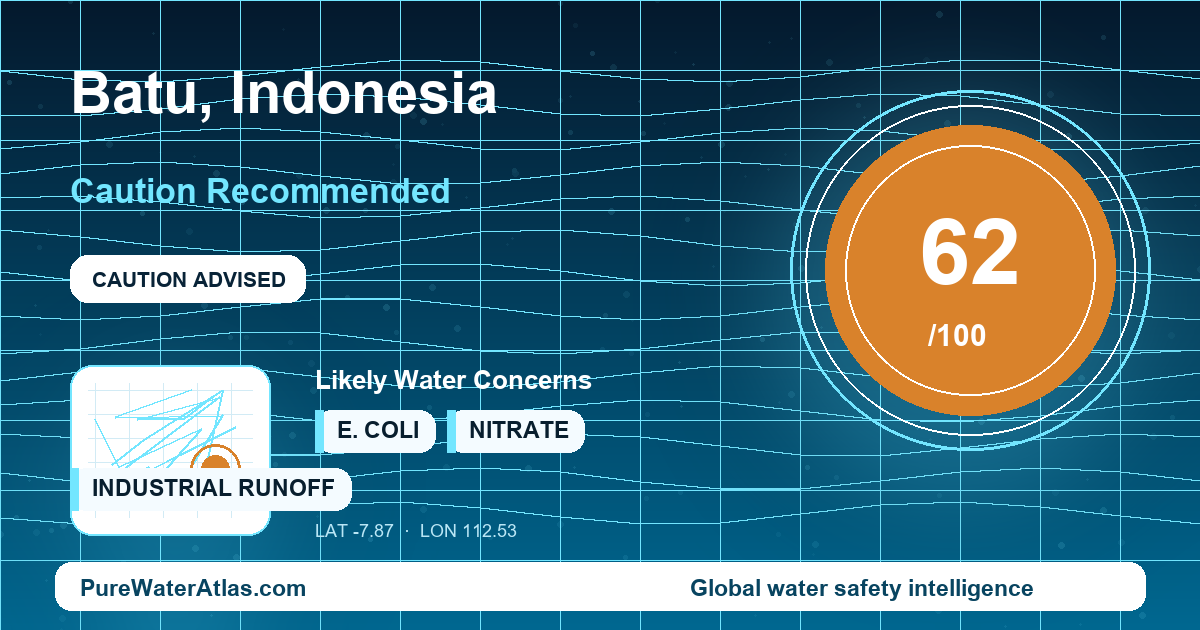
Batu, East Java: spring-fed highland water with caution recommended at the tap because public finished-water data are limited and building-level storage can change water quality.
Quick Answer
| Overall status | Caution recommended. Batu’s highland, spring-associated water setting is favorable compared with many lowland coastal systems, but direct drinking from the tap is not recommended without boiling, filtration, or confirmed treatment. |
|---|---|
| PureWaterAtlas score | 62 / 100 — risk level: Caution Recommended. |
| Traveler advice | Use sealed bottled water, properly boiled water, or water from a reliable purifier. Bathroom tap water should not be assumed potable. |
| Resident advice | Use point-of-use treatment for drinking and cooking unless your tap water has been verified as potable. Test private wells, community springs, and storage tanks periodically. |
| Main water source context | Batu’s supply is strongly associated with upland springs, local groundwater or spring catchments, and the upper Brantas watershed. |
| Local authority | Municipal piped water is associated with Perumdam Among Tirto Kota Batu, with public-health oversight linked to Dinas Kesehatan Kota Batu and national standards set by Indonesia’s Ministry of Health. |
| Filter recommendation | For most homes: sediment prefiltration, activated carbon, and a microbial barrier such as UV or ultrafiltration. Reverse osmosis is best reserved for cases where testing shows nitrate, high dissolved solids, or specific chemical concerns. |
Why Batu Is Different
Batu is not a coastal lowland city where seawater intrusion or desalination dominates the drinking-water discussion. It is an inland highland city in East Java, located in the upper Brantas watershed near volcanic mountain areas such as Arjuno-Welirang and Panderman. That geography gives Batu a different risk profile: the key question is not saltwater, but how well springs, recharge areas, small source captures, pipes, and household storage are protected from contamination.
The city’s drinking-water identity is closely tied to mata air, or springs. Batu developed as a highland settlement and tourism-agricultural area where springs, small upland streams, and local sources have long been important. This source-water geography can be an advantage because upland spring systems may begin with relatively favorable raw water. However, favorable source geography does not automatically mean safe water at the kitchen tap. Microbial intrusion, storage tanks, intermittent supply, runoff after rain, and building plumbing can all change water quality before someone drinks it.
Batu is also a tourism destination with many hotels, villas, restaurants, and attractions. For visitors, this means actual drinking-water safety may depend heavily on the individual property. A hotel that maintains tanks, filters, dispensers, and boiling practices may provide safer drinking water than an older guesthouse with stagnant rooftop storage, even if both are served within the same city.
Where Does Batu’s Tap Water Come From?
Batu’s municipal drinking-water system is primarily associated with upland spring water and local groundwater or spring catchments in the Brantas headwaters area of East Java. The wider basin context is the Brantas River basin, managed at basin scale by Balai Besar Wilayah Sungai Brantas. Batu’s raw-water availability is therefore closely connected to spring discharge, catchment protection, land use, and seasonal rainfall.
The local piped-water system is identified with Perumdam Among Tirto Kota Batu and spring-source infrastructure. The dataset used for this profile does not support a claim that every Batu neighborhood receives identical water from a single source or that all taps have the same quality. Instead, the best-supported description is that Batu’s public supply context is spring-dominated rather than a large coastal desalination, seawater-affected, or major lowland river-intake system.
At the household, hotel, restaurant, and villa level, storage tanks are especially important. Even if water leaves a treatment or distribution point in acceptable condition, it can deteriorate in a rooftop or ground tank that is open to insects, rodents, sediment, runoff, or biofilm. In Batu, where accommodations and homes may store water for practical reliability, tank hygiene is a real point-of-use safety issue.
Who Manages Drinking Water in Batu?
The municipal drinking-water company for Batu is Perumdam Among Tirto Kota Batu. The official Pemerintah Kota Batu portal is the appropriate starting point for local government context, while BPS Kota Batu provides official statistics relevant to geography, population, tourism, agriculture, and infrastructure context.
National drinking-water quality requirements in Indonesia are set through Ministry of Health regulations, including Permenkes No. 2 Tahun 2023 on environmental health implementing regulations. Local utilities and health offices are responsible for operational monitoring and public-health implementation.
A key limitation for Batu is data transparency at the tap. Publicly accessible information supports the identity of the local utility and the spring-dominated source context, but recent, consolidated, citywide finished-water compliance results by neighborhood and season are not readily available in an open format. For that reason, this profile does not claim that all municipal tap water in Batu either meets or fails a specific standard. The safer conclusion is practical: verify water quality at the point of use before drinking it untreated.
Main Local Water Concerns
- Microbial contamination: The most important practical risk is contamination by disease-causing organisms if spring water, private wells, community supplies, distribution pipes, or storage tanks are not adequately disinfected or protected. See PureWaterAtlas on E. coli in drinking water for the key indicator organism.
- Rain-related turbidity and sediment: During the wet season, heavy rainfall can increase runoff, sediment, and turbidity in vulnerable springs, shallow wells, small intakes, pipes, and poorly sealed tanks. Learn more about turbidity and sediment in drinking water.
- Agricultural runoff: Batu’s economy includes intensive highland agriculture. Where source protection is weak, upland recharge areas may be vulnerable to nitrate or pesticide-related concerns. Citywide public tap data are limited, so this should be treated as a reason to test wells and springs, not as proof of universal contamination. See nitrate in drinking water.
- Dry-season stress: Lower spring discharge in dry periods can reduce dilution, increase supply interruptions, and increase reliance on stored water or alternative sources.
- Iron and manganese: Some groundwater or plumbing contexts may show discoloration, staining, or taste issues from iron or manganese. The available dataset does not establish this as a verified citywide hazard.
- Building-specific metals: Lead is not documented as a citywide Batu issue in the provided sources, but older plumbing, brass fixtures, solder, or uncertified fittings can create building-level exposure. See lead in drinking water.
For Travelers
Most short-term visitors to Batu should not drink untreated tap water. Use sealed bottled water, properly boiled water, or water treated with a reliable purifier. This advice is especially important for young children, pregnant travelers, older adults, and immunocompromised visitors. The CDC Travelers’ Health guidance for Indonesia supports conservative food and water precautions for visitors.
For brushing teeth, the lowest-risk choice is bottled or boiled water. Many healthy adults may brush with tap water without swallowing, but that is not the most cautious option. Avoid ice unless the hotel or restaurant can confirm it is made from treated drinking water. In tourist areas, many establishments may use commercial ice, but verification is still advisable.
Hotels, villas, and guesthouses deserve specific questions. Ask whether drinking water comes from sealed bottles, a maintained refill dispenser, or boiled water. Do not assume bathroom tap water is intended for drinking. In smaller properties, ask how often rooftop or ground tanks are cleaned. If tap water is cloudy, discolored, or has sediment, do not drink it untreated. If you need an emergency microbial safety step, boiling is useful when water is clear; if water is cloudy, let particles settle and filter before boiling. PureWaterAtlas has a detailed boiling water purification guide.
For Residents
Residents connected to Perumdam Among Tirto or a verified community supply should still consider point-of-use treatment for drinking and cooking unless water quality has been confirmed at the tap. The need is highest after heavy rain, pipe repairs, pressure interruptions, contamination events, or long storage in rooftop or ground tanks.
A practical Batu household setup starts with sediment prefiltration if there are visible particles, followed by activated carbon for taste and odor control where appropriate, and UV or ultrafiltration for microbial protection. UV is most effective when water is already clear; see the PureWaterAtlas UV water purification guide. Reverse osmosis can be useful where lab testing shows nitrate, elevated dissolved solids, or specific chemical contaminants, but it should not be chosen blindly without testing and maintenance planning.
Private wells, community springs, and household spring-fed systems should be tested at least annually for E. coli and total coliforms, and again after floods, landslides, nearby construction, or pipe repairs. Additional tests should include turbidity, pH, electrical conductivity or total dissolved solids, nitrate, iron, and manganese. If infants, pregnant residents, or immunocompromised people drink the water, prioritize microbial and nitrate testing. For nitrate-specific testing guidance, see Nitrate Contamination in Drinking Water: Testing and Detection Methods.
Older homes, schools, guesthouses, and small hotels should not ignore internal plumbing. Batu does not have a verified citywide lead crisis in the available sources, but building-level metals testing is sensible where plumbing materials are unknown. PureWaterAtlas explains options in Lead in Drinking Water: Testing and Detection Methods.
Storage tanks are one of the most important resident control points. Tanks should be sealed, screened from insects and rodents, protected from runoff, cleaned on a routine schedule, and disinfected after contamination events. A safe supply can become unsafe if stored in a dirty or poorly protected tank.
Relevant Contaminants and Water-Quality Issues
The most relevant Batu issues are microbial safety, turbidity, sediment, agricultural runoff indicators, disinfection, and building-specific plumbing risks. Start with E. coli because it is central to assessing whether water has fecal contamination risk. During heavy rain or after pipe work, review turbidity and sediment, since cloudy water can reduce treatment effectiveness and indicate intrusion into sources, pipes, or tanks.
For households using private wells or spring-fed systems near agricultural recharge areas, nitrate is a priority test, especially where infants or pregnant residents may drink the water. For municipal users, chlorine is relevant because disinfection helps control microbial risk, even when taste or odor is noticeable. For older buildings, lead remains a building-level concern rather than a confirmed Batu-wide problem.
How to Verify Your Water Quality
The most reliable way to decide whether your Batu tap water is drinkable is to test the water actually coming from your tap, tank, well, or spring line. City-level source context is useful, but it cannot prove that a specific household, villa, restaurant, or school has safe water at the point of use.
Use the PureWaterAtlas complete guide to water testing and analysis to choose laboratory and field tests. For general decision-making, the Drinking Water Safety guide explains how to interpret whether water is safe to drink. If your main concern is bacteria, viruses, or microbial intrusion after rain or storage, review Water Microbiology. If you are choosing equipment, compare boiling, UV, filtration, and reverse osmosis in Water Treatment Systems.
For broader comparisons, use the Global Water Quality Checker. To research specific contaminants mentioned in this Batu profile, use the PureWaterAtlas Contaminants Search Engine. Related PureWaterAtlas categories include Global Water Quality, Drinking Water Safety, and Water Testing.
Official and Technical Sources
- Perumdam Among Tirto Kota Batu — local municipal drinking-water company for Batu.
- Pemerintah Kota Batu — official Batu city government portal.
- BPS Kota Batu — official statistics for Batu’s population, geography, economy, tourism, agriculture, and infrastructure context.
- Balai Besar Wilayah Sungai Brantas — Brantas basin authority relevant to Batu’s upper-watershed setting.
- Ministry of Health Regulation: Permenkes No. 2 Tahun 2023 — national Indonesian environmental health and drinking-water regulatory context.
- CDC Travelers’ Health: Indonesia — conservative travel-health guidance on food and water practices.
- WHO Drinking-water Fact Sheet — global public-health context for safe drinking water, source protection, and treatment.
Bottom Line
Batu’s tap water deserves a cautious but not alarmist rating. The city’s highland position and spring-associated supply are favorable compared with many water systems facing coastal salinity or heavily degraded lowland sources. However, open public data showing routine finished-water results at Batu consumer taps are limited, and point-of-use risks are real. Heavy rain, pipe repairs, intermittent pressure, private wells, community springs, and dirty rooftop or ground tanks can all affect safety. Travelers should drink bottled, boiled, or reliably purified water. Residents should verify their own tap, tank, well, or spring supply with microbial and basic chemistry testing, then choose treatment based on results.
Read the full guide: Global Water Quality Guide
Explore more in this category: Global Water Quality Articles