
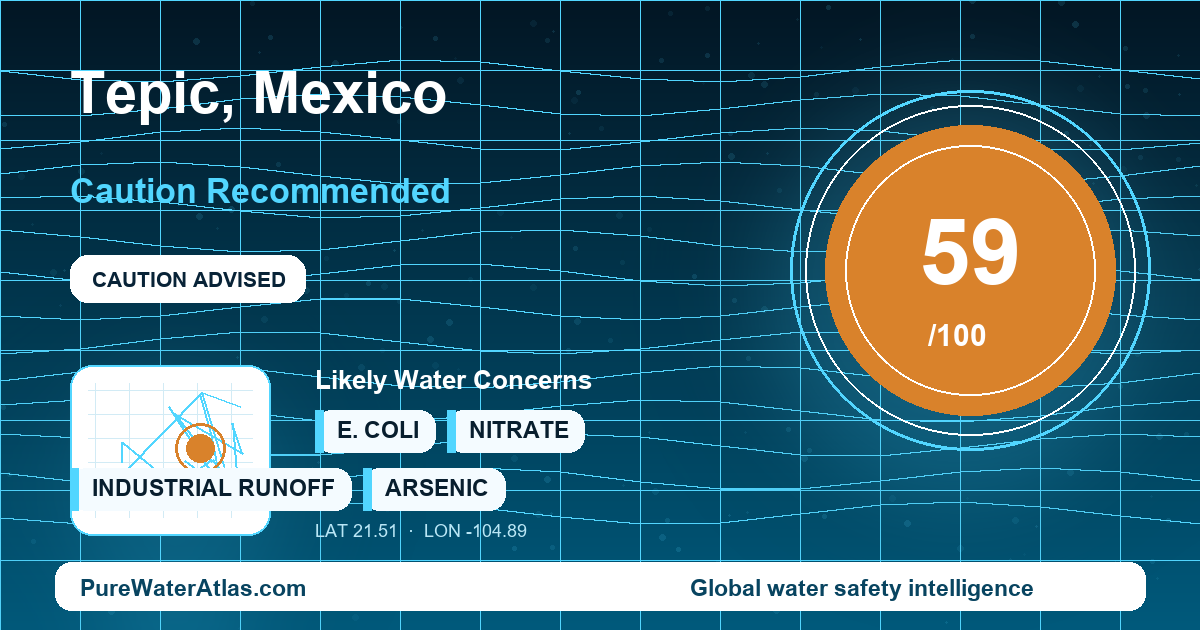
Tepic, Nayarit has a treated municipal groundwater supply, but direct tap-water drinking requires caution because public neighborhood-level test data are limited and actual tap quality can depend on pressure stability, distribution pipes, cisterns, rooftop tinacos, and building plumbing.
Quick Answer
| City | Tepic, Nayarit, Mexico |
|---|---|
| Water safety score | 59 / 100 |
| Risk level | Caution Recommended |
| Is Tepic tap water safe to drink? | Caution recommended. Tepic is not a simple yes-or-no tap water city. The municipal supply is treated and chlorinated, but recent, public, citywide laboratory reporting is limited, and water quality can change after water leaves the well and travels through pipes, pressure zones, household cisterns, rooftop tanks, and building plumbing. |
| Traveler advice | Most short-term visitors should use sealed bottled water, hotel-provided purified water, or a verified purification refill source for drinking. Tap water is generally acceptable for showering and handwashing, but visitors should not drink it directly unless their hotel specifically maintains and tests its water system. |
| Resident advice | Residents should treat municipal tap water as a source that may need point-of-use protection. A maintained sediment prefilter plus activated carbon, UV, or reverse osmosis may be appropriate depending on testing results, storage-tank condition, household risk, and private-well use. |
| Main water source | Predominantly municipal groundwater wells drawing from the Tepic-Valle de Matatipac groundwater system in central Nayarit. |
| Local authority | SIAPA Tepic, the Sistema Integral de Agua Potable y Alcantarillado de Tepic, under the municipal government of Tepic. |
| Filter recommendation | For daily drinking use, consider sediment filtration and activated carbon as a baseline, with UV or reverse osmosis added when testing, storage tanks, infants, immunocompromised residents, or private wells raise concern. |
Why Tepic Is Different
Tepic’s drinking-water profile is shaped by its geography and infrastructure. The city is inland and highland, located in the Valle de Matatipac in central Nayarit rather than on the coast. That matters because the main water-safety questions are not the same as in a coastal city where seawater intrusion and coastal salinity may dominate. In Tepic, the more relevant issues are groundwater management, pumping reliability, pipe integrity, distribution pressure, rainy-season effects, and the condition of household storage tanks.
The available information indicates that Tepic’s public drinking-water supply is predominantly groundwater from municipal wells associated with the Tepic-Valle de Matatipac groundwater system. Groundwater can be relatively protected compared with open surface-water sources, but that does not automatically mean every household tap is safe to drink without treatment. Once water leaves a municipal well and disinfection point, it must remain protected through pumping systems, distribution lines, storage tanks, and building plumbing.
This is why Tepic receives a “Caution Recommended” rating rather than a simple approval or rejection. The local utility identity and groundwater dependence are reasonably clear, but recent downloadable, neighborhood-level water-quality results are not consistently public. Without transparent citywide data for microbial indicators, residual chlorine, metals, nitrate, turbidity, and disinfection performance, PureWaterAtlas does not claim that all Tepic taps meet Mexican drinking-water standards at all times.
Where Does Tepic’s Tap Water Come From?
Tepic’s public tap water appears to come mainly from municipal groundwater wells rather than a large surface-water reservoir or a conventional river treatment plant. The wells draw from the valley groundwater system in the Tepic-Valle de Matatipac area. The city also sits near the Mololoa River basin, but that river should not be assumed to be a potable tap-water source unless official source-water documents state that it is. In the urban context, the Mololoa River is better understood as part of Tepic’s hydrologic and environmental setting, not as confirmed drinking-water supply for household taps.
The main infrastructure elements relevant to Tepic drinking water include municipal wells, pumping systems, chlorination or other disinfection points, storage tanks, pressure-management infrastructure, and distribution lines. After that, water quality is often influenced by private or building-level infrastructure: underground cisterns, rooftop tinacos, interior plumbing, faucets, and fixtures.
For many households, the most important question is not only whether the municipal supply is disinfected, but whether that protection survives to the kitchen tap. Intermittent service, low pressure, main repairs, stagnant plumbing, long distribution lines, and poorly maintained storage tanks can all affect water quality after treatment. In Tepic, this distribution-and-storage step is central to practical drinking-water safety.
Who Manages Drinking Water in Tepic?
The local drinking-water operator is SIAPA Tepic, commonly referred to as the Sistema Integral de Agua Potable y Alcantarillado de Tepic. SIAPA operates within the municipal public-service context of the Gobierno Municipal de Tepic.
At the national level, water-resource oversight is handled by CONAGUA’s Sistema Nacional de Información del Agua and by CONAGUA’s groundwater and aquifer availability framework, including official information on disponibilidad por acuíferos. This is relevant for Tepic because the city’s public supply is understood to depend primarily on groundwater from the valley system.
Drinking water for human consumption in Mexico is governed by federal sanitary standards, including NOM-127-SSA1-2021, which sets permissible quality limits and treatment requirements. Public-health surveillance and sanitary protection frameworks also involve federal health authorities such as COFEPRIS. These standards and institutions are important, but they do not replace the need for accessible local test results and building-level verification when deciding whether to drink directly from a specific tap.
Main Local Water Concerns
Tepic’s main water concerns are not based on a publicly verified citywide exceedance pattern for a single contaminant. Instead, the risk profile is tied to groundwater vulnerability, service continuity, distribution conditions, disinfection residual, and household storage. The most important documented concerns are practical and local:
- Intermittent service and low pressure: Pressure drops can increase the chance of intrusion where pipes are damaged, poorly sealed, or affected by repairs.
- Sediment after repairs or outages: Discolored water, particulates, or turbidity may appear after main repairs, pressure changes, flushing, or localized service interruptions.
- Declining chlorine residual: Municipal chlorination is important, but residual free chlorine can decline in long distribution lines, stagnant building plumbing, cisterns, or rooftop tanks.
- Groundwater nitrate screening: Groundwater in urban and agricultural valley settings can be vulnerable to nitrate. The available data do not support claiming a citywide Tepic nitrate exceedance pattern, but nitrate testing is prudent for private wells, infants, pregnant people, and households near agricultural or septic influence.
- Premise plumbing metals: Older buildings may have plumbing materials, solder, fixtures, galvanized pipe, or corrosion conditions that affect lead and metal exposure independently of municipal source-water quality.
- Private wells and non-municipal sources: Water outside the main SIAPA-treated network needs separate laboratory testing and should not be assumed to match the municipal supply.
Season also matters. During the summer rainy season, runoff, localized flooding, turbidity episodes, power interruptions, and pressure instability can increase risk around poorly sealed wells, damaged pipes, and household storage tanks. After outages or repairs, first-draw water may be discolored or contain sediment, and flushing plus disinfection precautions are appropriate before using that water for drinking.
For Travelers
Most visitors to Tepic should not drink directly from the tap. Use sealed bottled water, hotel-provided purified water, or a trusted purification refill source. This advice is conservative, but it is appropriate because travelers usually do not know whether a hotel’s cistern, rooftop tank, or internal plumbing is maintained and tested.
For brushing teeth, short-term visitors should use bottled or purified water, especially if they are immunocompromised, traveling with small children, or staying in accommodations with unknown tank maintenance. Showering and handwashing with tap water are usually acceptable, but drinking from bathroom taps is not recommended.
Ice should be treated as a source-specific decision. Ice in established hotels, restaurants, or cafés is often made from purified water or commercial ice, but visitors should ask rather than assume. Avoid informal ice if the water source is unclear. In restaurants, ask whether drinking water and ice are purified, especially outside tourist-standard accommodations.
Carry bottled water during the day, check that bottle seals are intact, and use oral rehydration salts if gastrointestinal illness occurs. If no safe packaged or treated water is available, boiling is the most reliable emergency method for microbial risk. A basic taste-and-odor filter alone is not enough unless it is specifically rated for the microorganisms of concern or paired with proper disinfection. For emergency treatment details, see PureWaterAtlas’ Boiling Water Purification: Complete Guide.
For Residents
Residents who drink Tepic tap water every day should think beyond the question “does the city disinfect water?” A better question is: “What is the quality of the water at my tap after my neighborhood distribution line, cistern, rooftop tinaco, and plumbing?” For many households, a point-of-use system is advisable.
At minimum, many homes should consider a maintained sediment prefilter and activated carbon. Sediment filtration helps with particulates and discolored water after distribution disturbances, while activated carbon can improve taste and reduce chlorine-related taste and some chemical concerns. Depending on test results and household risk, UV disinfection or reverse osmosis may be appropriate. UV is especially relevant where stored municipal water creates microbial concern, while reverse osmosis may be considered when testing indicates the need for broader dissolved-contaminant reduction. For a deeper comparison, see Water Treatment Systems and UV Water Purification: Complete Guide.
Testing is important for Tepic households with cisterns, rooftop tanks, private wells, recent outages, flooding, sewage odors nearby, infants, pregnant people, immunocompromised residents, or older plumbing. Test for total coliform and E. coli when microbial risk is possible. Check residual free chlorine at the tap during normal service and after water has been stored. Test nitrate for infants, pregnant people, private-well users, and homes near agricultural or septic influence. In older buildings, test lead and other metals, especially after long stagnation or where plumbing materials are unknown.
Storage tanks are a major control point. Cisterns and tinacos should be sealed, screened, shaded where possible, cleaned, and disinfected on a routine schedule. After flooding, long outages, visible sediment, animal entry, or nearby sewage contamination, do not drink stored water until the tank and lines are cleaned and disinfected and microbiological safety is verified.
Relevant Contaminants and Water-Quality Issues
The most relevant Tepic water-quality issues are linked to microbial protection, disinfection residual, sediments, groundwater screening, and premise plumbing.
- E. coli: A key indicator for fecal contamination and the most important concern when service is intermittent, tanks are poorly maintained, or disinfection residual is uncertain.
- Turbidity: Relevant after pipe repairs, pressure changes, rain events, flushing, and sediment disturbance.
- Sediment: Useful for understanding discolored water, clogged filters, and particulates released by distribution-system disturbance.
- Chlorine: Residual chlorine is central to maintaining microbial protection after groundwater is pumped and distributed.
- Nitrate: A prudent screening concern for groundwater in urban and agricultural valley settings, especially for infants, pregnant people, and private wells. See also Nitrate Contamination in Drinking Water: Testing and Detection Methods.
- Lead: A building-level risk that can occur from older plumbing, solder, fixtures, or corrosion even when the municipal source is acceptable. See Lead in Drinking Water: Testing and Detection Methods.
How to Verify Your Water Quality
Because Tepic lacks easily accessible, recent, neighborhood-level laboratory results for all major indicators, the safest way to answer the drinking question for a specific home is to test the water actually used for drinking. Use a certified laboratory for health decisions. Home strips can screen for chlorine, nitrate, hardness, and total dissolved solids, but they should not be treated as definitive for microbiological safety.
For a practical testing plan, start with the PureWaterAtlas Water Testing guide. For general safety principles, see Drinking Water Safety and Water Microbiology. You can also compare city-level context using the Global Water Quality Checker and research specific issues in the Contaminants Search Engine.
Residents should test both first-draw and flushed samples if lead or premise-plumbing corrosion is a concern. If water is discolored, metallic tasting, staining fixtures, or clogging filters, include turbidity, iron, manganese, hardness, and total dissolved solids. If the property uses a private well or non-municipal source, do not rely on assumptions about SIAPA-treated water; test that source separately.
Official and Technical Sources
- SIAPA Tepic official information — local operator identity, service notices, infrastructure context, and municipal water-service information.
- Ayuntamiento de Tepic — official municipal context for Tepic and public-service institutions.
- CONAGUA Sistema Nacional de Información del Agua — national water-resource and water-service indicators, including state and basin context.
- CONAGUA groundwater and aquifer availability information — official aquifer availability and groundwater management framework.
- NOM-127-SSA1-2021, Agua para uso y consumo humano — Mexican federal drinking-water quality standard.
- COFEPRIS — federal sanitary authority relevant to drinking-water health surveillance.
- INEGI geographic information for Tepic municipality — official geographic and municipal reference for Tepic, Nayarit.
- CDC Mexico traveler health guidance — traveler advice supporting conservative food and water precautions in Mexico.
- WHO Guidelines for Drinking-water Quality — international reference for microbial risk, treatment barriers, and drinking-water safety principles.
Bottom Line
Tepic’s tap water should be treated with caution for drinking. The city’s municipal supply is understood to rely mainly on treated, chlorinated groundwater from the Tepic-Valle de Matatipac system, managed locally by SIAPA Tepic, but publicly accessible, recent, neighborhood-level lab reporting is limited. For visitors, sealed bottled water, purified hotel water, or verified refill sources are the safest choices; use purified water for brushing teeth and confirm that ice is made from purified water. Residents should focus on the tap they actually use: distribution pressure, pipe condition, cisterns, rooftop tinacos, old plumbing, and chlorine residual can determine safety. A maintained sediment and carbon system, plus UV or reverse osmosis when testing indicates, is a practical approach.
Read the full guide: Global Water Quality Guide
Explore more in this category: Global Water Quality Articles