
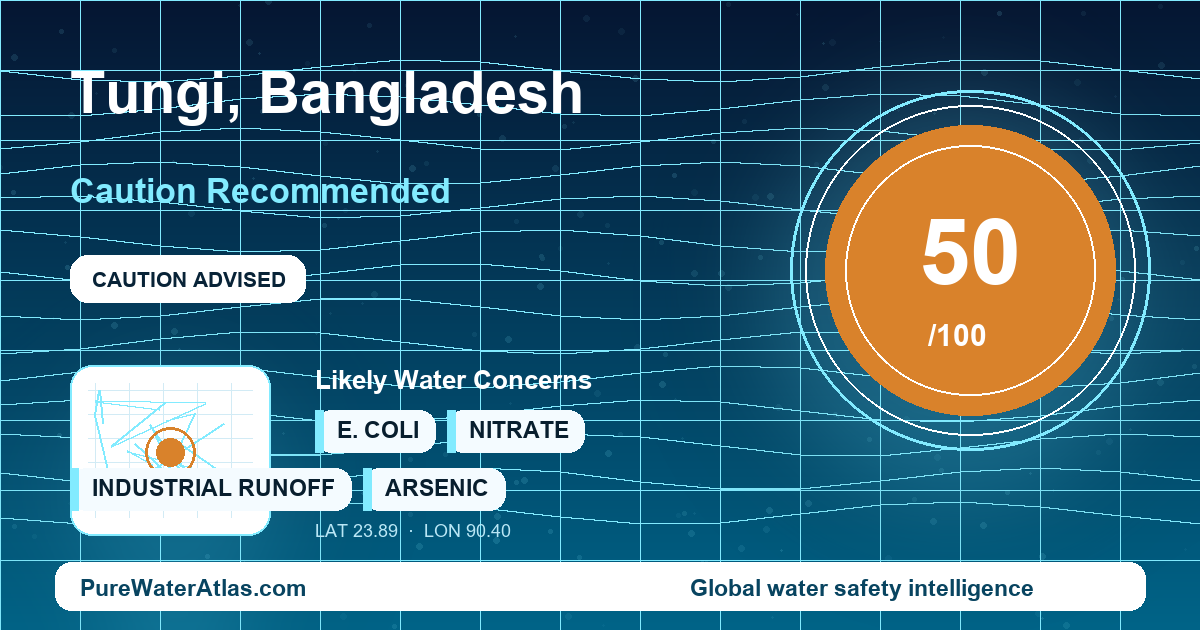
Tungi, Bangladesh: groundwater-dominant urban water supply, building-tank variability, and caution recommended for untreated tap water.
Quick Answer
| Tap water safety status | Caution recommended. PureWaterAtlas assigns Tungi a water safety score of 50/100. Untreated tap water should not be assumed safe citywide. |
|---|---|
| Short-term visitor advice | Do not drink untreated tap water unless it has been boiled, disinfected, or passed through a well-maintained purifier. Use sealed bottled water, boiled water, or verified hotel-filtered water. |
| Resident advice | Treat drinking water as source-specific. Piped water, private tube wells, building pumps, and rooftop tanks can produce different risk profiles even within the same area. |
| Main practical water source | Tungi is best characterized as groundwater-dominant, using municipal and private tube wells or production wells, pumps, local pipes, and building storage tanks. |
| Local authority | Gazipur City Corporation is the municipal authority for Tungi, with national water-sector context involving the Department of Public Health Engineering and the Local Government Division. |
| Filter recommendation | Often advisable, but do not choose blindly. For private wells, test first for arsenic, iron, manganese, nitrate, salinity/TDS, and microbial indicators. For tank-stored water, include a microbial barrier such as boiling, UV, or suitable disinfection. |
Confidence level: Medium-low for citywide tap-water safety. The groundwater-based supply pattern and local authority context are reasonably supported, but PureWaterAtlas did not find a recent public Tungi-specific consumer water-quality report showing routine neighborhood-level compliance for arsenic, E. coli, residual chlorine, turbidity, metals, or distribution-zone performance.
Why Tungi Is Different
Tungi is not a place where tap-water safety can be summarized by a single central treatment plant result. It is a dense industrial and residential area in the northern Dhaka urban corridor, administratively part of Gazipur City Corporation, and closely connected to Dhaka’s commuter and industrial belt. The city lies along the Turag River, but the Turag is better documented as a polluted urban-industrial river and drainage corridor than as a verified potable-water intake for residents.
The practical drinking-water chain in Tungi is highly local. A household, apartment, hotel, institution, or workplace may receive water from a municipal connection, a private building pump, a tube well, or a combination of local supply and storage. That water may then pass through underground reservoirs, rooftop tanks, internal pipes, and taps before anyone drinks it. In this setting, the safety of water at the kitchen tap depends not only on the original groundwater source, but also on pump protection, pipe integrity, pressure reliability, tank hygiene, and safe household handling.
This building-by-building variability is especially important for travelers. A visitor staying in Tungi may not be drinking water from a continuously monitored municipal distribution chain. The water may have passed through a hotel or apartment building’s own pump and rooftop tank. That does not automatically mean it is unsafe, but it does mean that untreated tap water should not be treated as reliably potable without confirmation and treatment.
Where Does Tungi’s Tap Water Come From?
Tungi’s practical drinking-water system is best described as groundwater-dominant. Municipal supply and private household or building pumps commonly draw from tube wells or deep production wells, then move water through electric pumps, local distribution mains, household connections, standpipes where available, and storage tanks. PureWaterAtlas did not find high-confidence public evidence that Tungi has a citywide, continuously monitored treated surface-water drinking supply comparable to major metropolitan utilities.
The key infrastructure for drinking water in Tungi includes Gazipur City Corporation local water-supply services and municipal engineering functions, groundwater tube wells and production wells, electric pumps, local pipes, private building wells or pumps, and rooftop or underground storage tanks. In practice, those tanks are one of the most important final water-quality control points. A protected well can still deliver unsafe drinking water if the storage tank is open, dirty, poorly screened, contaminated by insects or rodents, or exposed to floodwater or drain backflow.
The nearby Turag River and drainage canals matter mainly as environmental pressure sources. Tungi’s industrial setting and the documented pollution concerns around rivers in the Dhaka-Gazipur corridor increase the importance of well protection, wastewater control, drainage management, and source testing. However, river pollution should not be interpreted as direct proof that every tap in Tungi is contaminated. The relevant point for household safety is that local source protection and testing are essential where groundwater, urban drainage, private pumps, and building tanks interact.
Who Manages Drinking Water in Tungi?
Tungi is under Gazipur City Corporation, which is the local municipal authority for the area. National water-supply and sanitation support in Bangladesh involves the Department of Public Health Engineering and the Local Government Division. Drinking-water quality standards are set at the national level through Bangladesh standards and environmental or public-health regulations.
For practical users, the important limitation is transparency at the neighborhood level. PureWaterAtlas found useful official context for Gazipur City Corporation and Bangladesh’s national water-sector institutions, but did not find a recent public consumer confidence report or routine Tungi water-quality dashboard showing continuous compliance for piped water. That lack of public city-level data is why this profile does not claim that all tap water in Tungi is safe or unsafe. Actual risk can change by source, building, tank condition, pipe condition, well depth, and recent flooding or repair history.
Main Local Water Concerns
- Microbial contamination: The main day-to-day risk is biological contamination after pumping, especially where water pressure is intermittent, pipes leak, tanks are not cleaned, or water is handled unsafely. E. coli in drinking water is a key indicator for fecal contamination and should be included in testing for wells, tanks, and suspect taps.
- Arsenic in groundwater: Bangladesh has a well-known groundwater arsenic problem, and arsenic cannot be detected by taste, smell, or appearance. Private tube wells in Tungi should be tested before drinking use. See the PureWaterAtlas guide to arsenic in drinking water.
- Iron and manganese: Groundwater may contain iron or manganese that causes yellow, brown, blackish, metallic-tasting, or staining water. These can be acceptability concerns and, depending on concentration, health-based screening concerns. Learn more about iron and manganese.
- Turbidity and sediment: Cloudy or sediment-heavy water can appear after pipe disturbance, pump maintenance, construction, monsoon runoff intrusion, or tank sludge. Turbid water can interfere with disinfection and should be treated cautiously. See turbidity in drinking water.
- Industrial and urban pollution pressure: Tungi’s industrial context and proximity to the Turag River make groundwater protection and wastewater management important, although this does not prove contamination at a specific tap.
- Nitrate and bacteriological risk near drains or sanitation sources: Shallow or poorly sealed wells near drains, latrines, septic systems, livestock areas, fertilizer use, or flood-affected ground should be tested for nitrate and microbial indicators.
Season matters. Monsoon flooding and heavy rainfall can increase drain overflow, wellhead contamination, and turbidity in poorly protected systems. Dry-season demand can increase reliance on private pumps or lower-yield wells and may worsen low-pressure distribution conditions. After storms, pipe repairs, or pump outages, residents should be more alert for cloudy water, unusual odor, or loss of disinfectant residual where chlorination is used.
For Travelers
Do not drink untreated tap water in Tungi. Short-term visitors should use sealed bottled water from reliable shops, boiled water, or hotel-supplied filtered water that the hotel can explain and maintain. Check bottle seals and avoid unsealed refilled bottles.
For brushing teeth, use bottled, boiled, or reliably filtered water, especially for children, immunocompromised travelers, and anyone with a sensitive stomach. Avoid swallowing water in the shower. Use good hand hygiene before eating, especially during hot weather or after travel through crowded areas.
Ice should be treated as higher risk unless a reputable hotel or restaurant can confirm it was made from treated water. Street-side ice should be avoided. In restaurants, prefer sealed bottled drinks, hot tea, or coffee served steaming, and food prepared hot. Better hotels and restaurants may use filtered or bottled water, but ask directly rather than assuming.
Carry oral rehydration salts during hot weather. If persistent diarrhea, fever, blood in stool, or dehydration develops, seek medical care. For practical treatment options, the PureWaterAtlas Boiling Water Purification Guide explains how boiling reduces microbial risk when done and stored correctly.
For Residents
Residents should start by identifying the actual household source: municipal piped connection, private tube well, building pump, shared supply, tanker or stored water, or a mixed system. In Tungi, the source and the last-mile pathway both matter. A household using municipal piped water still needs clean internal storage. A household using a private tube well needs source testing before choosing a treatment device.
For piped or tank-stored water, a practical setup often includes sediment prefiltration plus a microbial barrier such as boiling, UV, or another reliable disinfection method. UV can be useful for biologically unsafe but relatively clear water, but it requires maintenance and low turbidity; see the PureWaterAtlas UV Water Purification Guide. Reverse osmosis can reduce several dissolved contaminants, but it also requires maintenance and safe storage and should not replace testing.
Private tube wells should be tested for arsenic, iron, manganese, nitrate, salinity/TDS, and E. coli or thermotolerant coliforms. Retest periodically, especially after flooding, new construction, pump changes, or changes in taste, color, odor, or clarity. For apartments, test water at the kitchen tap after the building tank as well as at the incoming source if possible, because tanks and internal plumbing can alter water quality.
Older buildings deserve extra caution. Bangladesh does not have the same documented lead-service-line profile as some older Western cities, but lead and other metals can still leach from fittings, soldered joints, brass components, corroded galvanized iron pipes, or internal plumbing materials. If a building is old, water has been stagnant overnight, or infants or pregnant people are present, consider first-draw and flushed sampling for metals. PureWaterAtlas has additional information on lead in drinking water and lead testing methods.
Storage tanks are a major control point. Rooftop and underground tanks should be covered, screened from insects and rodents, protected from floodwater and drain backflow, and cleaned and disinfected on a routine schedule. If sludge, algae, odor, dead insects, or animal access is found, do not drink the water without treatment and tank remediation.
Relevant Contaminants and Water-Quality Issues
The most relevant PureWaterAtlas contaminant profiles for Tungi are E. coli for microbial contamination from tanks, wells, and intermittent distribution; arsenic for Bangladesh groundwater risk; turbidity for cloudy water after monsoon events, pipe work, or tank sediment; iron and manganese for common groundwater color, taste, and staining problems; and lead for older internal plumbing and fittings.
For broader context, see PureWaterAtlas pillar guides on Drinking Water Safety, Water Microbiology, and Water Purification.
How to Verify Your Water Quality
The safest approach in Tungi is to test the water you actually drink, at the point you drink it. For a household tap, that means sampling after the building tank and internal plumbing. For a private well, it means testing the well source and, if storage is used, the post-storage tap as well.
Use the PureWaterAtlas Water Testing Guide to plan sampling and choose parameters. Residents using tube wells should also review Arsenic in Drinking Water: Testing and Detection Methods. To compare broader city and country risk context, use the Global Water Quality Checker. To look up specific substances such as arsenic, E. coli, iron, manganese, nitrate, turbidity, and lead, use the Contaminants Search Engine.
Official and Technical Sources
- Gazipur City Corporation — official municipal authority for Gazipur City Corporation, which includes Tungi.
- Department of Public Health Engineering, Government of Bangladesh — national public-health engineering role in water supply, sanitation, and arsenic-related water-supply programs.
- Local Government Division, Government of Bangladesh — national institutional context for local government water-supply and sanitation responsibilities.
- WHO/UNICEF Joint Monitoring Programme — Bangladesh national drinking-water and sanitation service context, not Tungi neighborhood-level compliance.
- World Health Organization: Drinking-water — general health basis for microbial safety, safe storage, and managed drinking-water systems.
- World Health Organization: Arsenic — health basis for arsenic testing in groundwater-dependent areas.
- UNICEF Bangladesh WASH — Bangladesh safe drinking-water and arsenic-affected water-supply context.
- World Bank Projects — municipal water-supply and sanitation sector context in Bangladesh.
- Department of Environment, Government of Bangladesh — environmental regulation relevant to industrial pollution and river protection.
- Peer-reviewed research indexed in PubMed Central — scientific literature documenting pollution concerns in rivers around Dhaka, including the Turag, as environmental-pressure context.
Bottom Line
Tungi’s tap water should be approached with caution, not panic. The area is groundwater-dominant and highly dependent on pumps, local pipes, private wells, and building storage tanks, so water quality can vary from one building to another. Short-term visitors should use sealed bottled, boiled, or reliably filtered water and avoid unverified ice. Residents should test private wells and tank-stored tap water for microbial indicators, arsenic, iron, manganese, nitrate, salinity/TDS, and relevant metals before relying on it for drinking. Clean, covered, disinfected rooftop and underground tanks are essential. Because public, recent, Tungi-specific compliance data are limited, the safest decision is to verify the water at your own tap and treat it according to the test results.
Read the full guide: Global Water Quality Guide
Explore more in this category: Global Water Quality Articles