
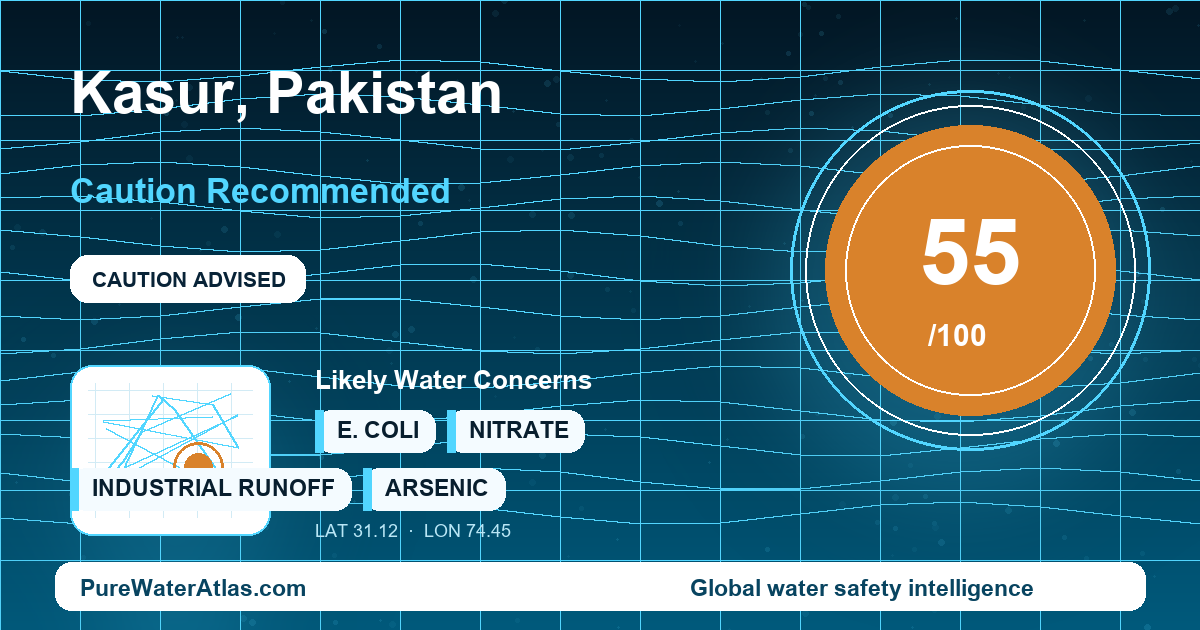
Kasur, Pakistan: groundwater-based drinking water with caution recommended because final tap quality can vary by bore depth, distribution condition, household storage, and proximity to drains or industrial influence.
Quick Answer
| Water safety score | 55 / 100 |
|---|---|
| Risk level | Caution Recommended |
| Can visitors drink tap water? | Not recommended untreated. Visitors should use sealed bottled water, boiled water, or water from a verified purifier. |
| Resident advice | Treat tap, bore, hand-pump, or stored water as source-specific. Test the actual drinking tap before assuming it is safe. |
| Main water source | Groundwater from municipal tube wells, private boreholes, hand pumps, and filtration-plant feed water. |
| Local management | Urban water supply is locally managed through Kasur’s municipal local government structure, with relevant roles for Punjab public-health engineering and safe-water programs. |
| Filter recommendation | A maintained multi-stage system is advisable for many homes. Where TDS, nitrate, arsenic, salinity, or metals are concerns, RO is more appropriate than a simple taste filter; add UV or another disinfection barrier where microbial risk is possible. |
Editorial verdict: Caution is recommended. Kasur’s drinking water is mainly groundwater supplied through municipal tube wells, private bores, hand pumps, public filtration plants, and household storage. The key concern is not a single proven citywide contaminant result, but the combined local risk profile: groundwater dependence, intermittent distribution, sewer-intrusion potential, household tanks, possible salinity or high dissolved solids in parts of Punjab aquifers, and industrial pressure associated with Kasur’s leather-tannery sector.
Why Kasur Is Different
Kasur is not a city where drinking water can be described accurately as one uniform supply. The practical household question is often: which source is this home actually using? A home may receive municipal line water, use a private bore, collect water from a public filtration plant, rely on a shallow hand pump, buy delivered water, or combine several sources in underground and rooftop tanks. Because of that chain, the water at the kitchen tap may differ from the water at the source bore or pump.
Kasur’s setting adds to this variability. The city is in Punjab near the India border, in the Ravi-Sutlej doab region, an intensively irrigated agricultural and urbanizing groundwater environment. Historically, local drinking water has depended on shallow and deeper groundwater. Urban growth, irrigation recharge, wastewater channels, drains, and local sanitation systems all matter when interpreting groundwater quality.
Kasur is also nationally known for its leather-tannery cluster. International and Pakistani environmental literature has repeatedly identified tannery wastewater as a major local pollution issue, especially for drains, soils, and groundwater near industrial influence zones. This does not prove that every municipal tap in Kasur contains tannery pollutants. It does mean households near tannery-affected drains, wastewater channels, or shallow industrial-zone groundwater should avoid assuming untreated groundwater is safe without laboratory testing.
Where Does Kasur’s Tap Water Come From?
Kasur is principally a groundwater city. Drinking water is drawn from the alluvial aquifer of the Punjab plains through municipal tube wells, private boreholes, public hand pumps, and feed water for filtration plants. There is no evidence in the available dataset that ordinary city supply is based on a large conventional surface-water treatment plant using river water.
The local drinking-water chain can include:
- Municipal tube wells and pumping stations serving the urban water network.
- Distribution mains and household service connections, with possible intermittent pressure.
- Public drinking-water filtration plants installed or supported by provincial and local programs.
- Private boreholes, suction pumps, and hand pumps where municipal supply is absent or unreliable.
- Household underground tanks, rooftop tanks, and in-building plumbing.
- Urban drains and wastewater channels that can influence shallow groundwater during leakage, flooding, or poor separation from water lines.
- Tannery effluent-management and industrial-wastewater controls, relevant to source-water protection rather than proof of contamination at every tap.
This infrastructure pattern is important because water quality can degrade after pumping. Low-pressure distribution, leaking pipes, nearby sewer lines, dirty storage tanks, stagnant rooftop tanks, and older building plumbing can all change the final water people drink.
Who Manages Drinking Water in Kasur?
Urban water supply in Kasur is locally managed through the city’s municipal local government structure, commonly referenced as Municipal Corporation or Municipal Committee Kasur under Punjab’s Local Government and Community Development Department. The Punjab Local Government and Community Development Department provides the provincial local-government framework under which municipal services are administered.
Other Punjab institutions can be relevant to safe-water projects and infrastructure. The Punjab Public Health Engineering Department is relevant to water-supply and sanitation schemes, especially outside large WASA-managed metropolitan systems. The Punjab Saaf Pani Authority is relevant to public filtration plants and safe drinking-water initiatives in Punjab. Pollution control and protection of local water resources fall within the relevance of the Punjab Environmental Protection Department, especially where industrial or municipal wastewater can affect drains, soils, or groundwater.
Pakistan’s drinking-water quality framework is guided by national standards and public-health agencies. The Pakistan Council of Research in Water Resources provides national water-quality research and monitoring, including water quality reports and publications. However, publicly accessible annual consumer confidence reports comparable to those in some high-income countries are not routinely available for Kasur. For that reason, this profile does not claim that all Kasur tap water is unsafe, and it also does not claim that all taps meet a specific standard.
Main Local Water Concerns
The main concerns in Kasur are source-specific and infrastructure-specific. A municipal connection in one neighborhood, a deep private bore in another, and a shallow hand pump near a drain can have very different risk profiles. The documented local concerns include:
- Microbial contamination risk: Intermittent supply, low pressure, leaking pipes, sewer proximity, shallow groundwater, and household storage tanks can allow fecal contamination to enter drinking water.
- High TDS, salinity, hardness, or poor taste: These can occur in groundwater depending on bore depth and local hydrogeology.
- Arsenic: Arsenic is a recognized issue in parts of Punjab’s alluvial aquifers. It should be tested rather than guessed.
- Nitrate: Nitrate risk can occur where groundwater is influenced by agriculture, livestock waste, septic systems, or sewage leakage.
- Industrial metals near affected zones: Chromium and other metals are plausible concerns near tannery-affected drains or shallow industrial-zone groundwater, but tap-specific testing is required before making a household claim.
- Turbidity, odor, discoloration, and sediment: These may occur after pump outages, pipe repairs, monsoon runoff, or tank disturbance.
- Lead from buildings: Lead risk is more likely from older building plumbing, fittings, solder, or fixtures than from Kasur’s raw aquifer itself.
Season also matters. Monsoon rain can increase turbidity, sewer overflow, drain backflow, and contamination of shallow wells or poorly sealed boreheads. Hot summer conditions increase demand, intermittent pumping, storage-tank stagnation, and loss of disinfectant residual where chlorination is used. Power outages or low-pressure periods can raise intrusion risk in compromised distribution lines. After flooding or street-level sewage overflow, private bores and hand pumps should be considered suspect until disinfected and tested.
For Travelers
Visitors should not rely on untreated tap water in Kasur. The safer choice is sealed bottled water from reputable brands, boiled water, or water treated by a reliable purifier. Check bottle seals and avoid bottles that appear refilled. Use treated water for taking medications and carry oral rehydration salts in hot weather.
For brushing teeth, short-stay visitors should use bottled, boiled, or treated water, especially children, pregnant travelers, and anyone with a sensitive stomach. Ice should be avoided from street vendors and small restaurants unless the venue can confirm it was made from treated water. Ice can carry the same microbial risk as untreated water.
Higher-end hotels and restaurants may use filtration, but travelers should not assume that all drinking water and ice are filtered or bottled. Ask directly, and prefer sealed bottles opened at the table. For infant formula, use boiled or otherwise treated water.
This guidance is consistent with conservative food-and-water precautions for Pakistan from travel-health authorities such as CDC Travelers’ Health: Pakistan.
For Residents
For most Kasur households, a filter is advisable unless recent laboratory testing of the actual drinking tap confirms acceptable microbiological and chemical quality. A simple sediment or carbon filter can improve taste, odor, and particles, but it is not enough for microbes, arsenic, nitrate, high TDS, salinity, or many metals.
A more appropriate household approach is often staged treatment: a sediment prefilter, activated carbon where chlorine or odor is present, reverse osmosis for dissolved salts, arsenic, nitrate, and some metals, and UV or another disinfection barrier where microbial contamination is possible. Filters must be maintained on schedule; neglected cartridges and dirty storage tanks can become part of the problem.
Residents should test the actual drinking tap, not only the source bore. At minimum, testing should include E. coli or total coliform, turbidity, pH, electrical conductivity or TDS, hardness, nitrate, arsenic, iron, and manganese. If the home is near tannery areas, industrial drains, wastewater channels, or shallow contaminated zones, add chromium and a broader heavy-metals panel. If infants, pregnant people, elderly residents, or immunocompromised residents drink the water, prioritize microbial, nitrate, and arsenic testing.
Retest after floods, sewer backups, bore repairs, new pump installation, major pipe repairs, or a noticeable change in taste, odor, color, or sediment. Use an accredited or government-recognized laboratory where possible. Home strips are useful for screening, but they are not enough for arsenic, chromium, or compliance-grade microbiology.
Older buildings can add risk through corroded galvanized iron pipes, brass fittings, old solder, rooftop-tank connections, and stagnant internal plumbing. Flush stagnant water before use and test first-draw and flushed samples if lead or metals are suspected. Household tanks are a major final-barrier issue in Kasur: keep underground and rooftop tanks covered, insect-proof, and cleaned periodically. If tanks receive intermittent municipal water, disinfect after cleaning and after sewage overflow or flood exposure.
Relevant Contaminants and Water-Quality Issues
The most urgent health concern in a setting with sewer-intrusion potential and household storage is microbial contamination. PureWaterAtlas profiles on E. coli and Water Microbiology explain why bacteria indicators matter for acute gastrointestinal risk.
For cloudy water after monsoon runoff, pipe repair, pump outages, or tank disturbance, see Turbidity and Sediment. For groundwater chemistry, Kasur households should pay close attention to Arsenic, Nitrate, Iron, hardness, and TDS. Where old plumbing is present, Lead is a building-level concern.
Helpful related guides include Arsenic in Drinking Water: Testing and Detection Methods, Nitrate Contamination in Drinking Water: Testing and Detection Methods, Lead in Drinking Water: Testing and Detection Methods, Boiling Water Purification: Complete Guide, UV Water Purification: Complete Guide, and Agricultural Runoff in Drinking Water: FAQs and Common Questions.
How to Verify Your Water Quality
Because Kasur lacks a recent, comprehensive, public, tap-by-tap compliance dataset, the best verification is household-specific testing. Start by identifying the actual source: municipal line, private bore, shallow hand pump, filtration plant, tanker, or mixed storage. Then collect a sample from the drinking tap after water has passed through the household’s normal tanks and plumbing.
Use PureWaterAtlas resources to plan testing and treatment: Water Testing, Drinking Water Safety, Water Treatment Systems, and Water Contamination. You can also browse the Contaminants Search Engine or compare broader risk context with the Global Water Quality Checker.
For topic navigation, see the PureWaterAtlas categories on Drinking Water Safety, Global Water Quality, Water Testing, Water Contamination, and Water Purification.
Official and Technical Sources
- Pakistan Council of Research in Water Resources — national water research and monitoring body.
- PCRWR water quality reports and publications — official and semi-official water-quality monitoring reports.
- Punjab Local Government and Community Development Department — local-government framework for municipal services.
- Punjab Public Health Engineering Department — water-supply and sanitation schemes.
- Punjab Saaf Pani Authority — safe drinking-water and filtration-plant initiatives.
- Punjab Environmental Protection Department — pollution control and wastewater regulation.
- Government of Punjab district portal for Kasur — official district context.
- UNIDO — technical resources relevant to industrial pollution control and tannery clusters.
- WHO Guidelines for Drinking-water Quality — international health-based reference for microbial and chemical risks.
- CDC Travelers’ Health: Pakistan — travel food-and-water precaution guidance.
- UNICEF Pakistan: Water, sanitation and hygiene — national WASH context.
Bottom Line
Kasur tap water should be approached with caution, not treated as uniformly safe or uniformly unsafe. The city depends mainly on groundwater through municipal tube wells, private bores, hand pumps, filtration plants, and household storage. That makes final drinking quality highly local: bore depth, pressure interruptions, sewer proximity, tank hygiene, plumbing age, monsoon conditions, and proximity to tannery-affected drains can all matter. Visitors should use sealed bottled, boiled, or reliably filtered water and avoid uncertain ice. Residents should test the actual drinking tap for microbiology, TDS, nitrate, arsenic, hardness, iron, and, where industrial influence is plausible, chromium and other metals. A maintained RO plus disinfection approach is often more protective than a simple taste filter.
Read the full guide: Global Water Quality Guide
Explore more in this category: Global Water Quality Articles