
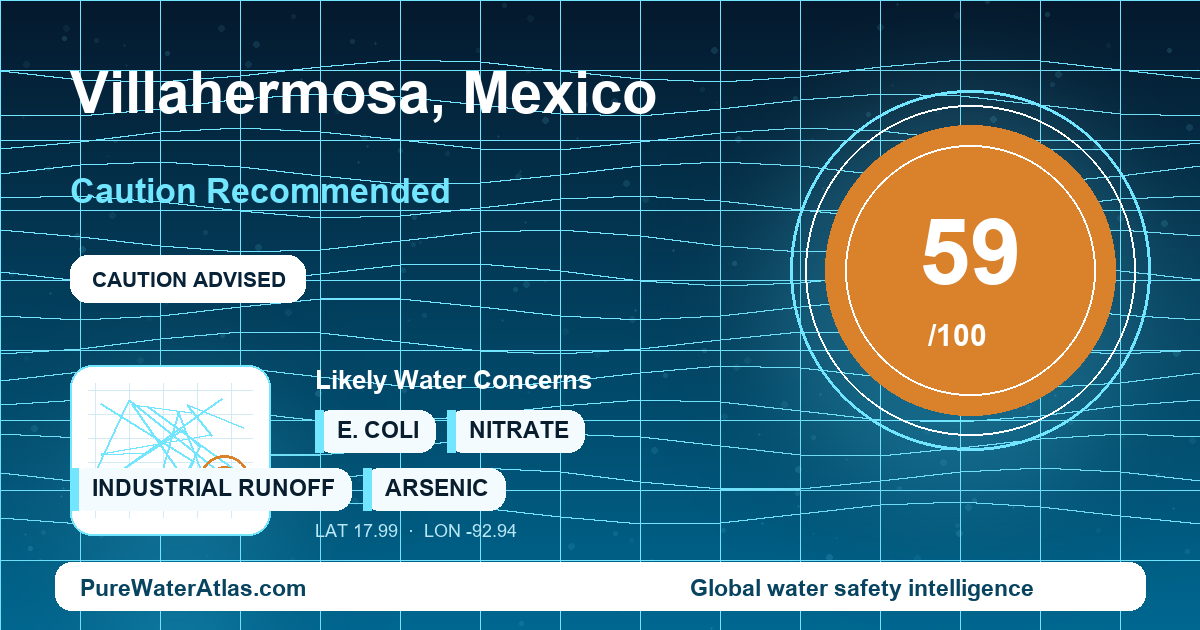
Villahermosa, Tabasco: treated river water in a hot, high-rainfall, flood-prone city where tap safety often depends on outages, turbidity, plumbing, and household storage tanks.
Quick Answer
| Water safety score | 59 / 100 |
|---|---|
| Risk level | Caution Recommended |
| Can visitors drink the tap water? | Not recommended for most travelers. Use sealed bottled water, verified hotel purified water, or water treated with boiling, UV, or a reliable purifier. |
| Resident guidance | Treat municipal water as a utility supply that may need point-of-use protection for drinking, especially after storms, outages, turbidity, or tank problems. |
| Main raw water setting | Treated surface water associated with the Grijalva-Carrizal river system in the Grijalva-Usumacinta hydrological region. |
| Local water authority | Sistema de Agua y Saneamiento del Municipio de Centro, commonly known as SAS Centro, under the Ayuntamiento de Centro. |
| Practical filter recommendation | Sediment prefilter plus certified activated carbon as a baseline; consider reverse osmosis or UV after filtration for higher-risk homes, based on testing. |
Overall verdict: caution is recommended. Villahermosa is not a city where visitors should assume municipal tap water is consistently safe to drink untreated. The local system relies heavily on treated surface water in a lowland river basin where heavy rainfall, high turbidity, flooding, pressure interruptions, distribution-network disturbances, and private cisterns or rooftop tinacos can affect the water that actually reaches a glass.
Why Villahermosa Is Different
Villahermosa is not a dry-city water story. It sits in the humid Tabasco plain within the Grijalva-Usumacinta hydrological region, surrounded by rivers, lagoons, wetlands, and recurring flood risk. The drinking-water challenge is therefore not simply access to water; it is treating and distributing abundant surface water in a hot, flood-prone environment where river conditions can change quickly.
Heavy rainfall, tropical storms, river rises, and urban flooding can increase raw-water turbidity and introduce additional microbial and sediment pressure into source waters and vulnerable infrastructure. In practical terms, this means a clear day at the treatment plant does not guarantee identical water quality at every household tap, hotel bathroom, restaurant, or rooftop storage tank across the city.
Villahermosa’s real-world tap-water safety is also building-specific. A hotel or home with clean cisterns, sealed tinacos, stable pressure, adequate chlorine residual, and point-of-use treatment may have much safer drinking water than a nearby building with stagnant storage, dirty tanks, old fixtures, or repeated service interruptions. This is why PureWaterAtlas rates Villahermosa as Caution Recommended rather than giving a simple universal yes or no.
Where Does Villahermosa’s Tap Water Come From?
Villahermosa is supplied mainly by treated surface water associated with the Grijalva-Carrizal river system serving the municipality of Centro. Municipal and local references identify major intake and potabilization infrastructure serving the urban area, including systems commonly associated with the Villahermosa and Carrizal supply networks.
This is a lowland river-source system, not a protected upland reservoir system. Surface-water intakes, potabilization plants, pumping, storage, pressure zones, and distribution mains all matter. During normal operation, treatment is intended to reduce turbidity, control microbes, and deliver water through the municipal network. During repairs, power interruptions, pump shutdowns, low-pressure episodes, flooding, or sudden source-water changes, the main tap-level risks include sediment disturbance, reduced disinfectant residual, and possible intrusion through damaged or depressurized pipes.
Household storage is another essential part of the Villahermosa water picture. Cisterns and rooftop tinacos are common in many Mexican cities, and in Villahermosa’s hot, wet climate they can become the final and sometimes most important water-quality control point. Even water treated adequately before distribution can be affected if a private tank is uncovered, dirty, cracked, poorly disinfected, or contaminated by floodwater.
Who Manages Drinking Water in Villahermosa?
The local municipal operator is Sistema de Agua y Saneamiento del Municipio de Centro, SAS Centro, under the Ayuntamiento de Centro. SAS Centro is responsible for municipal drinking-water and sanitation services in Villahermosa and the wider municipality of Centro.
Several state and federal institutions shape the broader water context. CONAGUA is Mexico’s federal authority for national water resources, hydrological information, and water monitoring programs. The Sistema Nacional de Información del Agua, SINA provides national water-resource and hydrological context relevant to Tabasco and the Grijalva-Usumacinta region. At the state level, the Comisión Estatal de Agua y Saneamiento de Tabasco is relevant to water-sector infrastructure and coordination.
Mexico’s national drinking-water standard is NOM-127-SSA1-2021, which applies to water for human use and consumption. Health oversight is also connected to federal health authorities such as COFEPRIS. However, the existence of a national standard does not prove that every tap in Villahermosa, especially after private tanks or older plumbing, meets that standard at all times.
Data limitation: recent, easily accessible, official neighborhood-level finished tap-water results for Villahermosa were not found in a consolidated public dataset suitable for making exact compliance claims. This profile therefore focuses on the documented source-water setting, operator framework, infrastructure risks, and practical precautions rather than claiming every tap is either safe or unsafe at all times.
Main Local Water Concerns
- Turbidity and sediment: intense rainfall, river disturbance, repairs, or changes in plant operation can increase cloudy water and suspended material. Learn more about turbidity in drinking water and sediment in drinking water.
- Microbial risk: bacteria and other pathogens are more plausible after flooding, low pressure, service interruptions, sewage backups, or poor cistern and tinaco maintenance. E. coli in drinking water is a key indicator of fecal contamination.
- Disinfectant changes: chlorine taste or odor may be noticeable. Absence of chlorine smell is not proof of unsafe water, and strong chlorine smell is not proof of full safety. See chlorine in drinking water.
- Unusual salty or brackish taste: treat salty, brackish, or unusual taste seriously, especially during dry-season low-flow periods or unusual river conditions. Use bottled or properly treated water until the cause is clarified.
- Old plumbing and fixtures: older buildings may contribute metals from legacy fixtures, solder, or corroded lines. Public citywide lead data for Villahermosa taps is not readily available, so older properties should consider testing. See lead in drinking water.
- Runoff pressure: agricultural and urban runoff in the wider basin can add nutrient, pesticide, and microbial pressure to surface waters, especially during storm events. For some households, nitrate in drinking water testing may be relevant, particularly where wells or non-municipal backup water are used.
Season matters. Rainy season and tropical storms can raise river turbidity and flood contamination risk. Flooding can contaminate private wells, ground-level cisterns, and storage tanks even when municipal treatment continues operating. Dry-season low flows can concentrate pollutants and may contribute to taste, salinity, or conductivity concerns in parts of Tabasco’s lowland river systems. Hot weather also accelerates microbial regrowth in stagnant plumbing and poorly maintained tanks.
For Travelers
Drinking: most short-term visitors should not drink Villahermosa tap water directly. Use sealed bottled water, water from a verified hotel filtration system, or water treated by boiling, UV, or a reliable purifier. This is especially important for children, pregnant travelers, older adults, and immune-compromised travelers.
Brushing teeth: cautious travelers should use bottled or filtered water. Some travelers brush with tap water without incident, but bottled water is the lower-risk choice after storms, outages, municipal advisories, cloudy water, unusual smell, or salty taste.
Ice: avoid ice from unknown street vendors or informal sources. In reputable hotels and restaurants, ice is often made from purified water, but ask whether it is made with agua purificada if you are unsure.
Hotels and restaurants: prefer properties that explicitly use purified water for drinking, ice, coffee machines, and food preparation. Do not assume bathroom tap water has the same risk profile as restaurant drinking water. A hotel may have a separate filtration or purification system for guest drinking water while ordinary tap water remains intended mainly for washing.
During storms or outages: carry bottled water during hot weather and heavy rain events. If flooding, service interruptions, hotel notices, or municipal advisories occur, avoid tap water for drinking until normal service and clear water return. Boiling can reduce microbial risk, but it does not remove salt, metals, nitrate, or many chemical contaminants. For method details, see the PureWaterAtlas boiling water purification guide and UV water purification guide. CDC travel guidance for Mexico also supports cautious food and water practices; see CDC Travelers’ Health: Mexico.
For Residents
Villahermosa residents should treat municipal water as a utility supply that may need point-of-use protection for drinking. A practical baseline is a sediment prefilter followed by certified activated carbon. This combination can improve taste, reduce sediment, and address chlorine-related taste and some organic compounds. It should not be treated as a universal solution for microbes, salinity, nitrate, or metals unless the system is certified and matched to test results.
Higher-risk households should consider lab testing and a stronger treatment train. This includes homes with infants, elderly residents, immune-compromised people, pregnancy, recurring turbidity, repeated outages, salty taste, gastrointestinal complaints, old plumbing, or use of wells or non-municipal backup water. Depending on results, reverse osmosis may be appropriate for drinking water, while UV can be useful for microbial control only after turbidity is controlled by filtration.
Test the water you actually drink. In Villahermosa, that usually means sampling at the kitchen tap after water has passed through the building’s cistern, tinaco, and plumbing. Prioritize total coliforms and E. coli after floods, sewage backups, tank-cleaning failures, or long interruptions. Check turbidity, free chlorine residual, pH, conductivity or total dissolved solids, and aesthetic parameters if water becomes cloudy, salty, brown, or has a strong odor.
Older buildings deserve extra attention. Legacy plumbing, corroded fixtures, stagnant lines, and rarely used taps can increase sediment, metallic taste, and microbial regrowth. Flush stagnant taps before use and consider first-draw and flushed lead samples if the property is old or has old fixtures. PureWaterAtlas has a detailed guide to lead testing and detection methods.
Cisterns and rooftop tinacos are critical risk points. Keep lids sealed, prevent insects and floodwater entry, clean and disinfect tanks on a regular schedule, and avoid drinking from tanks that were submerged, cracked, uncovered, or not cleaned after flooding.
Relevant Contaminants and Water-Quality Issues
The most relevant Villahermosa drinking-water issues are not limited to one contaminant. They are a combination of river-source variability, turbidity, disinfection performance, intermittent pressure, household storage, and building plumbing. The following PureWaterAtlas profiles are especially useful for interpreting local conditions:
- Turbidity in Drinking Water — important after heavy rainfall, river changes, or treatment stress.
- Sediment in Drinking Water — relevant after repairs, brown water, or tank disturbance.
- E. coli in Drinking Water — a key microbial indicator after flooding or pressure loss.
- Chlorine in Drinking Water — useful for understanding disinfectant residual and taste.
- Lead in Drinking Water — relevant for older buildings and legacy fixtures.
- Nitrate in Drinking Water — especially relevant for wells or backup sources and for vulnerable households.
How to Verify Your Water Quality
Because recent neighborhood-level Villahermosa tap-water datasets are limited publicly, verification should happen at the point of use. Start with a household tap sample, not only a municipal-main assumption. For a broader framework, use the PureWaterAtlas guide to water testing and analysis and the pillar guide on drinking water safety.
For treatment selection, review water treatment systems. For microbial concerns, see water microbiology. If nitrate is a concern, consult the PureWaterAtlas guide to nitrate testing and detection methods.
You can also compare country and city-level guidance with the Global Water Quality Checker and research individual substances through the Contaminants Search Engine. Related PureWaterAtlas categories include Drinking Water Safety, Global Water Quality, Water Testing, and Water Contamination.
Official and Technical Sources
- Ayuntamiento de Centro – Sistema de Agua y Saneamiento, SAS — official municipal source for the local water and sanitation operator serving Villahermosa and Centro.
- Comisión Nacional del Agua, CONAGUA — federal authority for national water resources and hydrological information.
- CONAGUA – Sistema Nacional de Información del Agua, SINA — national hydrological and water-resource information system.
- Diario Oficial de la Federación – NOM-127-SSA1-2021 — Mexico’s drinking-water quality standard for human use and consumption.
- Secretaría de Salud – COFEPRIS — federal health authority relevant to sanitary control and public-health oversight.
- INEGI – Información por entidad, Tabasco — geographic and hydrological background for Tabasco.
- CDC Travelers’ Health – Mexico — travel-health guidance supporting cautious food and water practices.
- World Health Organization – Guidelines for Drinking-water Quality — international reference for microbial risk, disinfection, turbidity, and household water safety.
- Gobierno de Tabasco – Comisión Estatal de Agua y Saneamiento — state water and sanitation institution relevant to Tabasco’s water sector.
Bottom Line
Villahermosa’s tap water should be approached with caution, especially by visitors. The city relies mainly on treated surface water from the Grijalva-Carrizal river setting in a lowland, humid, flood-prone basin. Treatment and regulation exist, but real-world quality at the tap can be affected by turbidity, storms, repairs, low pressure, private cisterns, rooftop tinacos, and older plumbing. Travelers should use sealed bottled or verified purified water for drinking and be cautious with ice. Residents should maintain storage tanks, test water at the kitchen tap, and consider sediment plus activated carbon filtration, with reverse osmosis or UV where testing or household risk justifies it. Public neighborhood-level tap data is limited, so household verification matters.
Read the full guide: Global Water Quality Guide
Explore more in this category: Global Water Quality Articles