
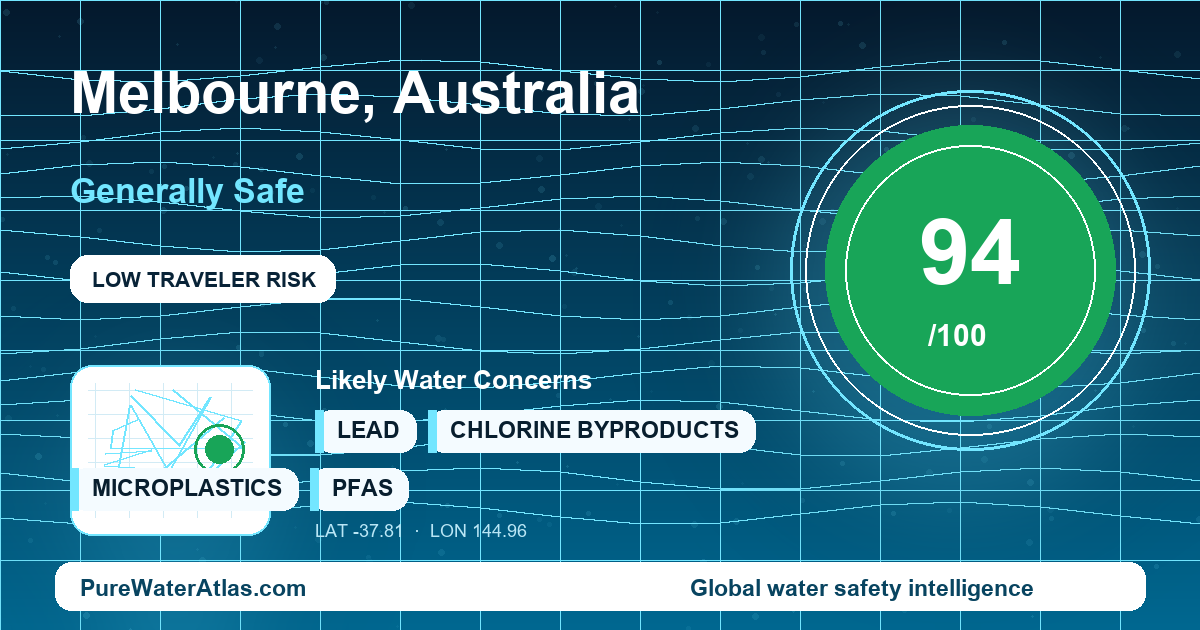
Melbourne, Australia: protected catchments, major reservoirs, regulated metropolitan mains water, and the building-level issues that can still affect water at the tap.
Quick Answer
| Overall safety status | Generally safe. Melbourne tap water from the metropolitan public mains supply is generally safe to drink. PureWaterAtlas rates Melbourne at 94/100 for drinking-water safety based on the supplied city record. |
|---|---|
| Can visitors drink it? | Yes. Typical travellers can drink Melbourne tap water, brush teeth with it, and use ice made from mains water in hotels, cafes, bars and restaurants unless an official boil-water notice or building-specific warning is in place. |
| Resident guidance | Most residents connected to the metropolitan mains supply do not need a filter for safety. Investigate older plumbing, persistent discolouration, private tanks, apartment tanks or unusual odours as property-specific issues. |
| Main water source | Melbourne’s mains water is mainly supplied from protected forested catchments and reservoirs east and north-east of the city, including the Thomson, Upper Yarra, Maroondah and O’Shannassy systems, with balancing and distribution through major storages such as Silvan, Cardinia, Sugarloaf, Yan Yean and Greenvale. |
| Who manages it? | Melbourne Water is the bulk water supplier and catchment manager. Retail delivery is handled by Greater Western Water, South East Water and Yarra Valley Water, depending on location. |
| Filter recommendation | No household filter is generally required for safety on the metropolitan mains supply. A certified activated carbon filter may improve chlorine taste or odour; use contaminant-specific certified treatment only when testing or plumbing history supports it. |
Why Melbourne Is Different
Melbourne’s drinking-water profile is unusually strong for a large city because the core supply is not drawn from Port Phillip Bay or from a heavily urbanised inner-city river. Melbourne sits on Port Phillip Bay, but the mains drinking water is primarily collected from inland, mostly forested water-supply catchments east and north-east of the metropolitan area. That protected-catchment model is central to the city’s water identity and is a major reason Melbourne has historically had high-quality raw water compared with cities that depend on intensively developed river systems.
The system is also distinctive because much of the raw water comes from protected catchments with limited public access. Water then moves through a large reservoir, transfer, treatment, disinfection, fluoridation and distribution network. The result is a metropolitan supply that is generally safe at the public-main level, while still leaving room for problems inside individual premises. Old internal pipes, brass fittings, legacy solder, storage tanks, stagnant building plumbing and poorly maintained private systems can change water quality after it leaves the public network.
That distinction matters. The evidence base is strong for Melbourne’s metropolitan mains system and official supplier descriptions, but it cannot prove the condition of every individual tap. PureWaterAtlas therefore treats Melbourne mains water as generally safe while avoiding unsupported claims about every building, street, apartment tank or private plumbing system.
Where Does Melbourne’s Tap Water Come From?
Melbourne’s drinking water is mainly sourced from a network of protected forested catchments, reservoirs and transfer systems managed by Melbourne Water. Key source areas include the Thomson, Upper Yarra, Maroondah and O’Shannassy catchments and reservoirs. Additional supply balancing and distribution are supported by storages such as Silvan, Cardinia, Sugarloaf, Yan Yean and Greenvale.
The Thomson Reservoir is one of the largest and most important storages in the Melbourne supply system. Upper Yarra Reservoir and associated Yarra catchment storages form another important part of the network. Maroondah and O’Shannassy reservoirs are historically important eastern catchment supplies, while Silvan Reservoir functions as a major distribution and balancing storage. Cardinia Reservoir is another major storage and distribution point serving the metropolitan system. Sugarloaf Reservoir and the Winneke Water Treatment Plant support treated supply from the Yarra system. Yan Yean and Greenvale reservoirs, together with treatment and distribution infrastructure, serve parts of the northern and western network.
Melbourne’s water system has expanded over time from early sources such as Yan Yean Reservoir, north of the city, to a much larger network including Maroondah, O’Shannassy, Upper Yarra and Thomson. This expansion reflects population growth, drought-security planning and the need for a resilient metropolitan supply.
The Victorian Desalination Plant at Wonthaggi can also contribute water to the Melbourne system when supply orders are made by the state government. In Melbourne’s context, desalination is best understood as a climate-resilience and drought-security source rather than the everyday identity of the city’s water. Extended dry periods, reduced reservoir inflows and climate variability are part of why this backup supply exists.
Who Manages Drinking Water in Melbourne?
Melbourne’s water is managed through a wholesale-retail structure rather than by a single city water department. Melbourne Water is the bulk water supplier and catchment manager for the metropolitan system. It manages major water-supply catchments, reservoirs and bulk supply functions. Retail drinking water is delivered to customers by three metropolitan water corporations: Greater Western Water, South East Water and Yarra Valley Water.
The relevant retail corporation depends on where in Melbourne you are. A traveller in the CBD, inner suburbs, airport hotels or typical residential accommodation is generally drinking the regulated metropolitan mains supply, but the retailer differs by service area: Greater Western Water covers much of the west and CBD area, South East Water serves the south-east, and Yarra Valley Water serves the north and east.
Drinking water in Melbourne is regulated under Victoria’s Safe Drinking Water Act and Safe Drinking Water Regulations, with oversight by the Victorian Department of Health. The Australian Drinking Water Guidelines provide the national health-based reference framework used by Australian drinking-water regulators and suppliers. The retail water corporations publish water-quality information and annual water-quality reports for their service areas.
Main Local Water Concerns
Melbourne’s common tap-water issues are usually local, temporary or building-specific rather than evidence of a citywide unsafe mains supply. Chlorine or chloramine taste and odour can be noticeable, especially after distribution changes or during warm weather. This is normally an aesthetic issue, not a sign that the water is unsafe.
Temporary brown, yellow or cloudy water can occur after main breaks, hydrant use, planned works, pressure changes or sediment disturbance in local pipes. If discolouration does not clear after flushing cold taps, residents should contact the relevant retailer: Greater Western Water, South East Water or Yarra Valley Water.
Lead risk in Melbourne is mainly a premise-plumbing issue rather than a known source-water problem. Older brass fittings, old solder, legacy service components or stagnant internal plumbing can contribute metals at the tap. Galvanised iron or old internal pipes may also cause rust-coloured water, metallic taste or particles in older properties.
Private rainwater tanks, apartment storage tanks, poorly maintained filters and building plumbing are outside the normal quality assurance of the mains network. These systems can introduce sediment, biofilm or microbiological concerns if they are not maintained. Bushfire in or near water-supply catchments is also a recognised catchment risk in Victoria because ash, sediment and nutrients can affect raw water after fire and intense rainfall, although the protected catchments, reservoirs and treatment systems are designed to manage such risks.
PFAS, pesticides, nitrate and industrial contaminants are not identified in this dataset as prominent documented citywide issues for normal Melbourne mains water. Residents seeking contaminant-specific assurance should consult their retailer’s annual report or order targeted laboratory testing rather than relying on taste, smell or appearance.
For Travelers
For typical travellers, Melbourne mains tap water is safe to drink without boiling or filtering unless an official boil-water advisory or building-specific notice is in place. You can normally drink tap water in hotels, rentals, cafes, restaurants, bars, airport-area accommodation and public venues connected to the metropolitan mains supply.
Brushing teeth with Melbourne tap water is considered safe in normal hotels and rentals. Ice made from mains water in licensed hotels, restaurants, bars and cafes is also generally safe. Avoid ice only if there is a current local advisory, poor hygiene at the venue, or uncertainty that the water comes from a safe supply.
Practical traveller advice is simple: carry a refillable bottle, use cold tap water for drinking, and do not use hot tap water for drinking or cooking. If you are staying in an older building and the water has been stagnant overnight, run the cold tap briefly before drinking, especially if the water is warm, stale-tasting or discoloured. If the water looks brown or contains particles, run the cold tap until it clears and ask the accommodation provider or water retailer if the issue persists.
Boiling is only necessary during an official boil-water notice or short-term microbiological uncertainty. It is important to understand that boiling does not remove metals such as lead.
For Residents
Residents connected to Melbourne’s metropolitan mains supply generally do not need a household filter for safety. A certified activated carbon filter may be useful for improving chlorine taste or odour. If you are concerned about a specific contaminant, choose a filter certified for that contaminant and base the decision on testing or plumbing history rather than on general anxiety about the city supply.
Older homes and apartment buildings deserve more attention. Lead exposure, if present, is most likely to come from internal plumbing, older brass fittings, lead solder, legacy components or stagnant water after the public main. Use cold water for drinking and cooking, flush taps after long stagnation, and consider targeted metals testing if the building is old, plumbing history is unknown, or infants, pregnant people or young children regularly drink the water.
If discoloured water, sediment, unusual odour or pressure changes persist after flushing, contact your relevant retail water corporation. Do not assume a persistent tap issue is citywide; in Melbourne it may be related to local works, pipe disturbance, a service line, internal plumbing, an apartment system or a private storage tank.
If a private rainwater tank is used for drinking, test for E. coli and maintain the roof catchment, screens, first-flush devices, pumps and any disinfection system. Apartment buildings with roof tanks, booster systems or complex internal plumbing should have building management maintain and document tanks, backflow prevention and plumbing hygiene. Boiling can help manage many short-term microbial risks, but it will not remove metals or many chemical contaminants.
Relevant Contaminants and Water-Quality Issues
The most relevant Melbourne water-quality topics are not exotic contaminants; they are the practical issues people actually notice at the tap. Chlorine in drinking water is relevant because disinfectant taste and odour are among the most common complaints in otherwise safe mains water. Turbidity helps explain cloudy water after storms, works, pressure changes or main breaks. Sediment in drinking water is relevant to particles, brown water and old-pipe disturbance.
For older Melbourne properties, lead in drinking water is the most important premise-plumbing concern to understand. The city’s protected catchments do not eliminate the possibility of lead contribution from household plumbing materials. For private tanks and boil-water situations, E. coli in drinking water is a useful indicator topic because it relates to faecal contamination and microbiological risk. Residents who want contaminant-specific assurance can also review PFAS in drinking water, while noting that this dataset does not identify PFAS as a prominent documented Melbourne-wide tap-water issue.
How to Verify Your Water Quality
Start with the correct Melbourne water retailer for your address: Greater Western Water, South East Water or Yarra Valley Water. Their water-quality pages and annual reports are the best location-specific official sources for routine metropolitan supply information. If the problem is discolouration, sediment, odour or pressure-related, contact the retailer after flushing if the issue persists.
For household-specific concerns, use testing rather than taste or appearance. First-draw and flushed samples can help evaluate metals such as lead where old plumbing is suspected. Laboratory testing is also the right approach for PFAS, nitrate and other chemical contaminants because many chemical risks cannot be detected by sight, smell or taste.
PureWaterAtlas resources that may help include the complete guide to water testing, the lead testing and detection guide, and the lead filter and solution guide. For boil-water situations, see the boiling water purification guide. For broader comparison, use the Global Water Quality Checker, and for contaminant research use the PureWaterAtlas Contaminants Search Engine.
General background resources include Drinking Water Safety, Water Microbiology and Water Treatment Systems.
Official and Technical Sources
- Melbourne Water: Water supply — official bulk water supplier overview for Melbourne’s supply system, catchments and reservoirs.
- Melbourne Water: Where your water comes from — source-water and protected-catchment information.
- Melbourne Water: Drinking water quality — treatment, monitoring and drinking-water-quality context.
- Victorian Department of Health: Drinking water quality in Victoria — state health-regulator context.
- Victorian Department of Health: Safe Drinking Water Act 2003 — legal framework for Victorian drinking-water suppliers.
- NHMRC: Australian Drinking Water Guidelines — national health-based guideline framework.
- Victorian Government: Desalination — role of the Victorian Desalination Plant in diversified supply and drought security.
- Yarra Valley Water: Water quality — retail water-quality information for northern and eastern Melbourne customers.
- South East Water: Water quality — retail water-quality information for south-eastern Melbourne customers.
- Greater Western Water: Water quality — retail water-quality information for western Melbourne and CBD-area customers.
Bottom Line
Melbourne tap water is generally safe to drink from the metropolitan mains supply. The city benefits from a protected-catchment, reservoir-based system managed at bulk level by Melbourne Water and delivered by Greater Western Water, South East Water and Yarra Valley Water. Visitors can normally drink the tap water, brush teeth with it and accept ice made from mains water. Residents usually do not need a filter for safety, though carbon filtration may improve chlorine taste. The main exceptions are building-level issues: old plumbing, lead-prone fittings, rust or sediment from ageing pipes, stagnant apartment plumbing, private rainwater tanks and temporary discolouration after works or main disturbances. If a tap problem persists, verify it through the relevant retailer or targeted laboratory testing rather than assuming it reflects Melbourne’s whole supply.
Read the full guide: Global Water Quality Guide
Explore more in this category: Global Water Quality Articles