
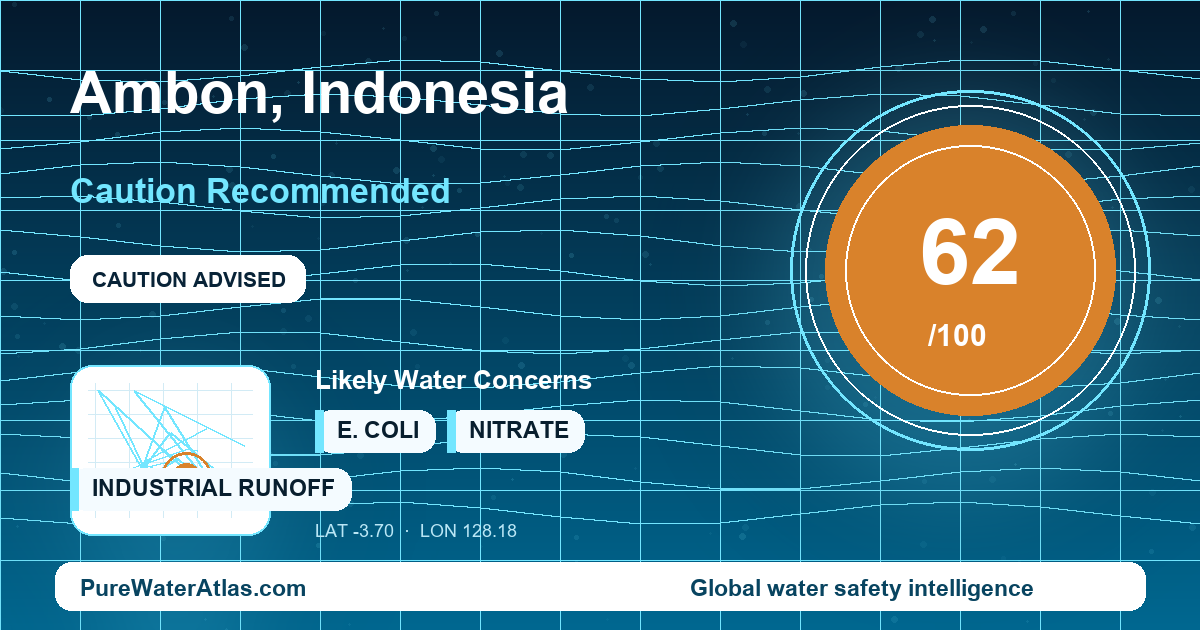
Ambon, Indonesia: caution recommended for direct tap-water drinking because public city-level test results are limited and safety can depend heavily on treatment, pipe pressure, storage tanks, rainfall, and building plumbing.
Quick Answer
| Water safety score | 62 / 100 |
|---|---|
| Risk level | Caution Recommended |
| Can visitors drink the tap water? | Not recommended as a default. Visitors should use sealed bottled water, reputable refill water, or water that has been boiled or properly filtered and disinfected. |
| Resident advice | Residents using PDAM/Perumda piped water should treat water intended for drinking unless they have recent local test results from their own tap and reliable household storage. |
| Main water system | Ambon is a small-island, hilly coastal system using multiple local raw-water points such as springs, upland streams or river intakes, treatment units, reservoirs, and separate distribution zones. |
| Water authority | PDAM or Perumda Air Minum Tirta Yapono Kota Ambon is the local municipal drinking-water service provider, with public-health oversight under the Indonesian Ministry of Health framework and Ambon City institutions. |
| Filter recommendation | For drinking water, use sediment filtration where water is cloudy plus boiling, UV, or another validated disinfection step. Test private wells before choosing reverse osmosis or other advanced treatment. |
Overall verdict: Caution recommended. Ambon has a formal municipal water operator and Indonesia has regulated drinking-water standards, but routine Ambon-specific consumer-facing tap-water quality data are limited. The main practical concern is not one confirmed citywide chemical contaminant; it is the reliability of treatment, pressure, storage, turbidity after heavy rain, private wells, and refill-water handling.
Why Ambon Is Different
Ambon is not a large mainland city supplied by one major reservoir. It is a steep, humid tropical island city built around Ambon Bay, where short watersheds drain quickly from the hills toward the coast. That geography matters for drinking water. Heavy rain can rapidly increase runoff, sediment, and turbidity in small stream-fed or spring-fed systems. Dry periods can reduce spring and stream yield, lowering pressure or increasing reliance on stored water, wells, vendors, or refill-water depots.
The local water-safety question in Ambon is therefore very practical: what source serves the building, how well is it treated, does the network maintain pressure, and what happens after water enters the property? In many Ambon homes, guesthouses, restaurants, and hotels, water used for drinking may be supplied separately as bottled or dispenser water rather than consumed directly from the bathroom or kitchen tap.
Ambon’s earthquake and landslide risk also affects water safety. Maluku, including the Ambon area, has experienced damaging earthquakes and service disruptions. After seismic events, severe storms, catchment disturbance, or pipe repairs, broken pipes and disturbed sediments can increase short-term microbial and turbidity risk. During these periods, water should be treated as higher risk until local authorities or the building operator confirm that supply is safe.
Where Does Ambon’s Tap Water Come From?
Ambon’s municipal water supply is associated with Perumda/PDAM Air Minum Tirta Yapono Kota Ambon and local SPAM infrastructure. Available official and planning context describes a small-island supply pattern using multiple raw-water points rather than one citywide reservoir. These may include springs, upland stream or river intakes, treatment units, service reservoirs, and distribution pipes serving separate pressure zones in a steep coastal city.
This source pattern has advantages and vulnerabilities. Springs and upland intakes can be locally important, but small catchments respond quickly to weather. During rainy periods, sediment and microbial runoff can increase. During dry periods, lower yield can contribute to lower pressure, rationing, or use of alternative sources. In an intermittent or low-pressure distribution system, the safety of water at the final tap depends not only on treatment but also on pipe integrity, pressure continuity, and whether intrusion can occur through leaks.
Building-level systems are especially important in Ambon. Household roof tanks, ground tanks, pumps, and internal plumbing can strongly affect final water quality. A clean, treated supply can become unsafe if it passes into an unsealed or dirty storage tank. Conversely, a building that maintains tanks, plumbing, and disinfection carefully may provide a lower-risk experience than a building with unknown tank maintenance.
Ambon’s older water-supply context reflects the island’s geography. Communities historically relied on nearby hillside springs, small streams, shallow wells, and rain-dependent local sources around Ambon Bay. Urban growth, coastal settlement, earthquakes, and pressure on catchments make these small raw-water systems more vulnerable than a large, highly monitored mainland reservoir network.
Who Manages Drinking Water in Ambon?
The local municipal drinking-water service provider is commonly identified as PDAM or Perumda Air Minum Tirta Yapono Kota Ambon. Local public-health oversight involves the Ambon City Health Office and Indonesia’s Ministry of Health framework. Public drinking-water infrastructure and SPAM development are also part of Indonesia’s public works and housing sector.
Indonesia’s drinking-water and sanitation-health requirements are set nationally by the Ministry of Health, including Permenkes No. 2 Tahun 2023 for environmental health quality standards. Public water-supply systems are also governed by the SPAM framework, including PP No. 122 Tahun 2015 on Drinking Water Supply Systems.
The important limitation for consumers is that a national regulatory framework does not automatically prove that every Ambon tap is safe on a given day. Publicly accessible Ambon tap-water compliance results, disinfectant residual maps, source-by-source treatment performance, and neighborhood-level distribution records are not readily available in a comprehensive public dashboard. For that reason, this profile emphasizes known system vulnerabilities and practical risk controls rather than claiming exact contaminant concentrations or universal pass/fail compliance.
Main Local Water Concerns
The main Ambon concerns are practical distribution and household-level issues rather than a single verified citywide contaminant. The most important risk is microbial contamination where water is untreated, under-disinfected, affected by leaks, or stored in unclean tanks. E. coli and thermotolerant coliform testing are especially relevant if water is being used for drinking, particularly after outages, pipe repairs, flooding, earthquakes, or tank cleaning.
Turbidity and visible sediment are also important in Ambon because steep rainy catchments can respond quickly to intense rainfall, road works, landslides, or disturbed intakes. Cloudy water can make disinfection less reliable and may signal that filtration or settling is needed before boiling, UV, or other disinfection.
Intermittent supply and low pressure are another concern. When pipes are not consistently pressurized, leaks can allow intrusion from surrounding soil or drainage. This is especially relevant in steep terrain and in systems with separate pressure zones. Once water enters a building, roof tanks and ground tanks can become the dominant safety point. Tanks should be sealed, screened from insects and animals, protected from roof runoff, and cleaned periodically.
For private wells, the concerns are different. Some coastal wells may have salinity or brackish taste risk, especially where groundwater is close to the shoreline or overdrawn. Testing should include conductivity, chloride, salinity indicators, nitrate, E. coli, iron, and manganese. Iron and manganese can cause staining, taste, or aesthetic problems, while microbiology and nitrate are important health-screening parameters. Old building plumbing can also add sediment, metals, biofilm, or microbial contamination after municipal water leaves the main line. Lead is not identified here as a confirmed Ambon-wide source-water contaminant, but testing may be appropriate in older buildings with unknown pipe materials.
For Travelers
Visitors should not assume Ambon tap water is safe to drink directly. The safer default is sealed bottled water, reputable refill water, or water that has been boiled or properly filtered and disinfected. This advice is precautionary: it reflects limited public tap-water data, small-island distribution risks, and traveler sensitivity to unfamiliar microbes, not a verified citywide failure notice.
For brushing teeth, use bottled, boiled, or reliably filtered water if you have a sensitive stomach, are immunocompromised, are traveling with young children, or are staying in budget accommodation where tank maintenance is unknown. In higher-end hotels, ask whether the bathroom tap is treated municipal water and whether roof or ground tanks are cleaned regularly.
Be cautious with ice. Avoid ice from informal vendors or unknown sources. Established hotels and restaurants may use treated or purchased water, but travelers should ask if unsure. When practical, choose sealed bottled drinks rather than drinks with uncertain ice.
In hotels and restaurants, do not assume bathroom tap water and drinking water are the same source. Many establishments provide bottled or dispenser water for drinking. If tap water looks cloudy, contains sediment, smells unusual, or service has just returned after an outage, do not drink it without treatment. For short stays, bottled water is the simplest risk-control option. For longer stays, a kettle boil or maintained purifier can reduce risk; if boiling, bring water to a rolling boil and store it in a clean covered container. PureWaterAtlas also provides a detailed boiling water purification guide for practical use.
For Residents
For Ambon residents, a point-of-use system is advisable for drinking and cooking water unless recent laboratory results show safe microbiology and chemistry at the actual tap used for consumption. Testing should be done after water has passed through building plumbing and storage tanks, not only at the street connection.
A practical setup for many homes is sediment prefiltration when water becomes cloudy, followed by boiling, UV, or another validated disinfection step. UV can be useful when turbidity is already controlled; see the PureWaterAtlas UV water purification guide for how it works and when it is appropriate. Reverse osmosis may be useful for brackish private wells or high dissolved solids, but it should be selected based on test results rather than assumption.
Residents using private wells near the coast should test for conductivity, chloride, salinity indicators, nitrate, E. coli, iron, and manganese. In dense settlement or sanitation-influenced areas, nitrate screening is especially important; PureWaterAtlas has a guide to nitrate testing and detection methods. For old buildings, consider testing for lead and other metals if pipe materials are unknown; see lead in drinking water testing methods.
Storage tanks are a major control point in Ambon-style household and hotel systems. Tanks should be sealed, screened, protected from insects and animals, cleaned on a schedule, and disinfected after repairs, flooding, long stagnation, earthquakes, or visible sediment. Retest water after tank cleaning or plumbing work if it will be used for drinking.
Relevant Contaminants and Water-Quality Issues
The most relevant Ambon issue is microbial risk, especially E. coli, where water is untreated, under-disinfected, affected by intermittent supply, or stored in unclean tanks. Turbidity and sediment are also central because heavy rain and catchment disturbance can quickly affect small island water sources.
Chlorine is relevant where chlorination is used because a residual can help protect water through the distribution system, although taste or odor may be noticeable. For private wells and older plumbing contexts, iron and manganese can affect taste, staining, and screening decisions. Lead should be treated as an old-building plumbing concern rather than a confirmed Ambon-wide contaminant.
How to Verify Your Water Quality
The most reliable way to know whether your Ambon water is safe is to test the water you actually drink. For PDAM/Perumda piped water, sample at the kitchen tap after water has passed through the building’s internal plumbing and storage tank. For wells, include microbiology, salinity indicators, nitrate, iron, manganese, pH, and conductivity or total dissolved solids. After outages, repairs, heavy rain, flooding, earthquakes, or tank cleaning, microbiological testing becomes more important.
Use PureWaterAtlas resources to plan testing and treatment. Start with the Water Testing guide, review the Drinking Water Safety guide, and compare options in the Water Purification and Water Treatment Systems guides. For microbial background, see Water Microbiology. You can also use the Global Water Quality Checker and browse the Contaminants Search Engine.
Official and Technical Sources
- Ambon City Government official portal — official municipal source for local government identity, public services, planning context, and institutional references.
- BPS Kota Ambon official statistics portal — official city statistics source for Ambon demographic, geographic, and infrastructure context.
- Indonesia Ministry of Public Works and Housing SPAM information system — national source for drinking-water supply system and SPAM infrastructure context.
- Permenkes No. 2 Tahun 2023 — Indonesian environmental health quality standards, including drinking-water-related health parameters.
- PP No. 122 Tahun 2015 on Drinking Water Supply Systems — national regulation defining Indonesian SPAM responsibilities and system framework.
- BMKG Indonesia — official weather and climate authority relevant to rainfall, extreme weather, and source-water variability.
- CDC Travelers Health: Indonesia — travel-health guidance supporting cautious food and water practices for visitors.
- WHO Drinking-water fact sheet — global public-health reference for microbial safety and safe management from source to tap.
Bottom Line
Ambon tap water should be treated with caution for direct drinking. The city has a formal municipal water operator and Indonesia has national drinking-water standards, but publicly accessible Ambon-specific tap-water quality data are limited. The local risk profile is shaped by small island catchments, steep terrain, heavy-rain turbidity, intermittent pressure, household tanks, old plumbing, wells, and variable refill-water handling. Visitors should use sealed bottled water, reputable refill water, or boiled/filtered water. Residents should test water at the actual tap, maintain storage tanks, and use sediment filtration plus disinfection where needed. Private wells, especially near the coast, should be tested for microbiology, salinity indicators, nitrate, iron, and manganese.
Read the full guide: Global Water Quality Guide
Explore more in this category: Global Water Quality Articles