Abidjan has a formal SODECI-operated piped water system and major supply investments, but tap-water safety can still vary by district, pressure events, storage tanks, building plumbing, and the city’s stressed coastal groundwater setting.
Quick Answer
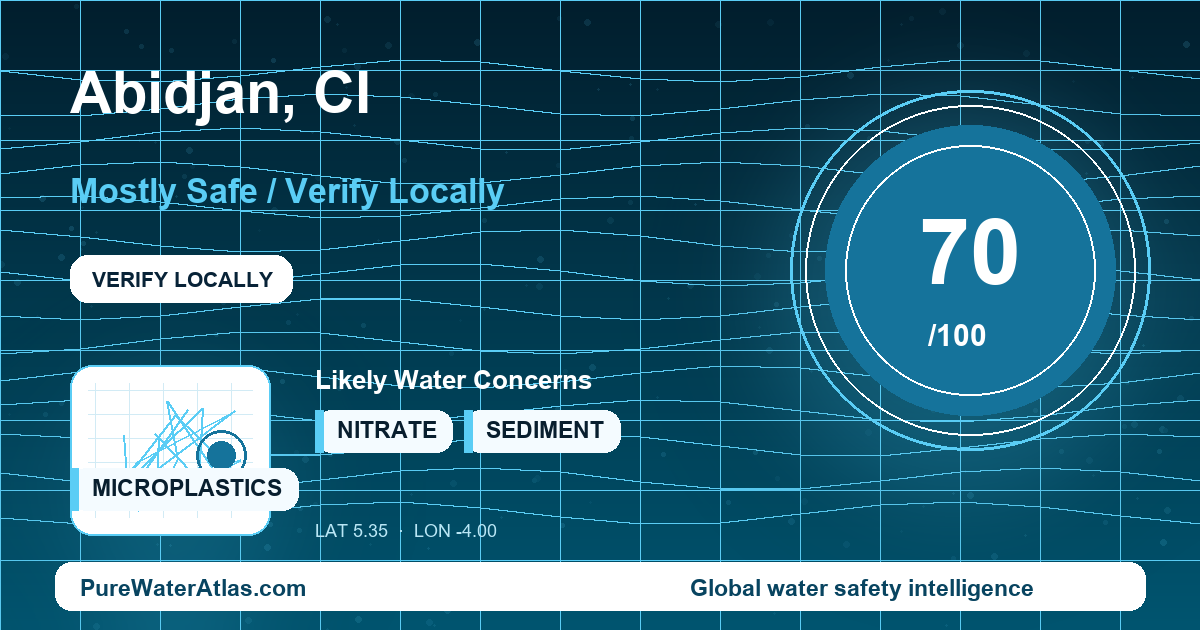
| Overall safety status | Mostly Safe / Verify Locally — PureWaterAtlas score: 70/100. Abidjan has a real municipal drinking-water system, but not every tap should be treated as equally reliable. |
|---|---|
| Can visitors drink the tap water? | Use caution. Short-stay travelers should generally choose sealed bottled water, boiled water, or properly filtered water for direct drinking unless a hotel confirms safe water handling and maintained tanks. |
| Resident guidance | Residents on a stable SODECI connection can usually use tap water for normal household purposes, but should verify local quality, flush stagnant water, maintain tanks, and test or treat water if it is cloudy, salty, rusty, odorous, or from old plumbing. |
| Main water sources | Historically, Abidjan has relied heavily on groundwater from the Abidjan aquifer system, often described as the Continental Terminal aquifer. Newer or strategic supply reinforcement includes the La Mé drinking-water production system and the Aghien Lagoon catchment. |
| Water authority | Drinking-water distribution is operated by SODECI, with national sector roles involving ONEP and the ministry responsible for hydraulics, sanitation, and salubrity. |
| Filter recommendation | A filter is not automatically required for every connected household. A sediment prefilter plus certified activated carbon is reasonable for clarity, odor, and chlorine taste. Add UV, boiling, or validated disinfection if microbial reliability is uncertain; consider reverse osmosis only where testing confirms salinity, nitrate, or specific dissolved contaminants. |
Why Abidjan Is Different
Abidjan is not a generic water-safety case. It is a coastal lagoon city on the Gulf of Guinea, built around the Ébrié Lagoon system, with dense districts, industrial zones, low-lying coastal areas, and rapidly expanding suburbs. Those local conditions matter because Abidjan’s drinking-water story is closely tied to groundwater protection, urban runoff, intermittent pressure, stormwater, sanitation pressure, and last-mile storage.
The city’s formal supply system makes Abidjan more reliable than places without a developed municipal network. However, the main question is not whether a utility exists. It does. The better question is whether water reaching a specific tap has remained protected through source capture, treatment, distribution, storage, and building plumbing. In Abidjan, that final chain can vary substantially between a well-managed hotel, a stable residential connection, an older apartment building, and a property relying on a poorly maintained private tank.
Hydrogeological and development-bank context repeatedly identifies Abidjan’s aquifer as strategically important but under pressure from urbanization, rising demand, sanitation gaps, industrial activity, and coastal groundwater stress. Because the aquifer is beneath or near the expanding metropolitan area rather than in a remote protected watershed, local land use and infrastructure conditions are directly relevant to drinking-water risk.
Where Does Abidjan’s Tap Water Come From?
Abidjan has historically depended heavily on groundwater from the Abidjan aquifer system, commonly described in technical literature as the Continental Terminal aquifer. Groundwater was attractive for decades because it was comparatively accessible and less visibly turbid than many surface-water sources. The city’s drinking-water expansion therefore grew around borefields and production stations linked to this aquifer system.
That historical model is now under pressure. Greater Abidjan has grown rapidly, increasing demand on groundwater resources and expanding urban activity over recharge and vulnerable zones. Groundwater concerns in Abidjan include vulnerability to pollution from sanitation deficits, uncontrolled waste disposal, dense settlement, and industrial activity. In coastal aquifers, over-pumping or hydraulic stress can also increase concern about saline intrusion or rising chloride levels, especially where properties are in coastal or lagoon-influenced areas.
To strengthen supply, Abidjan is also being reinforced by large surface-water projects. The La Mé drinking-water production plant was developed to increase supply to Greater Abidjan. The Aghien Lagoon catchment has also been identified by development institutions as a strategic raw-water reserve or future supply area for Abidjan. This mixed system can improve resilience, but it can also mean that taste, mineral character, turbidity management, or service experience may differ by supply zone, season, and local distribution conditions.
Key infrastructure relevant to tap-water safety includes SODECI-operated distribution networks, groundwater borefields, the La Mé surface-water drinking-water production system, Aghien Lagoon-related development planning, and household, building, hotel, or commercial storage tanks. In practice, those storage tanks can be decisive. Even if treated water leaves the utility system in acceptable condition, contamination can occur later if a tank is uncovered, dirty, exposed to floodwater, or connected to degraded internal plumbing.
Who Manages Drinking Water in Abidjan?
Abidjan’s drinking-water service is operated by SODECI, the Société de Distribution d’Eau de la Côte d’Ivoire. SODECI is the main utility identity residents and visitors are likely to encounter for urban drinking-water distribution in Côte d’Ivoire, including Abidjan. National responsibilities also involve ONEP, the Office National de l’Eau Potable, which is associated with public drinking-water assets and programs, and the national ministry responsible for hydraulics, sanitation, and salubrity.
The regulatory and public-reporting context is national rather than a city-only consumer-confidence model. Public information identifies SODECI as the operator, ONEP as a national drinking-water institution, and the ministry as the policy authority. However, easily accessible, recent, neighborhood-level tap-water compliance reports for Abidjan are limited. This matters for interpretation: the existence of a formal utility and treatment system supports a “mostly safe” rating, but the available public data do not justify claiming that every tap in every Abidjan neighborhood, building, and storage-tank system is consistently safe for direct drinking.
Main Local Water Concerns
The most important water-quality concerns in Abidjan are local and practical. First, the city’s groundwater is vulnerable because urban expansion, sanitation gaps, waste disposal, industrial activity, and dense settlement can place pressure on recharge areas and aquifer protection. Where groundwater remains a major part of supply, protecting that resource is central to long-term safety.
Second, Abidjan’s coastal and lagoon geography makes salinity a concern in vulnerable aquifer zones. If groundwater is over-pumped or hydraulically stressed, chloride, conductivity, and total dissolved solids may become more relevant. A salty taste should not be ignored; it is a reason to test rather than assume the issue is only aesthetic.
Third, microbiological risk can increase after pipe breaks, flooding, low-pressure events, construction works, or service interruptions. Heavy rainy periods can increase stormwater runoff, local flooding, sewer overflows, and contamination pressure around shallow wells, damaged distribution points, and tanks. High-turbidity raw surface water during wet periods can also place more demand on treatment systems for runoff-influenced sources.
Fourth, the last mile matters. Private rooftop, ground, hotel, and commercial storage tanks are common where pressure or continuity is variable. A covered, cleaned, protected tank is very different from one that is open, dirty, insect-accessible, or flood-exposed. Older building plumbing can also introduce sediment, iron, rusty color, metallic taste, or potentially building-level metals after treated water has already entered the property.
Finally, chlorine taste or odor may occur in treated municipal water. Disinfection is important, and a chlorine smell does not automatically mean the water is unsafe. But taste and clarity are not reliable safety tests. Clear water can still carry microbiological risk, and chlorinated water at one point in the network does not prove that every stored or stagnant tap sample is safe.
For Travelers
For short-stay visitors, Abidjan tap water should be treated as conditionally safe rather than universally safe. In higher-standard hotels and restaurants, municipal water may be used for washing, cooking, and general operations, but bottled, sealed, boiled, or properly filtered water remains the safer default for direct drinking, especially during the first days of travel or for anyone with a sensitive stomach.
For brushing teeth, many healthy travelers staying in good hotels use tap water. More cautious travelers, young children, pregnant travelers, immunocompromised visitors, and people recovering from illness should use bottled or treated water. For baby formula, use boiled water and follow safe preparation practices.
Ice deserves extra caution. Avoid ice from street vendors or informal settings unless you know it was made from treated water. In reputable hotels and restaurants, ice is more likely to be made from treated or purchased water, but it is still reasonable to ask. The same logic applies to fresh drinks diluted with water.
When booking or checking into a hotel, ask whether the drinking water is filtered or bottled, whether storage tanks are cleaned, and whether the property has treated water. If you carry a travel filter, choose one rated for bacteria and protozoa, and add disinfection or UV if virus risk is a concern. Do not rely on taste, cold temperature, or visual clarity alone.
For Residents
Residents on a stable SODECI connection can generally use tap water for daily household purposes, but local verification is important. After overnight stagnation, flush first-draw water before drinking, especially in older buildings. If water turns cloudy, salty, rusty, black, brown, metallic-tasting, or foul-smelling, treat it as a signal to investigate rather than as a normal nuisance.
A home filter is not automatically required for every connected household in Abidjan. For many homes, a sediment prefilter plus certified activated carbon can improve clarity, odor, and chlorine taste. If microbial reliability is uncertain because of intermittent pressure, tank storage, flooding, repeated gastrointestinal illness, or service disruptions, add a validated disinfection step such as boiling or UV. PureWaterAtlas has detailed guides to boiling water purification and UV water purification.
Reverse osmosis may be useful only when testing confirms a reason, such as salinity, nitrate, or specific dissolved contaminants. It should not be selected blindly as a substitute for understanding the actual problem. If water tastes salty, test chloride, conductivity, and total dissolved solids. If reddish or metallic water appears, test iron and manganese. If the building is old or plumbing materials are unknown, consider lead testing, especially for water that sits overnight in pipes.
Storage tanks deserve routine attention. Tanks should be covered, screened against insects and animals, cleaned periodically, protected from floodwater, and disinfected after suspected contamination. If tank maintenance is unknown, boil, disinfect, or properly filter water before drinking. For health-critical decisions, use an accredited or recognized laboratory where possible rather than relying only on simple color-strip tests.
Relevant Contaminants and Water-Quality Issues
Several PureWaterAtlas contaminant profiles are especially relevant to Abidjan’s local conditions. Chlorine is relevant because treated municipal water is expected to use disinfection, and chlorine taste or odor is a common user concern. Turbidity matters after rainy periods, pipe disturbances, tank contamination, or treatment stress. Sediment is useful for understanding brown, sandy, or rusty particles from plumbing, tanks, or disturbed mains.
E. coli is the key microbiological indicator to test for when water has been stored in a tank, when pressure has been intermittent, after flooding, or when sewage contamination is suspected. Lead is primarily a building-plumbing concern where older materials, stagnant water, or unknown fittings may affect tap quality. Nitrate is relevant to groundwater vulnerability from sanitation and land-use pressure, but site-specific testing is needed. Iron is relevant where water is reddish, metallic, or staining laundry and fixtures.
How to Verify Your Water Quality
Because recent neighborhood-level tap-water data for Abidjan are not easily accessible to the public, household verification is the best way to resolve property-specific uncertainty. Start with the situation: if the concern is illness, flooding, tank storage, or pressure loss, prioritize E. coli or thermotolerant coliform testing. If the concern is cloudy water, test turbidity and, where possible, disinfectant residual. If the concern is salty taste, test conductivity, chloride, and total dissolved solids. If the concern is old plumbing, test for metals such as lead.
PureWaterAtlas resources can help you interpret results and choose a response. See the general guide to drinking water safety, the complete guide to water testing, the overview of water microbiology, and the guide to water purification methods. You can also compare destination-level risk using the Global Water Quality Checker and look up individual substances in the Contaminants Search Engine.
Official and Technical Sources
- SODECI official website — local water utility context for drinking-water distribution service in Côte d’Ivoire, including Abidjan.
- Office National de l’Eau Potable — national drinking-water institution with context on potable-water infrastructure and programs.
- Ministère de l’Hydraulique, de l’Assainissement et de la Salubrité — national policy and sector context for water supply, sanitation, and public services.
- World Bank: Côte d’Ivoire Urban Water Supply Project P156739 — development context for urban water-supply investment and service expansion.
- African Development Bank Project Portal — project-level context for water-supply investments, including Abidjan-area source development such as Aghien Lagoon-related programs.
- WHO/UNICEF Joint Monitoring Programme data for Côte d’Ivoire — national WASH service context, not a substitute for Abidjan tap-level testing.
- World Bank Climate Change Knowledge Portal: Côte d’Ivoire — background on rainfall, flooding, and climate factors relevant to water sources and urban infrastructure.
Bottom Line
Abidjan’s tap water is best described as mostly safe but locally variable. The city has a formal SODECI-operated supply network, long-standing groundwater production from the Abidjan aquifer system, and major reinforcement through surface-water projects such as La Mé, with Aghien Lagoon identified as a strategic source area. The main safety uncertainty is at the local point of use: intermittent service, flooding, old plumbing, storage tanks, turbidity, salinity signals, and limited public neighborhood-level test data. Visitors should prefer sealed bottled, boiled, or properly filtered water for drinking. Residents with stable connections can use tap water for routine needs, but should maintain tanks, flush stagnant water, and test when water is cloudy, salty, rusty, odorous, or from older building plumbing.
Read the full guide: Global Water Quality Guide
Explore more in this category: Global Water Quality Articles