Quick Answer
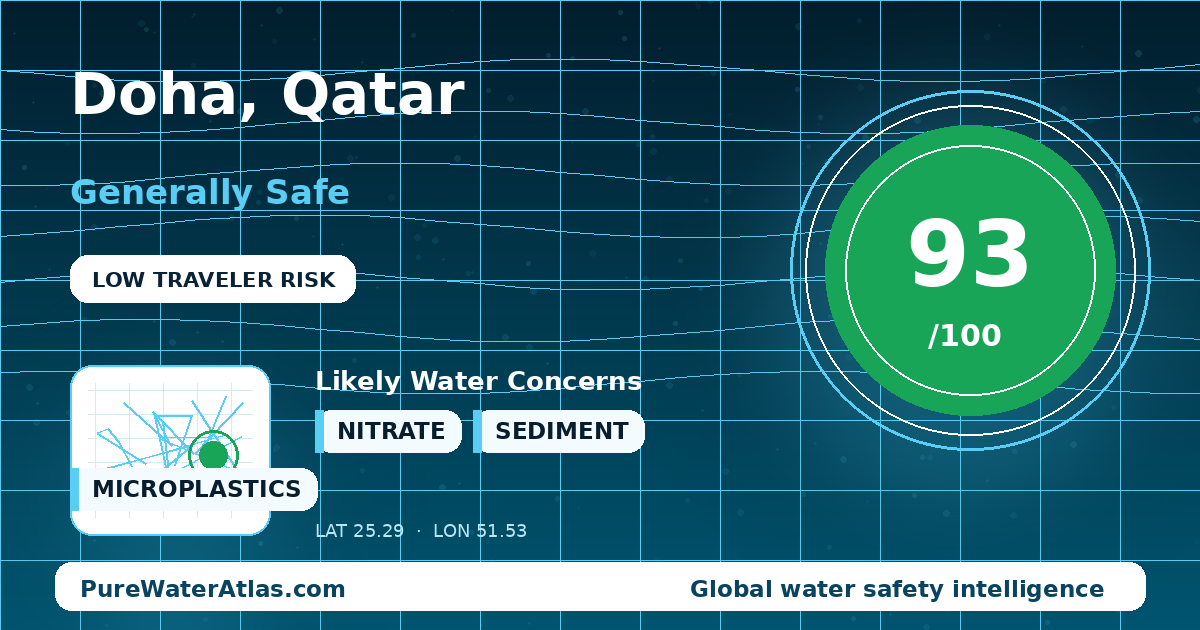
| Overall safety status | KAHRAMAA’s treated network water is presented by the utility as potable and quality-monitored. Safety at an individual Doha tap also depends on the condition of the building’s storage tanks, filters, and internal plumbing. |
|---|---|
| Can visitors drink the tap water? | Usually reasonable in a well-managed hotel or residence that confirms the cold-water tap is supplied from a maintained potable-water system. If tank or filter maintenance is unknown, sealed bottled water is a cautious alternative. |
| Resident advice | Confirm tank-cleaning and filter-maintenance records, use the cold kitchen tap for drinking and cooking, flush stagnant water, and test the tap if there is discoloration, odor, recurring sediment, illness concerns, or old plumbing. |
| Main water source | Desalinated seawater. Groundwater is a separate national resource and emergency-security reserve, not the documented main supply for connected Doha homes. |
| Responsible authority | Qatar General Electricity & Water Corporation (KAHRAMAA). |
| Filter recommendation | No filter is automatically required solely because the property is in Doha. Select treatment only after identifying a building-specific problem, and maintain filters strictly because neglected devices can encourage biofilm growth or accumulate sediment. |
For most people in Doha, the useful distinction is between water delivered by the municipal network and water emerging from a particular building’s tap. Available evidence supports the utility’s description of treated network water as potable, but it cannot establish the condition of every private tank, filter, pump, or pipe. Travelers should therefore ask about the property’s potable-water arrangements, while residents should pay close attention to building maintenance.
Doha’s Water Source and Supply System
Doha’s connected municipal supply is based overwhelmingly on desalinated seawater. KAHRAMAA reports that Qatar’s potable desalinated-water production stood at 538 million imperial gallons per day in 2024. This is national production information rather than a Doha-only supply breakdown, and the reviewed material did not identify which plant supplies each Doha neighborhood.
The utility’s current water-sector page distinguishes desalinated potable production from groundwater. It calls groundwater Qatar’s only natural water source and describes rehabilitated well fields and proposed aquifer storage of desalinated water as water-security measures. That does not mean private groundwater is routinely blended into every Doha tap.
Older Doha research describes desalinated water receiving post-treatment to improve stability and mineral balance, followed by chlorine-dioxide disinfection. Treatment details can vary by production facility, and no current plant-by-plant treatment specification was found during this review.
The responsible utility is the Qatar General Electricity & Water Corporation, commonly known as KAHRAMAA. It manages potable-water transmission, storage, pumping, distribution, system control, and water-quality monitoring.
KAHRAMAA reports that its water laboratory performs physical, chemical, and microbiological analysis and is accredited to ISO/IEC 17025:2017. It also reports 81 automated monitoring systems at water tanks and pumping stations. The National Water Control Center uses SCADA to oversee pumping, storage, transmission, distribution, and selected water-quality conditions.
Responsibility changes at the property boundary. Owners, landlords, hotel operators, and building managers may control tanks, booster pumps, internal pipes, and filters. A compliant utility sample therefore cannot prove that water remains unchanged at every individual tap. This distinction is particularly important when two properties in the same part of Doha have different maintenance practices: one building may deliver clear, acceptable water while another experiences sediment, stagnation, or filter problems.
Main Local Water-Quality Concerns
Building storage tanks and stagnation
A peer-reviewed study of 32 Doha housing units found that municipal water was commonly pumped into ground-level tanks, sometimes with additional rooftop tanks. Warm conditions, long residence time, weak maintenance, and loss of disinfectant residual can permit water quality to change inside a property. The study sampled homes in 2015–2016, so it establishes a credible local pathway rather than the present condition of every Doha building.
Tank use does not automatically make water unsafe. It does mean that tank condition, protection from outside entry, cleaning, and the time water spends stored can matter. Water that has remained unused during a vacation or long vacancy deserves flushing before it is used for drinking or cooking.
Poorly maintained filters
The same study found very low heterotrophic plate counts in service-line water but much higher counts after water entered household storage and filtration systems. Heterotrophic plate counts do not by themselves prove pathogen contamination, but the findings showed that neglected filters could become sites for microbial growth and biofilm. Activated carbon also removes disinfectant residual, making timely cartridge replacement especially important.
A filter should not be assumed to improve safety simply because it is installed. Its media, intended purpose, replacement history, and sanitation all matter. Reduced flow, visible buildup, or an unknown service date are reasons to investigate rather than continue using the device indefinitely.
Soft, low-mineral water and plumbing interaction
Desalinated water is naturally low in minerals and requires stabilization. The Doha study found low concentrations of arsenic, cadmium, and lead in sampled tap water, but it also found corrosion-derived material and elevated lead in residues captured inside some filters. That is not evidence of citywide lead exceedances; it supports building-specific testing where plumbing is old, sediment appears, or a filter has been neglected.
Limited current public results
KAHRAMAA’s current page describes a substantial monitoring program, and its 2022 statistical report includes biological compliance as a tracked indicator. However, this research did not locate a recent Doha consumer report presenting sample counts and individual chemical results. That limits the precision of any present-tense citywide assessment. Official system descriptions and historical household research are informative, but neither substitutes for a current sample from a tap with a suspected problem.
Advice for Visitors
Qatar Tourism states that drinkable tap water is broadly accessible in Qatar while noting that bottled water is widely consumed. This is national travel guidance, not an inspection of a traveler’s particular hotel. A visitor’s practical decision should be based on whether the property identifies the tap as potable and can confirm that its tanks and filters are maintained.
- Ask the hotel whether the bathroom or kitchenette cold tap is designated potable and whether building tanks and filters are professionally maintained.
- Use the cold tap rather than hot-water plumbing for drinking or filling a kettle.
- After a room has been vacant, run the cold tap until the temperature stabilizes before drinking.
- Do not drink water that is discolored, contains persistent particles, or has an unusual sewage, fuel, or chemical odor. Notify the property and use sealed bottled water until the cause is resolved.
- Following an outage, plumbing repair, or official warning, follow KAHRAMAA or property-management instructions rather than assuming a household filter makes the water safe.
Visitors who prefer additional caution can use factory-sealed bottled water. Refillable bottles should only be filled from a tap or dispenser the property identifies as potable and routinely maintained. Clear appearance alone cannot confirm microbiological or chemical safety, so property information is more useful than a visual check by itself.
Advice for Doha Residents
Residents are better positioned than short-term visitors to verify how water moves through their building. Ask where the drinking tap is supplied from, whether there is a ground or rooftop tank, and whether any point-of-entry or under-sink filters are installed.
- Request written records for tank inspection, cleaning, disinfection, and filter replacement from the landlord or facilities manager.
- Make sure tank lids, vents, and overflow openings prevent entry by dust, insects, animals, and runoff.
- Replace cartridges on schedule. A filter that looks dirty or produces reduced flow should not simply remain installed indefinitely.
- Flush water after vacations, long vacancy, plumbing work, or prolonged stagnation.
- Use cold water for drinking and cooking; hot-water systems can increase contact with plumbing materials.
- Report pressure loss, suspected utility contamination, or recurring supply problems to KAHRAMAA’s 24-hour emergency and incident line at 991.
Residents evaluating unexplained tap-water changes can consult the PureWaterAtlas drinking-water safety guide and the water-testing category.
Contaminants and Indicators to Consider
Microbial regrowth and biofilm
The strongest Doha-specific concern is not documented failure of desalination. It is deterioration within tanks, household filters, and internal plumbing. The local study measured much higher heterotrophic bacterial counts after the property connection, while acknowledging that this measurement cannot determine whether pathogens are present. If microbial contamination is suspected, request tests for total coliforms and E. coli rather than relying only on a general plate count. More background is available in the water microbiology guide.
Lead and other plumbing metals
Lead averaged 0.34 micrograms per liter in the study’s Doha tap-water samples, while arsenic and cadmium were below 0.1 micrograms per liter. These historical results were low, but metal-rich deposits inside some used filters showed why an individual property can differ from the municipal line. Testing is appropriate for older or altered plumbing and after long stagnation. See the lead in drinking water guide and home safety checklist.
Organic carbon and disinfectant loss
The Doha study found changes in total organic carbon after water entered household systems. Organic matter can support microbial growth and increase filter fouling, especially where activated carbon removes residual disinfectant. The total organic carbon profile explains its operational significance.
Disinfection by-products
Older Qatar-wide research detected chlorite, chlorate, and trihalomethanes associated with chlorine-dioxide treatment. Reported concentrations were below the WHO guidelines and KAHRAMAA operational limits cited by the researchers. These results should not be treated as current Doha compliance data or used to predict conditions at a specific tap.
When and How to Test Water in Doha
Testing should match the point in the system where a problem may be occurring. A sample from the kitchen tap evaluates the water people actually drink, while paired samples before and after a tank or filter can help identify where deterioration begins. Testing can be particularly useful when a problem recurs after flushing or when several occupants observe the same change.
- Check official and property information: Ask KAHRAMAA about any active local incident and obtain tank and filter records from the building manager.
- Inspect without opening the water system: Note persistent color, sediment, odor, pressure changes, tank damage, or an overdue filter.
- Use an appropriate laboratory: For safety decisions, use a laboratory with recognized accreditation and methods suitable for drinking water. Home strips are useful for limited screening but cannot replace microbiological or trace-metal laboratory analysis.
- Choose a targeted panel: Test total coliforms and E. coli after tank contamination, pressure loss, or sewage concerns; lead, copper, iron, nickel, and zinc for plumbing or corrosion concerns; and pH, conductivity, turbidity, and disinfectant residual when diagnosing storage or treatment performance.
- Sample correctly: A first-draw sample can evaluate overnight plumbing exposure, while a flushed sample helps distinguish premise plumbing from incoming supply.
The comparison between first-draw and flushed results can be more informative than a single isolated result. If a problem appears only in first-draw water, internal plumbing or stagnation may deserve closer attention. If it persists after flushing, investigation may need to extend to the tank, filter, or incoming supply.
Use the complete water-testing guide, the home water-testing guide, and the PureWaterAtlas contaminants search engine to plan a targeted investigation. The Global Water Safety Checker provides broader country and city context but cannot verify a specific building.
Choosing Water Treatment
Do not select treatment from Doha’s location alone. Treatment should follow testing or a clearly identified operational problem. Using the wrong device can add maintenance without addressing the actual source, and an overdue cartridge may itself become part of the problem.
- Taste or chlorine odor: Certified activated carbon can improve taste and reduce chlorine-related compounds. It must be replaced on schedule and does not reliably disinfect contaminated water.
- Confirmed lead or plumbing metals: Use a device independently certified for the specific metal and reduction claim. Depending on the result, suitable options may include certified adsorption media or reverse osmosis. Correcting the plumbing source is preferable where feasible. See lead removal and treatment options.
- Confirmed microbial contamination: Stop drinking the water and follow official instructions. Boiling can temporarily inactivate most disease-causing microorganisms, but it does not remove metals, salts, or chemicals and can concentrate nonvolatile contaminants. UV requires clear water, adequate dose, and maintenance and provides no residual protection in a dirty tank or pipe.
- Sediment: First inspect and clean the tank and correct the source. A sediment prefilter can protect equipment, but it is not proof of microbiological safety.
- High salinity or dissolved contaminants: Reverse osmosis may be appropriate only when laboratory results show a dissolved-solids problem. It wastes water, needs maintenance, and is not justified merely because the municipal source was originally seawater.
Further comparisons are available in the water treatment systems guide.
Official and Technical Sources
- KAHRAMAA — Water Sector: current utility information on desalinated production, distribution, reservoirs, monitoring, laboratory accreditation, groundwater, and network development.
- KAHRAMAA Annual Statistics Report 2022: national production, biological-compliance, tanker, storage, demand, and network indicators.
- Qatar national SDG 6 report: national safely managed drinking-water and water-resource context; the figures are not Doha tap-sample results.
- State of Qatar Open Data — Biological Water Quality Compliance by Year: official description of Qatar’s biological-compliance dataset.
- Scientific Reports — Influence of Household Water Filters on Bacteria Growth and Trace Metals in Tap Water of Doha, Qatar: peer-reviewed Doha household study based on samples collected in 2015–2016.
- Visit Qatar travel tips: official tourism guidance on drinking-water availability and bottled-water use.
Bottom Line
Doha’s utility water is desalinated, treated, and distributed through a closely monitored national system. The available evidence does not support labeling Doha’s entire municipal supply unsafe. It also does not justify promising that every tap is safe, because tanks, pumps, filters, stagnation, and premise plumbing can change water quality inside a building.
Visitors can generally use a potable cold-water tap in a reputable, well-maintained property, while bottled water is a reasonable precaution when maintenance is unknown. Residents should focus on tank hygiene, scheduled filter replacement, flushing, and targeted testing. Recent parameter-level Doha monitoring results were not publicly available in the sources reviewed, so this conclusion remains qualified rather than absolute.
Read the full guide: Global Water Quality Guide
Explore more in this category: Global Water Quality Articles