
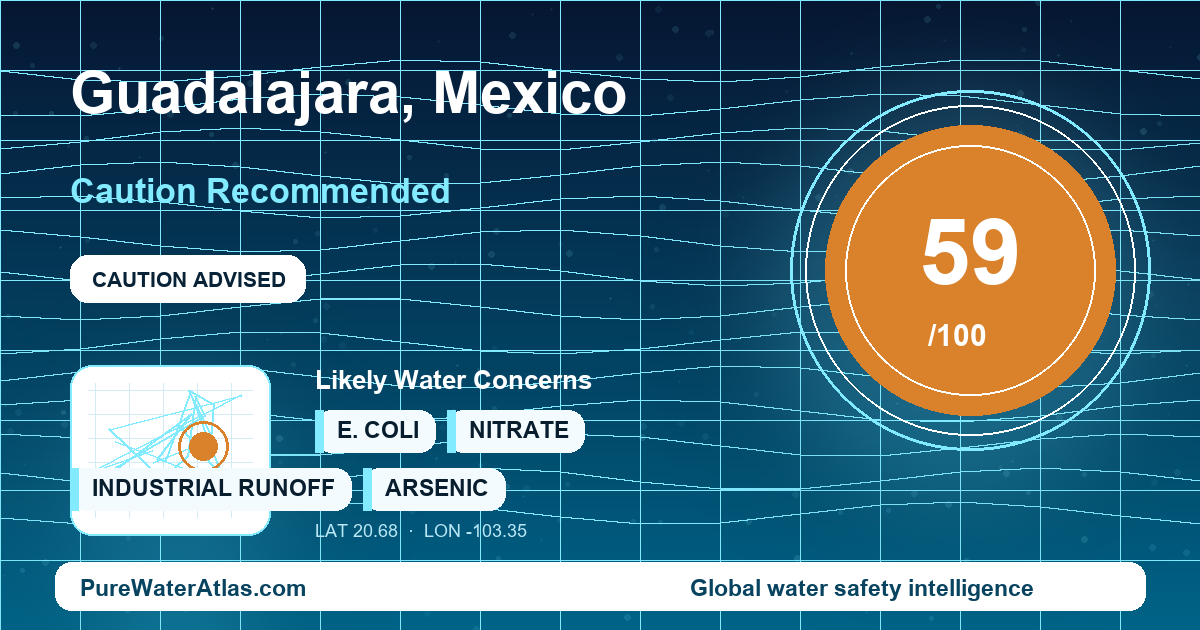
Guadalajara, Jalisco has a formal SIAPA-treated municipal supply, but direct tap drinking still deserves caution because final water quality can be affected by mixed sources, pressure interruptions, aging distribution lines, cisterns, rooftop tinacos, and building plumbing.
Quick Answer
| Overall tap-water status | Caution recommended. Guadalajara’s municipal water is treated, but untreated tap water is not the best default choice for drinking, especially for visitors. |
|---|---|
| PureWaterAtlas safety score | 59 / 100 — Risk level: Caution Recommended. |
| Traveler advice | Most short-term visitors should use sealed bottled water, hotel-provided purified water, or reliably filtered and disinfected water for drinking. |
| Resident advice | Evaluate water at the building level. Storage tanks, cisterns, plumbing condition, and point-of-use treatment matter as much as the city supply. |
| Main water sources | A blended metropolitan system using Lake Chapala, local groundwater wells, and surface-water infrastructure associated with the Calderón system. |
| Water authority | SIAPA, the Sistema Intermunicipal de los Servicios de Agua Potable y Alcantarillado, with state and federal roles involving CEA Jalisco and CONAGUA. |
| Filter recommendation | For routine drinking, consider sediment prefiltration plus activated carbon; add UV or ultrafiltration where cistern or rooftop-tank microbial risk is a concern. Reverse osmosis is useful when dissolved contaminants are confirmed or strongly suspected. |
Why Guadalajara Is Different
Guadalajara is not a city where the safety question can be answered only by asking whether a treatment plant exists. The metropolitan area has an established municipal drinking-water system operated by SIAPA, and water is treated before distribution. The more practical question is what happens between the utility and the glass: pressure changes, pipe disturbance, neighborhood outages, old internal plumbing, building cisterns, and rooftop tinacos can all influence final tap quality.
Guadalajara is an inland highland metropolis in Jalisco, hydrologically linked to the Lerma-Chapala-Santiago system. Lake Chapala, southeast of the city, is Mexico’s largest lake and has long been the strategic water reserve for the metropolitan area. The city has also developed wells and regional dam infrastructure to reduce dependence on a single source. Because the system is blended and operations can shift with drought, maintenance, and hydraulic conditions, the exact water source at one apartment or house may not be identical to another.
This is why the PureWaterAtlas verdict is caution recommended, not because Guadalajara lacks a formal system, but because public, recent, neighborhood-level finished-tap data are limited and building-level water conditions can vary sharply. A clean, maintained building with a good point-of-use system may have much safer drinking water than a nearby building with a dirty aljibe, unsealed tinaco, or stagnant internal plumbing.
Where Does Guadalajara’s Tap Water Come From?
Guadalajara’s metropolitan water supply is a mixed system. The most important raw-water source historically and operationally is Lake Chapala, delivered through the Chapala-Guadalajara supply system. SIAPA also uses local groundwater wells and surface-water infrastructure associated with the Calderón system, including the Elías González Chávez or Calderón dam area. Source contributions can change depending on drought, operational needs, repairs, and hydraulic conditions.
Key infrastructure includes the SIAPA municipal distribution network serving Guadalajara and neighboring metropolitan municipalities, the Lake Chapala intake and conveyance system, treatment and pumping infrastructure for lake and dam water, groundwater well fields, pressure zones, storage tanks, pumping stations, household cisterns, and rooftop tinacos. These last elements are especially important for end users because they are often outside the direct control of the utility.
Lake Chapala’s role also makes seasonal and drought conditions part of Guadalajara’s drinking-water story. Rainy-season runoff can increase turbidity, organic matter, and microbial treatment demand in source waters. Dry-season and drought periods can lower lake or reservoir levels, concentrate dissolved solids, and increase operational stress. These conditions do not automatically mean a particular faucet is unsafe, but they help explain why direct tap drinking is not the safest default without building-level verification.
Who Manages Drinking Water in Guadalajara?
The primary urban water utility for Guadalajara is SIAPA, the Sistema Intermunicipal de los Servicios de Agua Potable y Alcantarillado. SIAPA serves Guadalajara and core municipalities of the metropolitan area and is the key public institution for urban water and sewer service information. Its transparency portal provides institutional and accountability materials.
State-level water planning and infrastructure roles involve the Comisión Estatal del Agua de Jalisco. At the federal level, CONAGUA is responsible for national water resources, concessions, hydrologic information, reservoir context, drought, and water policy. Mexico’s national drinking-water quality framework is set through the Secretaría de Salud, including NOM-127-SSA1-2021 for water intended for human use and consumption.
However, national standards and utility treatment do not prove that every Guadalajara building tap is safe at every moment. Water quality can change after the municipal connection. That limitation is central to this page: official sources establish the utility, source system, and regulatory framework, but recent granular public lab results by neighborhood and building are not consistently available.
Main Local Water Concerns
Intermittent supply and pressure variation are among the most relevant practical concerns. Low-pressure events, repairs, and service returns can increase intrusion risk and resuspend sediment in pipes. If water appears cloudy, yellowish, earthy, or sediment-heavy after an outage, it should not be used for drinking until flushed and, if persistent, tested.
Lake Chapala source-water stress matters because lake level changes, watershed runoff, organic matter, turbidity, and drought conditions can make treatment more challenging. Treatment may continue, but the burden on the system can change seasonally.
Groundwater mineral content may affect taste, hardness, dissolved solids, or other geogenic constituents depending on the well field. Publicly available citywide data are not sufficient to assign one mineral profile to all Guadalajara taps.
Building-level microbial contamination is a major reason for caution. Cisterns and rooftop tanks can lose disinfectant residual, accumulate sediment, or become contaminated if poorly sealed or irregularly cleaned. A building with a neglected aljibe or tinaco can have worse tap water than another building connected to the same municipal system.
Older plumbing and fixtures can also alter water quality. Older homes, schools, offices, and apartments may have corroded internal lines, old brass fixtures, solder, galvanized plumbing, or stagnation problems. Lead risk should be treated as a premise-plumbing issue and tested rather than assumed citywide.
For Travelers
Most short-term visitors should not drink Guadalajara tap water straight from the faucet. The practical risk is moderate rather than extreme, but high enough that untreated tap water is not the recommended default. Use sealed bottled water, professionally purified water, hotel dispenser water, or water treated with a reliable filter and disinfection method.
Tap water is generally acceptable for showering and handwashing. Healthy adults often brush their teeth with tap water without incident, but cautious travelers, children, pregnant travelers, immunocompromised people, and anyone with a sensitive stomach should use bottled or purified water for brushing as well.
For ice, ask for hielo purificado if uncertain. Better hotels, cafes, and established restaurants commonly use purified water systems, garrafón water, or commercial ice, but the bathroom tap should not be assumed to be drinking water. Avoid ice in informal settings where the water source is unclear.
If boiling is necessary during an outage or suspected microbial event, bring water to a rolling boil. Boiling can help address microbial risks, but it does not remove metals, salts, or chemical contaminants. For details, see the PureWaterAtlas Boiling Water Purification Guide.
For Residents
Residents who want to drink Guadalajara tap water routinely should focus on the building and kitchen tap, not only on the city supply. A practical home setup for municipal water is sediment prefiltration plus activated carbon. Where storage tanks, cisterns, or microbial concerns are present, UV treatment or ultrafiltration may be appropriate; see the PureWaterAtlas UV Water Purification Guide. Reverse osmosis can be useful when dissolved solids, taste, nitrate, arsenic, fluoride, or other dissolved contaminants are confirmed or strongly suspected, but it requires maintenance and follow-up testing.
Testing should be done at the kitchen tap because building plumbing and storage can change water after it enters the property. For homes with cisterns, rooftop tinacos, intermittent supply, or gastrointestinal symptoms among occupants, test for total coliform and E. coli. After outages, repairs, or visible sediment events, check free chlorine residual, turbidity, color, and odor. If the water tastes salty, bitter, or mineral-heavy, or if scaling is severe, measure TDS, hardness, chloride, and sulfate.
Older buildings should be treated as separate risk cases. Test first-draw and flushed samples for lead and other metals before assuming internal plumbing is safe. Cisterns and rooftop tinacos should be sealed, screened, and cleaned on a regular schedule. A dirty or uncovered tank can defeat municipal disinfection by allowing sediment, insects, biofilm, or microbial contamination to accumulate.
Relevant Contaminants and Water-Quality Issues
The most relevant Guadalajara issues are not a single confirmed citywide contaminant, but the water-quality indicators and building-level risks that match the local system. Chlorine matters because residual disinfectant helps indicate whether treated water has maintained protection through distribution and storage. Turbidity and sediment are relevant after rain events, Lake Chapala source changes, outages, repairs, or tank disturbance.
E. coli is the key microbial warning organism for cisterns, rooftop tanks, pressure loss, and premise contamination. Lead is relevant for older buildings and internal plumbing, but should not be described as a confirmed citywide Guadalajara condition without testing. For private wells or non-SIAPA sources, nitrate and arsenic should be included in a certified laboratory panel, along with fluoride, conductivity, microbiology, and basic metals where appropriate.
How to Verify Your Water Quality
The most reliable answer for a Guadalajara resident is a building-specific test. Start with the kitchen tap and include microbial testing if the building uses a cistern or tinaco. Add chlorine residual, turbidity, color, odor, TDS, hardness, chloride, sulfate, and metals depending on symptoms, building age, and source. If you use a private well or non-standard source, broaden the panel to nitrate, arsenic, fluoride, conductivity, microbiology, and basic metals.
PureWaterAtlas resources that can help include the Water Testing Guide, the Drinking Water Safety Guide, the Water Treatment Systems Guide, and the Water Microbiology Guide. For destination comparison, use the Global Water Quality Checker. To look up terms from a lab report, use the Contaminants Search Engine.
For older buildings, see Lead in Drinking Water: Testing and Detection Methods. For groundwater or non-municipal sources, see Arsenic in Drinking Water: Testing and Detection Methods and Nitrate Contamination in Drinking Water: Testing and Detection Methods.
Official and Technical Sources
- SIAPA official website — metropolitan water and sewer utility information for Guadalajara service areas.
- SIAPA transparency portal — institutional documents and public accountability materials.
- Comisión Estatal del Agua de Jalisco — Jalisco water planning and infrastructure context.
- CONAGUA — federal water-resource authority for Mexico.
- CONAGUA water quality program information — national water-quality monitoring context.
- NOM-127-SSA1-2021 — Mexico’s national sanitary standard for water intended for human use and consumption.
- CDC Mexico Traveler View — travel-health guidance supporting safe drinking-water precautions.
- WHO drinking-water fact sheet — global public-health reference on microbial and chemical drinking-water risks.
Bottom Line
Guadalajara’s tap water comes from a real municipal system, not an informal supply, and SIAPA treats water before distribution. Still, direct faucet drinking is not recommended for most visitors because final water quality can be affected by Lake Chapala source conditions, blended groundwater and surface-water operations, pressure interruptions, repairs, sediment disturbance, cisterns, rooftop tinacos, and older building plumbing. Travelers should use bottled or purified water for drinking and cautious brushing. Residents should make decisions at the building level: maintain tanks, verify microbial safety, check chlorine and turbidity after outages, and test for metals in older properties. With proper maintenance, testing, and point-of-use treatment, many households can manage the risk, but citywide assumptions are not reliable.
Read the full guide: Global Water Quality Guide
Explore more in this category: Global Water Quality Articles